Core
A Grocer’s V.C. Bets on the Backbone of Retail’s AI Future
stephan · 2026-07-30 · 11 min read
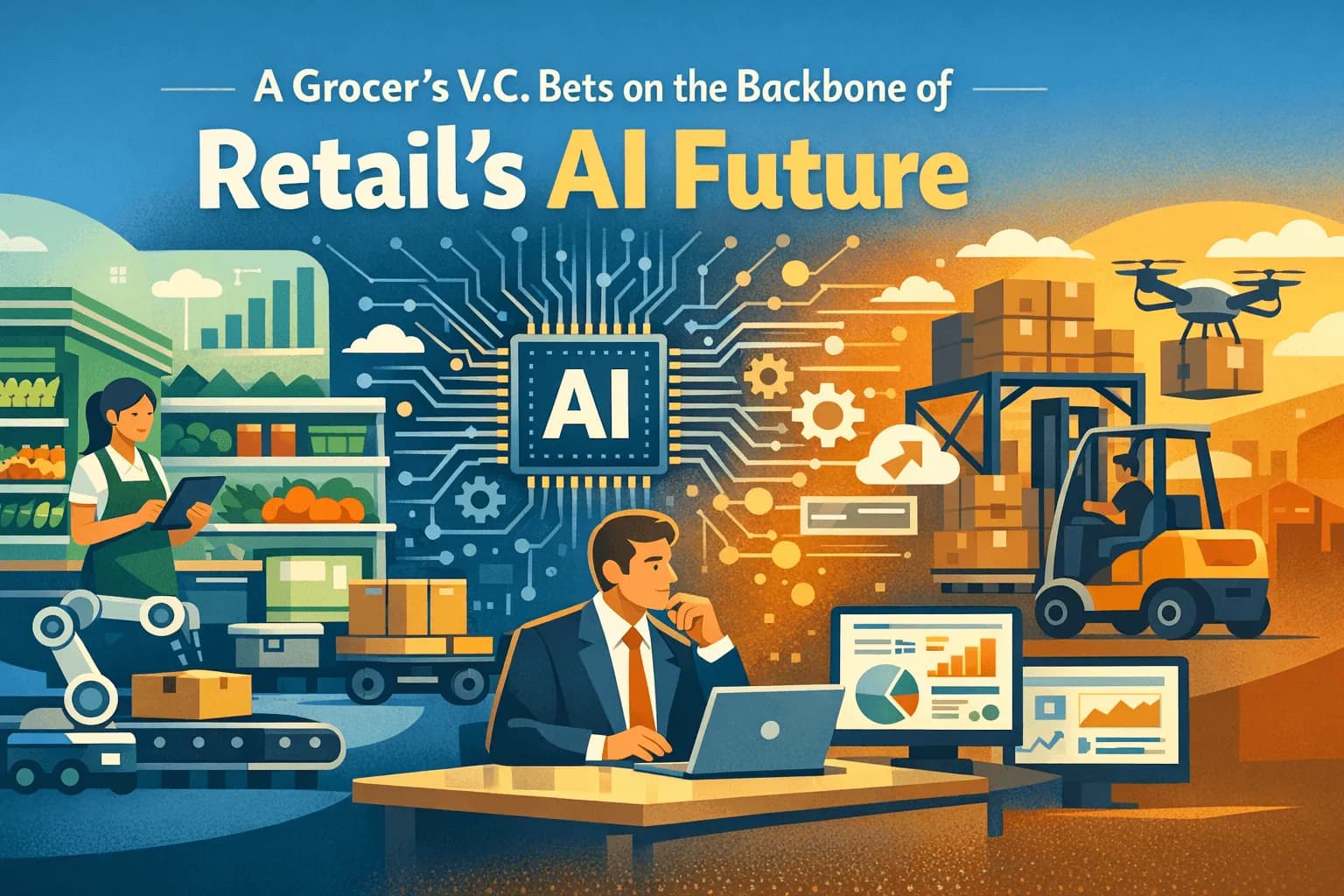
This article is based on an announcement from Ahold Delhaize’s venture arm W23 Global and what it signals about the next wave of retail tech - and, quietly, the next wave of PIM and operational data infrastructure behind grocery.
A grocery giant’s VC fund is quietly sketching the next decade of retail infrastructure
Ahold Delhaize’s venture fund W23 Global has added five new startups to its portfolio: Moment Energy, Verse, Skyfire, Haast, and Cresta. On the surface, that looks like a grab bag of energy storage, energy intelligence, AI commerce security, marketing compliance, and contact center AI.
Underneath, it’s a roadmap for where grocery tech - and by extension, PIM and operational data systems - are going next: real-time, AI-native, sustainability-constrained, and increasingly automated at the edge.
W23 Global is backed by some of the biggest grocers on the planet - Tesco, Ahold Delhaize, Woolworths Group, Shoprite, and Empire. When a group with that much shelf space bets on a particular stack, it’s worth assuming your product information, catalog, and operations data platforms will eventually be expected to plug into it.
The new portfolio: AI and infrastructure, not apps and widgets
W23’s latest round is striking because almost none of it is front-end retail tech. No shiny consumer apps, no gimmicky checkout experiments. This is back-end infrastructure with a heavy AI and data footprint:
-
Moment Energy: second-life EV batteries turned into certified commercial energy storage systems.
-
Verse: energy intelligence to manage sprawling, multi-site utility data and distributed resources.
-
Skyfire: identity and payments stack for AI shopping agents - the “trust fabric” of agentic commerce.
-
Haast: AI-native marketing compliance and brand protection across text, images, video, and audio.
-
Cresta: generative AI for contact centers, blending autonomous agents with real-time coaching for humans.
Taken together, this is less about selling more groceries and more about ensuring the grocery stack doesn’t crumble under the weight of AI, regulations, unstable grids, and customer expectations.
Circular energy and the data gravity around “the store”
Moment Energy: the store as a battery-powered data node
Moment Energy builds repurposed battery energy storage systems (BESS) from second-life EV batteries. They’re the first in North America to produce certified, commercial-scale systems of this kind - and they’re going straight at grocery infrastructure: stores, DCs, microgrids, plus edge-heavy environments like data centers and hospitals.
For retailers, the business case is simple: lower peak-demand utility costs and more resilient backup power. For the broader tech stack, it quietly shifts what a “store” is. It’s no longer just a physical endpoint for inventory and POS; it’s an energy node in a circular system, with its own operational telemetry, forecasts, and constraints.
That matters for PIM and ERP because energy is moving from a line item to a real-time variable that should influence:
-
Assortment and fulfillment logic: which SKUs are promoted, when chilled or frozen products are moved or processed, when micro-fulfillment systems run hardest.
-
Store-level configuration: operating hours, in-store production (bakeries, kitchens), and refrigeration strategies aligned with grid conditions.
PIM systems that used to live comfortably in their own universe of attributes and digital assets will increasingly be asked to share data with energy and operations platforms: cold chain attributes, storage and handling constraints, shelf life, and environmental impact metadata suddenly become optimization levers.
Verse: utilities as a first-class data domain
Verse’s Aria platform centralizes utility bills, contracts, and power purchase agreements across thousands of sites. Then it layers on Dispatch Intelligence to orchestrate on-site resources in real time - a big deal when retailers are trying to bolt energy-hungry AI infrastructure onto grids that weren’t built for it.
In practice, this pushes retailers closer to a world where:
-
Utility data sits alongside POS, inventory, and product data as a core operational domain.
-
Forecasts and actuals for energy consumption feed into planning systems - and ultimately, into merchandising and logistics decisions.
For PIM, it’s another sign that “product data” no longer stops at specs, rich content, and regulatory fields. It’s part of a larger operational graph where AI models can ask questions like: “What’s the cost and carbon profile of promoting this chilled range in this region this week?” That requires PIMs to be good citizens in a broader data mesh: clean identifiers, consistent hierarchies, and event-level interoperability with systems like Verse.
Skyfire and the coming wave of AI shopping agents
Skyfire is probably the most future-facing bet here. The company is building what amounts to a trust and permission layer for AI agents that shop on behalf of humans. Think “Know Your Customer,” but for bots: verified “Know Your Agent” credentials, identity, and integrated payments.
The premise: retailers will soon see surging traffic from autonomous AI agents - not all of them benign. You don’t want your ecommerce API hammered by untrusted scrapers and malicious automation, but you also don’t want to block high-intent, authorized agents placing real orders for real people.
Once that world exists, three things change for PIM and retail data infrastructure:
-
Your primary “customer” might be an API client, not a browser. Agents will expect precise, structured product data: ingredients, allergens, ESG claims, packaging formats, substitution rules, and availability - all reliably machine-readable.
-
Latency and completeness suddenly matter more. Agents won’t tolerate half-populated product records, vague descriptions, or disconnected stock and attribute data. PIM has to be almost “lossless” and near real-time when synchronized with inventory, pricing, and promotions.
-
Policy, permissioning, and data contracts move into the foreground. If your commerce stack is opening up to third-party agents, you need tight, well-documented schemas and rules baked into your PIM and product APIs: which fields are exposed, under what terms, with what refresh cadence.
Skyfire is focusing on identity and payments, but what it indirectly signals is a world where PIM is not just a repository - it’s a contract: a promise that, if an agent hits your endpoint, the product data it gets is complete, current, and safe to reason about.
Haast and the AI content explosion: compliance meets catalog
Haast is an AI-native platform aimed at one of AI’s least glamorous but most necessary problems: compliance and brand protection across the entire content lifecycle. It checks and monitors text, images, video, and audio before and after publication.
On paper, this is a marketing-tech story. In reality, it’s tightly connected to PIM and DAM:
-
Product content is marketing content. Product descriptions, claims, nutritional statements, sustainability badges, pricing language - all live inside or adjacent to PIM and DAM.
-
AI-generated content amplifies risk. As generative tools start producing product copy, imagery, and even localized variants at scale, the surface area of potential non-compliance explodes.
-
Lifecycle monitoring can’t be bolted on at the end. To be effective, compliance needs to be embedded into the same workflows that manage product data, assets, and syndication to channels.
The implication for the PIM market is clear: “content quality” is no longer just about SEO, findability, or conversion. It now includes regulatory guardrails, brand safety, and constant surveillance of what’s actually live in the wild. That means:
-
PIM vendors will be pushed to integrate tightly with AI compliance engines like Haast or build native equivalences.
-
Audit trails, versioning, and approval workflows in PIM go from “nice governance” to “absolute requirement.”
-
Future RFPs may treat marketing compliance and PIM as a single, connected capability rather than separate stacks.
In other words, as content volume and velocity spike, the winners in PIM won’t just manage attributes and assets - they’ll orchestrate safe automation across the entire product storytelling layer.
Cresta and the feedback loop from the contact center back into product data
Cresta is a generative AI platform for contact centers that blends autonomous agents with real-time coaching for human agents. It uses conversation intelligence to turn calls and chats into live assistance and training signals.
For retailers, it promises better service at lower cost. For PIM and ERP systems, it points to a missing link: the feedback loop. Customer conversations are where product data quality problems are exposed in the harshest possible light - wrong attributes, missing compatibility info, unclear allergy flags, misleading imagery, or confusing pricing.
If platforms like Cresta become standard, there’s an opportunity - and likely pressure - to:
-
Mine conversation intelligence for structured signals: recurring questions about a specific product range, frequent clarification about ingredients, persistent issues with sizing or usage.
-
Feed those signals back into PIM and content operations: updating attributes, adding FAQs, adjusting categorization, or creating new product relationships.
-
Close the loop between what customers say and what product data claims.
A future-fit PIM won’t just publish product data outwards; it’ll ingest qualitative and quantitative evidence from customer interactions and trigger structured updates - either automated or supervised. Cresta’s presence in W23’s portfolio hints at that direction: customer experience and product information will increasingly be part of the same optimization cycle.
W23 Global’s role: a grocery-native testbed for the next retail stack
W23 Global is structurally unusual: a single venture fund backed by competing grocery giants across multiple continents - Tesco in Europe, Ahold Delhaize spanning the US, Europe, and Indonesia, Woolworths in Australia and New Zealand, Shoprite in Africa, and Empire in Canada.
That gives it two things that pure-play VCs rarely have:
-
Scale and diversity of environments: urban versus rural, mature grids versus fragile ones, heavily regulated versus lighter-touch markets.
-
A built-in proving ground: if a solution works across that set of retailers, it has a chance to become de facto infrastructure for the sector.
W23 explicitly targets technologies with practical application across markets and with a sustainability lens. The new investments keep that line: circular energy, smarter energy usage, safer AI commerce, compliant content, and better customer service economics.
From a PIM and ERP perspective, the signal is that grocery-specific constraints - perishable goods, tight margins, brutal logistics, and strict regulation - are setting the baseline for what “modern retail infrastructure” looks like. Other verticals tend to follow, often with fewer constraints.
What this means for PIM and retail data platforms
Put the pieces together, and W23 Global’s bets read like a specification for the next generation of PIM and operational data systems in retail:
-
PIM must be AI-native, not just AI-adjacent. It’s not enough to add a generative copy assistant on top of existing fields. Product data needs to be structured, governed, and exposed in ways that AI agents, compliance engines, and optimization platforms can reliably consume.
-
Interoperability is non-negotiable. Energy platforms (Moment, Verse), agent infrastructures (Skyfire), compliance stacks (Haast), and AI CX tools (Cresta) all depend on clean identifiers, shared taxonomies, and consistent events. PIM that tries to live as an island will get sidelined.
-
Compliance and governance become core PIM features. As AI accelerates content production, the ability to enforce constraints - regulatory, brand, ethical - becomes a first-order requirement. Expect PIM RFPs to explicitly call for integrated or pluggable compliance capabilities.
-
Real-time becomes the expectation, not a stretch goal. Autonomous agents, dynamic energy management, and AI-augmented contact centers all assume that product, price, availability, and attribute data are near real-time. Nightly batch syncs and manual approvals won’t cut it.
-
Feedback loops are table stakes. Customer conversations, agent behaviors, and compliance violations all contain signals about the quality of underlying product data. Systems that can translate those into structured PIM updates will have a clear edge.
-
Sustainability data moves into the catalog itself. Circular energy projects and constrained grids push ESG information closer to the operational core. Expect more pressure to encode environmental impact, energy intensity, recyclability, and supply chain data directly into product records.
The grocery sector often looks unglamorous compared to fashion or electronics. But the stack required to ship a yogurt, a frozen meal, or a prepared sandwich at scale, profitably, and compliantly is brutally complex. W23 Global’s portfolio suggests that the players solving those problems are now the ones defining the standards every other retailer - and every PIM vendor - will eventually be judged against.
Diagnostic
Do you actually need a PIM?
Run the complexity index before you budget software or hire an SI.
Budget
Model a first-pass TCO
Translate catalog shape into a three-year cost range in under ten minutes.