
Core
Trends in PIM, Part 3: Distribution is moving to a layer behind the PIM
Stephan Spijkers · 2026-10-21 · 8 min read
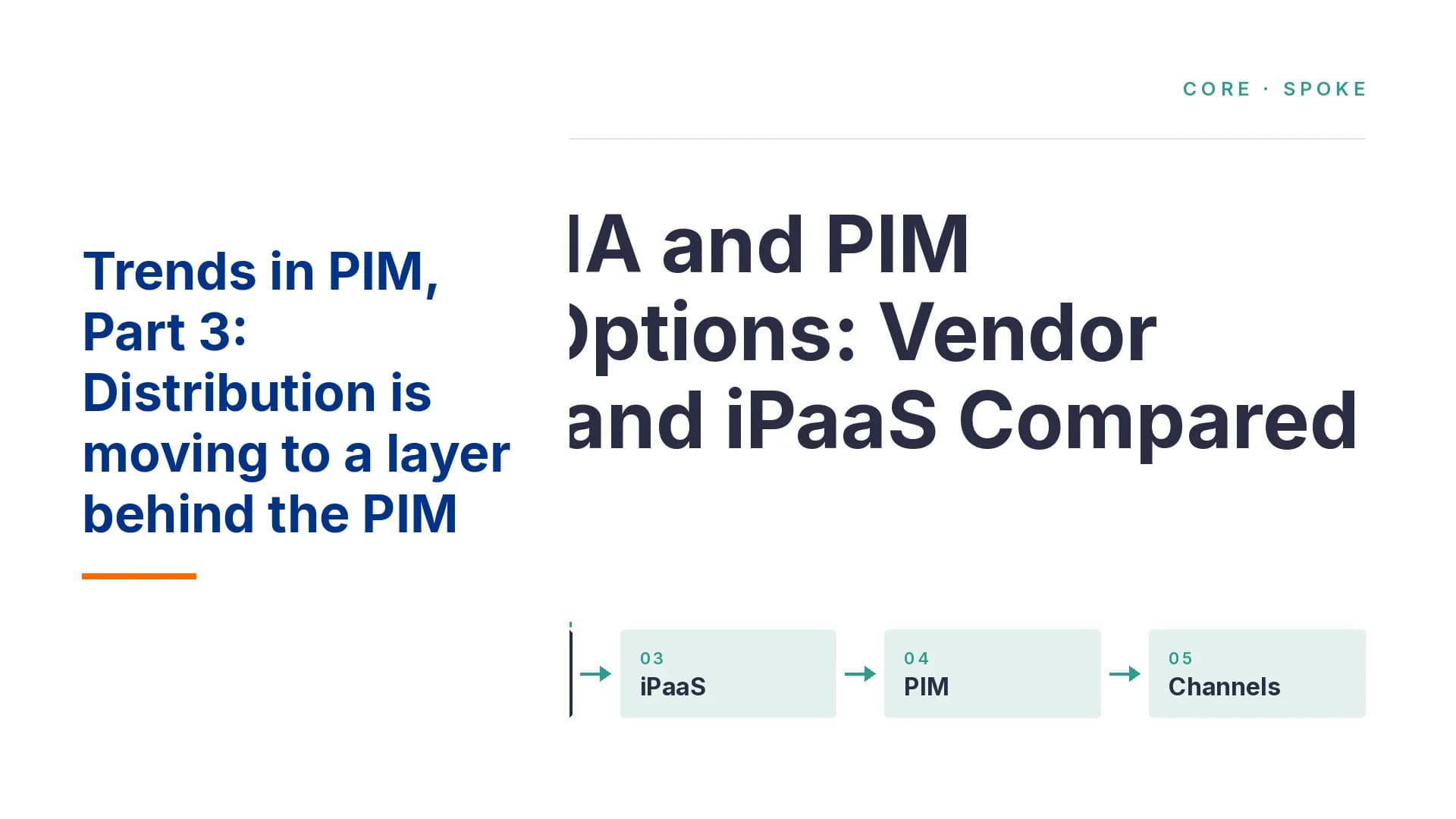
Before you add another sales channel to your PIM project, decide where that channel's rules will live. Publishing is moving out of the PIM into a distribution layer: syndication modules, feed tools and integration platforms (iPaaS) that turn one approved product record into the format each channel wants. The PIM keeps the product facts. Whoever runs the distribution layer owns the mappings, and the mapping decides what your product looks like in each channel.
Alumio describes the problem in terms every ecommerce team will recognise. An attribute is corrected in the PIM, then again in the webshop, then again in a marketplace feed, until "nobody can say which version is the correct one." Bluestone PIM, writing for manufacturers on 12 October, counts four routes for sharing product data with B2B partners (a portal, an API with webhooks, an industry datapool and a syndication tool) and says most manufacturers need two or more at once.
Part 1 showed supplier onboarding peeling off into a layer in front of the PIM. Part 2 covered the AI agents that enrich the record from the side, under rules the PIM enforces. Part 3 follows the data out the back, where publishing now runs in a layer with its own vendors, contracts and rules.
Distribution has become its own category
Feed management tools sell the last step as a product. Productsup lists more than 2,500 channels, with AI channels next to advertising and marketplaces. Channable advertises more than 3,000 channel templates and a rule system that exports to any format. Feedonomics offers more than 2,000 destinations plus a dedicated feed manager, so part of the work is bought as a service. Marketplace integrators add stock, price and orders to the same flow, and our ChannelEngine article splits that flow by owner: content from the PIM, price and stock from the ERP, orders back to your own systems.
Syndication networks draw the same line for brands that sell through retailers. Syndigo describes content aligned to more than 2,000 global recipients and 23,000 unique requirement sets. Each requirement set is a channel rule somebody keeps current, and the network sells that upkeep.
Integration platforms take the plumbing role. Alumio describes picking up content from the PIM, mapping it to the fields each channel expects, and combining it with pricing held in the ERP before a channel sees it. Our SAP S/4HANA connector comparison covers the same platform category on the ERP side, from SAP Integration Suite to Boomi and Alumio. The layers also overlap: Productsup lists supplier onboarding next to its channel products, so the intake layer from Part 1 and this distribution layer can end up with one vendor.
PIM vendors are building the layer next to the record
PIM vendors answer by selling distribution as a module beside the record, the same move Part 1 described for intake. Akeneo Activation supports more than 500 channels, and Akeneo states its case directly: "Rather than implementing, learning and maintaining a third-party syndication tool, Akeneo Activation is built natively on top of the Akeneo PIM." Its Spring 2026 release added Custom Channels, built from an uploaded retailer file, and a Channel Readiness Guide that checks the PIM model against marketplace requirements before mapping starts.
Salsify maps what it calls universal properties across retailers once, with Readiness Reports that validate content before it is sent. Inriver describes Syndicate Advance as sitting "between your internal systems and the market." Different packaging, same boundary. The record stays in the PIM, and converting it into each channel's format is a separate product, whoever sells it.
The mapping is where ownership gets decided
Every option above holds channel rules: category mappings, attribute conversions, value lists, title formulas and exclusions. Bluestone PIM states the limit plainly: "A connector moves data between systems, but it doesn't decide which one is right." Someone has to decide, per channel, which rules belong to the product record and which belong to the channel.
The vendor material points to one split. Product facts such as dimensions, materials, safety statements and translations stay in the PIM, under the governance from Part 2. Channel formatting, such as a marketplace category tree or a title length limit, can live in the distribution layer. Trouble starts when a fix for one channel is made in that layer instead of at the source. Our ChannelEngine article warns against patching data inside the connector, because it creates a second version of the truth that your webshop and other channels never see.
Vendors handle the return path differently. Akeneo describes fixing Amazon publishing errors directly within the PIM. Alumio flags a record that is missing required attributes, and the team fixes it in the source system before it continues through the same flow. In an iPaaS the mappings belong to whoever builds and runs the flows, usually your integration team or a partner, as the SAP comparison sets out.
Agents are adding new endpoints
The list of destinations now includes AI clients. Syndigo syndicates product content to ChatGPT through OpenAI's Agentic Commerce Protocol. Akeneo names the Stripe Agentic Commerce Suite as an Activation integration. Bluestone PIM exposes its API operations as tools on an MCP server and sends a webhook within seconds of a published change, so partner systems fetch only what changed. On the ERP side, Precisely released an MCP server on 20 October that exposes existing SAP automation workflows to any MCP-compatible AI client, built once instead of once per AI platform, with native OData support because, Precisely writes, older SAP scripting routes face increasing restrictions in SAP's cloud.
For product data the consequence matches the marketplace case. An agent endpoint is one more channel with its own format, and its mapping needs an owner. How product data has to look for shopping agents is covered in AI-ready product data and agentic commerce.
What this means when you buy
Distribution is one important point in a PIM evaluation, next to the data model, the team that will work in the PIM and the governance from Part 2. It seldom decides a selection on its own. Three things to settle while you compare vendors:
- Where each channel rule lives. Ask the vendor to show one channel mapping, such as a marketplace category tree, and say whether it sits in the PIM, a syndication module or an outside tool. Then ask how a corrected product fact reaches that channel, and how long it takes.
- Who maintains the mapping when a channel changes. Ask whether the PIM vendor, the network, the feed tool provider, your own team or an integration partner updates the template, and put that name in the contract.
- How errors travel back. Ask to see a rejected listing from one channel arrive in the PIM, so its owner fixes the source record instead of the feed.
A separate distribution layer earns its cost when many channels draw on several sources, such as PIM content with ERP price and stock, or when you expect to replace a shop or ERP and want the connections to survive it. It adds a subscription, another party between the PIM and the channel when data does not arrive, and another place where rules can drift from the PIM model. A PIM-native syndication module keeps the rules next to the record and ties your channel coverage to that vendor's roadmap. With one webshop and a PIM that ships a maintained connector for it, an extra layer is a cost to weigh, not a default. Our guide to headless and composable commerce makes the same point for the front end: every module needs an integration, monitoring and an owner.
Part 4, coming next, is about regulation. The Digital Product Passport and the wider ESPR rules add compliance attributes that suppliers deliver at intake, that agents should not rewrite, and that have to reach each channel as approved. Our Digital Product Passport guide covers the regulation itself.
Taken together, the series gives you one map for your next selection. Intake in front, agents alongside, distribution behind, and compliance pulling on all three. Decide layer by layer what the PIM should own and what you buy, build or plug in, and write down whose name sits on each set of rules.
Sources
All pages fetched 21 October 2026.
- Alumio, PIM integration use case
- Bluestone PIM, How to Give B2B Partners Live Product Data, 12 October 2026
- Productsup
- Channable
- Feedonomics
- Syndigo Syndication
- Akeneo Activation
- Akeneo 2026 Spring Release
- Salsify Syndication
- Inriver Syndicate Advance
- Precisely, Cloud SAP automation now has a standards-based path to AI, 20 October 2026
Diagnostic
Do you actually need a PIM?
Run the complexity index before you budget software or hire an SI.
Budget
Model a first-pass TCO
Translate catalog shape into a three-year cost range in under ten minutes.