


Why PIM Suddenly Matters More Than Your CMS
Product information used to be the boring plumbing behind ecommerce. Now it’s becoming the foundation for how we search, compare, and buy almost anything. In an AI‑search driven world, Product Information Management (PIM) is quietly moving from back-office afterthought to strategic infrastructure.
One neat illustration of that shift: Henry Stewart’s new Product Information Management (PIM) Masterclass, taught by PIMvendors.com co-founder Stephan Spijkers. On the surface, it’s a tidy 90‑minute online class about data modeling, attributes, and workflow. Underneath, it’s a signal that PIM has grown up – and the market around it is changing fast.
PIM 101: From “Copy the Spreadsheet” to Data Foundation
The masterclass pitches itself as a crash course in “core principles and practical skills” to build and manage effective product information systems. That sounds basic, but it’s exactly where many organizations still struggle. The promise here is to explain:
- What PIM actually is – not just a database, but a system for structuring and governing product data.
- Why product data is becoming the new foundation in an AI‑search driven world.
- How to design a scalable taxonomy and process so that product information doesn’t collapse under growth.
- Where typical PIM initiatives fail: workflows, ownership, and alignment across teams.
That last point is the quiet killer. Tools are improving; it’s the operating model around them that’s stuck. A structured walkthrough from someone who’s actually deployed systems for a living – not just sold licenses – is still rare.
Data Modeling and Attribute Design: The Unsexy Stuff That Decides Everything
At the core of the course is what most vendors hand‑wave past in demos: data modeling, attribute management, and workflow design, all backed by real examples.
Data modeling in PIM is no longer just about “products and categories.” It’s about:
- Flexible product structures: Bundles, configurable products, region‑specific variants, service add‑ons – all of which need to coexist without turning into a schema horror show.
- Attribute strategy: Deciding what’s global vs. local, required vs. optional, and human‑managed vs. system‑generated.
- Governance in the schema: Encoding who owns which fields, which systems write them, and which channels consume them.
The reason this matters: AI and search engines can only be as smart as the structure they’re fed. LLMs can help clean and enrich text, but they can’t fix a broken product model. If your taxonomy doesn’t reflect how customers think and search, no AI layer on top will save you.
Designing Product Data Processes That Don’t Break at Scale
The masterclass leans heavily into process design – how product information actually moves from source to shelf:
- Where data enters (suppliers, PLM, ERP, spreadsheets, legacy systems).
- How it’s validated, enriched, translated, and approved.
- How it’s mapped and published to ecommerce, marketplaces, catalogs, and emerging channels.
That’s where most PIM projects drift off course. Without clear workflows, PIM becomes a dumping ground: part ERP clone, part digital asset graveyard, part CMS backup. Spijkers’ framing – offering frameworks and templates for product managers, data managers, ecommerce leads, and technical teams – hints at a broader maturity in the space: PIM is now a cross‑functional discipline, not just an IT tool.
AI in the PIM Pipeline: Hype, but Also Real
The masterclass explicitly calls out AI’s impact on “each step in the product data process,” from data cleansing and enrichment to publication mapping. That’s not just buzzword dressing; it mirrors the most interesting real‑world PIM experiments right now:
- Data cleansing: Using AI to normalize attributes, detect inconsistencies, and spot missing mandatory fields across large catalogs.
- Content enrichment: Generating long and short descriptions, feature bullets, compatibility notes, and FAQ content in multiple languages, then routing them through human approval.
- Classification and mapping: Automatically mapping products to internal and external taxonomies (think Amazon, GS1, specialized marketplaces) – still imperfect, but rapidly improving.
The interesting tension: while AI can lower the operational cost of handling product information, it also raises the bar on data quality. If your base data is noisy, AI just scales the noise. Masterclasses like this are starting to position PIM as “AI‑ready infrastructure” – and that’s exactly where the market seems to be heading.
Short, Focused, and Aimed at the People Who Actually Do the Work
The format is deliberately lightweight: a 90‑minute online session, including 20 minutes of Q&A, scheduled for May 19 at 8AM PDT / 11AM EDT / 4PM BST / 5PM CEST. Attendees get a certificate of participation, and a recording if they can’t join live.
That tells you something about where PIM education is going:
- Compressed expertise: PIM is too niche for multi‑week generalist courses, but too critical to leave to ad‑hoc experimentation. A tight, expert‑led format hits the middle.
- Broad audience by design: The target list – product managers, data managers, digital commerce professionals, technical team members – reflects reality on the ground. PIM lives at the intersection of all of them.
- Professionalization: Certificates may be minor on their own, but together with a growing ecosystem of events and courses, they signal PIM becoming a recognized specialization, not just “extra work” someone in ecommerce picks up.
What This Signals About the PIM Market
On its own, a 90‑minute masterclass is just another line in the conference calendar. In context, it tracks with several bigger trends in the PIM ecosystem.
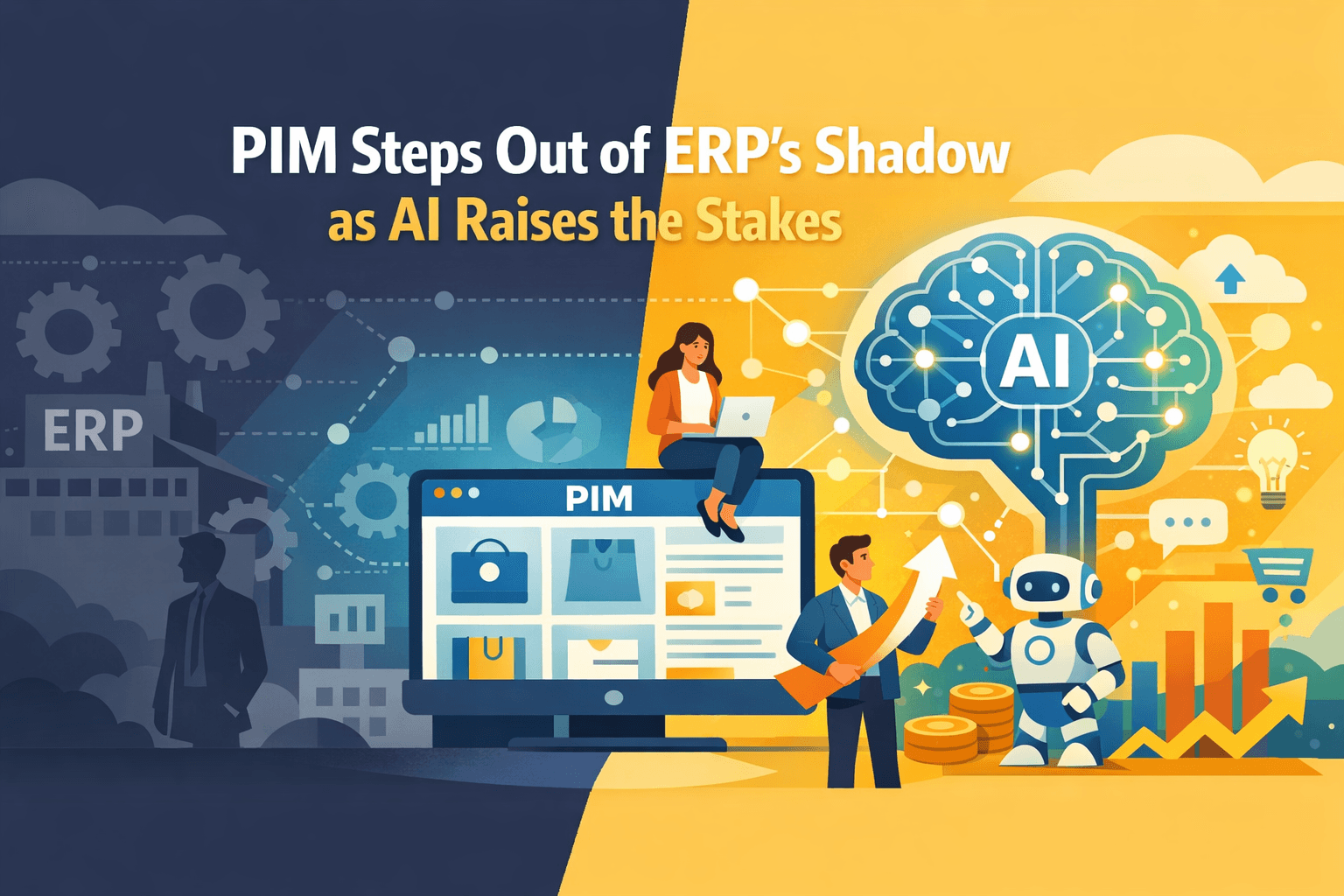
PIM Is Drifting Out of ERP’s Shadow
Historically, product data was whatever the ERP needed to track inventory and finance. Everything else – rich content, images, translations, technical attributes – lived in scattered spreadsheets and shared drives.
The framing here – “product data as foundation in an AI‑search driven world” – underlines something vendors and practitioners have felt for a while: ERP is no longer the source of truth for how products are discovered and sold. That mantle is moving to specialized PIM and PXM (product experience management) platforms that integrate with, but don’t bow to, ERP.
Taxonomy Is Becoming Strategy, Not Admin
The emphasis on scalable product data taxonomy is not a minor detail. As search gets more conversational and marketplaces more crowded, the way you classify products becomes a competitive weapon:
- It shapes how AI models understand similarity and compatibility.
- It dictates how easily you can enter new channels without redoing your entire catalog.
- It underpins personalization and recommendations.
We’re seeing taxonomy design shift from a clerical task to something more akin to information architecture for commerce. Masterclasses that lean into that complexity suggest the market is finally recognizing it as such.
AI Is Forcing PIM to Mature Faster
The PIM market has been evolving quietly for years, but generative AI put it under a spotlight. Retailers and manufacturers want AI‑generated descriptions, automated translations, and smarter search overnight. Without good PIM, they hit a wall.
That’s creating a split:
- Vendors that bolt AI on the surface – demos look great, but the underlying schema, governance, and workflows are unchanged.
- Vendors and practitioners that rebuild the pipeline – treating AI as another actor in the workflow, with clear guardrails, training data, and feedback loops.
Educational offerings that walk through “each step in the product data process” with AI in mind are aligning with the latter camp. Expect to see more frameworks for blending human and machine contributions to product content.
PIM Skills Are Turning Into a Career Track
The fact that a short session can credibly promise “frameworks and templates you can apply immediately” says a lot about demand. Organizations are realizing that:
- PIM isn’t going away when the replatforming project ends.
- The skills involved – modeling, taxonomy, governance, workflow design – don’t live naturally in any single traditional role.
- People who understand both the business side of products and the technical side of data are becoming extremely valuable.
The PIM market is responding with a slow but steady professionalization: certifications, role definitions (“PIM product owner,” “product data manager”), and yes, short, focused masterclasses like this one.
Where PIM Goes Next
Viewed from the outside, the PIM world can look obsessively granular: attributes, mappings, workflows, taxonomies. But the direction of travel is clear.
- From systems to ecosystems: PIM sitting in the middle of ERP, PLM, DAM, ecommerce, marketplaces, and analytics, orchestrating product data as it moves between all of them.
- From static catalogs to dynamic experiences: Product data shaped on the fly by context – who’s asking, from where, in what language, on which channel.
- From manual governance to assisted governance: AI not just enriching content, but flagging bad data, suggesting schema changes, and predicting where the model will break as the catalog grows.
For now, a 90‑minute masterclass is a small, practical step: helping the people in the trenches fix the basics – models, attributes, workflows – so that the more ambitious AI‑powered promises of the PIM market have something solid to stand on.
Source: https://henrystewartconferences.com/events/product-information-management-pim-masterclass
