


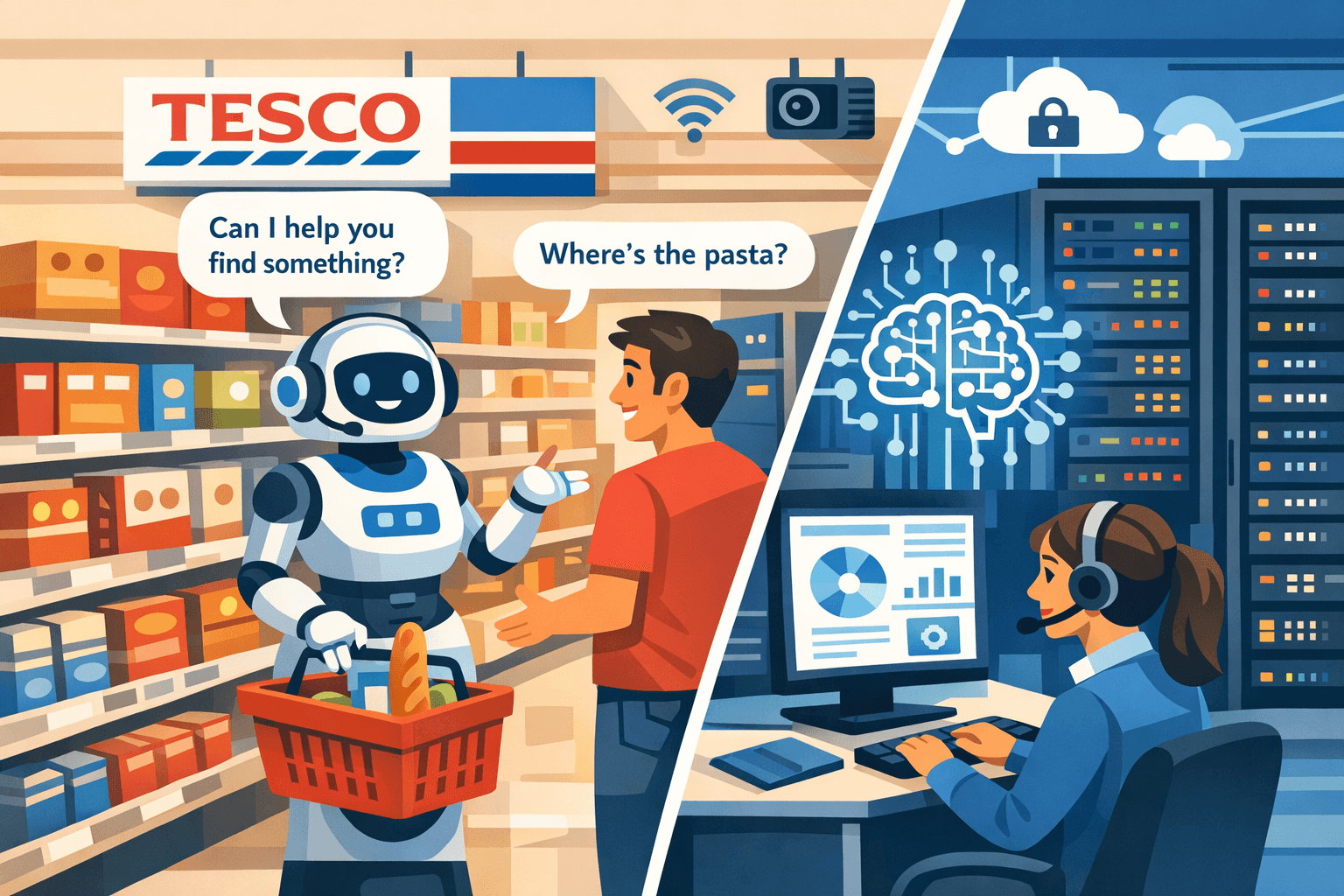
Supermarkets have always been early adopters of automation — from barcode scanners to self-checkouts — but Tesco’s latest experiment pushes that logic into the heart of retail operations: an AI “store assistant” designed to quietly manage the millions of tiny product details that keep shelves stocked and customers vaguely sane.
On its face, Tesco’s move looks like yet another “AI assistant” headline in a summer already drowning in them. Underneath, though, this is a story about something far less buzzy and far more consequential: how product information itself is becoming the battlefield where large language models, PIM platforms, and retail workflows collide.
What Tesco is actually testing
Tesco has kicked off what it’s calling a “large-scale colleague trial” of a new AI assistant across stores, with a clear goal: reduce the time employees spend doing product-lookup and admin so they can spend more time dealing with customers and running the floor.
This assistant doesn’t chat with shoppers directly; it’s for staff. The idea is that a colleague faced with a practical question — Where’s the gluten-free version of this? Has the packaging changed? What’s the exact spec on this item? — can ask the system in natural language and get an answer sourced from Tesco’s own product data.
In other words, Tesco is putting a conversational layer on top of a very controlled, very high-stakes product information stack. That’s what makes this more interesting than the usual “AI in retail” pitch.
PIM quietly takes the main stage
The announcement is framed as an AI story, but underneath it is a classic PIM problem: retailers sit on vast, fragmented product data estates — specs, ingredients, allergens, images, packaging variants, regional differences, and real-world quirks — and the only way any of this is useful at scale is if someone (or something) can surface it quickly and reliably.
Tesco’s assistant only works if the underlying product information management is disciplined:
- Consistent structure for every SKU across categories.
- Governed terminology for attributes (allergens, nutritional data, origin, packaging type, promotions).
- Version history to cope with constant change (new suppliers, reformulations, label and compliance updates).
- Clear links between physical store context (what’s on this shelf, in this region, in this format) and master product data.
Retailers used to treat PIM as plumbing: a back-office system you bought once and cursed forever. Tesco’s trial points to a different reality — PIM is no longer backstage. It’s the substrate that makes AI in retail either transformative or terrifying.
AI plus PIM: from static database to conversational layer
What Tesco is experimenting with is essentially a “conversational PIM front-end” for staff. Instead of navigating rigid product hierarchies and cryptic field names, colleagues ask questions in plain English and the AI maps them to structured data and rules.
If you zoom out from the Tesco specifics, this model looks like where serious product organizations are heading:
- Retrieval over browsing: Instead of drilling through a PIM UI tree to find a product attribute, teams query it directly — “Show me all chilled products with nut allergens in this region” — and the AI translates the intent into the right filters and joins.
- Context-aware answers: The “right” answer isn’t just in the PIM. For a store colleague, it’s a blend of master data, local assortment, planograms, and real-time availability. That demands tighter integration between PIM, ERP, and in-store systems.
- Human language in, structured data out: The assistant becomes a translator between messy human questions and the controlled vocabulary PIM needs to function.
This is where LLMs stop being a novelty and start acting like a UI for the entire product stack.
Trust is the hard part
Making an AI assistant that can talk is easy; making one that store staff actually trust is much harder. A hallucinated answer about last year’s iPhone might be annoying. A hallucinated answer about allergens or use-by dates is a liability.
Tesco’s framing emphasizes “lightening the load” for colleagues, but to do that safely the assistant has to:
- Anchor every answer in verified internal data (not the open web).
- Signal uncertainty clearly when data is missing, ambiguous, or outdated.
- Reflect live changes — new product ranges, reformulations, de-listed items — without manual babysitting.
- Play nicely with existing compliance workflows around labeling and regulatory data.
This is where PIM strategy stops being a technical footnote and becomes an AI safety issue. If your product data governance is sloppy, your AI assistant will be, too.
What this means for the PIM market
For PIM vendors, Tesco’s trial is a warning shot. The core value proposition can’t just be “single source of truth” or “faster syndication to channels” anymore. The new baseline is: Can your PIM stack safely power AI-native workflows for non-specialists on the front line?
Expect retailers and brands to start asking some pointed questions of their PIM providers:
- Is your data model AI‑ready? Taxonomies and attributes need to be both rigid enough for governance and expressive enough to support natural language mapping. If your hierarchy is a Frankenstein of legacy ERP field names, that’s going to show.
- How do you expose product data to LLMs? It’s no longer enough to offer an “API.” Customers will want retrieval-optimized endpoints, vector search support, and guardrails to ensure models only see what they’re supposed to see.
- Can you support conversational use cases? Not by slapping a chatbot on top of a product feed, but by enabling query translation, disambiguation, and traceability back to specific attributes and versions.
- What’s your stance on in-house vs. external models? Retailers like Tesco will be sensitive about shipping sensitive product and supplier data into generic cloud LLMs. PIM vendors will need a story here — private hosting, fine-tuning on anonymized product corpora, or tight partnerships with hyperscalers.
The upshot: PIM is drifting from “back-office record system” toward “AI data platform for everything product-related.” Vendors that don’t make that jump risk becoming little more than a slow-moving database behind more dynamic layers.
Retail PIM trends this move reinforces
Tesco’s trial neatly surfaces a slate of trends already emerging in the broader PIM ecosystem.
1. PIM is converging with DAM and store operations
Frontline colleagues don’t care whether an answer comes from PIM, DAM, ERP, or store systems. They just want “the right information.” That pressure is pushing retailers toward:
- Tighter integration of product data (PIM), media assets (DAM), and transactional data (ERP/POS).
- Unified product knowledge graphs instead of siloed platforms.
- Experiences where a single query can return a spec, an allergen list, a product photo, and a planogram hint in one place.
AI assistants are forcing the stack to behave as if it were one system — even if the reality behind the scenes is still messy.
2. The “AI lens” on product data
We’re moving from hand-authoring every attribute to using AI to enrich, verify, and explain them. Tesco’s use case is front-of-house, but the same stack can be turned inward:
- Auto-summarizing complex specifications into staff-friendly snippets.
- Flagging anomalies or missing fields across huge assortments.
- Generating localized descriptions or guidance for specific stores or regions.
PIM systems that can broker this kind of AI enrichment while maintaining control and audit trails will stand out.
3. Frontline staff as a core PIM user group
Traditionally, PIM users were merchandisers, content teams, e‑commerce managers. Tesco’s trial assumes store colleagues become daily consumers of product data — and potentially contributors, too, flagging errors or gaps on the fly.
That pushes PIM into new territory:
- Interfaces and APIs designed for non-specialists, not just data stewards.
- Feedback loops from stores back into product data governance.
- Real-time validation of how well product data aligns with what actually shows up on shelves.
The risk: AI on top of broken foundations
None of this is automatic. If a retailer drops an LLM into the middle of a badly governed product data estate, the outcome isn’t “AI transformation” — it’s just faster confusion.
PIM projects have always wrestled with taxonomy battles, ownership fights between IT and business, and slow-moving governance committees. AI doesn’t solve those problems; it exposes them. Put simply:
- If allergens aren’t consistently tagged, the assistant can’t reliably answer allergen questions.
- If regional variants aren’t modeled cleanly, store staff will see the wrong specs for their shelves.
- If change management is ad hoc, the assistant will confidently repeat last month’s truths.
Tesco’s scale makes those stakes clear. This isn’t a small DTC brand attempting some cute chatbot; it’s a national grocer whose product data has real-world health and safety implications. That alone should nudge other retailers to get serious about the state of their PIM before throwing “AI assistants” at the problem.
What comes next
If Tesco’s trial proves successful, it doesn’t just validate one assistant — it validates a model where product knowledge is treated as an active, conversational asset instead of a static catalog buried in back-office systems.
For the broader PIM market, that means a few likely shifts:
- RFPs will change: “How do you support LLM‑based use cases?” will move from a curiosity to a core requirement in PIM and product data platform tenders.
- Integration will be non-negotiable: Isolated PIMs with weak APIs will struggle against platforms that assume live connectivity to ERP, DAM, and operational systems.
- Data quality will get board-level attention: When executives see AI answers fail because of poor product data, investment in taxonomy, governance, and stewardship suddenly becomes less abstract.
- Retailers will build more in-house layers: The most advanced players will use PIM as a backbone while building their own AI orchestration, knowledge graphs, and assistant UIs on top.
Tesco is framing this as a way to “lighten the load” for colleagues. It is that — but it’s also a signal that the quiet, unglamorous world of PIM is now firmly in the spotlight. In a retail landscape where differentiation is increasingly about experience and efficiency, the brands that win may simply be the ones whose product data is clean enough, connected enough, and trusted enough to let AI sit confidently on top of it.
