


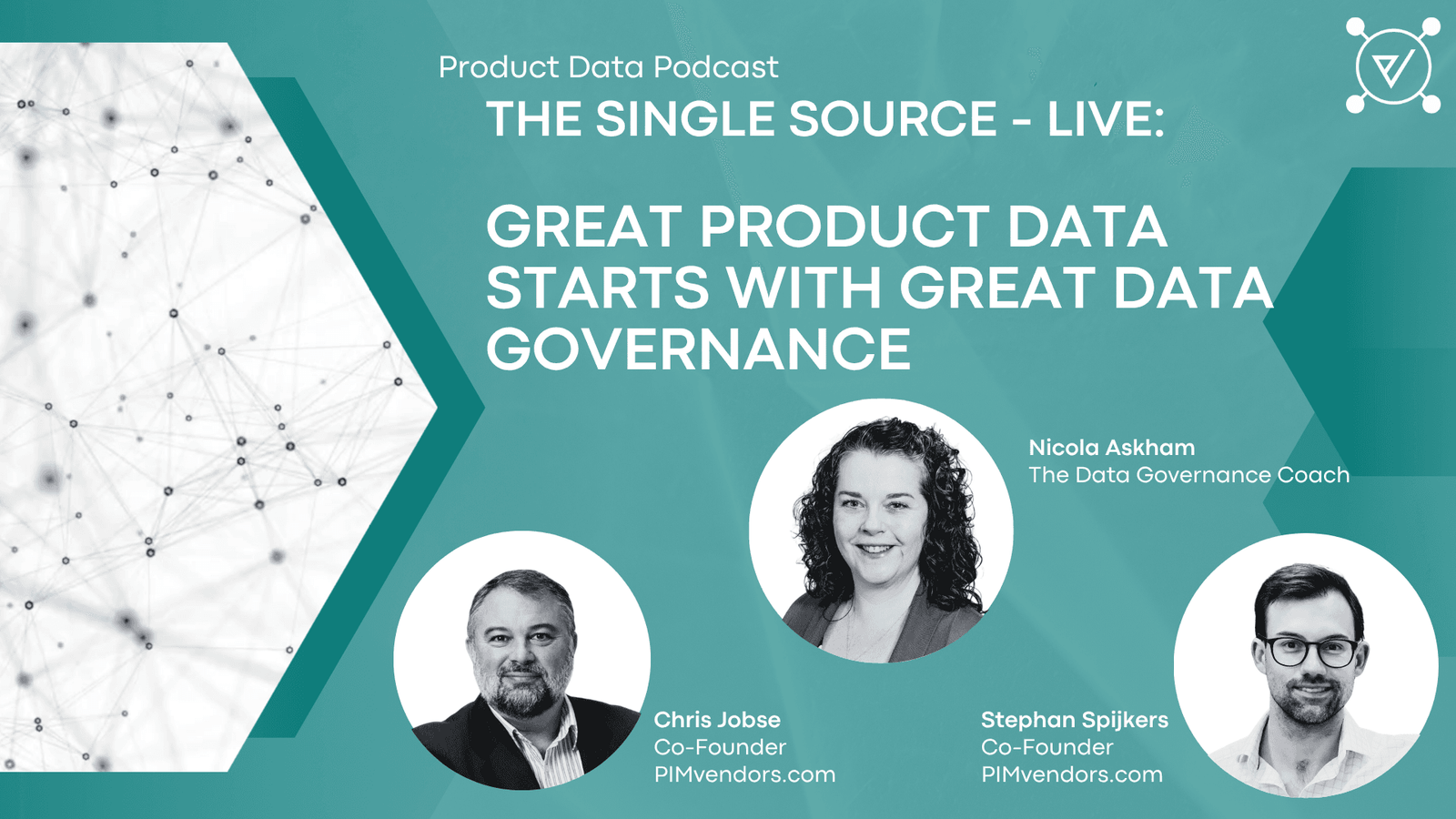
Most organizations have invested in PIM. Far fewer have invested in what actually keeps it working. In this episode of The Single Source, Nicola Askham — known as The Data Governance Coach and one of the UK’s leading authorities on data governance with 24 years of experience — joins PIMvendors co-founders Stephan Spijkers and Chris Jobse to address the structural problem that follows every PIM implementation: the data starts deteriorating within months, not years, and the root cause is almost never the tool.
The conversation covers what data governance actually is (and what it is not), why even well-funded PIM projects fail without it, how to assign meaningful data ownership across complex organizations, and why regulatory pressure and AI adoption are now forcing the topic onto leadership agendas it previously never reached. This is the episode for anyone who has implemented a PIM, or is about to, and wants to understand why the tooling alone will not hold.
Speakers:
Stephan Spijkers — Co-Founder, PIMvendors.com
Chris Jobse — Co-Founder, PIMvendors.com
Nicola Askham — The Data Governance Coach
Data governance is not the tool — and confusing the two is the single most expensive mistake in PIM.
Organizations consistently pour six-figure budgets into PIM licensing and deployment, only to watch data quality erode within three to six months. The reason is structural, not technical: the tool was implemented without a governance framework defining who owns the data, who is authorized to make decisions about it, and what processes keep it clean after go-live. Data governance is the decision-making framework around data — roles, responsibilities, and processes — not software. A PIM without governance is a well-organized container that slowly fills with bad inputs.
The costs of poor product data governance are real, but they hide in the wrong P&L lines.
Returns spike. Customer service hours climb. Emergency logistics orders cost four to five times the planned rate. Shipments get confiscated at customs because a country-of-origin field was filled in incorrectly. A sofa ends up on a warehouse loading bay in the rain. None of these incidents show up as a line item called “data quality failure” — which is precisely why leadership rarely acts on them. Chris Jobse put a concrete figure on it: a single product data error costs an organization an estimated €500 when the full downstream impact is traced across systems, processes, and corrective effort.
Defining data ownership across organizational silos is harder than it looks — and skipping it is not an option.
Most product data problems trace back to the same structural gap: nobody is formally accountable across the full data lifecycle. Purchasing, category management, e-commerce, and regional sales teams all touch product data, each with different requirements and different incentives. Nicola Askham’s framework is clear on this point: you need data owners who are empowered to make binding decisions, and data stewards who follow consistent processes — not a master data team that functions as a manual fix-it crew at the end of the pipeline. That team, as Chris Jobse observed, is an entry team operating without process authority, not a governance function.
Pragmatism is not the opposite of governance — it is a requirement for governance that actually holds.
Draconian data governance breaks in practice. When every new product entry requires sign-off from one person, and that person goes on holiday, underwriters lose deals and category managers route around the system. Stephan Spijkers’ point is precise: people will always find exceptions to rules that cannot flex — through political pressure, parallel spreadsheets, or dummy data entries to close a quarter-end deal. A well-designed governance framework explicitly accommodates the rush job, the exception, the incomplete enrichment at intake, and then has a clear corrective path. Allowing dummy data with a documented clean-up process beats having no flexibility and getting nothing but workarounds.
Regulatory pressure and AI adoption are now the two fastest routes to getting data governance on the executive agenda.
Nicola Askham’s preferred framing is value-led: data governance reduces returns, improves conversion, lowers customer service costs, and makes every downstream system more reliable. But she acknowledges a practical reality — some organizations will not move without a compliance driver. The Digital Product Passport, PPWR, and related EU regulation require structured, verified, machine-readable product data, which is exactly what a mature data governance framework produces. AI is the second lever: large language models cannot recover from ungoverned inputs, and organizations that let AI train on poorly structured product data will produce confident-sounding, commercially damaging outputs. Both pressures point to the same foundational work.
The best time to start was 200 years ago. The second best time is now — but start with the right question.
Nicola Askham’s oak-tree analogy is an accurate description of how long data governance takes to mature. Her practical guidance for organizations ready to begin: identify the specific business problem your organization needs solved — not “we need data governance,” but “we are losing supplier relationships because our data quality is unacceptable” or “our AI outputs are failing because the underlying product data is ungoverned.” The entry point is a business problem, not a best-practice mandate. Once the problem is clear, start small, assign one person to coordinate, and build the framework around real organizational pain rather than theoretical completeness.
👉 Evaluating your PIM setup or unsure where your product data governance stands?
Compare vendors and book a call with our team at:
