


Why PIM Suddenly Feels Like the Center of the Commerce Universe
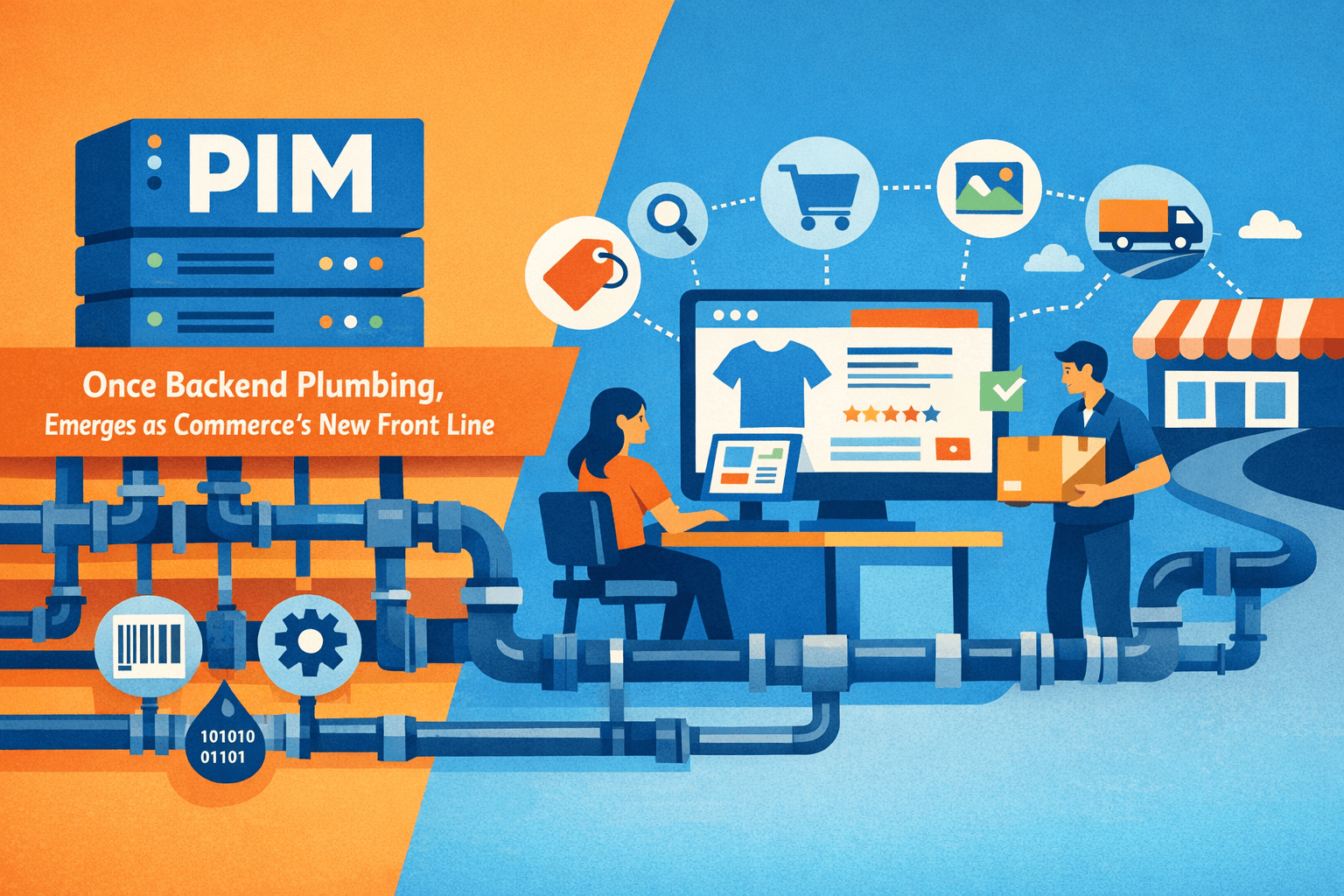
Product Information Management used to be the unglamorous plumbing of digital commerce: essential, underfunded, and mostly invisible as long as it didn’t break. That’s changing fast. In an AI-search driven world, product data isn’t just supporting the experience; it is the experience.
A recent PIM masterclass from Henry Stewart Conferences, led by PIMvendors.com co-founder Stephan Spijkers, is a good snapshot of how the discipline is evolving. Strip away the event framing, and what remains is a clear message: PIM is shifting from “catalog hygiene” to “strategic infrastructure for AI-native commerce.”
PIM, Redefined for an AI-Search World
At its core, the masterclass positions PIM as the operational backbone for any organization that wants to be discoverable, comparable, and trustworthy across digital channels. The framing is blunt: product data is the new foundation in a world where discovery is increasingly mediated by AI models and algorithmic search rather than human merchandisers or static navigation.
That shifts the question from “Do we have a PIM?” to “Is our product data structured well enough for machines to interpret, reason over, and serve to customers in context?” In other words: if your PIM is just a glorified spreadsheet with images attached, you’re already behind.
Data Modeling, Attributes, and Taxonomy Stop Being Back-Office Problems
The masterclass leans into three topics that tend to make people’s eyes glaze over until their search results tank: data modeling, attribute management, and taxonomy design.
- Data modeling decides how products, variants, collections, and bundles relate to each other. In a generative search context, those relationships become the scaffolding that lets AI answer nuanced queries (“show me sustainable running shoes under $150 that match my previous purchase”).
- Attribute management is no longer just “which fields do we need?” It’s about deciding which attributes are mandatory, which are channel-specific, and which are critical for semantic search, filters, and comparison. Poor attribute discipline leads to messy, inconsistent records that break AI reasoning.
- Taxonomy design moves from “what category tree do we like?” to “what hierarchy makes sense to both humans and machines?” AI still benefits enormously from predictable, normalized hierarchies, especially in complex assortments (B2B, technical goods, configurable products).
The implicit argument: if you don’t invest here, it doesn’t matter how many AI tools you layer on top. You’re feeding a large language model junk food and hoping for Olympic performance.
From Static Pipelines to AI-Augmented Product Data Workflows
Traditionally, the product data process looks like a linear pipeline: ingest → cleanse → enrich → approve → publish. The masterclass walks through how AI is quietly infiltrating each of those steps, turning them from manual bottlenecks into semi-automated systems.
- Data cleansing: AI models can detect and normalize inconsistent values (units, sizes, color naming), flag anomalies, and suggest corrections. That doesn’t eliminate human oversight, but it massively reduces the grunt work.
- Data enrichment: Generative models are increasingly used to draft descriptions, translate content at scale, and infer missing attributes from partial data. The quality of those outputs depends entirely on the underlying schema discipline.
- Publication mapping: Different channels (marketplaces, resellers, internal catalogs) still demand their own attribute sets and formats. AI is starting to help map a brand’s canonical data model to each target channel, maintain those mappings, and react when external schemas change.
The trendline is clear: PIM workflows are evolving from brittle rule-based systems to AI-assisted flows where humans supervise and refine rather than manually touch every record.
PIM as a Cross-Functional Discipline, Not Just an IT System
Another quiet signal in the masterclass pitch is the target audience: product managers, data managers, digital commerce teams, and technical stakeholders all show up as intended learners. That’s notable.
PIM used to be “owned” by IT or e-commerce operations. Now it’s creeping into roadmap discussions, merchandising strategy, and data governance. When a 90-minute course promises reusable frameworks and templates, it’s really acknowledging that:
- PIM decisions increasingly shape customer experience, not just backend data quality.
- Frameworks for governance, workflows, and roles are as important as the tool selection itself.
- Teams need a shared language to talk about product data beyond “just fill in the fields.”
That’s also why certificates start to matter: not as vanity credentials, but as signal inside organizations that PIM is a defined, teachable discipline rather than tribal knowledge.
What a 90-Minute Masterclass Tells Us About the PIM Market
On the surface, this is a typical bite-sized training: a 90-minute online session, 20 minutes of Q&A, recording available, and a single expert at the helm. Look a little deeper, and it reflects how the PIM ecosystem itself is maturing.
- Time-boxed, tactical learning: The market isn’t asking for long theoretical programs; it wants focused, digestible sessions that connect day-to-day PIM pain points to new AI capabilities.
- Vendor-neutral expertise: A co-founder of PIMvendors.com teaching the session underscores that buyers are overwhelmed by choice and conflicted vendor positioning. Independent frameworks are becoming more valuable than product demos.
- Global, remote-first adoption: A single 90-minute slot covering multiple time zones (PDT, EDT, BST, CEST) reflects how PIM is now a global discipline, spanning brands, distributors, and marketplaces that operate across regions.
The offer structure itself — recording access, flexible attendance, credentialing — reads like a response to teams that are under pressure to “do something with AI and product data” but don’t have weeks to step away from operations.
Where PIM Is Headed Next
Put together, the themes from this masterclass hint at where PIM is likely going over the next few years:
- From repositories to “product data platforms”: Expect PIM to look and behave more like modern data platforms: APIs everywhere, event-driven updates, analytics baked into the core, and tight coupling with DAM, ERP, and commerce engines.
- AI as a co-pilot, not a bolt-on: The winners won’t just bolt generative AI onto their PIM as a separate feature. They’ll rebuild workflows so models assist at every step, with governance and human review as first-class citizens.
- Schema literacy as a key skill: Understanding how to design, extend, and govern product schemas will become a mainstream competency for product and commerce teams, not just data architects.
- Marketplace and channel pressure: As marketplaces and retail partners raise their data standards — and start using their own AI to evaluate feeds — brands will feel direct commercial pressure to clean up PIM or risk throttled visibility.
- Closer alignment with DAM: Rich media and product data will continue to converge. AI that generates, tags, and recommends assets will need consistent, high-quality product data as fuel.
The masterclass is really a sign that PIM is stepping out of the basement. It’s becoming a strategic function that sits at the intersection of AI, search, merchandising, and operations. The tools will keep evolving, but the fundamentals — good models, disciplined attributes, clear workflows — are now table stakes.
Source: https://henrystewartconferences.com/events/product-information-management-pim-masterclass
