


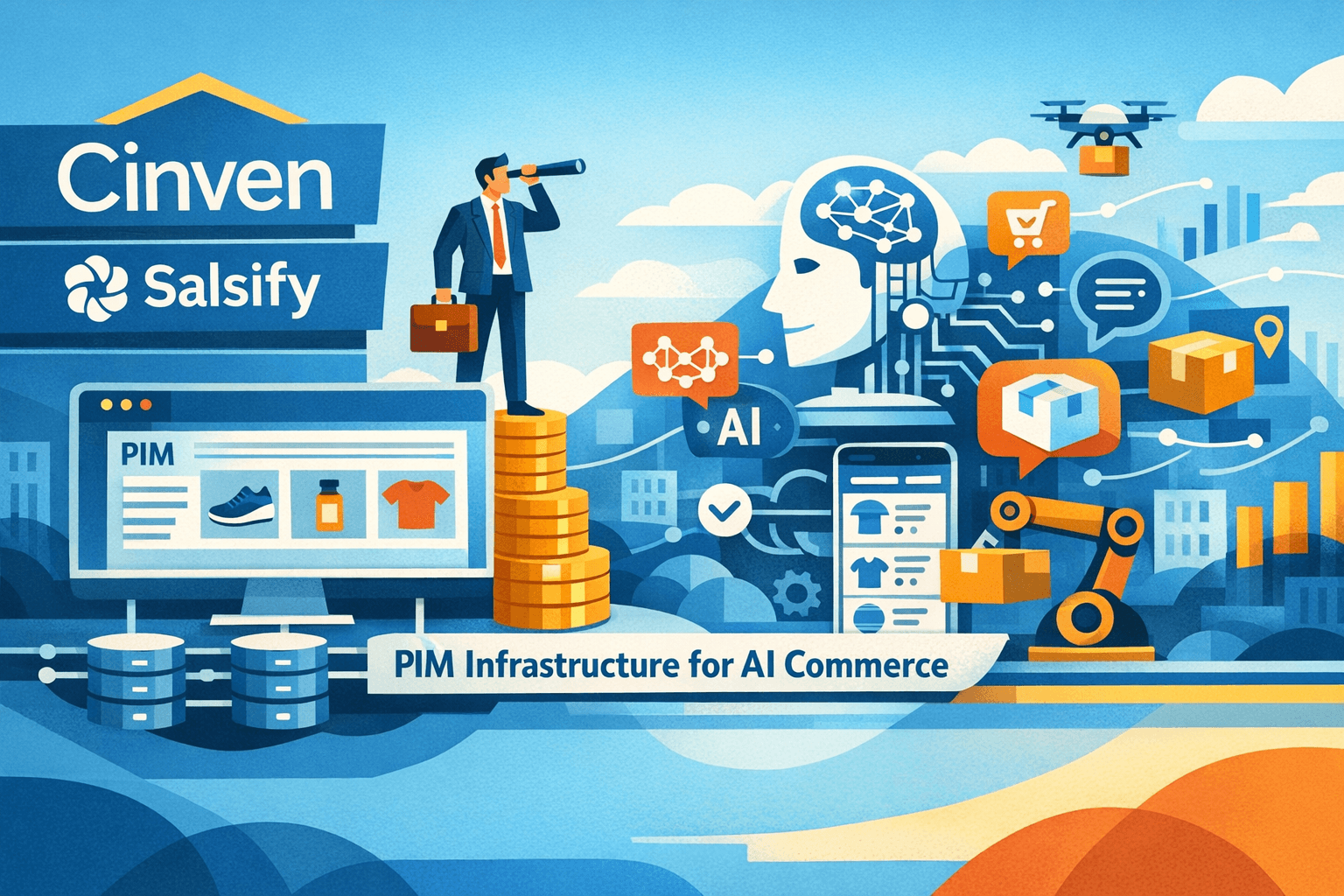
Cinven Is Buying Salsify. Here’s What That Really Means for PIM and the Digital Shelf
Another big private equity deal just landed in product information land: Cinven, the international PE firm, has agreed to acquire Salsify, one of the flagship names in Product Experience Management (PXM). The numbers are private, but the signal to the broader PIM/PXM market is loud and clear: the digital shelf is maturing into serious infrastructure, and private equity wants in before AI and agentic commerce redraw the map.
Salsify: From PIM Start-Up to PXM Infrastructure Layer
Founded in 2012 and headquartered in Boston, Salsify has spent the last decade trying to solve a brutally specific problem: how do large brands keep every product detail — dimensions, ingredients, images, claims, translations, rich content — consistent and up to date across an exploding number of digital shelves?
The company’s pitch is familiar to anyone living in PIM, DAM, or commerce operations: a single home for product data that syndicates out to every retailer, marketplace, and channel, automatically reshaped to fit whatever arcane and ever-changing content requirements those destinations demand.
Salsify now claims:
- More than 2,000 customers, including major global consumer brands.
- Roughly 750 million products published across 2,600 commerce destinations.
- More than 70,000 active users.
That’s not a niche PIM implementation footprint; that’s a de facto data distribution layer for global CPG and retail. In practice, Salsify has evolved from “just another PIM” to an operational hub for digital shelf execution — part PIM, part DAM, part syndication engine, wrapped in workflow.
Why Cinven Wants Salsify Now
Cinven is leaning heavily into the idea that the product experience stack is on the verge of another growth phase, driven by three overlapping forces: e-commerce complexity, AI, and the shift from “channels” to continuous digital presence everywhere.
In their own words, Cinven is buying Salsify for a familiar set of private equity reasons — but each one matters for the PIM/PXM ecosystem:
1. A structurally growing market
Product Experience Management sits at the convergence of PIM, DAM, syndication, and digital shelf analytics. It’s riding the same long-term e-commerce tailwinds that fueled the first boom in PIM a decade ago, but with new drivers: SKU proliferation, more markets, more local regulations, and increasingly picky retailer templates.
Every new sales channel (TikTok Shop, retail media networks, specialized marketplaces, B2B portals) adds one more set of requirements the brand has to manage and keep synchronized. That problem doesn’t shrink with time; it compounds.
2. A business-critical platform, not a “nice to have”
For Salsify’s customers — global brands like Mars, L’Oréal, The Coca-Cola Company, Bosch, ASICS, and retailers such as Carrefour, Metro, and Intermarché — the platform isn’t a peripheral record system. It’s embedded in daily workflows for content teams, e-commerce managers, and supply chain operations.
When a tool becomes the way product data gets to market, it’s no longer easy to rip out. That’s exactly the kind of “mission critical” positioning PE loves in SaaS: high stickiness, high switching costs, and a high likelihood customers will expand usage as they add channels, brands, and regions.
3. Network effects between brands and retailers
Salsify’s ecosystem play has always been its hidden weapon. The more brands syndicate content to retailers through the platform, the more incentive retailers have to integrate, standardize, and adopt Salsify-fed workflows. That, in turn, makes Salsify more attractive to other brands.
This network effect is one of the few truly defendable moats in the PIM/PXM space, which is otherwise full of overlapping feature sets and similar marketing claims. Cinven is essentially buying a network, not just a software license base.
4. AI and “agentic commerce” as the next growth lever
The press release explicitly calls out Salsify’s positioning as “an essential data layer, as agentic commerce reinforces the strategic value for brands to maintain rich, structured and timely product data across multiple digital shopfronts.”
Strip out the buzzwords and the logic is straightforward: if AI agents — whether retailer-side, marketplace-side, or consumer-facing — are going to pick products, compare options, and build baskets on behalf of shoppers, then product data suddenly has to do more heavy lifting:
- More structured attributes for machine reasoning.
- More precise, timely updates for availability, compliance, and content.
- More context-rich media and descriptions that AI models can interpret.
In that world, PIM stops being just about “feeding pages” and starts being about “feeding algorithms.” PE sees that future and is betting that Salsify can be the bridge between brand-side data chaos and agent-driven commerce environments.
5. Room to expand: new geographies, new verticals, new modules
Cinven is framing this acquisition as a classic expansion story. Europe gets singled out as an “untapped” opportunity, but the broader ambition is clear: use Cinven’s footprint and consumer sector relationships to push Salsify deeper into global CPG, retail, and adjacent verticals.
Expect more modules and integrations around:
- Retail media content operations.
- B2B and distribution use cases.
- Analytics and optimization layers on top of product content performance.
In other words, expect Salsify to lean even further away from being “just PIM” and deeper into digital shelf operations and performance tooling.
How This Shifts the PIM / PXM Competitive Landscape
The Salsify–Cinven deal is not happening in a vacuum. The broader PIM, DAM, and commerce stack has been consolidating and rearranging for years. This acquisition intensifies some of the key trends already reshaping the market.
1. PIM is no longer a standalone category
If you still think of PIM as the quiet back-office database behind ERP and e-commerce, you’re already a few years behind. Deals like this underline a shift that’s been underway for a while: PIM is morphing into PXM — and PXM is colliding with DAM, syndication, and digital shelf analytics into a single operational capability.
Vendors that remain “just PIM” — focused narrowly on data modeling and governance with minimal activation, syndication, or analytics — are going to feel more pressure. The value in this market is clearly pooling around platforms that can take product data from source to shelf, not just store it.
2. PE-backed PIM/PXM will get more aggressive
Private equity money typically comes with a familiar playbook: accelerate growth through geographic expansion and M&A, broaden the product footprint, optimize costs, and push toward a more obvious category-leadership story.
For Salsify’s rivals, that means competing not only with a strong product but with a well-funded roll-up threat. Expect to see:
- More acquisitions of niche PIM, DAM, and syndication players.
- Deeper integrations with major ERP and commerce platforms to lock in enterprise workflows.
- A faster pivot into AI-native features for content generation, attribute enrichment, and compliance automation.
3. AI will become the primary differentiation narrative
The mention of “agentic commerce” is not accidental; it’s an early attempt to plant a flag in the next wave of differentiation. Over the next few years, expect every serious PIM/PXM vendor to pitch themselves as:
- The best training/ground-truth data layer for AI agents.
- The safest governance layer for AI-generated content (claims, compliance, local regulations).
- The fastest system to detect and correct content issues algorithmically.
The winners won’t just use AI to auto-fill attributes or spit out descriptions. They’ll use it to rewire workflows: “no-touch” content onboarding from suppliers, risk scoring for incomplete or non-compliant items, automated readiness checks per channel, and dynamic content experimentation driven by performance signals.
4. PIM will sit closer to revenue, not just IT
Salsify has always sold into digital commerce and marketing stakeholders as much as IT. With Cinven backing, that commercial orientation is likely to intensify. PIM/PXM will increasingly be sold as:
- A lever for digital shelf share gain and conversion lift, not just data quality.
- An enabler of retail media performance — better content, better ROAS.
- A cost-control engine for managing SKU proliferation without adding headcount.
This reframing matters because it pulls PIM further out of the ERP shadow and into the orbit of growth, merchandising, and performance teams. In budget conversations, that shift is huge.
What This Means for Brands
If you’re on the brand side — especially in CPG, consumer electronics, or any category with thick product data — this deal reinforces a few hard truths about where your product stack is heading.
1. The “system of record” for product is moving away from ERP
ERP is still the backbone for pricing, inventory, and finance. But the system of record for consumer-ready product content and attributes is drifting toward specialized PXM platforms like Salsify — tools that can handle all the nuance digital channels demand, plus versioning, localization, and rich media.
2. Omnichannel is no longer the ceiling
Omnichannel once meant harmonizing in-store, e-commerce, and marketplace data. The new bar adds:
- Retail media placements where creative, copy, and attributes must be fully aligned.
- Social commerce surfaces (short-form video, live shopping, creator-driven formats).
- Agentic and AI-assisted journeys — search, recommendations, and chat interfaces that interpret product content on the fly.
PIM/PXM platforms now have to orchestrate content across all of those, in a continuous feedback loop rather than a one-off syndication push.
3. Vendor choice will increasingly lock in your operating model
The more your content operations, internal workflows, and retailer integrations are built around a platform like Salsify, the harder it becomes to change direction later. That has pros and cons:
- You gain speed and scale today.
- You depend heavily on that vendor’s roadmap tomorrow.
Cinven’s ownership likely means more investment in product and expansion — but also the familiar PE pressures around pricing, packaging, and upsell. Brands evaluating PIM/PXM now need to assess not just features, but ownership structure and long-term strategy.
What This Signals for the Future of the PIM Market
This acquisition is one more data point that PIM, DAM, and digital shelf tools are moving from “nice productivity booster” to non-negotiable infrastructure for modern commerce. A few directional bets look increasingly safe:
- Convergence will continue. Expect more vendors that historically sat in separate buckets (PIM, DAM, MDM, syndication, digital shelf analytics) to fuse into broader “commerce data platforms.” Salsify is already there in practice; this deal will push competitors to move faster.
- Stand-alone, narrow PIM offerings will feel the squeeze. Especially those without strong retailer networks, AI capabilities, or activation layers that tie directly to revenue outcomes.
- AI-native workflows will become table stakes. PXM vendors will distinguish themselves not by whether they have AI, but by where in the workflow AI meaningfully reduces manual effort and risk.
- Private equity will keep circling. With Salsify now under Cinven’s umbrella, expect other firms to hunt for the next consolidation node — whether in mid-market PIM, regional specialists, or niche DAM players that can be plugged into a broader stack.
Salsify calling itself the backbone for “digital and agentic shelves” is more than branding. It’s a hint at the future: when AI systems start acting as the primary interpreters and intermediaries of product data, brands will need infrastructure that can feed those agents with clean, rich, structured information at scale. Cinven is betting that Salsify can be that infrastructure for a large chunk of the global consumer economy.
