


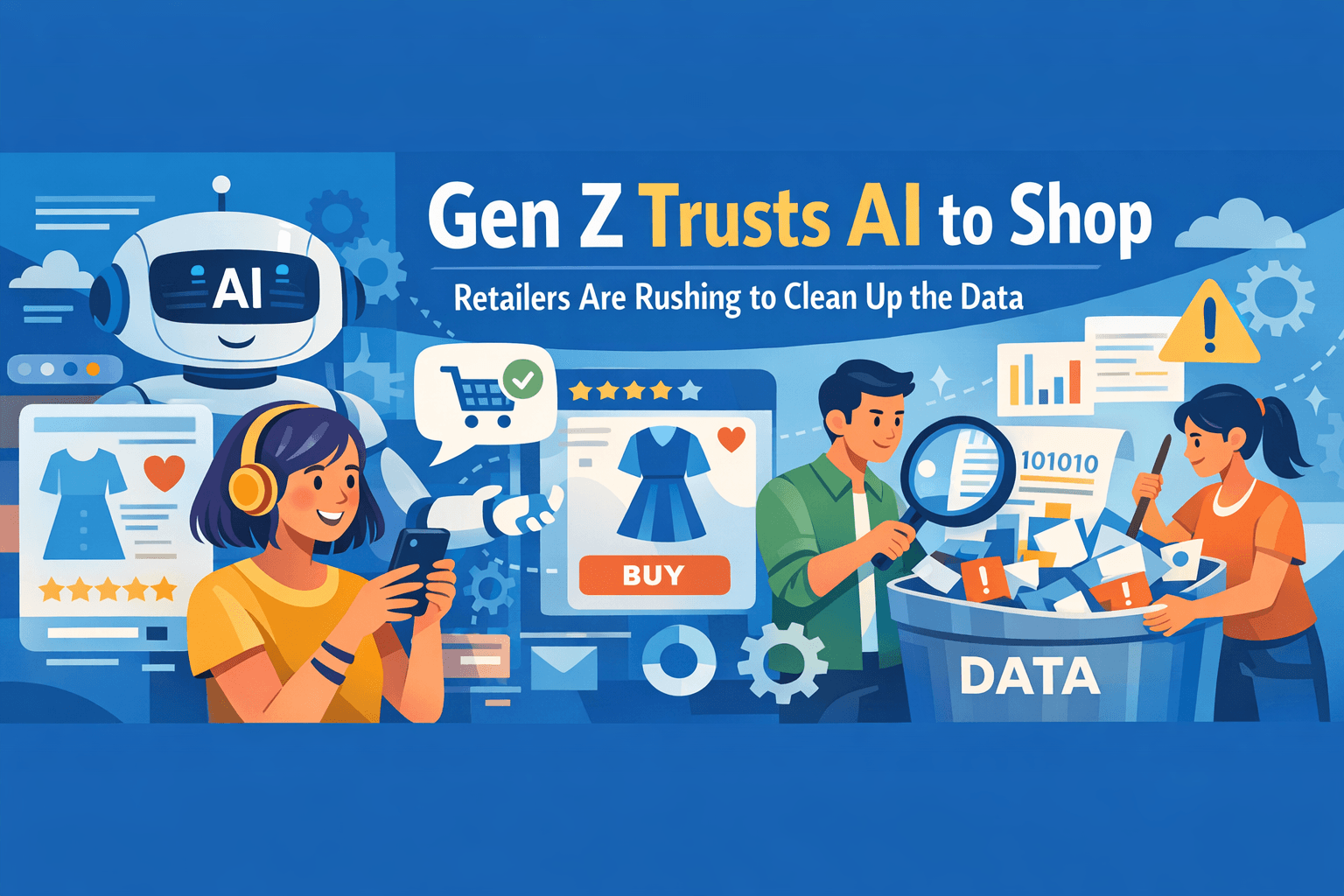
AI Shopping Tools Are Winning Over Young Shoppers — And Rewriting the Product Information Playbook
Millennials and Gen Z aren’t just tolerating AI in their shopping journeys — they’re actively opting into it. But beneath the hype around AI “shopping agents” sits a quieter, more structural shift: the only way these tools work is if brands and retailers have clean, consistent, deeply structured product information. That’s where the PIM market comes in, and the stakes just went up.
Younger shoppers trust AI more than humans — up to a point
According to a new survey from The Harris Poll and Quad, 62% of Gen Z and Millennial shoppers say they prefer to use AI-powered tools when shopping, compared with 51% of consumers overall. For these younger cohorts, AI isn’t a novelty — it’s a filter against regret. They’re using it to reduce the risk of making a bad purchase and to cut through choice overload.
The trust gap is already visible. Six in 10 Millennials say they have more faith in AI shopping tools than store associates when it comes to offering unbiased advice. That sentiment is shared by 54% of Gen Z and 45% of all consumers. In other words, almost half the market is closer to trusting a model than a salesperson.
This has direct implications for product content: when AI is the “associate,” your PIM effectively becomes your sales floor. Every attribute, spec, compatibility note, and usage guideline feeds into what shoppers perceive as “unbiased” guidance.
Surveillance pricing is pushing people back to stores
At the same time, consumers are spooked by algorithmic pricing. Nearly three-quarters of respondents say algorithm-driven pricing makes it harder to know if they’re getting the best deal. About seven in 10 say the rise of “surveillance pricing” — pricing tuned by data trails and profiles — actually makes them want to shop in physical stores, where they expect consistent shelf prices.
This tension is telling: people want AI’s efficiency and insight, but not when it feels like the system is watching them a little too closely or quietly adjusting prices based on who they are or what they’ve done. For PIM and product experience teams, this is a warning: transparency can’t be an afterthought.
AI shopping agents are already a price-comparison weapon
Despite the anxiety, consumers are clearly leaning on AI to make smarter decisions. Two-thirds of respondents overall — and 76% of Millennials — say using AI to find pricing inconsistencies across retailers is appealing. Six in 10 respondents, and 68% of Millennials, like the idea of AI quickly narrowing down options for them.
It’s the algorithmic version of a power user with ten tabs open — except now that comparison layer sits between the shopper and every retailer’s catalog. If your product information is partial, inconsistent, or locked inside legacy systems, your assortment either disappears from that layer or gets misrepresented by it.
In a world of AI-first shopping, PIM isn’t a back-office tool anymore. It’s the language you use to negotiate with the AI agents that are screening your products on behalf of your customer.
Trust collapses the moment AI feels pay-to-play
There’s a hard line consumers are drawing: three-quarters of Americans say they would lose trust in AI shopping if the results were sponsored or paid. That’s a serious problem for any commerce strategy that assumes AI search will just become the next ad slot.
“Consumers are scrutinizing value more closely and questioning who, or what, is shaping their purchase decisions,” Quad’s Heidi Waldusky said in the report. “AI offers real promise for efficiency and personalized service to make life easier, but any hint that AI shopping is quietly steering users toward paid influence could confirm a fear that the system isn’t on our side.”
For brands, this raises the bar on data quality and content richness. If you can’t pay your way into the top result — or doing so kills trust — you have to win by being the product that an AI agent, trained to optimize for relevance and user value, consistently surfaces on its own.
Retailers are wiring themselves into AI ecosystems
Major retailers aren’t waiting for this AI shopping layer to stabilize — they’re trying to define it. Target, Walmart, Etsy, and Best Buy have all announced partnerships with AI providers like Google, OpenAI, and Microsoft to plug their assortments directly into AI platforms.
Functionally, that means their catalogs and content are being ingested into large models and search systems that will interpret, summarize, compare, and recommend products in natural language. If you ask a model to “find me a 55-inch TV under $600 that works well in a bright room,” the quality of the recommendation depends entirely on how well that retailer’s product data describes screen size, brightness, panel type, typical use cases, and pricing.
This turns traditional PIM strategy on its head:
- PIM is no longer just for channel syndication — it’s for model consumption and AI ranking.
- Attribute depth and consistency aren’t “nice-to-haves”; they’re competitive weapons.
- Every missing or ambiguous attribute is an opportunity for a rival with better-structured data to win the recommendation.
What this means for the broader PIM market
The survey is about attitudes toward AI shopping, but it might as well be a roadmap for where PIM is heading. A few clear trends emerge:
1. AI-native PIM becomes the default, not the upgrade
Most PIM systems were built for humans: marketers, merchandisers, content teams. Now the primary consumer of product data is a machine. That shifts priorities:
- Structured, standardized attributes matter more than marketing copy bloat. Models need clear fields, not poetic blurbs.
- Context-rich metadata (use cases, compatibility, sustainability tags, regional rules) becomes as important as basic specs.
- APIs and event-driven updates are table stakes so AI platforms can stay synced with price and assortment changes.
Expect new PIM offerings to brand themselves explicitly as “AI-ready” and prioritize machine readability as much as human usability.
2. Explainable, transparent product data will be a trust lever
Because consumers already suspect surveillance pricing and hidden sponsorship, retailers will need to show their work. That will push PIM teams to capture and expose more explanatory data:
- Why something is recommended (e.g., “Matches your previous purchase,” “Best value per ounce,” “Highest durability rating”).
- Clear provenance for reviews, ratings, and certifications.
- Standardized pricing logic and policies that can be described back to the user.
AI agents can’t explain what they can’t see. If explanations become part of the UX, then PIM needs to store not just product facts but the structured rationale behind them.
3. PIM, DAM, and ERP will be forced closer together
In an AI-driven journey, shoppers don’t distinguish between “product information,” “media assets,” and “inventory facts” — they want a single, coherent answer. That means:
- PIM + DAM: Rich media (images, 3D, video, AR assets) must be tagged and linked at the attribute level so AI can select and describe the most relevant assets.
- PIM + ERP: Real-time stock, lead times, and regional availability become part of decision logic for AI agents — and must be tied tightly to product records.
- Unified schemas: Retailers will either rationalize schemas across systems or let the AI improvise on top of messy data. Only one of those ends well.
4. Product content governance moves from back office to boardroom
If AI tools become the “face” of your brand for a large share of Millennial and Gen Z shoppers, then your PIM strategy is effectively your brand strategy. Sloppy data translates into incoherent, contradictory, or flat-out wrong AI recommendations — and that’s a direct hit to trust.
Expect to see:
- Dedicated AI merchandising or “agent optimization” roles that sit between PIM and digital commerce teams.
- New KPIs tying product data quality directly to conversion, return rates, and customer satisfaction with AI interactions.
- Audits of how third-party AI platforms represent your products, with remediation feeding back into PIM and schema design.
5. PIM vendors will differentiate on AI partnerships and semantics
As retailers plug into platforms like Google, OpenAI, and Microsoft, PIM providers will compete on how elegantly they can feed those ecosystems. That likely means:
- Prebuilt connectors and semantic mappings to major AI and marketplace schemas.
- Native enrichment tools using AI to normalize, dedupe, and infer attributes at scale.
- Support for domain ontologies and knowledge graphs that make it easier for models to reason about relationships between products.
The PIM players that treat “AI as a downstream consumer” — not just another channel — will have an edge.
AI is the new front end. PIM is the new battleground.
The headline here is about generations warming up to AI shopping tools, but the subtext is more disruptive: shoppers are beginning to offload entire chunks of their consideration process to agents that sit between them and the brand. Whether those agents work in your favor depends on how well your product data is structured, governed, and exposed.
For PIM, that means graduating from a behind-the-scenes content repository to the core infrastructure that determines which products AI systems see, understand, and trust — and which ones they quietly ignore.
Source: https://www.retaildive.com/news/millennials-gen-zers-warm-up-to-ai-shopping-tools/817509/
