
Signal
Recap: Data Cleansing: Folksonomy and Data Dictionaries
Stephan Spijkers · 2026-09-29 · 5 min read
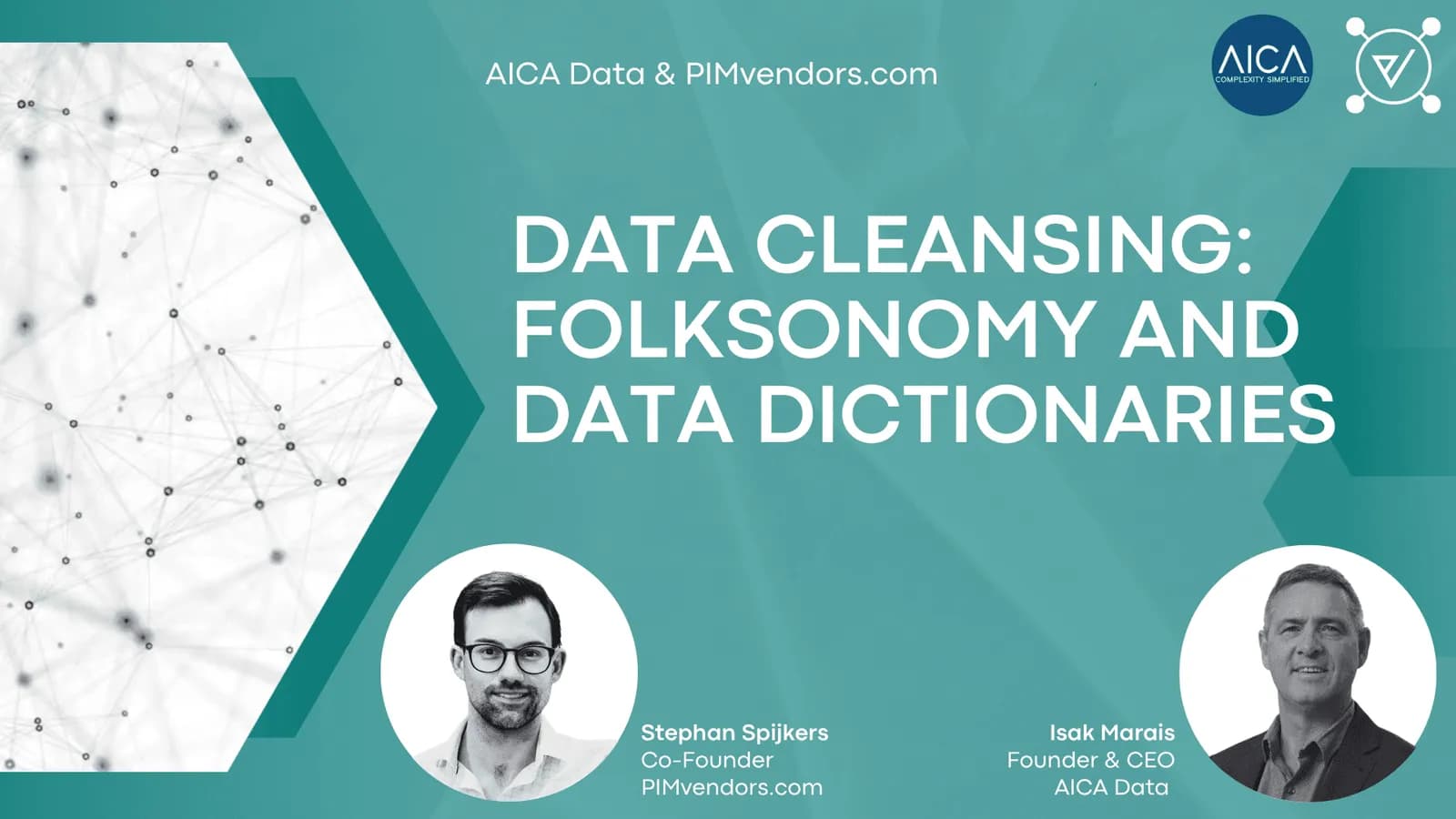
Companies preparing for AI are investing in the right foundations. They select PIM and MDM platforms, define governance structures, appoint data stewards and set up data councils. Yet one layer keeps landing last in line: the quality of the product data itself. Organizations have operated at their current data quality levels for years, so few see it as a problem. With AI in the loop, that blind spot becomes expensive. Garbage in, garbage out holds truer than ever, and "pretty good" model output still breaks processes at enterprise scale.
In this session, Stephan Spijkers talks with Isak Marais, Founder of AICA Data International, about what it takes to build product and MRO data you can actually trust, and how to get there with a business case in hand.
Speakers
- Stephan Spijkers, Co-Founder, PIMvendors.com
- Isak Marais, Founder, AICA Data International
Takeaways
Trust Starts With Deterministic Rules
Generic language models can clean a small dataset convincingly, but at enterprise volume they drift. Isak describes multiple projects where clients first tried standard LLMs and ran into limits on time, effort and consistency. AICA's answer is a golden record built on deterministic rules. A central brain, isolated for each client, works alongside a global brain trained on years of MRO data, and a product data dictionary validates every AI decision. Each record carries its source, a confidence score and the evidence behind every change. For data teams, that traceability is what turns AI output into data a business can act on.
AI Is a Set of Tools, One Per Step
Stephan frames a point many buyers miss: AI is many capabilities, each suited to a different step in the data journey. Classification and enrichment call for one approach, data cleansing for another, and field capture for a third. AICA's portfolio reflects this. Atlas handles classification and enrichment. Smart Capture is a mobile app that identifies a part from a photo and updates the record, so nobody has to travel to a warehouse on the other side of the world. The practical implication is to map AI to specific process steps before selecting tools.
An Enhancement Layer for the Systems You Already Run
AICA replaces none of the existing stack. It works alongside ERP, enterprise asset management, PIM and MDM systems, and makes sure the data entering them is correct. This matters most during migrations. SAP ECC to HANA projects stall on data volume and poor data quality, and moves from one PIM to another carry the same risk. Isak sees clients increasingly insisting that their EAM and PIM providers integrate specialist data quality tools. He cites a large mining group and a European PIM migration as recent examples.
People and Process Still Carry the Weight
Some data problems start before any software can help. Isak describes a project spanning more than 70 locations, where warehouses held unstructured stock in bags and usable data barely existed. In cases like this, AICA's verified partner network provides boots on the ground to introduce process and data capture. Stephan adds that AI is shifting the role of implementation partners, while change management and process leadership remain as important as ever.
Prove the ROI Before the Project Starts
A year and a half ago, AICA knew that dirty and unenriched data cost money but could not quantify it. Today, ROI and economic value added calculators, backed by published case studies, put numbers on recoverable annual revenue, value exposure and ranked actions before a pilot begins. Isak sees this as a clear advantage over traditional ERP, EAM and PIM projects, where proof of value arrives later and rests on assumptions.
His advice for anyone starting out is to understand your cost structure and the cost of your data problem first. From there, engagements run in weeks rather than months and begin with prototyping on the client's own data. AICA offers five engagement models: full service, self-service, API access, white label and procurement through AWS Marketplace.
The Market Moves Slower Than AI
Both speakers agree that adoption lags the technology. Large software houses and enterprises move on an oil tanker timeline, while AI releases arrive every few months. Stephan draws a parallel with PIM itself: 25 years after the e-commerce boom, the spreadsheet remains PIM's biggest competitor. Education fills the gap, which is why AICA launched the AICA Academy and a quarterly benchmark center. Regulation is also accelerating demand. Digital Product Passport requirements expose weak classification, which is driving inquiries from PIM teams and DPP service providers alike.
Key Takeaways for Product Data Leaders
Treat data quality as its own layer, with its own budget, alongside systems, process, governance and people. Demand traceability from any AI data tool, meaning a source, confidence score and evidence on every record. Quantify the cost of bad data before selecting a solution, because that number drives both the business case and the scope.
👉 Find the right PIM or product data partner for your organization at pimvendors.com
Diagnostic
Do you actually need a PIM?
Run the complexity index before you budget software or hire an SI.
Budget
Model a first-pass TCO
Translate catalog shape into a three-year cost range in under ten minutes.