
Signal
Pixyle on What AI Changes in Fashion Product Data
Nathalie · 2025-10-30 · Updated 2026-10-19 · 3 min read
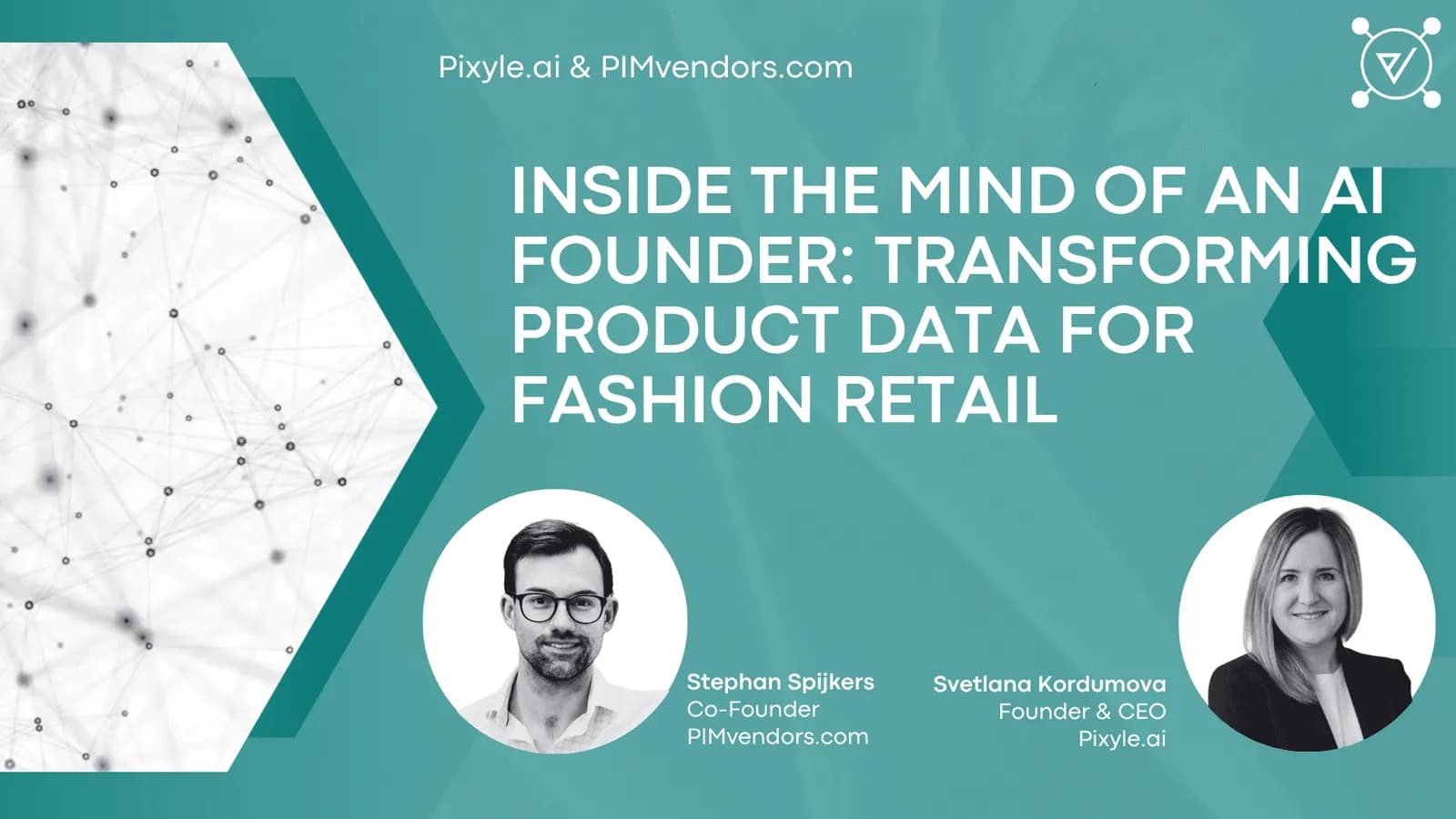
Rich product attributes, not a new shopping screen, are what make fashion findable. That is the practical point from this conversation between Stephan Spijkers and Svitlana Kodomova, CEO of Pixyle.ai.
Kodomova's path, as she tells it, runs from AI research to a company that enriches retail product data, with fashion as the hard case. The session covers how the technology moved, why thin product data hides products, and where a specialist tool fits next to a general model. PIM for fashion and apparel is the buyer-side map of that hard case: variants, composition, size and the channels that each want a different cut.
Speakers
- Stephan Spijkers, Co-Founder, PIMvendors.com
- Svitlana Kodomova, CEO, Pixyle.ai
What she walked through
Kodomova puts her own work in AI at more than 15 years, from research through to founding Pixyle.ai. She describes the field's shift from shallow learning to deep learning as the break that made visual product work viable, and she ties the company to a long interest in fashion and technology together.
The early product was visual search. During the pandemic, she says, that pivoted to data enrichment: taking what is already in the image and the thin record, and writing the attributes a shopper or a channel needs in order to find the product. Product-market fit, in her account, was the ordinary startup problem of learning which job retailers would pay for.
The commercial claim is straightforward. Richer product data improves discoverability, and discoverability is what shows up in sales. AI belongs on the repetitive part of that work, so people can spend their time on creative and commercial judgment. A general model can draft. A tool built for fashion, which is how she positions Pixyle, is cut for the attributes that category actually uses.
She also flags conversational shopping as the next pressure on the same record. If a shopper asks for a dress in a fabric, a fit and a use, the answer is only as good as the attributes behind it. AI-ready product data is that requirement written for a buyer: the record has to be able to answer, not only to display.
What to do with this
If fashion is the catalog, score an enrichment vendor on a sample of your own images and your own attribute list, not on a demo catalog. The trade-off of a specialist tool is another system to govern. The trade-off of asking a general model to invent attributes is confident values nobody checked.
Either way, the attributes have to land in the PIM under a rule for what "complete" means. Product data quality and governance is where that rule lives. An enrichment pass that writes beside the record will disagree with the record by the next season.
Diagnostic
Do you actually need a PIM?
Run the complexity index before you budget software or hire an SI.
Budget
Model a first-pass TCO
Translate catalog shape into a three-year cost range in under ten minutes.