
Signal
AI Guardrails for Product Data: Stop Invented Claims and Trace Every Change
Stephan Spijkers · 2026-11-06 · 6 min read
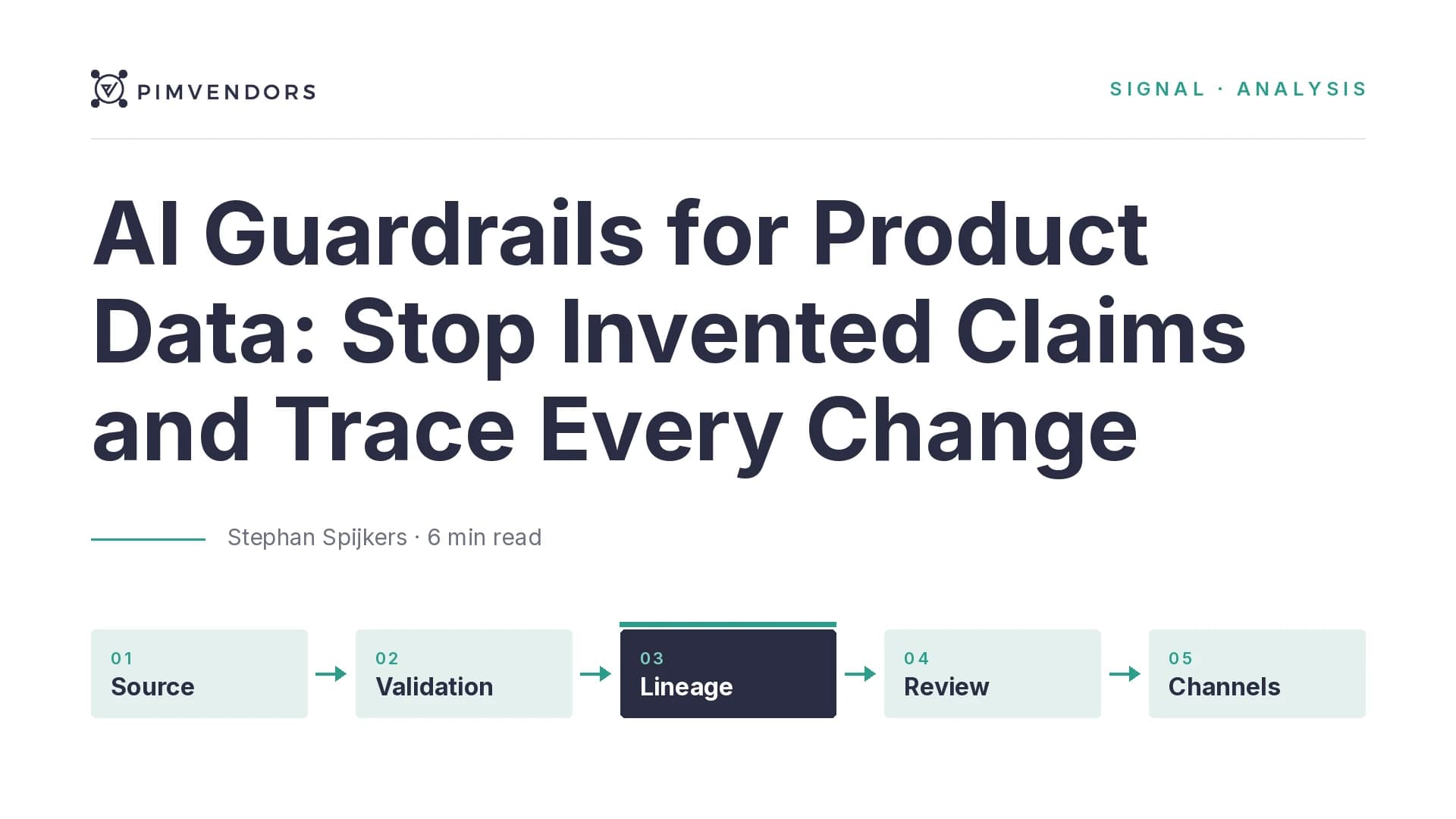
AI guardrails for product data have two jobs: prevent unsupported values from reaching customers, and preserve the evidence needed to explain an accepted change afterwards. Grounding a model in an approved product record addresses the first. Connecting that record to the agent's recommendation, the review and the published result addresses the second. Neither permission to write nor a human approval timestamp tells the whole story.
Two vendor articles published this week bring those jobs together. Casey Paxton's Akeneo article, Your AI Governance Policy Isn't Enough: Why Decision Lineage Matters, focuses on reconstructing a decision from source to channel. Dagmara Śliwa's Bluestone PIM article, How To Prevent AI Hallucinations In Product Data, connects approved records, scoped access, validation and review before bulk changes. This follows the permissions boundary in our DwyerOmega MCP and agent governance case: once access is controlled, the next issue is what an agent does with that access and how its changes can be explained.
An approved source is the start, not the result
Bluestone PIM gives concrete examples of product-data errors: a description adds "waterproof" or "BPA-free" without supplier support, a unit changes from 250 mm to 250 cm, a shortened description loses an allergen statement, or a supplier error is copied into every language. These are different failure modes. A model can invent a claim, mishandle a valid value or reproduce an error already present in its source.
The golden record is therefore more than a place to store generated copy. Bluestone PIM describes checking a category for missing attributes, mixed units and outliers before using that record to generate content. Its built-in agent and external agents connected through MCP read structured product records, including attributes and accepted values. The intended behavior when an approved value is missing is to flag the gap rather than fill it with a guess.
That distinction matters for a catalog with technical or regulated information. An accepted unit or range can catch a malformed value. A plausible certification still needs supporting evidence. Bluestone PIM treats safety information, certifications and allergens as information to check against documents before publication. Our guide to product data quality and governance explains the ownership and data-model work beneath those checks.
Grounding and permission solve different problems
Bluestone PIM describes external MCP connections using OAuth and the signed-in user's permissions. Product history records who changed what and when. The same article points out that deleting an attribute definition removes its values from every product using it. A permission boundary limits the available action, but the consequences of an allowed action can still span a whole category.
MCP is the connection to the structured record, not proof that a generated value is true. Nor does connecting through MCP alone establish how an external model provider handles retrieved information. Bluestone PIM explicitly calls for checking the provider's data processing agreement, where information is handled and where connected tools can share product data. Its article describes support for a customer's own LLM provider and API keys.
For writes, the article distinguishes the PIM's permissions from approval in the AI tool. IT can configure Claude or ChatGPT to request approval before saving through MCP. That is a configured control, not a claim that every connection automatically has it. Read-only analysis, review of proposed changes and a small test before a bulk job are separate stages. Bluestone PIM illustrates the scale difference with 20 products before 2,000. Our Trends in PIM Part 2 on AI governance sets out why the identity behind a connection and the reach of its rights matter.
Product history is not the same as decision lineage
Akeneo takes the record further. A change log can identify the user, field and time without showing which supplier document justified the change or which version the reviewer saw. Decision lineage connects the source and its version to the agent, model, prompt, mapping or rule used, the recommendation and evidence, any reviewer edits or overrides, the resulting attribute change and the destinations affected.
Its multi-agent example makes the difference clear. A supplier-data agent changes a specification, an enrichment agent fills related attributes from it, and a content agent turns those attributes into customer-facing copy. Three independent logs describe three operations. A connected history shows how a challenged source value spread through the product information.
Akeneo proposes a shared identifier that follows a material change through enrichment, validation, content creation, localization and activation. That makes the source version part of the approval context. If it changes later, the team can identify the descriptions, translations and published destinations that need review. Human approval is evidence of a decision on particular information, not permanent approval of every later use.
Stopping a claim and explaining a claim belong together
The two articles meet at the moment a proposed change becomes accepted product data. Bluestone PIM focuses on the record, validation and controlled writes; Akeneo focuses on the connected evidence around that decision. Both treat review as work with evidence, not simply an instruction to keep a person involved. Akeneo names conflicting authoritative sources, technical or sustainability claims and large SKU batches as examples of review triggers.
Akeneo also describes a reconstruction drill: start with a published claim, trace it back through reviews and automated actions to its original source, then test whether it can be stopped, corrected and republished. Time spent reconstructing the decision, missing evidence and repeated overrides expose weaknesses that a written policy alone cannot show. This extends the staged operating model in our article on what AI inside a PIM actually does and where it breaks.
These are complementary vendor arguments, not a feature comparison or a guarantee against errors. Bluestone PIM explicitly acknowledges that a language model cannot be made incapable of inventing values. Akeneo's decision-lineage article describes a governance approach rather than demonstrating that every element is an available product feature. The useful distinction is between an agent being allowed to change a record, a value being supported enough to accept, and the team being able to reconstruct why it was accepted. Guardrails cover all three, from the approved source to the last channel that received the result.
Diagnostic
Do you actually need a PIM?
Run the complexity index before you budget software or hire an SI.
Budget
Model a first-pass TCO
Translate catalog shape into a three-year cost range in under ten minutes.