
Signal
Single Source Ep. 4: Dirty Data, and Why Excel Will Not Fix It
Nathalie · 2026-03-31 · Updated 2026-10-17 · 3 min read
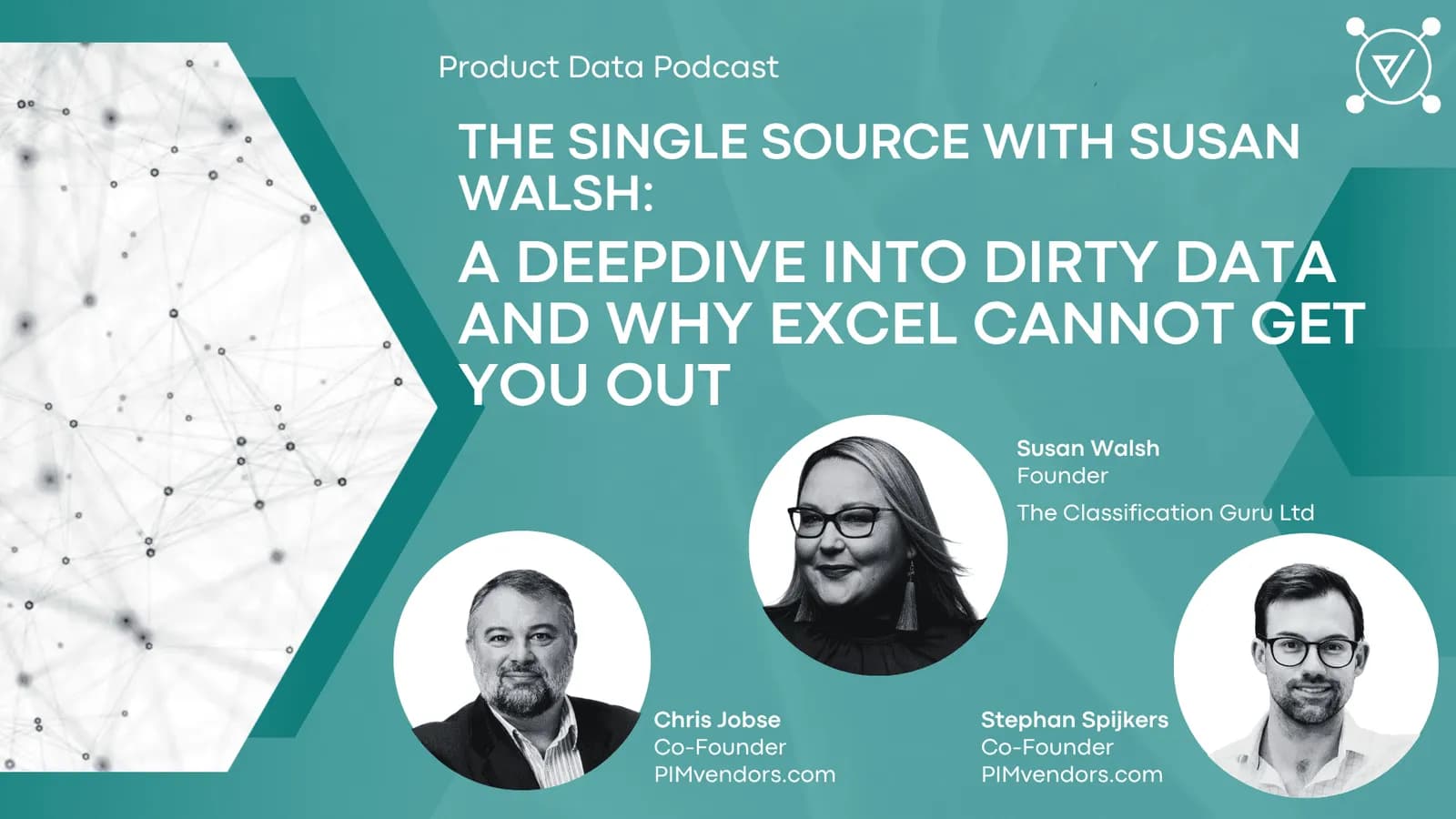
Dirty product data stays cheap to ignore until a launch slips, an integration fails, or an AI feature repeats the error in a confident voice. That is the frame of Single Source episode 4. Excel is how most of those errors stay alive: the fix lives in a personal file, and the file leaves with the person.
Stephan Spijkers, Chris Jobse and Susan Walsh, founder of The Classification Guru, walk through why quality decays, who is supposed to own it, and what to do before automation multiplies the mess. The episode was published on the PIMvendors YouTube channel.
Speakers
- Stephan Spijkers, co-founder, PIMvendors.com
- Chris Jobse, co-founder, PIMvendors.com
- Susan Walsh, founder, The Classification Guru Ltd
What to keep
- Treat quality as a funded capability, with a business case you can point at. The session's framing: organizations that file data quality under overhead lose to the ones that pay for it on purpose. The case is late launches, failed integrations and rework, not a generic percentage. Product data quality and governance is how you turn that case into dimensions, roles and a definition of complete per channel.
- AI multiplies the record you already have. Clean inputs, output you can act on. Dirty inputs, errors at volume and with more confidence. Start an AI initiative with an audit of the fields the model will read. AI-ready product data is that audit, written as a condition list rather than a tool tour.
- "Hidden heroes" are a risk, not a compliment. They are the people who repair a broken feed by hand and tell nobody. When they leave, the flow breaks and the postmortem cannot find a process. Write the repair down. Then decide if it belongs in the record or in a ticket that should not exist.
- Mergers are where two weak standards become one worse standard. You inherit two taxonomies, two ideas of "required", and two heroes. Without a deliberate integration of the data, you keep the looser rule from each side because it is the one that does not block go-live.
- Ownership is an assignment. If nobody is named, everybody assumes the other team checks the column. The session pushes for accountability that survives a reorganization, not a RACI slide. The PIM implementation guide puts names on the model while the project still has a deadline.
- A central standard and local decisions can coexist. The pattern they describe: one place for definitions and allowed values, and room for a business unit to run the day inside those rules. The failure mode is either a central team that blocks every pack-size change, or local files that quietly fork the taxonomy.
- Standards cut the cost of the next move. Consistent structures, names and categories make the following migration, integration or automation cheaper. Product classification, GS1, ETIM and ECLASS is the concrete version: pick the standard your channels already speak, and stop maintaining a private one in Excel beside it.
The trade-off is boredom against heroics. A documented repair is slower this week than the person who "just fixes it" before the feed goes out. It is also the only version that still works in August, when that person is on leave and the AI feature is quoting the value they used to correct by hand.
Diagnostic
Do you actually need a PIM?
Run the complexity index before you budget software or hire an SI.
Budget
Model a first-pass TCO
Translate catalog shape into a three-year cost range in under ten minutes.