
Signal
Single Source Ep. 6: AI Stalls on Product Data That Is Not Ready
Nathalie · 2026-04-22 · Updated 2026-10-19 · 4 min read
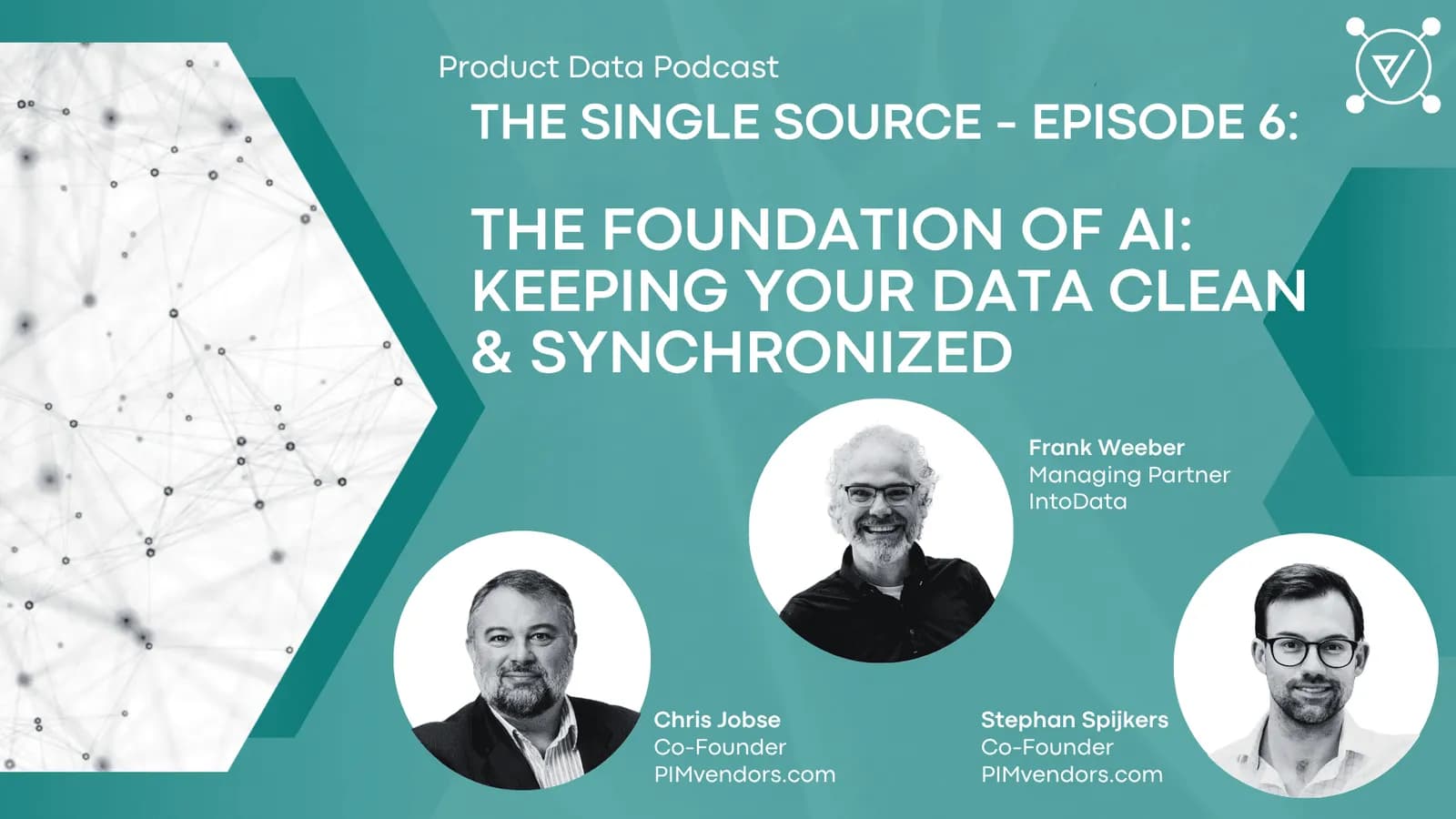
Every AI initiative in product data hits the same wall: the record underneath was not ready. That is the point of episode 6 of The Single Source. Deploy the model first and you get the same gaps, faster, and on more channels.
The session notes name Helen Grimster, Director of Product Marketing at Syndigo, as the guest in the conversation, and they also list Frank Weeber, Managing Partner at IntoData, on the speaker card, with Stephan Spijkers and Chris Jobse of PIMvendors.com. Both names are in the notes. The recording below is the check on who speaks.
The discussion is about why data quality still caps what AI can do, what it takes to put a real owner on the record, and how to build a foundation that makes the output reliable. Product data quality and governance is the longer treatment of that owner, the rules, and the definition of complete.
Speakers
- Frank Weeber, Managing Partner, IntoData
- Stephan Spijkers, Co-Founder, PIMvendors.com
- Chris Jobse, Co-Founder, PIMvendors.com
- Helen Grimster, Director of Product Marketing, Syndigo
What the episode argues
Data quality decides whether AI speeds up growth or spreads the existing mess. Incomplete, inconsistent or ungoverned product data does not produce a better answer. It produces a worse answer, at higher speed and scale. The foundation sets the ceiling for everything built on it. AI-ready product data starts from the same constraint: an agent can only answer with what the record actually holds.
Ownership is the bottleneck that stays hidden. In most organisations, responsibility for quality is split across teams and nobody is accountable. That split is why quality projects stall and the debt compounds. A cleanup with no owner is a project you will run again.
Hallucinations are often a data problem. When the output is wrong or inconsistent, the cause is frequently the reference data, not a weak model. Spending on a more capable model before the record is addressed is the wrong sequence.
"Good" also depends on the channel. A record that is complete enough for an internal ERP fails the bar for e-commerce, marketplace syndication or print. You need an explicit quality bar per channel. One universal definition is not enough. Where ERP stops and PIM starts is the practical split: the ERP holds the transactional core, and the sellable record is a different job.
Several versions of the truth need a rule. As product data moves across systems, suppliers and channels, conflicting records pile up. Naming which source is authoritative, and enforcing that order, comes before any coherent use of AI.
Quality is an operating process. Treat it as a one-time cleanup and you will clean the same data again. Lasting quality needs workflows in the daily work, standards you can measure, and someone who stays accountable. Periodic remediation sprints do not hold.
The episode also points at two levers teams underuse: gamification, and collaboration across functions. Motivating people to keep quality up takes more than a policy. Structured incentives and alignment across departments, in the session's account, hold up better than a mandate from the top.
What to do with this
Before you fund a model, name the owner of the product record and write the quality bar for the two channels that actually sell. The trade-off is time. A governance pass delays the demo. Skipping it makes the demo the thing you have to explain later, when the answers are confident and wrong.
If the owner and the channel rules are still open, the selection question is not which model to buy. It is which system can hold the rules. The PIM implementation guide covers where that work sits in a rollout, including the part that is people and process rather than software.
Diagnostic
Do you actually need a PIM?
Run the complexity index before you budget software or hire an SI.
Budget
Model a first-pass TCO
Translate catalog shape into a three-year cost range in under ten minutes.