
Core
Top Akeneo PIM Alternatives You Need to Consider
Stephan Spijkers · 2025-04-18 · Updated 2026-10-13 · 14 min read
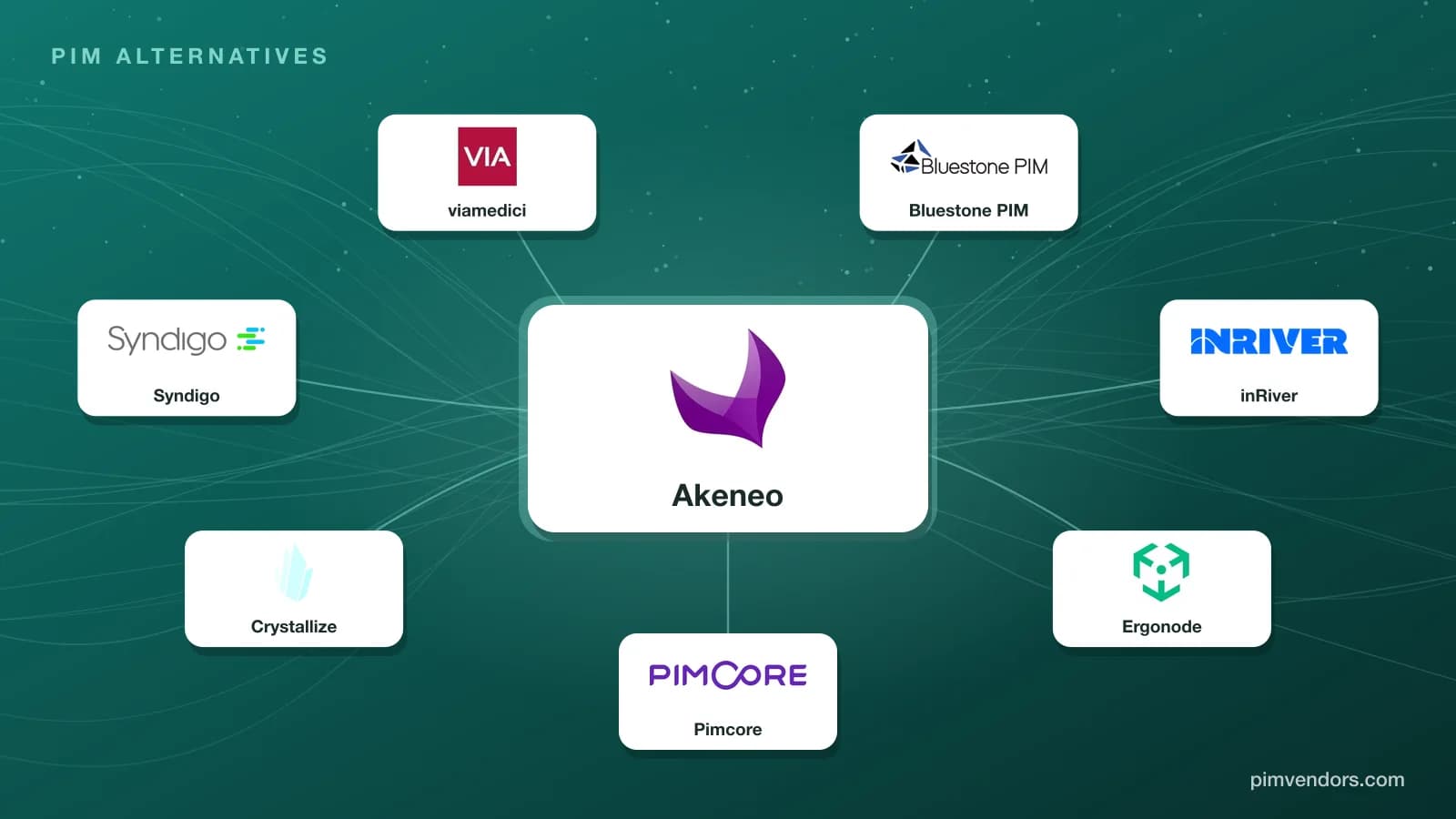
Akeneo is on most PIM shortlists, and teams that run it reopen the decision for practical reasons: a renewal, the sunsetting of the Community Edition, which moves self-hosted teams to a paid plan or to another system, a new commerce stack, or a scope that has grown beyond product content. Each of those reasons points to a different kind of alternative, so this guide starts with what Akeneo is built for and where its limits lie. It then covers why teams compare it, seven alternatives ordered by how close they sit to Akeneo's buyers, and how to switch.
What Akeneo is and who it fits
Akeneo is a French PIM vendor, founded in 2013. It has open-core roots, with a free Community Edition next to the paid SaaS Product Cloud. Akeneo is sunsetting the Community Edition (see the Tenzing article linked under Pimcore below), so its product today is Product Cloud. It sells to small, mid-market and enterprise companies, and its core capabilities fall into five areas:
- Product modeling with families, variants and enrichment completeness, so you can see per product how far its enrichment is from done.
- Data quality tooling, with completeness scoring and quality insights as its signature features.
- Supplier onboarding through Supplier Data Manager, with a portal, mapping and AI extraction, aimed at the work of turning supplier files into usable product data.
- A native DAM in Product Cloud, focused on product assets rather than a full brand DAM, so a marketing team with a large brand library may still need a separate DAM.
- Localization, with enrichment across many locales for companies that sell in several countries and languages.
Its best fit is with mid-market and enterprise brands, retailers and wholesalers that prioritize multi-channel product experience, an API-first or composable architecture, enrichment productivity and supplier onboarding. In practice that is a company where a content team enriches a large assortment for several webshops and marketplaces, and where the daily question is which products are not yet complete enough to publish.
Why teams look for an Akeneo alternative
The most fundamental reason is that the job has grown into master data management. Akeneo is not a substitute for multidomain MDM of the Stibo Systems or Precisely EnterWorks class. If customer, supplier or location data must share a governed golden record with products, you need an MDM platform next to or instead of a PIM. A typical trigger is a group of companies that wants one supplier master across all its subsidiaries, with products linked to it, which is a different project from enriching product content.
Standards are the second reason. GS1, ETIM and digital product passport support need explicit proof in a proof of concept, and often run through a partner. Industrial manufacturers whose wholesalers require ETIM, and companies that must publish through a data pool, tend to compare systems where this is part of the product. For them the standard is a condition for doing business with a customer, so an extra partner in the chain feels like an extra risk.
Third, the licence or hosting model changes. With the Community Edition being sunset, teams that run Akeneo themselves have to move to the paid SaaS product or to another system, and they compare the paid offer with alternatives at that point. For a team that has run the Community Edition for years with its own developers, this is a budget decision as much as a technical one, because a licence fee appears where there was none. Teams that want to keep self-hosting, or to self-host one platform for product data, assets and content, look at Pimcore.
Fourth, the retailer network is sometimes the real problem. Akeneo is PIM-first, and brands whose revenue depends on retailer compliance, GDSN and enhanced content often need a network platform more than a better product record. A health and beauty brand that loses listings because its content fails a retailer's validation will not fix that with better completeness scores in its own PIM.
Finally, some digital-native teams that build their own storefront prefer a headless commerce backend with PIM built in. For them product data, editorial content and commerce logic belong together, and running a separate PIM next to a commerce platform adds an integration they would rather not maintain.
Akeneo alternatives at a glance






| Alternatives to Akeneo | Built for | Industry | Runs as | Founded | Go-live (estimate) |
|---|---|---|---|---|---|
| Today: Akeneo | Small business, Mid-market, Enterprise | Retail, Wholesale | SaaS, Open source, Cloud-hosted | 2013 | 16 weeks |
| Bluestone PIM | Mid-market, Enterprise | Retail, Manufacturing | SaaS, Cloud-hosted | 2016 | 20 weeks |
| inRiver | Mid-market, Enterprise | Manufacturing, Retail, Wholesale | SaaS, Cloud-hosted | 2007 | 20 weeks |
| Ergonode | Small business, Mid-market, Enterprise | Retail | SaaS, Cloud-hosted | 2018 | 16 weeks |
| Pimcore | Small business, Mid-market, Enterprise | Manufacturing, Retail | Open source, Cloud-hosted, On-premise | 2009 | 16 weeks |
| Crystallize | Small business, Mid-market, Enterprise | Retail | SaaS, Cloud-hosted | 2017 | 16 weeks |
| Syndigo | Mid-market, Enterprise | Retail, Manufacturing | SaaS, Cloud-hosted | 1973 | 20 weeks |
| Viamedici | Mid-market, Enterprise | Manufacturing, Wholesale | SaaS, Cloud-hosted, On-premise | 1999 | 20 weeks |
The map above places Akeneo and each alternative by the company size it is built for and by industry: retail, manufacturing or wholesale. Starting from the row for your own industry, it is easy to spot which options keep you in similar territory and which ones move you toward a suite, a network or a commerce backend. The list below gives the main reason to consider each one, in the same order as the detailed sections.
- Bluestone PIM fits composable, API-first commerce stacks with large and complex catalogs.
- inRiver fits companies with many channels and marketplaces that want print and digital shelf analytics from one model.
- Ergonode fits mid-market teams that want a usable enrichment interface, an included DAM and published pricing.
- Pimcore fits teams that want open-core software and one platform for product data, assets and content, self-hosted if needed.
- Crystallize fits DTC and B2B teams with engineers who want product, content and commerce in one headless backend.
- Syndigo fits brands where retailer compliance, GDSN and enhanced content drive revenue.
- Viamedici fits SAP-centric manufacturers that need MDM, PIM, DAM and a configurator from one vendor.
The alternatives
Each section below covers what the system is, how it compares with Akeneo in practice, and what to check before it goes on your shortlist. Founding years, headquarters, fit and watch-outs per system are in the vendor profiles.
Bluestone PIM
Bluestone PIM is a Norwegian SaaS PIM, founded in 2016, built on microservices with an API-only architecture and MACH certification. It serves mid-market and enterprise manufacturers, distributors and omnichannel retailers.
Compared with Akeneo, it is the closer fit when the PIM must sit inside a composable commerce stack and handle complex structures. It offers three-level product families, bundles with quantities and 16 attribute types, plus a native DAM with a CDN and AI tools for enrichment and translation. A distributor that sells the same products as single items, in multipacks and in kits, and serves images to several storefronts, can use those structures from the start instead of working around them.
Evaluate deployment effort, proof of standards support and the commercial terms. Its footprint is mainly the Nordics and Europe, so check whether there are implementation partners in your own country. It is a PIM and does not replace a multidomain MDM.
inRiver
inRiver is a Swedish SaaS PIM on Microsoft Azure, founded in 2007, for mid-market and enterprise manufacturers, brands and wholesalers with complex catalogs.
Akeneo and inRiver are often compared directly. inRiver leans further into the channel side: syndication to marketplaces and digital shelf analytics are first-class features, and print and PDF come from the same governed model as the digital channels. Akeneo leans on completeness tooling, supplier onboarding and its open-core roots. A brand that sells heavily on marketplaces and wants to see how its products appear there, or that still prints a dealer catalog, will find more of what it needs in inRiver.
Pricing is quote-only with indexed renewals, so model three to five years of cost. GS1, GDSN and ETIM are often partner extensions, as they are for Akeneo, so moving to inRiver does not settle a standards question either. More options in our inRiver alternatives.
Ergonode
Ergonode is a Polish SaaS PIM, founded in 2018 and active in Europe. It fits mid-market digital brands and retailers that need a usable enrichment interface, API and headless delivery, and an included product DAM, with transparent SaaS pricing.
It is a close match for Akeneo's mid-market buyers who want a simpler commercial model: pricing is published, and the DAM is part of the product. That makes budgeting straightforward, which helps a mid-sized online retailer that has to get a PIM approved without a long procurement process. The enrichment interface is the other reason to look at it, for teams where marketers and product managers do most of the data work themselves.
Enterprise multidomain MDM and native GS1 support are not proven, and the maturity of its supplier portal is unclear. If supplier onboarding is why you chose Akeneo, test that part first, with real supplier files.
Pimcore
Pimcore is an Austrian open-core platform, founded in 2009, that combines product data, digital assets and content (CMS and portals) in one data layer, with modules toward MDM and commerce. It runs open source, cloud-hosted or on-premise.
It is the closest alternative for teams that value Akeneo's open-core roots and want to keep self-hosting now that the Community Edition is being sunset, or that want one extensible platform for more than product data, with full control over hosting. Its ETIM and ECLASS classification is credible, which matters for industrial companies. A manufacturer that runs the Akeneo Community Edition on its own servers with its own developers can keep that way of working on Pimcore, and bring assets and website content onto the same data layer.
Open-core is not free at enterprise scale. Check the licence thresholds, audits and which features need the paid Enterprise edition, and plan for a technical team or integrator. See also what Tenzing buying Pimcore changes.
Crystallize
Crystallize is a Norwegian headless commerce backend with PIM, founded in 2017, for small and mid-market teams. It combines product data, content and commerce, with a GraphQL API, native subscriptions and multi-market pricing.
It fits differently from Akeneo. PIM is co-equal with CMS and commerce, so it suits DTC and B2B teams that build their own storefronts, more than teams that feed many external channels from a PIM. Its base pricing tiers are published. A brand that sells only through its own sites in several markets, with prices per market, gets product data, content and commerce logic from one backend.
It needs engineering capacity, it is not a pure PIM for ERP-centric catalog operations, and it has no native GDSN, ETIM or marketplace syndication. If your Akeneo setup feeds marketplaces today, that work will need another home.
Syndigo
Syndigo is a US platform that combines PIM, MDM through Riversand, DAM and content syndication with a network of retailers, and it is a certified GDSN data pool. It added 1WorldSync in 2025.
Akeneo versus Syndigo is mostly a choice between a product record and a network. Syndigo fits enterprise teams in consumer goods, foodservice, health and beauty and hardlines, where retailer compliance, GDSN and enhanced content drive revenue. A foodservice supplier that must deliver complete, validated data to every wholesaler and retailer it sells through, often via GDSN, gets more from a network than from better enrichment screens.
Authoring and composable APIs are secondary to network compliance, and the content hub and the Riversand MDM are two integration surfaces, so plan an architecture review. It is less suited as a first PIM for a DTC brand. Our Syndigo vs competitors goes deeper.
Viamedici
Viamedici is a German enterprise suite, founded in 1999, that combines PIM, multidomain MDM with a golden record and supplier portal, DAM, and an integrated configurator and CPQ. It runs as SaaS, cloud-hosted or on-premise.
It covers what Akeneo does not aim to: governed master data outside SAP, ETIM and ECLASS classification, and print and digital catalogs from one system. It fits SAP-centric manufacturers and industrial distributors with complex configurable products, especially in DACH and the rest of the EU. An industrial supplier that sells configurable products, has to classify them in ETIM for its wholesalers and prints technical catalogs in several languages gets all of that from one suite, without combining a PIM with partners.
It is not a lean composable PIM, so budget for suite complexity and integrator cost. Evidence for GDSN and GS1 retail syndication is thin.
How to choose and switch
Write down why you are leaving
Name the gap: MDM scope, standards, licence or hosting, retailer network, or commerce architecture. Each gap points to a different part of this list. MDM scope points to Viamedici, licence and hosting to Pimcore, the retailer network to Syndigo, and commerce architecture to Crystallize or Bluestone PIM. If none applies, negotiate the renewal instead, because a PIM migration costs time and money that only a real gap justifies.
Turn the gap into requirements
List the families, attributes, locales, channels, integrations and supplier flows you run in Akeneo today, and mark which ones must work on day one. Include the awkward cases, such as products with many variants or locales that are only partly translated, because those are where systems differ most. The PIM RFP guide helps turn this into questions for vendors.
Shortlist three and demo with your own data
Give each vendor one real product family with variants, assets and two channels. Let the people who enrich products every day score the work, and ask for proof of every standard you need. Have them do ordinary tasks in each system, such as completing a new product and fixing an export that a channel rejected, so the score reflects the work they will actually do.
Migrate in slices
Export families, attributes, options and assets, clean them before the move, and migrate one product family or channel at a time with a parallel run until the output matches. Cleaning comes first because attributes nobody fills and options nobody uses make the new model harder to understand and add work to every mapping.
Time the contract
Check the notice period of your Akeneo subscription, and compare the cost of the new system over three to five years, including connectors and services. Add the cost of the parallel run and the time of your own team, which are easy to leave out of the comparison.
Compare more systems
Compare these and other systems in the PIM profile overview, or get a free shortlist based on your scale, sector and must-haves with the PIM Scan. The guides below cover the related topics in more depth.
- Open source PIM compared: Pimcore, AtroPIM and other open options side by side.
- PIM costs compared: what a PIM costs per segment.
- How to select the right PIM: the full selection method.
Where to go from here
Frequently asked questions
What are the best Akeneo alternatives?
It depends on why you are leaving. For a composable enterprise stack, Bluestone PIM. For syndication, print and digital shelf analytics, inRiver. For a mid-market team that wants published pricing, Ergonode. For open-core software you can self-host, Pimcore. For a headless commerce backend, Crystallize. For retailer compliance and GDSN, Syndigo. For SAP-centric manufacturers that need MDM, Viamedici.
Who are Akeneo's main competitors?
In PIM-first selections Akeneo usually meets inRiver, Bluestone PIM, Ergonode and Pimcore. When the scope grows into master data or retailer networks, it meets MDM platforms such as Stibo Systems, Precisely EnterWorks and Viamedici, and network platforms such as Syndigo and Salsify.
Akeneo vs inRiver, which one fits?
Both are PIM-first and serve mid-market and enterprise manufacturers, brands and retailers. inRiver puts syndication, digital shelf analytics and print from one model first, runs as SaaS on Microsoft Azure and is quote-only with indexed renewals. Akeneo puts completeness tooling, supplier onboarding and an API-first SaaS platform first. Test both with one real product family and your own channels.
Akeneo vs Syndigo, what is the difference?
Akeneo is PIM-first: a flexible product record with enrichment, quality and supplier onboarding tools. Syndigo is network-first: validation and syndication to retailer requirements, GDSN as a certified data pool and enhanced content, with PIM and MDM around it. Heavy retailer compliance points to Syndigo, a product record for your own channels points to Akeneo.
Is there an open source alternative to Akeneo?
Yes, and it matters more now that Akeneo is sunsetting its Community Edition. Pimcore is the closest open-core alternative: one platform for product data, assets and content that you can self-host. Open-core is not free at enterprise scale, so check the licence thresholds and which features need the paid edition. Our open source PIM comparison also covers AtroPIM and Odoo.
Is Akeneo cheaper than its alternatives?
Akeneo prices are not documented, so compare offers over three to five years rather than on year one. Ergonode and Crystallize publish their pricing, inRiver is quote-only with indexed renewals, and Pimcore's open-core licence has thresholds above which the paid edition applies. Include connectors, services and your own team in the sum.
When is Akeneo still the right choice?
When the job is multi-channel product experience: enrichment, completeness, localization and supplier onboarding in an API-first or composable stack. It is less suited when you need multidomain MDM, native GS1 or ETIM support, or a retailer network.
How do you migrate away from Akeneo?
Write down why you are leaving, export and clean families, attributes, options and assets, demo three systems with your own data, migrate one product family or channel at a time with a parallel run, and switch Akeneo off only when every channel runs from the new system and the notice period allows it.
Diagnostic
Do you actually need a PIM?
Run the complexity index before you budget software or hire an SI.
Budget
Model a first-pass TCO
Translate catalog shape into a three-year cost range in under ten minutes.