
Core
PIM Costs: Entry Level, Mid-Market & Enterprise Compared
Stephan Spijkers · 2022-06-23 · Updated 2026-10-10 · 12 min read

Cost decides more PIM selections than the feature list. "How much does a PIM cost?" is the question vendors and integrators answer with "it depends." This guide turns that answer into bands per segment, the drivers behind them, what the money pays for, and how to calculate the return. The same drivers feed our cost calculator.
How much does a PIM cost?
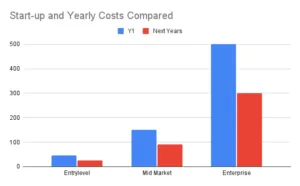
The ranges below are bands, not a quote. Year 1 includes design and implementation, so it sits above the years after.
- Entry level (startups, scale-ups and small businesses): year 1 €20–70k, later years €10–40k.
- Mid-market (larger organizations, or a smaller one with a complex catalog or a complex organization): year 1 €50–250k, later years €30–150k.
- Enterprise (large organizations, large catalogs and deep organizational complexity): year 1 €200k–€1 million, later years €100k–€600k. The enterprise band is wide because it covers a local category leader and a multinational.
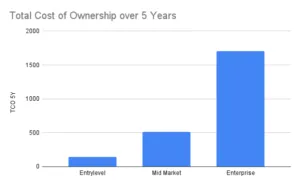
Over five years the bands look like this. Five years is a short horizon: in practice a PIM is often replaced after 5 to 10 years.
Which segment you are pricing
Solution partners on this site are tagged entry-level, mid-market or enterprise on the partner page. The tag is a budget signal, not a fit. Capterra's pricing guide compares list prices across products. A higher price usually means more features, including features you will not use, and features are not implemented to the same depth everywhere.
What drives PIM cost
The drivers behind "it depends" collapse into three: complexity, quantity and IT readiness.
Complexity
Higher complexity raises both the implementation and the license. A lighter product often cannot meet the requirement, so you leave the cheaper tier.
Product complexity:
- Calculated attributes, attribute transformations, or a required structure such as ETIM
- Large hierarchies and categories that overlap
- Relationships that depend on attributes: several upsells, sets or spare parts per product
- A lot of text, images, video and PDFs per product, in more than one language
These stack. A catalog with two of them is a different project from a catalog with all four.
Organizational complexity:
- Rigid processes mean more rework and more customization
- More input sources (suppliers, data pools, internal teams) mean more conflicts
- More output channels (marketplaces, syndicators, marketing feeds) mean more channel-specific mapping
- The same catalog across several business units, especially across countries, multiplies the rules
Quantity
More products, relations, assets and users cost more. Part of that is storage, bandwidth and servers. Part of it is keeping the application responsive at that size. Products with larger development budgets tend to handle a large catalog more smoothly, and they cost more.
Performance starts to separate the field above 100,000 products. Below that, the limit is usually the model and the process, not the server.
IT readiness
Complexity and quantity pick the product. IT readiness picks the design and implementation cost. Two questions sort it:
- Architecture. Is the rest of the architecture already in place, with the PIM as the missing piece? Or is the PIM part of a wider replacement, with or without a blueprint? Starting from a blank architecture is a lot of work before configuration starts.
- Knowledge. Are product creation, enrichment and output already defined? Are teams already working in a PIM, or do they need training before they can run one?
What the money pays for
The bands bundle three kinds of cost. Vendors and integrators quote them separately, so it helps to know which line you are looking at.
License or subscription
Most PIM vendors sell subscriptions, usually priced per year. The fee depends on the number of users, the deployment method (cloud or on-premise) and the functionality you need.
- A lightweight cloud PIM with limited user seats and functionality: about €5,000–€15,000 per year. That fits a company that is starting to centralize its product data or manages a limited catalog.
- A PIM for a larger enterprise with complex product hierarchies, several languages and integration needs: €50,000–€200,000 per year or more. That buys broader capabilities such as omnichannel publishing, advanced data validation, API access for real-time sync, and role-based permissions across departments and regions.
The trade-offs between cloud and on-premise are in on-premise versus SaaS.
Implementation
Implementation is the largest cost in the first years and can be up to half of total cost of ownership. It covers:
- Integration with existing systems such as ERP, ecommerce platforms, DAM or CRM
- Data migration, which usually means cleaning and structuring legacy data
- Customization for your own workflows and product types
- Training and onboarding for internal teams
Depending on the complexity of your product data and infrastructure, this ranges from a few thousand euros to well over €100,000. How the work is phased is in PIM implementation phases.
Ongoing cost
- Maintenance. Most vendors charge an annual maintenance fee of 15% to 25% of the license cost. It covers updates, bug fixes, performance work and compatibility with the rest of your stack. With SaaS, maintenance is already included in the subscription.
- Support. Basic support may be email during business hours. Premium tiers add 24/7 access to technical experts, a dedicated account manager and SLAs. Some vendors include support in the subscription; others charge separately, especially for enterprise tiers.
- Continuous improvement. As the catalog and the channel mix change, you add integrations (for example with marketplaces such as Amazon or Zalando), data quality rules and languages. That work usually runs through a PIM integrator or an internal IT team. Budget for it: often an additional 10–20% a year.
PIM ROI: what you get back
Return on investment compares what an investment returns with what it costs. For a PIM, that means putting a number on better product information, then putting a number on the project. Skip the formula until you have both.
Why the case grows with the catalog
Manufacturers and distributors are being asked for broader, more precise product information, including the same facts in several languages. The arithmetic gets away from you quickly. 10,000 products with 10 attributes in 1 language is 100,000 values. The same 10,000 products with 30 attributes in 3 languages is 900,000 values. Nine times the work, on paper, before anyone argues about quality. A PIM is how you keep that volume editable and still see the whole range.
The formula
Yield is extra turnover plus the time and cost you stop spending. Cost is the project.
ROI = (yield of the investment − cost of the investment) ÷ cost of the investment × 100%
More turnover
Count these if you can measure them, or estimate them from a baseline you trust:
- Better product information, available sooner, changes the conversion rate.
- Findability brings in customers who could not see the product before.
- Upsell and cross-sell have something reliable to point at.
- Resellers and data pools can be fed without a special project, which is additional turnover.
- Fewer returns where the cause was the content. A wrong record also costs the follow-on sale, because the customer tells someone else.
- Sales and back office spend less time answering basic product questions, and more time selling.
For example, if you estimate that those changes lift conversion by 15%, that lift goes into the yield. Extra channels add turnover on top, scaled by how many channels and products you actually connect. Estimate this from your own range and channels, not from a percentage on a vendor slide.
Time and cost you stop spending
- Maintenance time. The hours per week or month that go into adding products and keeping the current range accurate: attribute changes, expired items, languages and relationships between products. Values that are identical across languages no longer need a separate entry per language, so the number of fields you touch drops.
- Reuse. Every characteristic you adopt from the ERP, or from a supplier's digital delivery with its images, is input and checking time you do not spend. If one third of the characteristics fill themselves, the 900,000 values above become 600,000.
- Work around the record. Entering customer-specific information, translations (in time and in invoices), and product questions to sales or back office all take less handling.
- Publishing. The time it takes to keep the online range current, what a catalog costs in data maintenance, layout, checking and corrections, and the lead time for a correct delivery to a customer or a data pool.
- Errors and compliance. Returns, complaints, and fines or missed service standards that you can tie to wrong product data.
For each line the sum is the same: hours saved times the hourly wage, plus the direct cost that disappears.
The cost side
Spread the investment over about three years:
- The license or the subscription
- The supplier's design of the PIM
- Hardware or infrastructure changes
- The one-off input, import and conversion of product information
- User training
- Support and a maintenance contract (this drops out if your subscription already includes it)
- Financing cost, meaning interest
How to build the business case
The formula is the easy line. The hard part is that most companies have never measured what the current method costs. Build the case in this order.
Document how the work happens today
Record the hours spent adding and maintaining products, the errors and returns you can tie to product data, and the time a product takes to reach every channel. This baseline is what every later number is measured against.
List the improvements, new wishes and budget
Write down what has to change, what you want to add (channels, languages, markets) and what you can spend. This is also the input for the requirements of your selection.
Estimate the yield
Put a number on extra turnover and on the time and cost you stop spending, line by line, from your own range and channels.
Add up the cost over three years
License or subscription, design, infrastructure, data conversion, training, support and financing. Our cost calculator gives a first estimate per segment.
Calculate the ROI for systems that could fit
Run the formula on a system you have already decided might fit, not on the market in general. A payback claim without the inputs is not a calculation.
Track the result after go-live
Measure against the baseline from the first step, with the metrics below, so the next budget round starts from facts.
What to track after go-live
- Error rate. Data issues removed after implementation, and the returns, complaints and manual corrections that go with them.
- Time to market. How long a product takes to launch across all channels.
- Conversion rate. The effect of complete, consistent product information on sales.
- Return rate. Returns caused by wrong specifications, poor images or unclear descriptions.
- Hours on repetitive work. Time spent on product uploads, updates and reformatting per channel.
- Scalability. Whether the catalog can grow without a proportional increase in people. Without a PIM, adding 1,000 new SKUs might mean hiring staff or delaying launches.
Some of the return is indirect: teams that stop chasing data, departments that work from one record, and less risk in regulated sectors where wrong information has legal consequences. It is real, and it is awkward to put a number on. A PIM is only as effective as the processes behind it.
Related guides
- The benefits of a PIM: what the yield side of the ROI is made of.
- The PIM RFP guide: how to ask vendors for pricing you can compare.
- How to select the right PIM: the full selection method.
- ROI of PIM: a free brief on cost drivers, value levers and what boards want to see.
Where to go from here
Frequently asked questions
How much does a PIM cost?
As a band, not a quote: entry level runs about €20–70k in year 1 and €10–40k in later years, mid-market €50–250k and €30–150k, enterprise €200k–€1 million and €100k–€600k. Year 1 is higher because it includes design and implementation.
What drives the cost of a PIM?
Complexity of the products and the organization, the quantity of products, relations, assets, and users, and IT readiness. Complexity and quantity pick the product. IT readiness sets the design and implementation cost, which can be up to half of total cost of ownership.
What does a PIM implementation cost?
Implementation is the largest cost in the first years and can be up to half of total cost of ownership. It covers integrations, data migration, customization and training, and ranges from a few thousand euros to well over €100,000, depending on the complexity of your product data and infrastructure.
What are the ongoing costs of a PIM?
Most vendors charge annual maintenance of 15% to 25% of the license cost, except for SaaS, where maintenance is part of the subscription. On top come support and continuous improvement, often an additional 10–20% a year.
How do you calculate PIM return on investment?
ROI = (yield of the investment minus cost of the investment) divided by the cost, times 100%. Yield is extra turnover plus time and cost savings. Cost includes software, implementation, data conversion, training, and support, often spread over about three years.
How does a PIM increase turnover?
Better, faster product information can lift conversion, findability, upselling, and cross-selling. It also makes it easier to feed resellers and data pools, reduces returns caused by poor content, and frees sales teams from answering basic product questions.
What cost savings does a PIM typically create?
Savings come from less time adding and updating products, reuse of ERP and supplier data, fewer duplicate language entries, faster translations, and cheaper catalog or channel publishing. For each line, multiply the hours saved by the hourly wage and add the direct cost that disappears.
Why is PIM ROI harder to prove than it looks?
Many companies have not measured how much time and cost the current method already consumes. Start by documenting today's working method, then map improvement points and budget before you run the ROI calculation.
Diagnostic
Do you actually need a PIM?
Run the complexity index before you budget software or hire an SI.
Budget
Model a first-pass TCO
Translate catalog shape into a three-year cost range in under ten minutes.