
Core
Contentserv Alternatives: 10 PIM Solutions to Compare
Stephan Spijkers · 2025-04-21 · Updated 2026-10-12 · 11 min read
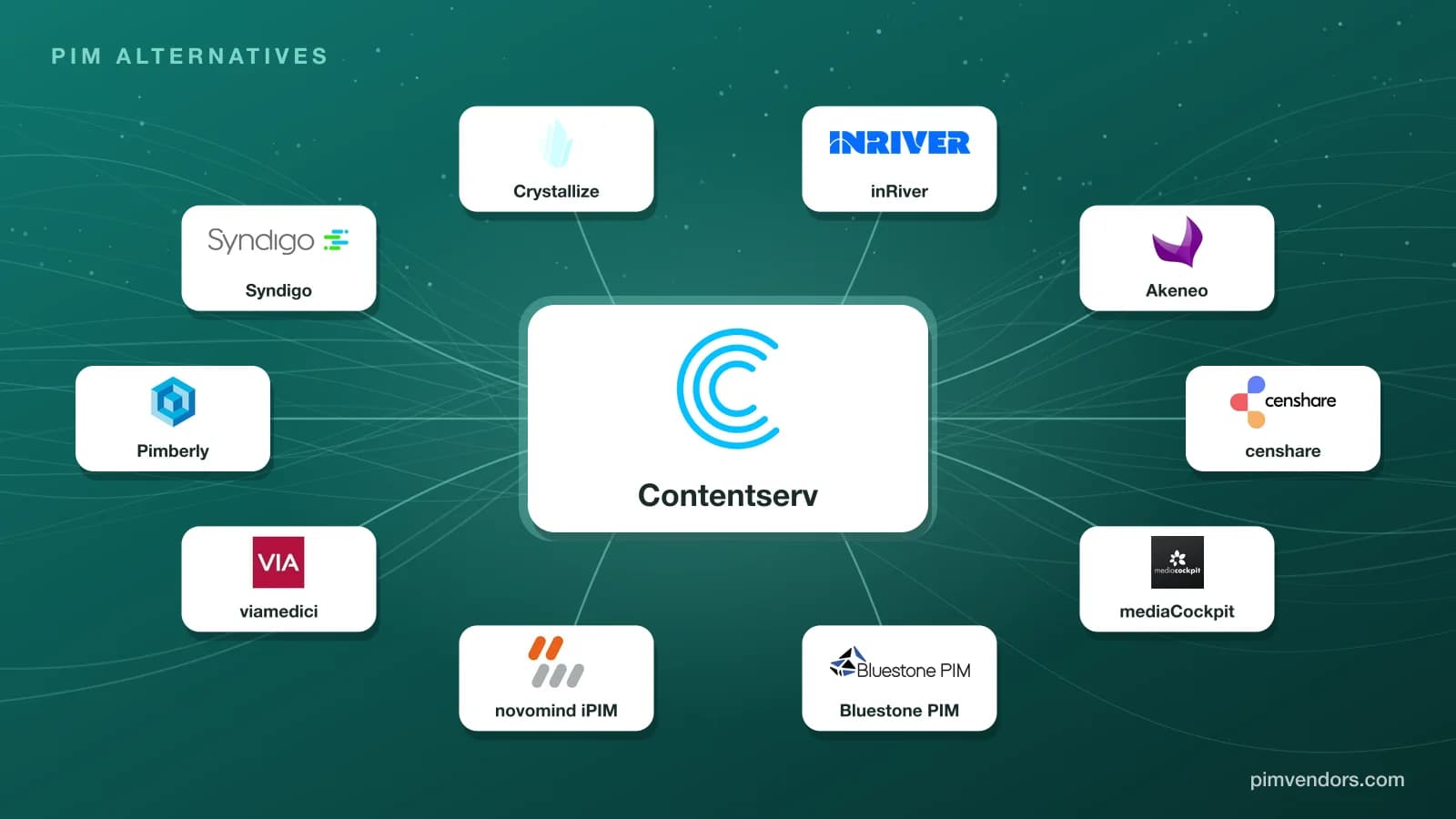
Contentserv has been on European PIM shortlists for years, mostly where product data and product media need to live in one system. Its change of owner is a natural moment to check whether it still fits: at a contract renewal, when the commerce stack changes, or when you want clarity on where the product is heading. This guide covers what Contentserv does, why teams look elsewhere, ten alternatives with the situation each one fits, and how to switch.
What Contentserv is and who it fits
Contentserv is a product information management suite that combines PIM, a native DAM, master data management for product data and product experience management (PXM). It runs as SaaS, cloud-hosted or on-premise, and the company lists its headquarters in Switzerland and Germany. Its core capabilities are:
- PIM, DAM and MDM in one platform: product data, media and master records for products.
- Data modelling and classification: multilingual hierarchies, technical attributes and standards such as ETIM, GS1 and eCl@ss. Treat classification or GS1 publication as a paid app or partner work unless a proof of concept shows a native path.
- Syndication: to commerce platforms, retailers, marketplaces and print catalogs.
- Workflows: roles, versions, approvals and dashboards for marketing, product and data teams.
- Rule-based content: product content adapted by market, language or customer segment.
Its best fit is with mid-market to enterprise manufacturers, brands and retailers in Europe that need PIM and DAM together, supplier onboarding with golden-record patterns for product data, industrial classification and high-volume marketplace and feed syndication. Its main strengths are the native DAM, supplier onboarding, a print path through an established publishing partner, a GDSN model for food and beverage, and a long European install base.
In February 2025 Centric Software, the PLM vendor owned by Dassault Systèmes, announced it would acquire Contentserv. The product is now sold as Centric PXM. For the same product under its new name, see our Centric PXM alternatives.
| System | What it owns | Who works in it | The question it answers |
|---|---|---|---|
| PIMProduct information managementPIM guide | Sellable product content: attributes, descriptions, asset links, translations and channel versions. | E-commerce, marketing, category and product content teams. | Is this product complete and ready to sell on this channel? |
| DAMDigital asset managementDAM guide | Files and media: images, video, documents, renditions and usage rights. | Brand, creative and marketing teams. | Where is the approved file, and where may we use it? |
| MDMMaster data managementMDM guide | Golden records across domains: customers, suppliers, locations and products, matched and governed. | Data governance, data stewards and IT. | Which version of this record is the true one, in every system? |
The answer sets your shortlist. If you use Contentserv for product data and media together, start with systems that have a native DAM. If you use it mainly for product data and feeds, the field is wider.
Why teams look for a Contentserv alternative
- The change of owner. This is the first watch-out: contracts now run with Centric PXM, so clarify the roadmap and support continuity before you renew. Teams that do not use Centric PLM get less out of the suite alignment.
- Master data beyond products. Contentserv is not a substitute for a domain-agnostic enterprise MDM for customer or finance data. If that is the need, you are comparing MDM platforms, not PIMs.
- Standards through partners or paid apps. ETIM, eCl@ss and GS1 publication may need a paid app or a partner. If those standards are daily work for you, compare systems that prove them in a demo.
- Connector scope and terms. Connector scope and commercial terms vary. When your ERP or commerce platform changes, that question opens again.
- Only part of the suite is in use. Paying for PIM, DAM and PXM while your team uses the PIM alone is reason enough to compare.
Contentserv alternatives at a glance










| Alternatives to Contentserv | Built for | Industry | Runs as | Founded | Go-live (estimate) |
|---|---|---|---|---|---|
| Today: Contentserv | Mid-market, Enterprise | Manufacturing, Retail | SaaS, Cloud-hosted, On-premise | 2000 | 20 weeks |
| inRiver | Mid-market, Enterprise | Manufacturing, Retail, Wholesale | SaaS, Cloud-hosted | 2007 | 20 weeks |
| Akeneo | Small business, Mid-market, Enterprise | Retail, Wholesale | SaaS, Open source, Cloud-hosted | 2013 | 16 weeks |
| censhare | Mid-market, Enterprise | Retail, Manufacturing | SaaS, Cloud-hosted, On-premise | 2001 | 20 weeks |
| mediacockpit | Mid-market, Enterprise | Manufacturing, Retail | SaaS, Cloud-hosted, On-premise | 1996 | 20 weeks |
| Bluestone PIM | Mid-market, Enterprise | Retail, Manufacturing | SaaS, Cloud-hosted | 2016 | 20 weeks |
| novomind iPIM | Mid-market, Enterprise | Retail, Wholesale | SaaS, Cloud-hosted, On-premise | 2000 | 20 weeks |
| Viamedici | Mid-market, Enterprise | Manufacturing, Wholesale | SaaS, Cloud-hosted, On-premise | 1999 | 20 weeks |
| Pimberly | Mid-market, Enterprise | Retail, Manufacturing | SaaS, Cloud-hosted | 2015 | 20 weeks |
| Syndigo | Mid-market, Enterprise | Retail, Manufacturing | SaaS, Cloud-hosted | 1973 | 20 weeks |
| Crystallize | Small business, Mid-market, Enterprise | Retail | SaaS, Cloud-hosted | 2017 | 16 weeks |
- Enterprise PIM with print and digital shelf analytics: inRiver
- API-first PIM with supplier onboarding and a DAM: Akeneo
- PIM, DAM and content management on one platform: censhare
- PIM, DAM and print publishing with ETIM and ECLASS: mediacockpit
- Composable, API-only PIM with a native DAM: Bluestone PIM
- Retail and wholesale supplier onboarding at scale: novomind iPIM
- SAP-centric manufacturers that want MDM, PIM, DAM and CPQ from one vendor: Viamedici
- Cloud PIM and DAM for retailers and brands: Pimberly
- Retailer network, validation and GDSN: Syndigo
- Headless PIM, content and commerce in one backend: Crystallize
The alternatives
inRiver
inRiver is a Swedish SaaS PIM on Microsoft Azure, founded in 2007, with an elastic data model for products, variants, bundles and components. It fits manufacturers, brands and wholesalers with complex catalogs and many channels and marketplaces. Print and PDF come from the same governed model as the digital channels, and digital shelf analytics sit inside the PIM. Compared with Contentserv, it is PIM-first, with syndication and analytics as its main story rather than a combined PIM and DAM suite.
Check: pricing is quote-only with indexed renewals, so model three to five years of cost. GS1, GDSN and ETIM are often partner extensions rather than native.
Akeneo
Akeneo is a French PIM, founded in 2013, sold as SaaS (Product Cloud); it is sunsetting its open-source Community Edition. It is built API-first, with completeness and quality tooling, supplier data onboarding and a DAM offered next to the PIM. It fits mid-market and enterprise brands, retailers and wholesalers that put multichannel product experience and a composable architecture first, which is close to the PXM job Contentserv does.
Check: it is not a substitute for multidomain MDM, and GS1, ETIM and digital product passport support need explicit proof in a proof of concept, often through a partner.
censhare
censhare is a German platform, founded in 2001, that brings PIM, DAM and content management together on a graph database, sold as SaaS, cloud-hosted or on-premise. It fits enterprises with multi-brand, multilingual content operations where product data, assets and marketing content are reused across markets. Its core stack is DAM, PIM and CMS, so its centre of gravity is content and assets, with product data as one part of the hub.
Check: a native engineering bill of materials or configurator is not documented, so confirm connector depth and standards requirements in shortlist demos.
mediacockpit
mediacockpit is a German PIM, DAM and publishing system by Bertsch Innovation, in business since 1996 and sold as SaaS, cloud-hosted or on-premise. It fits European mid-market and enterprise manufacturers, retailers and publishers that need PIM, DAM and print close together, with deep ETIM and ECLASS support and GDSN through a partner. For Contentserv users who depend on print catalogs and B2B classification, it covers similar ground with a stronger print focus.
Check: it is not a lightweight composable PIM, API documentation is gated, users describe the interface as dated, and marketplace syndication is narrower than in feed-first tools.
Bluestone PIM
Bluestone PIM is a Norwegian SaaS PIM built on microservices with an API-only, MACH-certified architecture. It fits mid-market and enterprise manufacturers, distributors and omnichannel retailers with large catalogs and complex variants and bundles. A native DAM module with a CDN keeps product media next to the product data, and AI tools help with enrichment and translation. It is the closer fit when you move to a composable commerce stack and want the PIM to be one service among others.
Check: evaluate deployment effort, proof of standards support and commercial transparency. It is a PIM, not a multidomain MDM.
novomind iPIM
novomind iPIM is a German enterprise PIM from a vendor founded in 2000, sold as SaaS, cloud-hosted or on-premise. Its best fit is with mid-sized to large European retailers, wholesalers and buying cooperatives that receive hundreds of supplier catalogs and need governed onboarding, BPMN workflows and optional print automation. It includes a native DAM and documented REST APIs. For Contentserv users whose main work is supplier onboarding in retail, it is the closer match.
Check: syndication and real-time publishing often assume novomind's own marketplace and shop products, and its GDSN certification is about receiving data, not replacing a data pool.
Viamedici
Viamedici is a German enterprise suite that combines PIM, multidomain MDM with a golden record and supplier portal, DAM, catalog publishing and a configurator (CPQ). It runs as SaaS, cloud-hosted or on-premise and is built around SAP integration. It fits SAP-centric manufacturers and industrial distributors with configurable products, multilingual print and digital catalogs, and ETIM or eCl@ss requirements. Where Contentserv covers master data for products, Viamedici also reaches into other domains.
Check: it is not a lean composable PIM, so expect suite complexity and integrator cost. Evidence for GDSN and GS1 retail syndication is thin, and its CatalogExpress module is partner middleware.
Pimberly
Pimberly is a UK cloud PIM and DAM built on AWS. It fits mid-market and enterprise retailers, brands and manufacturers with large multi-category catalogs that syndicate to websites, marketplaces and partners. Like Contentserv, it keeps product data and media in one platform, but only as SaaS.
Check: evaluate deployment effort, proof of standards support and commercial transparency. Ask for a reference with a catalog and channel mix like yours.
Syndigo
Syndigo is a US platform that combines PIM, MDM, DAM and content syndication with a large retailer network, and it is a certified GDSN data pool. It fits enterprise consumer goods, foodservice, health and beauty, hardlines and retail vendor-management teams where retailer compliance, GDSN and enhanced content drive revenue. For a Contentserv user, it replaces the syndication end of the suite more than the authoring end.
Check: authoring and composable commerce APIs are secondary to network compliance, and the content hub and the Riversand MDM are two integration surfaces, so plan an architecture review. More in our Syndigo comparison.
Crystallize
Crystallize is a Norwegian headless platform, founded in 2017, that combines PIM, content and commerce behind a GraphQL API, with subscription commerce built in. It fits digital-native direct-to-consumer and B2B commerce teams with engineering capacity that want one backend for product storytelling and custom storefronts. That is a different architecture from Contentserv: the PIM sits next to content and commerce, not upstream of every channel.
Check: it is not a pure PIM for ERP-centric catalog operations, and it has no native GDSN, ETIM or marketplace syndication, so budget a custom build or a feed tool for those.
How to choose and switch
List what Contentserv does for you today
PIM, DAM, supplier onboarding, feeds, print, workflows and any rules that adapt content per market. Note who uses which part and which integrations depend on it. This shows which alternatives replace all of it and which replace only part.
Write requirements and a shortlist
Turn the list into requirements, with your standards (ETIM, eCl@ss, GS1), channels and integrations named. Our PIM RFP guide helps. Pick three or four systems from the list above that match the job.
Demo with your own data
Give each vendor one real product family with its assets, one supplier file and two channels with different rules. Let the people who maintain the content score the work.
Migrate in slices with a parallel run
Move product data and assets one product family or channel at a time, and compare the output of both systems until it matches. Plan the asset migration as its own work package: renditions, rights and the links between assets and products all have to move.
Agree the contract and switch off last
Sign with the new vendor when the pilot works, and switch Contentserv off only when every feed, integration and print process runs from the new system.
Compare more PIM systems
Compare these and other systems in the PIM profile overview, or get a free shortlist based on your own requirements with the PIM Scan. Related guides:
- Centric PXM alternatives: the same product under its new name.
- What PXM stands for and DAM and PIM systems: the jobs Contentserv combines.
- Akeneo alternatives and inRiver alternatives: the other enterprise comparisons.
- How to select the right PIM: the full selection method.
Where to go from here
Frequently asked questions
What is Contentserv PIM?
Contentserv is a product information management suite that combines PIM, a native DAM, master data management for product data and product experience management (PXM). It is sold to mid-market and enterprise manufacturers, brands and retailers as SaaS, cloud-hosted or on-premise. Its headquarters are in Switzerland and Germany, and it is now owned by Centric Software and sold as Centric PXM.
Who owns Contentserv?
Centric Software, the PLM vendor owned by Dassault Systèmes, announced in February 2025 that it would acquire Contentserv. The product is now sold as Centric PXM, so contracts run with Centric. Ask about the roadmap, support continuity and how the PIM connects to Centric PLM.
What are the best alternatives to Contentserv?
It depends on the job. For an enterprise PIM, compare inRiver, Akeneo and Bluestone PIM. For PIM and DAM in one system, censhare, mediacockpit and Pimberly. For SAP-centric manufacturers, Viamedici. For retail supplier onboarding, novomind iPIM. For a retailer network and GDSN, Syndigo. For a headless commerce backend, Crystallize.
Is Contentserv a PIM, a DAM or an MDM?
Mainly a PIM with a native DAM and PXM features. Its master data story covers the product domain, such as supplier onboarding with golden-record patterns. It is not a substitute for a domain-agnostic enterprise MDM for customer or finance data.
Does Contentserv have an API?
Yes. Contentserv offers REST APIs and connectors for ERP systems such as SAP and Microsoft Dynamics and commerce platforms such as Magento and Salesforce Commerce Cloud. Connector scope and commercial terms vary, so confirm every connector you need during shortlisting.
Which Contentserv alternatives include a DAM?
censhare, mediacockpit and Pimberly combine PIM and DAM in one platform. Bluestone PIM has a native DAM module, Akeneo offers a DAM next to its PIM, and Viamedici and novomind iPIM include media asset management. Check rights, renditions and sharing if your DAM use goes beyond product images.
When is Contentserv still the right choice?
When you need PIM and DAM in one product, supplier onboarding for product data, industrial classification and high-volume feed syndication, and when alignment with Centric PLM is attractive. Its best fit is with mid-market to enterprise manufacturers, brands and retailers in Europe.
How do you migrate away from Contentserv?
List what you use (PIM, DAM, supplier onboarding, feeds, print), check the contract and notice dates, map and clean the data model, move assets and product data one product family or channel at a time with a parallel run, and switch Contentserv off only when every feed and integration runs from the new system.
Diagnostic
Do you actually need a PIM?
Run the complexity index before you budget software or hire an SI.
Budget
Model a first-pass TCO
Translate catalog shape into a three-year cost range in under ten minutes.