
Core
AI Does Not Clean Product Data for You
Nathalie · 2026-07-03 · Updated 2026-10-16 · 4 min read
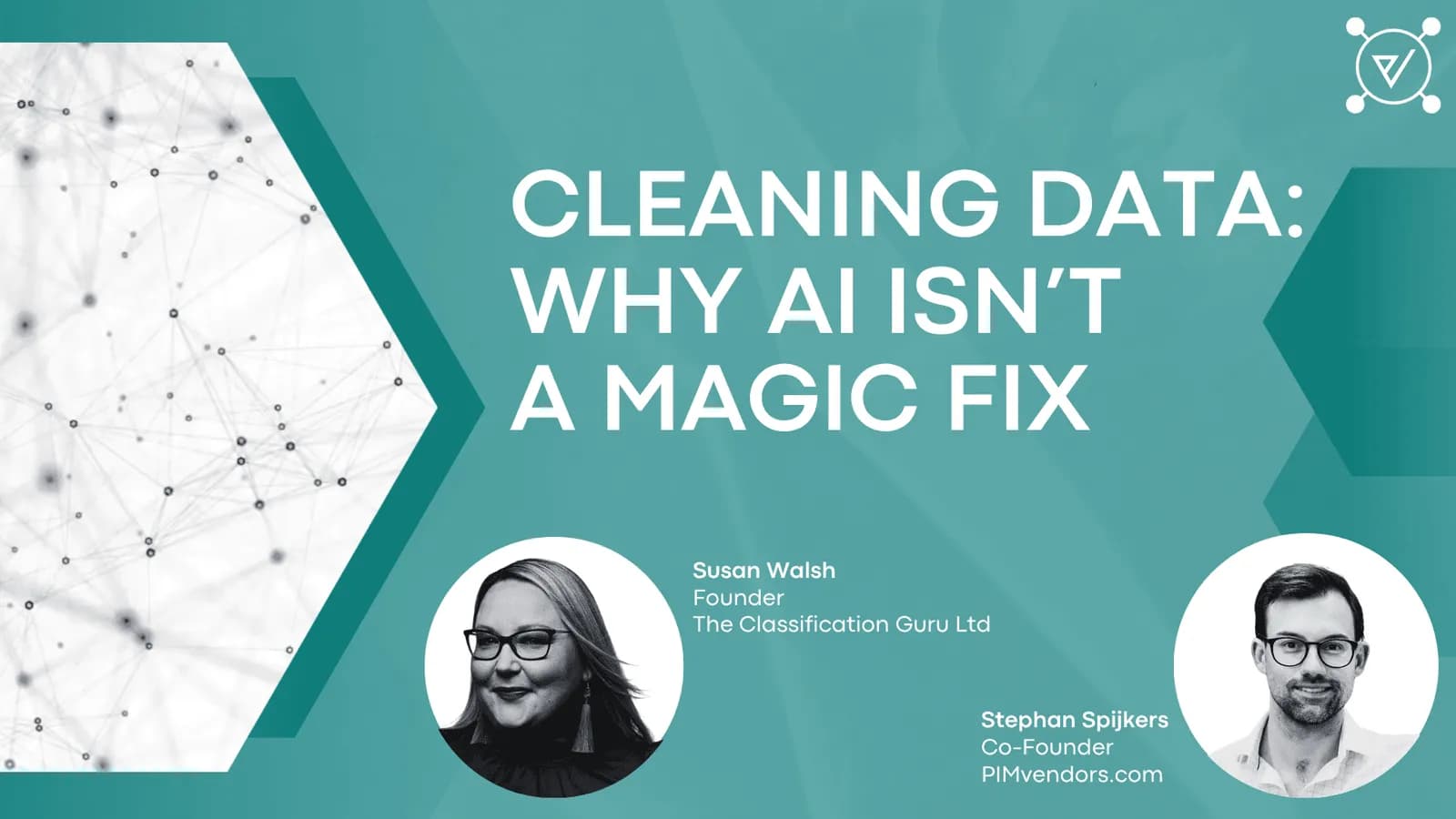
AI does not clean product data. It processes whatever file you hand it, and it does that faster than a person with a spreadsheet. If the names, units and supplier labels already disagree, the disagreement shows up in more systems, sooner. That was the point of a PIMvendors webinar with Susan Walsh, who works as the Classification Guru: where AI earns a place in product data work, where it makes a mess larger, and why the fix still runs through people who know the catalogue.
Speakers: Stephan Spijkers, co-founder of PIMvendors, and Susan Walsh, founder of The Classification Guru Ltd. The speaker note on this page lists nine years of classification and cleansing work for more than 100 clients, and two books on dirty data.
What the conversation established
Susan said her client workload has grown since teams started adopting AI, and she traces that to the tool. A model does not separate a clean row from a dirty one. It processes both. A company with inconsistent product names or mismatched units gets that inconsistency copied into every system that takes the output.
She rejects the idea of one model for every job. GPT, Claude and Google's models suit different tasks, and the right one depends on the data and the job. She uses AI to refine ideas and draft reports. She does not let it run unsupervised as an agent. In the session she pointed to Ford hiring roughly a thousand people back after an automation programme fell short.
Pattern matching is a weak stand-in for context. Her team built a module to normalize supplier names. It merged three unrelated businesses into one group: a hairdresser, a cleaning company and a law firm, all named Walsh. The model saw a repeated word and treated it as a match. On a sheet of a million rows, nobody spots that by eye.
Asked where she would spend a limited AI budget, she chose documentation over a one-time cleaning pass. Tools change every few years. Rules for how a value is entered, formatted and labelled still apply when the tool is gone. She said a cleaned file with no rules is dirty again within months.
Both speakers put AI on checkable work: spreadsheet formulas, lookups, pattern detection across large sets. It is weaker on classification that depends on someone who understands the business behind the row. Those calls stay with that person.
Her starting point for a team that has not begun is modest. Pull the product data into a pivot table, sort description against product code, and look at the inconsistencies a raw export hides. Fix by business impact. The easiest column is often the wrong one.
What that means for the file you already have
The Walsh merge is the argument in one row. A repeated token is not a shared identity. Point a model at supplier files, marketplace exports and the PIM at once, and you multiply that kind of join. Our piece on what AI inside a PIM actually does walks the same line from the product side: tagging, anomaly checks and generated text have a place, and they break when the underlying record is undefined. Data quality is the standard those features are being asked to hit: accurate, complete, consistent, and fit for the channel. A score from a model does not set that standard.
The mess usually arrives before the model does. Incomplete product data starts with the supplier file: the columns in the inbox are the intake, and a cleanup that ignores them writes the same errors back next month. The wider pattern is in the product data problem no one is fixing fast enough. Teams buy a faster pass over the file. Ownership of the file stays where it was.
What to do before you buy another tool
- Write the entry rules down. Naming, units, which supplier field wins, who may overwrite a value. That document outlasts the model.
- Point AI at checkable work. Lookups, duplicate detection, formula checks. Keep a person on the classification that changes a commercial claim.
- Start from a pivot, not a platform. One export, description against code, sorted. You will see the breaks a scrolling sheet hides.
- Fix the intake. If the supplier file is the source of the bad rows, cleaning the PIM and leaving the inbox alone spends the budget twice.
The trade-off: documentation is slower than a demo, and a pivot table looks modest next to an agent. Skip it, and the Walsh problem gets a second copy on every channel that trusted the output.
Diagnostic
Do you actually need a PIM?
Run the complexity index before you budget software or hire an SI.
Budget
Model a first-pass TCO
Translate catalog shape into a three-year cost range in under ten minutes.