
Core
Gredi Alternatives: 7 PIM Solutions to Compare
Stephan Spijkers · 2026-10-11 · 9 min read
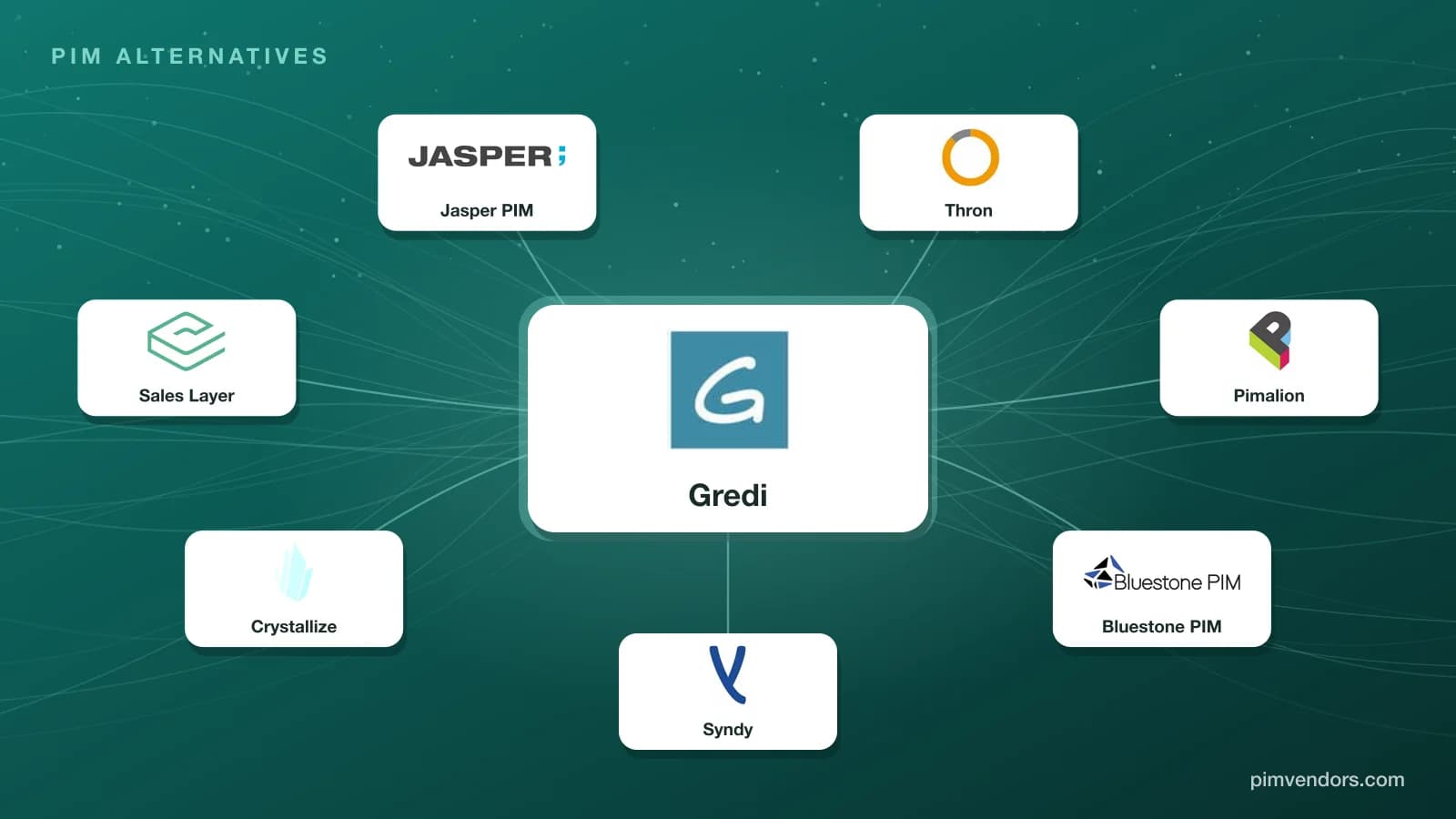
Gredi Content HUB is used by marketing, brand and sales teams to keep brand materials in one place and to produce materials without a designer. The question behind a search for Gredi alternatives is often which job you need done: a different DAM, or one system for product data and product media. This guide covers what Gredi does, why teams look elsewhere, seven alternatives, most of which combine PIM and DAM, and how to switch.
What Gredi is and who it fits
According to our Gredi profile, Gredi Content HUB is a Finnish DAM and brand management platform developed by Gredi Oy, in business since 1997. It is sold as SaaS, active in the Nordics, and aimed at small and mid-sized organisations. The profile describes:
- Asset management: images, documents, videos and brand materials in one repository, through their lifecycle.
- Template-based production: users create personalised materials for several channels without design skills.
- PIM integration: product information flows from a PIM into marketing materials.
- Search and metadata: AI-powered search and metadata management.
- Integrations: with e-commerce platforms, content management tools and other business systems.
Its users are marketing, brand and communication managers, sales teams and distributors who pick up current materials, and IT teams who connect it to PIM and e-commerce systems.
The profile does not give an analyst assessment for Gredi, so this guide lists no strengths or watch-outs beyond the profile's own description. Ask Gredi directly for references, its roadmap and support terms.
| System | What it owns | Who works in it | The question it answers |
|---|---|---|---|
| DAMDigital asset managementDAM guide | Files and media: images, video, documents, renditions and usage rights. | Brand, creative and marketing teams. | Where is the approved file, and where may we use it? |
| PIMProduct information managementPIM guide | Sellable product content: attributes, descriptions, asset links, translations and channel versions. | E-commerce, marketing, category and product content teams. | Is this product complete and ready to sell on this channel? |
Gredi does the DAM job and relies on a PIM for product data. The alternatives below either do both in one platform or are PIMs with a DAM for product media. Their profiles say less about brand guidelines and template production than Gredi's does, so decide first which job matters most to you.
Why teams look for a Gredi alternative
- One system for product data and product media. Gredi takes product data from a separate PIM. Teams that want both in one place, with one data model and one connection to the shop, look at combined PIM and DAM platforms.
- E-commerce and marketplaces become the main job. When content work moves from brand materials to product pages, feeds and marketplaces, a PIM with channel connectors takes the lead.
- Work beyond the Nordics. The profile lists Gredi as active in the Nordics. Companies with teams and partners in other regions check local support and partners.
- Growth beyond the mid-market. Gredi's profile targets small and mid-sized organisations. Larger, multi-brand organisations can compare platforms aimed at mid-sized to large companies.
Gredi alternatives at a glance
- DAM and PIM in one platform, with a brand portal: THRON
- PIM, DAM, brand portal and automated print: Pimalion
- Composable PIM with a native DAM, from Norway: Bluestone PIM
- PIM and DAM for product content that goes to retailers: Syndy
- Headless product, content and media backend, from Norway: Crystallize
- Marketer-friendly PIM with images and documents: Sales Layer
- PIM with a DAM on every plan, for Shopify and BigCommerce sellers: Jasper PIM
The alternatives
THRON
THRON is an integrated DAM and PIM platform, sold as SaaS, that keeps digital assets and product content in one environment. Its profile describes workflows for approvals, enrichment and publishing, delivery that adapts assets to each channel, AI tools for media and product content, and a brand portal for controlled sharing with partners, distributors and agencies. It targets mid-sized to large companies in manufacturing, retail, fashion, food and beverage and consumer goods. Of the seven, it is the closest to Gredi's job, with product data added.
Check: the profile does not give an analyst assessment, so ask for references with a size and region like yours, and ask whether it covers template-based production of marketing materials.
Pimalion
Pimalion is a Belgian platform, sold as SaaS or cloud-hosted, with modules for PIM, a DAM with rights, IPTC metadata and duplicate detection, a brand portal, and automated print publishing through InDesign and EasyCatalog, including POS materials. Our analyst calls it a strong fit when print, brochures and catalog publishing sit at the centre of the product content job. For a Gredi user, its print automation is the closest match to template-based production, built on structured product data.
Check: its architecture and licensing aim at mid-market and enterprise organisations with established marketing operations, and it is active in Europe, so check partners and support in the Nordics.
Bluestone PIM
Bluestone PIM is a Norwegian SaaS PIM with an API-only, MACH-certified architecture. Its native DAM module handles images, video, documents and 3D, with a CDN and a PDF generator, and it can also link to an external DAM. It fits mid-market and enterprise manufacturers, distributors and omnichannel retailers. For a Gredi user, it is the option when product data becomes the centre and product media should live with it, from a vendor in the Nordic region.
Check: it is a PIM, not a brand platform, so check how brand materials, templates and external sharing would work. Our analyst advises evaluating deployment effort, proof of standards support and commercial transparency.
Syndy
Syndy is a Dutch SaaS PIM, part of the Icecat Group, with an integrated PIM and DAM environment for product descriptions, specifications, images, 3D and 360-degree views, and video. It exchanges content directly with suppliers and maps exports to retailer formats. Its profile names brands, retailers and distributors in FMCG, DIY, toys and healthcare. For a Gredi user, it fits when most of the media you manage are product media that must reach retailers.
Check: the analyst note on the profile is short: evaluate deployment effort, proof of standards support and commercial transparency. Brand materials and template production are not part of its profile.
Crystallize
Crystallize is a Norwegian headless platform, founded in 2017, that combines product information, content and media with commerce behind a GraphQL API. It fits digital-native direct-to-consumer and B2B teams with developers that want product storytelling and custom storefronts from one backend. For a Gredi user, it is an option when brand content and product content should feed your own storefront.
Check: it needs engineering capacity, its profile does not describe template-based production for non-designers, and our analyst notes it is not a pure PIM for ERP-centric catalog operations.
Sales Layer
Sales Layer is a Spanish SaaS PIM, founded in 2013, for small and mid-sized manufacturers, brands, distributors and B2B suppliers. It keeps product information, images, documents and attributes in one cloud hub, with completeness scoring, collaborative workflows and connectors for Amazon, Shopify, Magento and other channels. Our analyst highlights its usability and onboarding. For a Gredi user, it fits when marketing teams take on product data and want a PIM that is easy to adopt.
Check: GS1 and GDSN are not native and need a partner at extra cost. Its asset handling is part of the product hub, so check whether it covers your brand assets or whether you keep a DAM next to it.
Jasper PIM
Jasper PIM is a SaaS PIM from Canada and the USA for e-commerce businesses, with connectors to Shopify, BigCommerce and marketplaces. A DAM for images, PDFs, video and CAD files is included on all plans, with advanced transformations on the enterprise tier. It fits sellers that want product data and product media in one tool for their online channels.
Check: our profile reads its DAM as operational, without enterprise depth in rights and metadata. Its base is North America, so check support and data hosting for your region. The analyst note is short: evaluate deployment effort, proof of standards support and commercial transparency.
How to choose and switch
Decide which job comes first
Brand DAM, product data, or both in one system. The answer decides whether you replace Gredi, add a PIM next to it, or move to a combined platform.
List assets, metadata, templates and integrations
How many assets, which metadata fields and usage rights, which templates people use, which external partners need access, and which PIM, shop and content systems are connected.
Write requirements and a shortlist
Turn the list into requirements. Our PIM RFP guide helps. Shortlist three or four systems from the list above.
Demo with your own assets
Give each vendor one product family with its images and documents, one brand template and one external partner who needs access. Let the marketing and sales people who use Gredi today score the work.
Migrate and switch off last
Move files with their metadata and rights, rebuild the templates, and switch Gredi off only when every team and partner works in the new system.
Compare more PIM systems
Compare these and other systems in the PIM profile overview, or get a free shortlist based on your own requirements with the PIM Scan. Related guides:
- DAM and PIM systems: what each one does and how they work together.
- What DAM stands for: the short definition.
- How to select the right PIM: the full selection method.
Where to go from here
Frequently asked questions
What is Gredi?
Gredi Content HUB is a Finnish digital asset management and brand management platform from Gredi Oy. It stores and shares images, documents, videos and brand materials, produces marketing materials from templates, and connects to PIM systems so product data flows into those materials. It is sold as SaaS and is active in the Nordics.
Is Gredi a PIM or a DAM?
A DAM and brand platform that integrates with PIM systems. It holds brand assets and produces marketing materials. The structured product record usually lives in a PIM next to it.
What are the best alternatives to Gredi?
For DAM and PIM in one platform, THRON, or Pimalion when print and a brand portal matter. For a PIM with a DAM for product media, Bluestone PIM, Syndy, Sales Layer and Jasper PIM. For a headless backend with product, content and media, Crystallize.
Do I need a PIM if I have Gredi?
If your product data lives in spreadsheets or the ERP and has to reach webshops, marketplaces and retailers, probably yes. Gredi is built to take product data from a PIM, not to replace one.
Which Gredi alternatives have a brand portal?
THRON's profile describes a brand portal for controlled sharing with partners, distributors and agencies, and Pimalion has a brand portal module. Ask the other vendors how external partners get access to approved assets.
Can a PIM replace template-based content production?
Partly. Pimalion automates print layouts in InDesign from product data. The other profiles in this list do not describe template-based production for non-designers, so ask each vendor to show it with one of your own templates.
Is there a Nordic alternative to Gredi?
Bluestone PIM and Crystallize are both Norwegian. Both are product data platforms with media handling, not brand DAMs, so check how brand materials and templates would work.
How do you switch from Gredi?
Decide which job comes first, list your assets, metadata, rights, templates, users and integrations, test the shortlist with your own assets, migrate files together with their metadata and rights, rebuild templates, and switch off only when every team and partner works in the new system.
Diagnostic
Do you actually need a PIM?
Run the complexity index before you budget software or hire an SI.
Budget
Model a first-pass TCO
Translate catalog shape into a three-year cost range in under ten minutes.