
Core
Oracle NetSuite PIM Alternatives: 7 PIM Solutions to Compare
Stephan Spijkers · 2026-10-11 · 8 min read
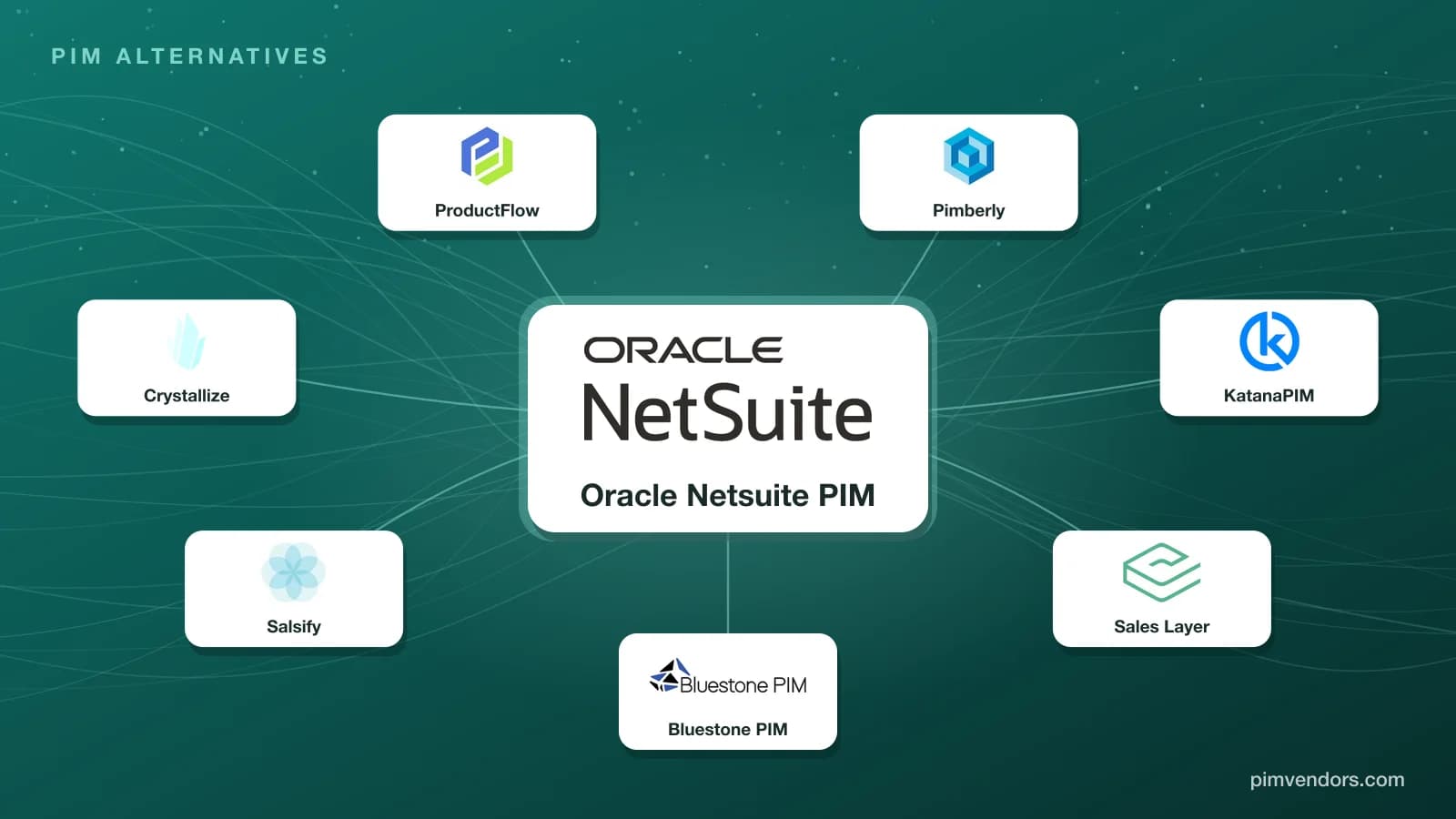
People who search for NetSuite PIM alternatives are rarely looking to leave NetSuite. They run the ERP and want to know whether its product data features are enough, or whether a dedicated PIM next to it would serve their channels better. This guide covers what NetSuite offers, when a dedicated PIM fits, and seven options with what to check for each.
What Oracle NetSuite PIM is and who it fits
Oracle NetSuite PIM is a product information management capability embedded in NetSuite, Oracle's cloud ERP, sold as SaaS. It consolidates product information and connects it with financials, inventory and order management, so product data and operational data sit in one platform.
It fits growing mid-market and enterprise businesses that already use NetSuite, or plan to, in retail, manufacturing, wholesale distribution and e-commerce. It is best suited to organizations that want to manage product information as part of a unified business system rather than in a standalone PIM.
Its separate PIM capabilities and its fit are not documented in detail, so treat the points below as questions to test, not verdicts.
| System | What it owns | Who works in it | The question it answers |
|---|---|---|---|
| ERPEnterprise resource planningERP guide | Transactions and operations: orders, stock, purchasing, pricing and finance. | Finance, supply chain, purchasing and sales operations. | What did we buy, make, sell, ship and invoice? |
| PIMProduct information managementPIM guide | Sellable product content: attributes, descriptions, asset links, translations and channel versions. | E-commerce, marketing, category and product content teams. | Is this product complete and ready to sell on this channel? |
Why teams look for an Oracle NetSuite PIM alternative
The choice is not NetSuite or a PIM. It is whether product content lives in the ERP or in a PIM connected to it. Our guide where ERP stops and PIM starts sets out the boundary. The usual signals for a dedicated PIM:
- More channels than one webshop. Marketplaces, retailers, distributors and print each want their own content and format.
- Rich content in several languages. Descriptions, media, manuals and country versions need room that ERPs rarely give them.
- Teams that enrich content every day. Marketing and e-commerce teams work faster in screens and workflows built for enrichment than in an ERP built for transactions.
- A preference for standalone tools. If you want to change your commerce or channel tools without touching the ERP, a separate PIM keeps those choices apart.
None of this says NetSuite is the wrong ERP. It says where its product data features stop being the right place for content.
Oracle NetSuite PIM alternatives at a glance








| Alternatives to Oracle Netsuite PIM | Built for | Industry | Runs as | Founded | Go-live (estimate) |
|---|---|---|---|---|---|
| Today: Oracle Netsuite PIM | Small business, Mid-market | Retail, Manufacturing | SaaS | 1998 | No estimate yet |
| Pimberly | Mid-market, Enterprise | Retail, Manufacturing | SaaS, Cloud-hosted | 2015 | 20 weeks |
| KatanaPIM | Small business, Mid-market, Enterprise | Retail, Wholesale | SaaS | 2017 | 16 weeks |
| Sales Layer | Small business, Mid-market, Enterprise | Manufacturing, Retail, Wholesale | SaaS | 2013 | 16 weeks |
| Bluestone PIM | Mid-market, Enterprise | Retail, Manufacturing | SaaS, Cloud-hosted | 2016 | 20 weeks |
| Salsify | Mid-market, Enterprise | Retail, Manufacturing | SaaS | 2012 | No estimate yet |
| Crystallize | Small business, Mid-market, Enterprise | Retail | SaaS, Cloud-hosted | 2017 | 16 weeks |
| ProductFlow | Small business, Mid-market | Retail | SaaS | 2019 | 8 weeks |
- A mid-market PIM and DAM with a vendor-listed NetSuite connector: Pimberly.
- Small and mid-sized merchants and wholesalers with published pricing: KatanaPIM.
- Fast onboarding for marketing and e-commerce teams: Sales Layer.
- A composable, API-first stack: Bluestone PIM.
- Brands that syndicate content to retailers: Salsify.
- A headless D2C or B2B commerce backend: Crystallize.
- Sellers who run mainly on marketplaces: ProductFlow.
The alternatives
The seven options are ordered by fit for a NetSuite customer adding a PIM. Fit and watch-out notes per vendor are on our vendor profiles.
Pimberly
Pimberly is a UK cloud PIM with integrated DAM, hosted on AWS, for mid-market and enterprise companies.
It is the only option on this page that lists NetSuite among its ERP connectors, next to SAP and Microsoft Dynamics. It fits retailers, brands and manufacturers with large catalogs, localized content and many channels, with connectors for Shopify Plus, BigCommerce, Adobe Commerce, Salesforce Commerce Cloud and marketplaces such as Amazon and eBay.
Check: the scope and terms of the NetSuite connector, which vary. Its fit is less well documented, so test deployment effort, standards proof and commercial transparency.
KatanaPIM
KatanaPIM is a Dutch SaaS PIM for small and mid-sized companies.
Its best fit is with mid-market merchants, wholesalers and distributors in Europe on Magento, Shopify or Shopware with an ERP such as Exact. Its strengths include published tier pricing with the API on all plans, practical import and mapping tools, workflows and specification groups.
Check: NetSuite is not among its documented connectors, so ask whether a connector exists or whether the link runs through the API or middleware. GS1, ETIM and GDSN run through partner middleware.
Sales Layer
Sales Layer is a Spanish SaaS PIM for small and mid-sized companies.
Its best fit is with mid-market manufacturers, brands, distributors and B2B suppliers that want a marketer-friendly PIM with Amazon, Google and Shopify connectivity, quality scoring and optional procurement punchout. Usability and onboarding are its main strengths.
Check: NetSuite is not among its documented connectors. Its API works with polling and rate limits rather than events, so test whether that sync frequency is enough for your stock and price updates. GS1 and GDSN are not native.
Bluestone PIM
Bluestone PIM is a Norwegian SaaS PIM built on microservices, with an API-only, MACH-certified architecture.
It fits growing mid-market and enterprise manufacturers, distributors and retailers that plan a composable stack around NetSuite, with complex variants, bundles and product families, native DAM and completeness scoring.
Check: test deployment effort, proof of standards support and the commercial terms. Ask for a reference with a NetSuite integration.
Salsify
Salsify is a product experience management platform that helps brands manage product content and syndicate it to retailers, distributors and digital channels.
Its focus is consumer goods brands and manufacturers that sell through many retailer channels and need content tuned per channel for the digital shelf. It fits a NetSuite brand whose main channel is its retailers' shops.
Check: its fit is less well documented. Ask how product data moves from NetSuite into Salsify, and for references from companies of your size.
Crystallize
Crystallize is a Norwegian headless platform that combines PIM, content and commerce behind a GraphQL API, for small and mid-market companies.
It fits digital-native D2C or B2B commerce teams that want one backend for product storytelling, subscriptions, multi-market pricing and custom storefronts, with developers in house. It publishes base pricing tiers.
Check: it is not a pure PIM for ERP-centric catalog operations unless you also adopt its commerce stack or add middleware. For a NetSuite user, that is the first question to answer.
ProductFlow
ProductFlow is a Dutch platform for marketplace sellers that combines listing content, offers, orders and repricing in one login.
Its best fit is with European merchants who sell mainly through marketplaces, especially bol.com, and its strengths include marketplace-native content screens, a broad connector library and a repricer.
Check: it also handles orders, so decide which system owns them. For a NetSuite user, orders should end up in NetSuite. It is not built for GDSN, ETIM or MDM programs, and its workflow and DAM depth is limited.
How to add a PIM next to NetSuite
Give each attribute one owner
Item numbers, prices, stock and purchasing data stay in NetSuite. Descriptions, media, translations, taxonomy and channel attributes move to the PIM. Write the split down before you talk to vendors.
List channels and requirements
Note every channel, language and file format you publish to, and who enriches content. The PIM RFP guide helps turn that into requirements.
Shortlist three and test the NetSuite link
Ask each vendor how items flow from NetSuite into the PIM and how orders flow back, who builds and maintains that link, and how often it syncs.
Demo with your own items
Give each vendor a product family with variants, images and two languages, and ask them to show it from NetSuite through to one of your channels.
Migrate content one category at a time
Move the enriched content for one category, publish it from the PIM, and check it against what the channel showed before.
Settle the contracts
Check what changes in your NetSuite licence and channel tools once the PIM is live, and time the PIM contract start to the integration work, not to the demo.
Compare more options
Compare these and other systems in the PIM profile overview, or get a free shortlist for your requirements with the PIM scan. If you are still deciding whether you need a PIM at all, read 10 signs your SMB needs a PIM system.
Where to go from here
Frequently asked questions
Does NetSuite have a PIM?
Yes. Oracle NetSuite offers product information management as a capability inside its cloud ERP, connected to financials, inventory and order management. It is not a separate product: it fits companies that want product data in the same system that runs the business.
Do I need a separate PIM if I use NetSuite?
Not by definition. The signals that you do are many products and variants, several channels or languages, rich media, and marketing and e-commerce teams that enrich content every day. In that case a dedicated PIM next to NetSuite usually fits better than stretching the ERP.
What are the best Oracle NetSuite PIM alternatives?
Pimberly, which lists NetSuite among its connectors. KatanaPIM and Sales Layer for small and mid-sized teams. Bluestone PIM for a composable stack. Salsify for brands that sell through retailers. Crystallize for a headless commerce backend. ProductFlow for sellers who run mainly on marketplaces.
Do I have to replace NetSuite to use another PIM?
No. A dedicated PIM runs next to NetSuite. NetSuite keeps item numbers, prices, stock, orders and the books. The PIM takes over descriptions, attributes, media, translations and the feeds to your channels, and orders flow back into NetSuite.
Which PIMs integrate with NetSuite?
Among the alternatives on this page, Pimberly names NetSuite among its ERP connectors. For the others, ask whether a connector exists, who maintains it, or whether the link runs through middleware or the API, and test it in a proof of concept.
Which NetSuite PIM alternative fits a small business?
KatanaPIM and Sales Layer target small and mid-sized companies with SaaS that is quick to start. KatanaPIM publishes its pricing tiers. Check the NetSuite connection for both, since NetSuite is not among the documented connectors of either.
What stays in NetSuite when you add a PIM?
The operational record: item numbers, prices, stock, purchasing, orders and finance. The PIM receives those items, enriches them with content and publishes them. Give every attribute one owner so the two systems do not keep competing copies.
Diagnostic
Do you actually need a PIM?
Run the complexity index before you budget software or hire an SI.
Budget
Model a first-pass TCO
Translate catalog shape into a three-year cost range in under ten minutes.