
Core
ProductFlow Alternatives: 7 PIM Solutions to Compare
Stephan Spijkers · 2026-10-11 · 8 min read
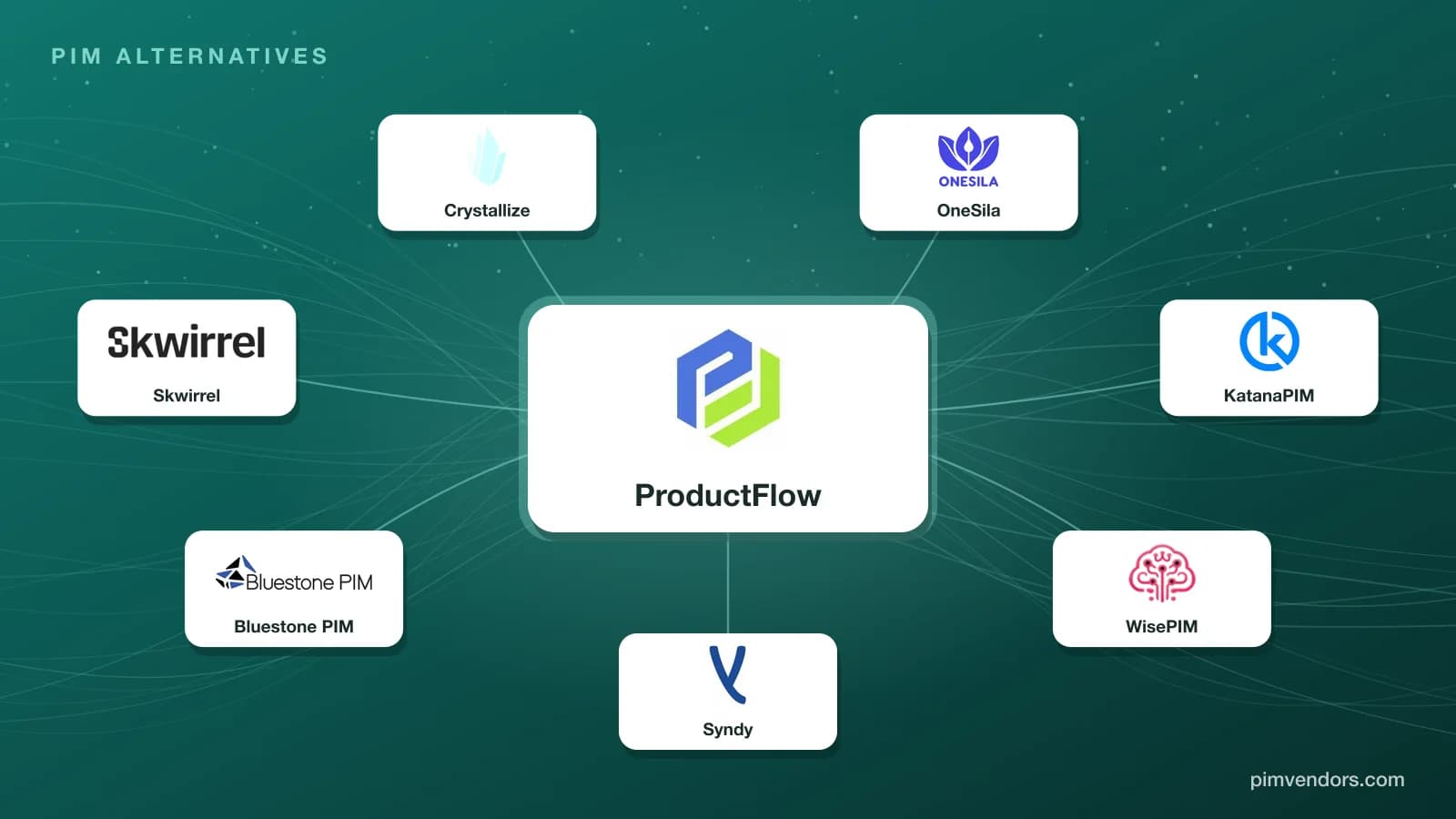
ProductFlow is built for sellers whose main channels are marketplaces. The question of an alternative usually comes up when the business grows past that: a webshop that becomes important, wholesale customers that ask for ETIM, or a catalog that needs approval steps. This guide covers what ProductFlow is, why teams look elsewhere, seven alternatives ordered by fit, and how to switch.
What ProductFlow is and who it fits
ProductFlow is a Dutch SaaS platform, founded in 2019, for SMB and mid-market sellers. It works content-first: you create and optimize product content inside each marketplace's environment instead of structuring all data centrally first. It connects to marketplaces such as bol, Amazon, Zalando, Blokker, Kaufland and Mirakl-based platforms, and combines listings with order and shipment management, feed management and automated pricing and stock updates.
Its best fit is with EU marketplace-led merchants, especially in the Netherlands and on bol, who want one login for listing content, offers, orders and repricing. That includes sellers without a webshop or ERP as the source of truth, and sellers who do not want a rule-only feed integrator. Strengths include a marketplace-native interface, bol Gold Partner status, a broad EU connector library, import tooling, a built-in repricer and an API.
Why teams look for a ProductFlow alternative
- One central record for more than marketplaces. Content-first works per marketplace. When a webshop, B2B portal, print or retailer feeds need the same structured record, a classic PIM fits better.
- Standards and compliance. ProductFlow is not a fit for GDSN, ETIM, digital product passport or MDM programs.
- Enterprise PIM depth. Workflows, DAM and golden record are weak. Teams with approval steps or many assets look elsewhere.
- Your own storefront becomes the main channel. ProductFlow suits sellers without a webshop as the source of truth. If you build one, your needs change.
ProductFlow alternatives at a glance








| Alternatives to ProductFlow | Built for | Industry | Runs as | Founded | Go-live (estimate) |
|---|---|---|---|---|---|
| Today: ProductFlow | Small business, Mid-market | Retail | SaaS | 2019 | 8 weeks |
| OneSila | Small business, Mid-market | Retail, Wholesale | SaaS | 2024 | 8 weeks |
| KatanaPIM | Small business, Mid-market, Enterprise | Retail, Wholesale | SaaS | 2017 | 16 weeks |
| WisePIM | Small business, Mid-market | Retail, Wholesale | SaaS | 2024 | 8 weeks |
| Syndy | Small business, Mid-market, Enterprise | Manufacturing, Retail | SaaS | 2010 | 16 weeks |
| Bluestone PIM | Mid-market, Enterprise | Retail, Manufacturing | SaaS, Cloud-hosted | 2016 | 20 weeks |
| Skwirrel | Small business, Mid-market | Wholesale, Manufacturing | SaaS | 2017 | 8 weeks |
| Crystallize | Small business, Mid-market, Enterprise | Retail | SaaS, Cloud-hosted | 2017 | 16 weeks |
- OneSila: best for marketplace listing readiness in a PIM with DAM.
- KatanaPIM: best for a central SaaS PIM with published pricing and marketplace export through integrators.
- WisePIM: best for AI enrichment and translation of large supplier feeds.
- Syndy: best for brands and retailers that syndicate content to retail partners.
- Bluestone PIM: best when you outgrow SMB tools and need workflows, a DAM and governance.
- Skwirrel: best for technical wholesalers and manufacturers that must deliver ETIM data.
- Crystallize: best for teams that build their own storefront on a headless backend.
The alternatives
Ordered by fit for typical ProductFlow buyers: marketplace and e-commerce PIMs first, other directions after.
OneSila
OneSila is a UK SaaS PIM and DAM, founded in 2024, for SMB and mid-market retailers, brands and distributors that sell across channels and countries.
- Where it differs: it is built around marketplace listing readiness: a rules engine, a product inspector, validation per channel, red and amber status and plain-language marketplace errors, with attribute sets and media per channel and AI translation. Order and shipment handling, which ProductFlow combines with listings, is not documented.
- Check: it is a young company, so ask for references and the roadmap. Its fit is less well documented, so ask for deployment effort, standards proof and commercial terms. Workflows are action-driven to-dos, not multi-stage approvals.
KatanaPIM
KatanaPIM is a Dutch SaaS PIM, founded in 2017, for SMB and mid-market merchants, wholesalers and distributors.
- Where it differs: a central product record with variants, specification groups and workflows, published tier pricing and the API on every plan. It fits Benelux and EU merchants on Magento, Shopify or Shopware with an ERP such as Exact, with marketplace export through integrators. That is the opposite of content-first: one record feeds every channel.
- Check: GS1, ETIM and GDSN run through partner middleware, and native AI is largely absent, so budget for it separately. Plan which tool sends listings to each marketplace.
WisePIM
WisePIM is a Dutch AI-assisted SaaS PIM, founded in 2024, for retailers, distributors and brands with large assortments and many supplier feeds.
- Where it differs: fast supplier feed onboarding, bulk editing, AI content generation and translation, quality rules per channel and preparation for webshops and marketplaces. It also imports ETIM releases and exports BMEcat, which ProductFlow does not cover.
- Check: it is a young company, so ask for references. Its fit is less well documented, and the vendor's AI accuracy claims have not been independently tested, so test enrichment on your own products.
Syndy
Syndy is a Dutch SaaS PIM and DAM, founded in 2010 and part of the Icecat Group, for brands, retailers and distributors in sectors such as FMCG, DIY, toys and healthcare.
- Where it differs: it is built around brand-to-retailer syndication, with supplier content exchange, retailer-specific export formats, content mapping and completeness scoring, rather than around marketplace seller operations.
- Check: its fit is less well documented, so ask for deployment effort, standards proof and commercial terms, and for the retailers and marketplaces it reaches for your channels.
Bluestone PIM
Bluestone PIM is a Norwegian SaaS PIM, founded in 2016, on a microservice, API-first architecture, for mid-market and enterprise manufacturers, distributors and omnichannel retailers.
- Where it differs: it offers the enterprise PIM depth where ProductFlow is weak: validation and completeness scoring, product families and bundles, a native DAM, governance through workflows, and AI tools for enrichment and translation.
- Check: ask for proof on deployment effort, standards support and commercial transparency. It is a bigger project than an SMB tool, and you may keep a marketplace tool next to it for listings and orders.
Skwirrel
Skwirrel is a Dutch SaaS PIM, founded in 2017, for SMB and mid-market technical wholesalers, distributors and manufacturers in the Benelux and DACH.
- Where it differs: it fits where ETIM classification and exchange through 2BA or a similar data pool are mandatory, with ERP and Magento or WooCommerce distribution. Strengths include ETIM depth, transparent entry pricing, an API with webhooks and a data-quality dashboard.
- Check: it is the wrong tool for Amazon or marketplace-first syndication and for GS1-led consumer goods, so it fits only if technical wholesale is where you are heading. Validate service levels with a small vendor.
Crystallize
Crystallize is a Norwegian headless commerce backend, founded in 2017, that combines PIM, content and commerce behind a GraphQL API.
- Where it differs: it suits direct-to-consumer and B2B teams that build their own storefront, with product storytelling, subscriptions and pricing per market in one backend. Base pricing tiers are published.
- Check: it has no native marketplace, GDSN or ETIM syndication, so you would keep a marketplace tool next to it. It needs engineering capacity.
How to choose and switch
List what runs where
Write down every channel and what ProductFlow does for it today: listings, offers, orders, shipments, returns or repricing.
Replace or add a PIM
Decide whether you replace ProductFlow, or add a PIM as the source of truth and keep ProductFlow for marketplace operations. The three ways to connect marketplaces help frame that choice.
Shortlist three and check connectors
Check each vendor's connectors for your exact marketplaces, ERP and webshop, and who maintains them: the vendor, a partner or an integrator.
Demo with your own data
Export one real category from ProductFlow, import it into each candidate and publish to one marketplace in a test environment.
Migrate per channel
Move one marketplace at a time, compare the listings until they match, and time the end of your subscription after the last channel moves.
Compare and shortlist
Compare these and other systems in the PIM profile overview, or get a free shortlist from the PIM Scan. For more on PIM and marketplaces, read 10 benefits of using a PIM for marketplaces.
Where to go from here
Frequently asked questions
What is ProductFlow?
ProductFlow is a Dutch SaaS platform, founded in 2019, that combines a content-first PIM with marketplace management. Sellers create and optimize listings per marketplace, such as bol, Amazon, Zalando and Kaufland, and handle offers, orders, shipments and repricing in the same login.
Is ProductFlow a PIM?
Yes, a content-first one: you optimize content inside each marketplace's structure instead of building one central data model first. Its enterprise PIM depth, such as workflows, DAM and a golden record, is weak. For marketplace-led sellers that may be all they need; for a central record that feeds every channel, a classic PIM fits better.
What are the best alternatives to ProductFlow?
For marketplace listing readiness, OneSila. For a Dutch SaaS PIM with published pricing, KatanaPIM. For AI enrichment of supplier feeds, WisePIM. For brand-to-retailer syndication, Syndy. For enterprise PIM depth, Bluestone PIM. For ETIM in technical wholesale, Skwirrel. For your own storefront, Crystallize.
When do you outgrow ProductFlow?
When the webshop, a B2B portal, print or retailer feeds need the same structured product record as the marketplaces, when you need approval workflows, a DAM or a golden record, or when a customer asks for GDSN, ETIM or a digital product passport. All three are outside ProductFlow's fit.
What is the difference between a marketplace tool and a PIM?
A marketplace tool is built around channels: listings, offers, orders and the rules of each marketplace. A PIM is built around your own product record, which it enriches, validates and publishes to every channel, marketplaces included. Many sellers need both, either in one product or as a PIM with a marketplace tool next to it.
Can you keep ProductFlow next to a PIM?
Yes, that is an option. A PIM holds the master record and ProductFlow handles listings, offers, orders and repricing. ProductFlow offers an API, webhooks and JSON or XML feeds for adjacent systems, so check how it imports from the PIM you choose.
Does ProductFlow support ETIM or GDSN?
ProductFlow is not a fit for GDSN, ETIM, digital product passport or MDM programs. For ETIM and 2BA in technical wholesale, look at Skwirrel. For GDSN you need a route to a data pool, and a native one is not documented for any system on this list, so ask every vendor how they connect.
Which ProductFlow alternative is closest for marketplace sellers?
OneSila is the closest: a PIM and DAM built around marketplace listing readiness, with validation per channel and plain-language marketplace errors. Check that it connects to the marketplaces you sell on, and note that order and shipment handling is not documented.
Diagnostic
Do you actually need a PIM?
Run the complexity index before you budget software or hire an SI.
Budget
Model a first-pass TCO
Translate catalog shape into a three-year cost range in under ten minutes.