
Core
Top 10 Salsify PIM Alternatives for Product Data
Stephan Spijkers · 2025-05-15 · Updated 2026-10-13 · 18 min read
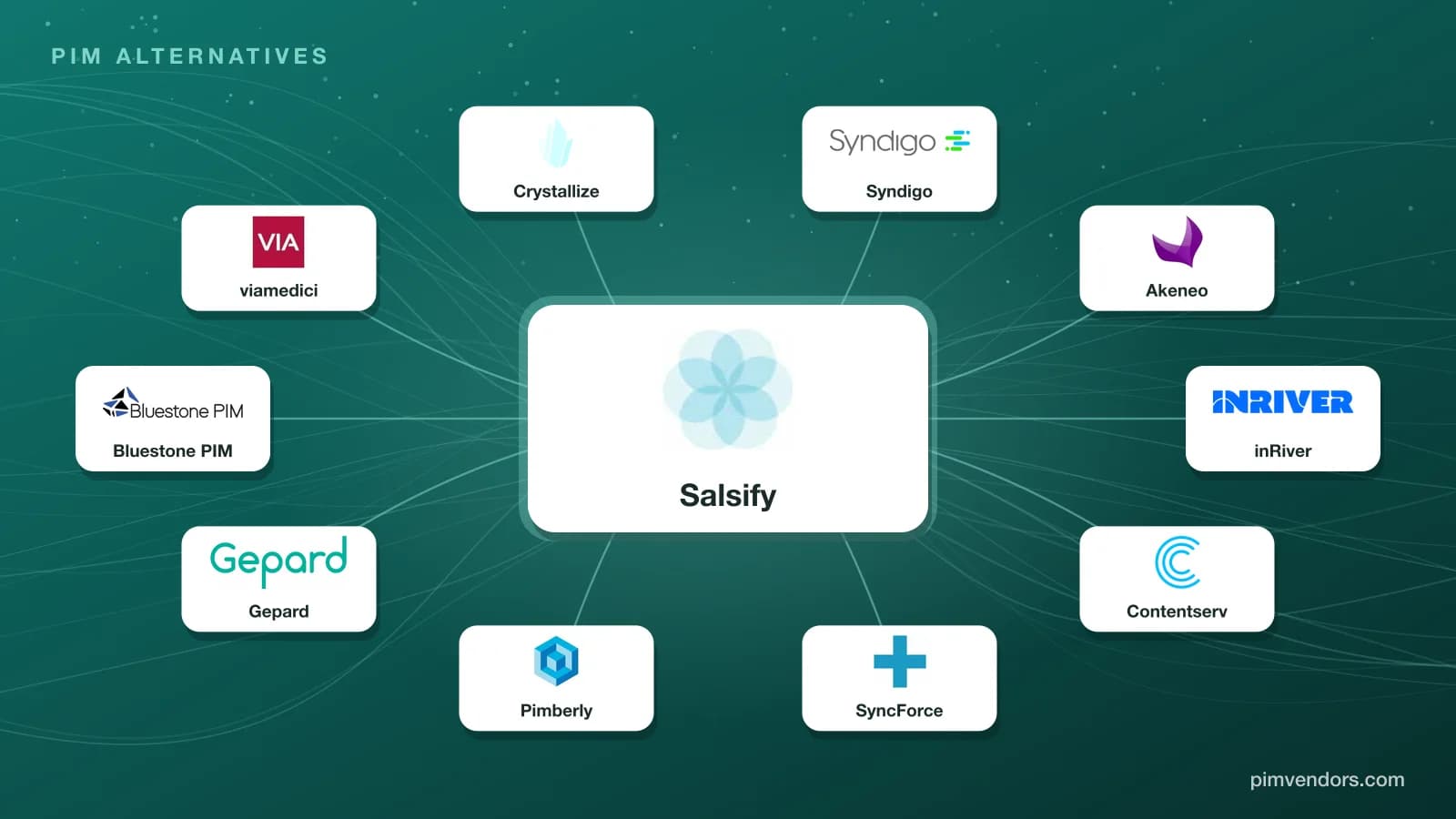
Salsify is on most shortlists where brands sell through large retailers, because its platform is built around getting product content into retailer and distributor channels in the shape each of them asks for. Teams that run it reopen the choice for ordinary reasons. A contract comes up for renewal, the company starts to sell more through its own webshop than through retailers, a new commerce stack changes what the product data has to feed, or the change of ownership announced in 2026 raises questions about pricing and roadmap. This guide explains what Salsify does and who it fits, why teams look for an alternative, ten alternatives ordered by how often they fit Salsify's buyers, and how to switch without losing a retailer feed along the way.
What Salsify is and who it fits
Salsify was founded in 2012 and is based in Boston. Its product experience management platform, ProductXM, lets brands and manufacturers centralize product data and rich media, then distribute it to retailers, distributors and digital channels. It primarily targets enterprise and mid-market consumer goods brands, manufacturers and retailers that sell through many retailer channels and need to syndicate content to a broad network of trading partners. It is proprietary software, sold as SaaS, so you do not host or upgrade it yourself.
In August 2026 the private equity firm Cinven agreed to acquire Salsify. Our article on the deal expects more investment in the product, together with the attention to pricing, packaging and upsell that private equity owners usually bring. Your contract stays in force when ownership changes, so the moment this matters is the next renewal, when module bundles and price lists may look different from the ones you signed.
Salsify's fit is less well documented, so if you are comparing it with the alternatives below, ask Salsify for references in your own sector and for the list of retailers and distributors it reaches for you today, with the way each one receives your content. That list tells you how much of the network you really use, and it is also the starting point for any switch.
Why teams look for a Salsify alternative
The most common reason is a mismatch between how the company sells and what Salsify is built for. Salsify is built around syndication to retailer networks. A direct-to-consumer brand, or a manufacturer that sells through its own webshop and a dealer network, gets less value from that network and needs a flexible product record more: a data model that handles its variants and attributes well, and content that feeds its own channels first. Think of a sports equipment brand that used to sell mainly through department stores and now makes most of its online revenue on its own site. Its priority shifts from meeting each retailer's template to running the best product pages itself.
A second reason is scope. Salsify covers product experience management, not master data for customers, suppliers or locations. When a company wants one governed record for products and suppliers, for example to stop maintaining supplier details in the ERP and the PIM at the same time, it ends up comparing MDM-class platforms rather than another product experience tool.
Deployment is the third reason. Salsify is sold as SaaS only, so teams that need on-premise or a private cloud, often because of internal IT policy or rules about where data may be stored, have to look elsewhere. The change of ownership is the fourth, and the most time-bound. A new owner can change the roadmap and the commercial terms, and a renewal under that owner is a natural moment to see what else the market offers, even for teams that end up staying.
Finally, some teams want a different integration model. In a composable commerce stack the PIM is often expected to be the API-first source that feeds the shop, the search, the marketplaces and the print output. If that is the architecture you are building, you compare Salsify with PIMs that are designed to sit at the center of that stack and feed every other system.
Salsify alternatives at a glance











| Alternatives to Salsify | Built for | Industry | Runs as | Founded | Go-live (estimate) |
|---|---|---|---|---|---|
| Today: Salsify | Mid-market, Enterprise | Retail, Manufacturing | SaaS | 2012 | No estimate yet |
| Syndigo | Mid-market, Enterprise | Retail, Manufacturing | SaaS, Cloud-hosted | 1973 | 20 weeks |
| Akeneo | Small business, Mid-market, Enterprise | Retail, Wholesale | SaaS, Open source, Cloud-hosted | 2013 | 16 weeks |
| inRiver | Mid-market, Enterprise | Manufacturing, Retail, Wholesale | SaaS, Cloud-hosted | 2007 | 20 weeks |
| Contentserv | Mid-market, Enterprise | Manufacturing, Retail | SaaS, Cloud-hosted, On-premise | 2000 | 20 weeks |
| SyncForce | Mid-market, Enterprise | Manufacturing | SaaS, Cloud-hosted | 1999 | 20 weeks |
| Pimberly | Mid-market, Enterprise | Retail, Manufacturing | SaaS, Cloud-hosted | 2015 | 20 weeks |
| Gepard | Mid-market, Enterprise | Retail, Wholesale | SaaS, Cloud-hosted | 2005 | 20 weeks |
| Bluestone PIM | Mid-market, Enterprise | Retail, Manufacturing | SaaS, Cloud-hosted | 2016 | 20 weeks |
| Viamedici | Mid-market, Enterprise | Manufacturing, Wholesale | SaaS, Cloud-hosted, On-premise | 1999 | 20 weeks |
| Crystallize | Small business, Mid-market, Enterprise | Retail | SaaS, Cloud-hosted | 2017 | 16 weeks |
The map above places Salsify and each alternative by the company size it is built for and by industry: retail, manufacturing or wholesale. Start in the row for your own industry to see which options sit close to Salsify and which ones take you somewhere else. The list below gives the main reason to put each one on a shortlist, in the same order as the detailed sections that follow.
- Syndigo is the closest like-for-like option, for enterprise brands where retailer compliance, GDSN and enhanced content drive revenue.
- Akeneo suits teams that want a PIM-first, API-first product record with quality tooling and supplier onboarding.
- inRiver fits complex catalogs with many channels, and brings print and digital shelf analytics into one PIM.
- Contentserv fits European manufacturers and brands that want PIM and DAM in one product.
- SyncForce fits packaged-goods manufacturers with packaging, regulatory and GS1 data pool needs.
- Pimberly fits retailers and brands that want PIM and DAM as SaaS with many commerce connectors.
- Gepard fits teams whose main pain is mapping and syndicating data to many retailer and marketplace endpoints.
- Bluestone PIM fits mid-market and enterprise teams that are building a composable commerce stack.
- Viamedici fits SAP-centric manufacturers that want MDM, PIM, DAM and configuration in one suite.
- Crystallize fits direct-to-consumer and B2B teams that build their own storefronts.
The alternatives
Each section below explains what the vendor is, where it fits compared with Salsify, and what to check before it goes on your shortlist. The fit and watch-out notes per vendor are on our vendor profiles; where a statement comes from another source, that source is linked.
Syndigo
Syndigo is a US platform that combines PIM, MDM and content syndication with a large retailer network, built through acquisitions such as Riversand and 1WorldSync. It is the closest like-for-like alternative to Salsify, because both are sold to brands whose content has to reach retailers in the format each retailer demands. Its best fit is with enterprise teams in consumer goods, foodservice, health and beauty, hardlines and retail vendor management, where retailer compliance, GDSN and enhanced product page content drive revenue.
Where Syndigo reaches further than Salsify is in scope around the content. It operates GDSN itself, and through Riversand it adds MDM for customer, vendor and location data. A food manufacturer that now pays for a data pool connection next to its content platform, and keeps vendor and location data in yet another system, could bring more of that under one vendor. Whether that is an advantage depends on how much of the extra scope you would really use.
The trade-off is that authoring and composable APIs are secondary to network compliance. If your team spends most of its day writing and enriching content, make that work part of the demo instead of judging the retailer connections alone. The content hub and the Riversand MDM are also two integration surfaces, so plan an architecture review that settles which system feeds which and how your ERP connects to both. More in our Syndigo vs competitors.
Akeneo
Akeneo is a French PIM, founded in 2013 and sold as SaaS (Product Cloud). It is sunsetting its open-source Community Edition, so today it is a SaaS choice. It fits mid-market and enterprise brands, retailers and wholesalers that put multichannel product experience, API-first architecture, enrichment productivity and supplier onboarding first.
The difference with Salsify is where each system starts. Salsify starts from the retailer network and works back to the content, while Akeneo starts from your own product record, with completeness and quality tooling, a supplier data product and a DAM, and treats each channel as an output of that record. That suits a brand with a broad assortment, several webshops of its own and a few marketplaces, where the hard work is keeping attributes complete and consistent across all of those channels.
Akeneo is not a multidomain MDM, so supplier or customer master data stays in another system. GS1 and ETIM support need proof in a proof of concept, often through a partner. If you send content to retailers that require GDSN today, ask which partner Akeneo would use, what that partner costs and how data passes between the two.
inRiver
inRiver is a Swedish SaaS PIM on Microsoft Azure, founded in 2007. It fits manufacturers, brands and wholesalers with complex catalogs and many channels and marketplaces. Syndication and digital shelf analytics are first-class features, which puts it closer to Salsify's territory than most PIMs.
What sets it apart is that print and PDF come from the same governed model as the digital channels, which few PIMs offer. A manufacturer that still sends a printed catalog to dealers and publishes data sheets as PDF can produce both from the same product data it sends to webshops and marketplaces. The alternative, a separate print tool fed by exports, means every product change has to be made twice or copied across, and the printed version is usually the one that falls behind.
Pricing is quote-only with indexed renewals, so model three to five years of cost before you set it against Salsify's renewal offer. GS1, GDSN and ETIM often run as partner extensions. If those standards matter to you, ask which partner provides them, and include that partner in both the demo and the cost model.
Contentserv
Contentserv is a European PIM and product experience vendor, founded in 2000 and sold as SaaS, cloud-hosted or on-premise. It fits mid-market and enterprise manufacturers, brands and retailers that want PIM and DAM in one product, supplier onboarding with golden-record patterns for product data, industrial classification and high-volume syndication, with a GDSN model for food and beverage. In February 2025 Centric Software announced it would acquire Contentserv.
Compared with Salsify, Contentserv puts as much weight on the supply side as on the channel side. Supplier onboarding with golden-record patterns helps a company that receives product information from many suppliers and has to merge it into one trusted record before anything is published. Industrial classification makes it relevant for manufacturers, and the GDSN model covers food and beverage companies that must publish through a data pool.
Two things need checking. The first is the roadmap and support continuity under Centric, so ask what changes for existing customers and which parts of the product will get investment. The second is scope: Contentserv does not replace a domain-agnostic MDM for customer or finance data.
SyncForce
SyncForce is a Dutch PIM for brand manufacturers, founded in 1999. It fits larger packaged-goods manufacturers in food, pet, home and personal care and building or DIY products, with complex trade hierarchies, frequent packaging and regulatory changes and GS1 data pool distribution in Europe.
Its model covers product, packaging and logistics data, with an evidenced GDSN connector and stage-gate proofing for new products. That brings it closer to the manufacturer's own product lifecycle than Salsify's retailer-facing content. When a detergent maker changes a pack size, for example, it has to update the trade item hierarchy, the logistics data and the label information, and send all of it through the data pool before retailers will list the new item. SyncForce is built for manufacturers whose workload looks like that, while Salsify is built around the content a retailer shows on its product pages.
The vendor itself says it is not for SMB, retail, fashion or automotive, and it is worth taking that at face value if you belong to one of those groups. Headless or composable buyers will hit read API and release constraints, which matters if you want the PIM to feed a custom storefront directly.
Pimberly
Pimberly is a UK cloud PIM and DAM, founded in 2015, for mid-market and enterprise retailers, manufacturers and brands. It is built for large multi-category catalogs, localized content for international e-commerce and syndication to websites, marketplaces and partners.
For a Salsify customer, the appeal is one SaaS platform for PIM and DAM that connects to the commerce platforms, ERPs and marketplaces you already use. It runs on AWS, and the vendor lists connectors for Shopify Plus, BigCommerce, Adobe Commerce, Salesforce Commerce Cloud, SAP, Microsoft Dynamics, NetSuite, Amazon, eBay and Google Shopping. A retailer that runs its own store on Shopify Plus, sells on Amazon and takes product data from NetSuite can check against that list whether its main systems are covered.
Pimberly's fit is less well documented, so evaluate it on deployment effort, proof of standards support and commercial transparency. Ask which retailer templates and GS1 connections it covers for you, because a connector to a commerce platform does not by itself meet a retailer's content requirements. Ask as well what each connector costs.
Gepard
Gepard is a European PIM and content syndication platform, in business since 2005. It fits mid-market and enterprise teams whose main pain is mapping supplier, ERP and content provider data and syndicating it to many retailer, marketplace and regulatory endpoints, including EU energy label feeds (EPREL) and ETIM flows.
That is a different starting point from Salsify. Gepard is at its strongest where data arrives from several sources in different shapes and has to leave again in many other shapes. An electronics distributor that combines manufacturer data with content provider feeds, and has to supply energy label data for the appliances it sells in the EU, has exactly that problem. It has a marketplace connector path through Mirakl and a free tier for small trials, so you can test the mapping work on a small scale before you commit.
Do API diligence before using it as a headless PIM, and ask for a proof of concept on GDSN, because those pages lean on marketing and services. In practice, ask to see a working GDSN publication with one of your own products before you count on it.
Bluestone PIM
Bluestone PIM is a Norwegian SaaS PIM, founded in 2016, built on a microservice, API-first architecture and MACH-certified. It fits mid-market and enterprise manufacturers, distributors and omnichannel retailers with large catalogs, several brands or markets and a composable commerce stack.
Unlike Salsify, it is built to be the product record that feeds the rest of your stack, with variants, bundles, validation, completeness scoring and workflows. A retailer that replaces its all-in-one webshop platform with separate services for storefront, search and checkout would use Bluestone as the service that holds and validates product data, and let each of the other services take what it needs through the API.
Evaluate deployment effort, proof of standards support and commercial terms. Bluestone is a PIM and does not come with a retailer network, so ask how you would reach retailers that require GDSN or their own templates. You may need a data pool subscription or a feed tool next to it, and that cost belongs in the comparison with Salsify.
Viamedici
Viamedici is a German vendor, founded in 1999, that sells MDM, PIM, DAM and product configuration (CPQ) as one enterprise suite, as SaaS, cloud-hosted or on-premise. It fits SAP-centric manufacturers and industrial distributors with configurable products, multi-language print and digital catalogs and governed master data outside SAP, especially in DACH and the EU with ETIM and ECLASS.
It answers a different question than Salsify: governance and SAP integration rather than retailer syndication. A manufacturer of configurable industrial equipment that publishes catalogs in several languages and keeps its material master in SAP needs product data that stays consistent with SAP and with the configurator, and a retailer network does little for that company.
It is not a lean composable PIM, so budget for suite complexity and integrator cost. Evidence for GDSN and GS1 retail syndication is thin, and CatalogExpress is partner middleware. If part of your business does sell through retailers, decide how that channel will be served before you commit.
Crystallize
Crystallize is a Norwegian headless commerce backend with PIM, founded in 2017, with a GraphQL API. It fits direct-to-consumer and B2B teams that want one composable backend for product content, subscriptions, multi-market pricing and their own storefronts, and that have engineers available.
It suits brands whose growth is moving from retailers to their own storefronts. Base pricing tiers are published, which makes a first budget estimate easier than with vendors that only quote. A coffee brand that started in supermarkets and now sells subscriptions on its own site in several countries is the kind of team it is built for, provided there are developers to build and maintain the storefront.
There is no native GDSN, ETIM or marketplace syndication, so budget a custom build or keep a separate tool for those channels. It is also not a pure PIM for setups where the PIM feeds every other system.
How to choose and switch
List your recipients and requirements
Write down every retailer, marketplace, distributor and data pool you send content to, how each one receives it (GDSN, retailer portal, API or feed), and which Salsify templates and rules you use for it. Add the domains you need beyond product, and your deployment requirements. Involve the people who maintain the feeds, because they know which recipients reject content and why.
Decide which job you are hiring for
The options are a retailer network, a PIM-first record, a composable commerce backend, or a PIM combined with a feed tool or a data pool subscription. Base the choice on the recipient list. If most of your revenue depends on retailers with strict templates and GDSN, a network platform is the logical replacement, and if most of it comes from your own channels, a PIM-first record is. Making this decision first narrows the shortlist far more than comparing feature lists.
Shortlist three and demo with your own data
Give each vendor one real product family, with rich media and two recipients that have different rules. Let the people who maintain product content score the authoring and validation work, using the same scorecard for every vendor. Ask each vendor to show what happens when a product fails a recipient's validation, because fixing rejected content is where your team will spend much of its time.
Plan the migration per recipient
Export product data, assets and channel mappings, rebuild the mappings in the new system, and run old and new in parallel for one recipient at a time until the output matches. Start with a recipient that matters but is forgiving, so the team learns the new system before it moves the retailers with the strictest rules.
Settle the contract
Check your Salsify renewal date and notice period, and model three to five years of subscription, connectors, data pool fees and services for the new system. Our PIM cost comparison gives ranges per segment. Include the parallel run in the budget as well, because for that period you pay for both systems.
Compare Salsify alternatives side by side
Compare these and other systems in the PIM profile overview, or answer a few questions in the free PIM Scan for a ranked shortlist based on your scale, sector and must-haves. The guides below cover the related topics in more depth.
- Syndigo vs competitors and Stibo alternatives: the other enterprise comparisons.
- What PXM stands for: product experience management, the category Salsify sells in.
- Data pools and syndication round table: practitioners on GDSN and syndication.
- How to select the right PIM: the full selection method.
Where to go from here
Frequently asked questions
What is Salsify?
Salsify is a product experience management platform, founded in 2012 and based in Boston. Brands and manufacturers use it to centralize product data and rich media and send that content to retailers, distributors and digital channels. It is sold as SaaS. In August 2026 the investment firm Cinven agreed to acquire Salsify.
Who are Salsify's main competitors?
For brands that sell through retailers, Syndigo is the closest like-for-like competitor. PIM-first vendors such as Akeneo, inRiver, Contentserv and Pimberly compete for the product record and channel syndication. SyncForce competes for packaged-goods manufacturers with GS1 and data pool needs, and Gepard for syndication to many endpoints.
What are the best Salsify alternatives?
It depends on why you are looking. For a retailer network and GDSN, compare Syndigo, SyncForce and Gepard. For a PIM-first product record with syndication, compare Akeneo, inRiver, Contentserv and Pimberly. For composable or direct-to-consumer stacks, look at Bluestone PIM and Crystallize. For SAP-centric manufacturers that need governed master data, Viamedici is the one to compare.
What is the difference between Salsify and Syndigo?
Both sell product content management and syndication to brands that sell through retailers. Syndigo also offers MDM through Riversand, operates a GDSN data pool and added the 1WorldSync network in 2025. Salsify is a product experience platform built around brand content and retailer connectivity. Compare them on the recipients you must reach and on the authoring work your own team does.
What does Cinven's acquisition of Salsify mean for customers?
Cinven, a private equity firm, agreed in August 2026 to acquire Salsify. Ownership changes do not change your contract on day one, but they can change the roadmap, packaging and pricing at renewal. Ask Salsify how it will handle your renewal and which modules it plans to invest in, and compare alternatives before your notice date.
Is Ergonode or Salsify the better fit for a mid-market team?
They solve different problems. Ergonode fits mid-market digital brands and retailers that want a usable enrichment interface, API and headless delivery, an included DAM and published pricing. Salsify is built around syndication to retailer networks. If retailer compliance is not your main pain, Ergonode is worth comparing.
Perfion or Salsify for a manufacturer that needs deep ERP integration?
Perfion fits manufacturers, distributors and wholesalers that have complex catalogs, a Microsoft Dynamics or SAP Business One footprint and print plus e-commerce needs. It is not a digital shelf or high-volume marketplace suite. Salsify fits brands whose main job is syndication to retailers. Test both on your own ERP data.
How do you switch from Salsify to another PIM?
List every recipient and template you use today, decide whether you need a network, a PIM or a PIM plus a feed tool, test three systems with your own product family, rebuild the channel mappings, run old and new in parallel per recipient, and switch off Salsify only after the last recipient runs from the new system.
Diagnostic
Do you actually need a PIM?
Run the complexity index before you budget software or hire an SI.
Budget
Model a first-pass TCO
Translate catalog shape into a three-year cost range in under ten minutes.