
Core
Stibo Alternatives: 6 PIM Options Worth Exploring
sites · 2025-04-22 · Updated 2026-10-13 · 13 min read
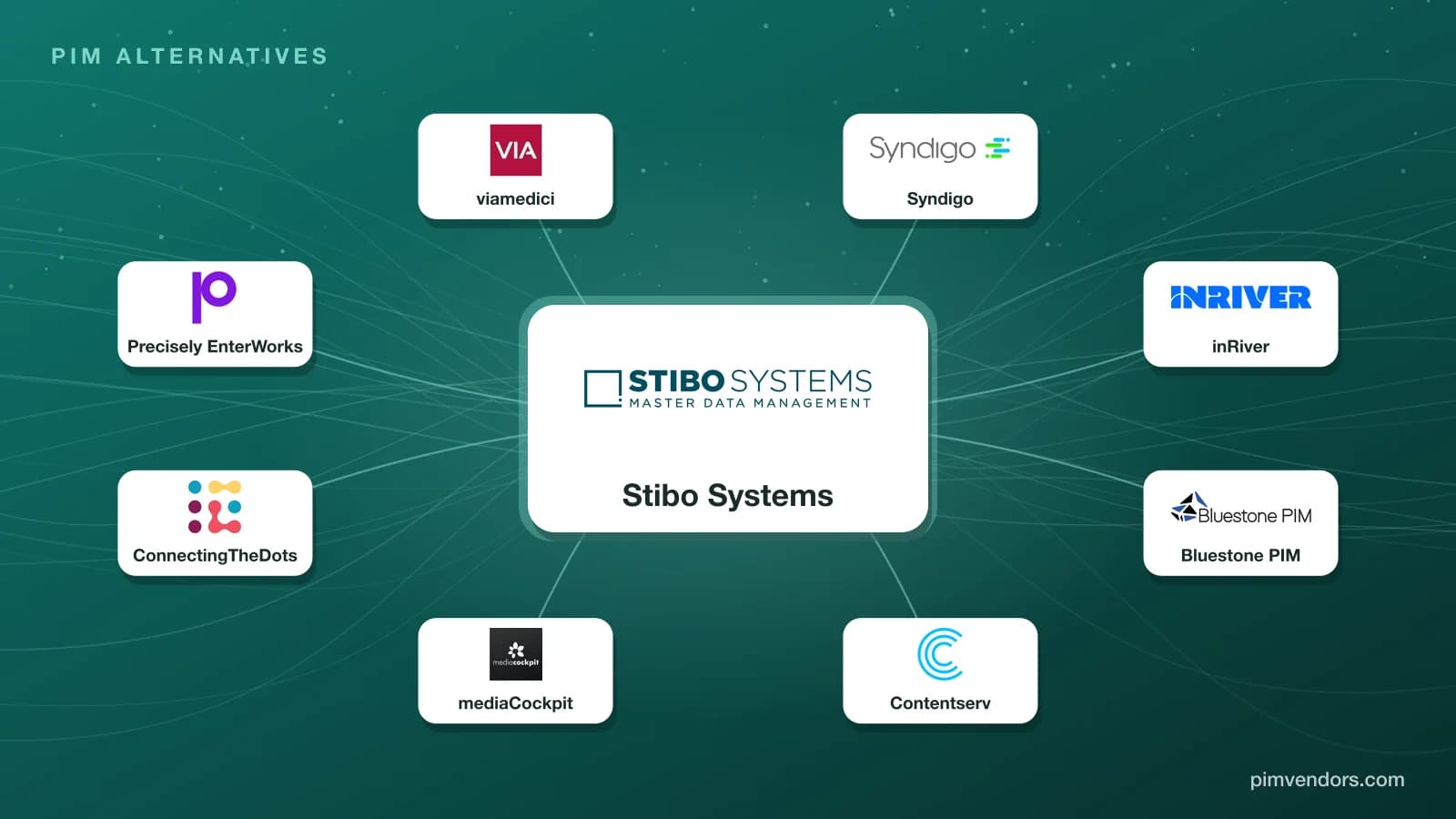
Stibo Systems has been on enterprise shortlists for master data and product information for a long time. Companies that run its STEP platform reopen the decision for familiar reasons: a contract renewal, a new commerce stack, a project that ran long, or a team that uses only part of what it pays for. Whether an alternative makes sense depends mostly on one question, which this guide answers first: does STEP manage master data across several domains for you, or mainly product content? After that it covers when STEP still fits, six alternatives grouped by the need behind the switch, and how to move off STEP if you decide to.
What Stibo Systems offers
Stibo Systems is a Danish software company, founded in 1976, that sells STEP to large enterprises in retail, manufacturing, healthcare, distribution and consumer goods. STEP runs as SaaS, cloud-hosted or on-premise. The platform covers five areas:
- Multidomain master data management, with product, customer, supplier and location data in one environment.
- Data governance and quality rules, with validation, completeness and traceability through built-in policies, so you can see who changed a record and under which rule.
- Workflows, with approval processes for creating and enriching product content.
- Global taxonomy management, with hierarchies and classification across markets and languages.
- Syndication, publishing to e-commerce, marketplaces, ERP systems and print, plus GDSN.
One caution applies to the first point: read multidomain as product-centric master data unless a proof of concept shows golden-record depth in the other domains. A platform can hold customer or supplier data without governing, matching and cleaning it as thoroughly as it does product data. Before you count a domain as covered, ask to see a customer or supplier golden record built from your own, imperfect data.
| System | What it owns | Who works in it | The question it answers |
|---|---|---|---|
| MDMMaster data managementMDM guide | Golden records across domains: customers, suppliers, locations and products, matched and governed. | Data governance, data stewards and IT. | Which version of this record is the true one, in every system? |
| PIMProduct information managementPIM guide | Sellable product content: attributes, descriptions, asset links, translations and channel versions. | E-commerce, marketing, category and product content teams. | Is this product complete and ready to sell on this channel? |
| ERPEnterprise resource planningERP guide | Transactions and operations: orders, stock, purchasing, pricing and finance. | Finance, supply chain, purchasing and sales operations. | What did we buy, make, sell, ship and invoice? |
That is the first question in any search for a Stibo alternative. If STEP does the MDM job for you, across several domains, you are replacing master data management, and the field of alternatives is small. If it mostly does the PIM job, the field is wide. A practical way to answer the question is to look at who uses STEP and for what. If finance, procurement or customer service rely on its customer or supplier records, the MDM job is real, and if the users are mostly product and e-commerce teams that enrich and publish product content, STEP is doing a PIM job and you are paying for an MDM platform to do it.
Is Stibo still the best choice?
When STEP still fits
STEP's best fit is with global enterprises that need a multidomain golden record and product governance, often with GDSN or retailer synchronization, complex hierarchies and a system architecture built around the ERP. Its strengths are multidomain MDM, governance, GDSN, enterprise scale and longevity. A consumer goods group that sells in many countries, synchronizes product data with retailers through GDSN and keeps supplier and location data under the same governance is the kind of company STEP is built for. If that describes your situation, the case for leaving has to come from something else, such as cost or a change in strategy, and replacing STEP then means replacing MDM as well.
When an alternative fits better
The clearest case is a job that is mainly lightweight enrichment. STEP can be the wrong tool when the work is mostly about giving a content team a usable interface for enriching product content. A platform built for enterprise governance asks for configuration, roles and workflows, and a small e-commerce team that only wants to write and publish product content may experience that as overhead.
Cost and duration are the main watch-outs for STEP. Enterprise MDM programs take time to design and roll out, and if the next phase of your roadmap does not justify such a program, a PIM may deliver what you need sooner. This conversation often follows a first project that ran long, when the business asks whether the next phase really needs the same scale.
A third case is a company where only the product domain is in use. Paying for multidomain MDM while running only product data is reason enough to reopen the decision, because a large part of what you pay for sits unused.
Finally, teams that move to a composable commerce stack often want an API-first SaaS PIM next to a headless shop, and they compare STEP with PIM-first systems built for that role. In that setup the PIM is one service among several, and how easily it connects to the others matters as much as what it can do on its own.
Six Stibo alternatives
The six options below are grouped by the need behind the switch, so start with the group that matches your situation. Within a group they are not ranked. Founding years, headquarters and the fit and watch-out notes come from each system's vendor profile.






| Alternatives to Stibo Systems | Built for | Industry | Runs as | Founded | Go-live (estimate) |
|---|---|---|---|---|---|
| Today: Stibo Systems | Enterprise | Retail, Manufacturing, Wholesale | SaaS, Cloud-hosted, On-premise | 1976 | 20 weeks |
| Syndigo | Mid-market, Enterprise | Retail, Manufacturing | SaaS, Cloud-hosted | 1973 | 20 weeks |
| inRiver | Mid-market, Enterprise | Manufacturing, Retail, Wholesale | SaaS, Cloud-hosted | 2007 | 20 weeks |
| Bluestone PIM | Mid-market, Enterprise | Retail, Manufacturing | SaaS, Cloud-hosted | 2016 | 20 weeks |
| Contentserv | Mid-market, Enterprise | Manufacturing, Retail | SaaS, Cloud-hosted, On-premise | 2000 | 20 weeks |
| mediacockpit | Mid-market, Enterprise | Manufacturing, Retail | SaaS, Cloud-hosted, On-premise | 1996 | 20 weeks |
| ConnectingTheDots | Mid-market, Enterprise | Retail, Wholesale | SaaS, Cloud-hosted | 2008 | 8 weeks |
The map above places STEP and each alternative by the company size it is built for and by industry: retail, manufacturing or wholesale. Read from the row for your own industry, it shows how far each option moves you from STEP's position, which is a useful first check before you read the groups below.
If you need MDM and a retailer network
This group is for companies that use STEP's MDM and GDSN capabilities and sell through retailers. They want to keep both, but in a platform with a stronger retailer network.
1. Syndigo
Syndigo is a US platform that combines PIM, MDM and content syndication with a large retailer network, built through acquisitions such as Riversand (MDM) and 1WorldSync. It fits enterprise consumer goods, foodservice, health and beauty, hardlines and retail vendor-management teams where retailer compliance, GDSN and enhanced content drive revenue.
Of the six options, it is the only one with MDM beyond the product domain, which makes it the natural comparison for a STEP customer that relies heavily on GDSN and retailer synchronization. STEP is one platform with governance at its core, while Syndigo starts from the recipients: the retailers and data pools your content has to reach. A food manufacturer whose main pressure comes from retailer requirements will find that emphasis closer to its daily problems.
Authoring and composable APIs are secondary to the network, and the content hub and Riversand MDM are two integration surfaces, so plan an architecture review. Coming from a single platform, check how your governance rules and workflows would be split across those two parts. More on the Syndigo profile and in our Syndigo vs competitors.
If you need an enterprise PIM
The three systems in this group take over STEP's product role. They suit companies whose STEP use is mainly product content, or that keep the other domains on an MDM platform and move product content to a dedicated PIM.
2. inRiver
inRiver is a Swedish SaaS PIM on Microsoft Azure, founded in 2007. It fits manufacturers, brands and wholesalers with complex catalogs and many channels and marketplaces, with print and PDF from the same governed model and digital shelf analytics inside the PIM.
For a STEP customer, inRiver offers a governed product model with print output and channel syndication, plus shelf analytics inside the PIM. It does not cover MDM for other domains, so customer, supplier or location data needs another home. A manufacturer that used STEP mainly to feed its webshops, marketplaces and printed catalogs from one product model would find that same pattern in inRiver.
Pricing is quote-only with indexed renewals, so model three to five years. GS1, GDSN and ETIM are often partner extensions, which matters if STEP handles your GDSN today. More on the inRiver profile.
3. Bluestone PIM
Bluestone PIM is a Norwegian SaaS PIM, founded in 2016, on a microservice, API-first architecture. It fits mid-market and enterprise retailers, manufacturers and distributors with a composable commerce stack.
It is the option for a company that is splitting its stack into separate services and wants the PIM to be one of them. A retailer that moves to a headless shop with separate search and checkout services can let each of them read product data from Bluestone through its API.
Evaluate deployment effort, proof of standards support and commercial terms. It is a PIM and does not cover multidomain MDM, so decide first where your non-product data will live. More on the Bluestone PIM profile.
4. Contentserv
Contentserv is a German PIM and product experience vendor, sold as SaaS, cloud-hosted or on-premise. In February 2025 Centric Software, the PLM vendor owned by Dassault Systèmes, announced it would acquire Contentserv.
It fits European manufacturers, brands and retailers that want PIM and DAM in one product, supplier onboarding with golden-record patterns for product data, industrial classification and high-volume syndication. The golden-record patterns give it a governance angle that a STEP customer will recognize, applied to the product domain. A manufacturer that receives component data from many suppliers and has to classify it before it can publish is a typical case. The on-premise option also matters for STEP customers that run their platform in their own data center today.
It does not replace a domain-agnostic MDM for customer or finance data. The roadmap now sits with Centric, so ask what that means for existing customers and for the parts of the product you would rely on. More on the Contentserv profile.
If you are mid-market
These two systems fit companies that are smaller than STEP's typical customer, or that use STEP only for product data and want a system sized for that job. Both give up the multidomain layer in exchange for a lighter setup.
5. mediacockpit
mediacockpit is a German PIM, DAM and publishing system, in business since 1996. It fits European mid-market and enterprise manufacturers and retailers that need PIM, DAM and print publishing close together, with deep ETIM and ECLASS support and GDSN through a partner.
That combination suits a manufacturer that still relies on printed catalogs and price lists next to its digital channels, and that has to classify technical products for wholesalers. A STEP customer that uses the print output and the classification features, but not the other domains, may find what it needs in this smaller system.
It is not a lightweight composable PIM, API documentation is gated and marketplace syndication is narrower than in feed-first tools. If marketplaces are a growing channel for you, test that part in the demo. More on the mediacockpit profile.
6. ConnectingTheDots
ConnectingTheDots is a Dutch SaaS PIM, founded in 2008. It fits mid-market and enterprise retailers, wholesalers and multi-brand e-commerce in the Benelux with messy supplier data, where automated supplier onboarding matters most.
Its strength is the inbound side: taking supplier data in many shapes and turning it into usable product content through automated onboarding. A Benelux wholesaler that uses STEP mainly to collect and clean supplier data before it reaches the webshop could do that job in a system built for it.
It is not an enterprise multidomain MDM, and GS1, GDSN and ETIM publication run through a partner. If you publish to data pools today, include that partner in the evaluation. More on the ConnectingTheDots profile.
How to move off Stibo STEP
Inventory what STEP does today
List the domains, data volumes, object types, workflows and approval steps, the GDSN connections, the integrations and the print processes, and who uses which part. This shows which parts of STEP carry the value for you. Talk to users outside the product team as well, such as procurement or customer service, because they are the ones who would notice if a domain disappeared.
Decide what stays MDM
Either keep the non-product domains on an MDM platform, STEP itself or another, and move only product content to a PIM, or replace the whole platform. This decision sets the shortlist: the first route opens up the PIMs in this guide, while the second limits you to MDM-class platforms. Keeping STEP for MDM and adding a PIM means two systems and an integration between them, so weigh that against the cost of keeping everything in STEP.
Map and clean the data model
Export the object types, attributes and hierarchies, retire what nobody uses, and agree the new model before the migration starts. Platforms that have run for years tend to collect attributes and object types that once served a project and were never removed, and migrating them only carries that weight into the new system. The PIM RFP guide helps turn the model into requirements.
Migrate in slices with a parallel run
Move one product family or one channel at a time, and compare the output of STEP and the new system until they match. Agree beforehand what counts as a match, for example the same attribute values and the same products in each feed, so the comparison stays objective.
Switch STEP off last
Switch STEP off only when every integration, feed, data pool connection and print process runs from the new system. Plan the end of the contract around that date, and keep an export of the STEP data for reference after the switch.
Related guides
- Best PIM software: the wider market overview.
- Basic principles of master data management: MDM, golden records and how they relate to PIM.
- Syndigo vs competitors and Salsify alternatives: the other enterprise comparisons.
- How to select the right PIM: the full selection method.
Where to go from here
Frequently asked questions
What is Stibo Systems STEP?
STEP is the master data management platform of Stibo Systems. It manages product, customer, supplier and location data in one environment, with PIM, data governance, workflows and GDSN for the product domain. Stibo Systems is a Danish company, founded in 1976, that sells STEP to large enterprises as SaaS, cloud-hosted or on-premise.
Is Stibo a PIM or an MDM?
Both. STEP is a multidomain MDM platform with PIM capabilities for the product domain. That is its strength for enterprises that need one governed record across domains, and its weakness when a team only needs product enrichment and publishing.
What are the best alternatives to Stibo Systems?
Six options cover most reasons to look elsewhere: Syndigo for MDM plus a retailer network, inRiver, Bluestone PIM and Contentserv for enterprise PIM, and mediacockpit and ConnectingTheDots for the mid-market. For a like-for-like multidomain MDM, also compare Precisely EnterWorks, Informatica and Viamedici.
When is Stibo still the right choice?
When you need a governed golden record across several domains, strict data governance, GDSN or retailer synchronization, complex hierarchies and integration with ERP-centric systems at enterprise scale. Replacing it then means replacing MDM as well as the PIM.
How does Stibo compare with Syndigo?
Both offer MDM beyond the product domain and GDSN. Syndigo adds MDM through Riversand on top of a large retailer network and enhanced content. STEP is one platform with governance at its core. Compare them on the recipients you must reach, the depth of governance you need and the number of integration surfaces.
How long does a Stibo STEP implementation take?
It depends on the domains, data volume and integrations in scope. Cost and duration are the main watch-outs for STEP. Ask for a reference with a similar scope and how long that project took, and plan the data model and the migration as separate work packages.
How do you migrate away from Stibo STEP?
Inventory what STEP does today, decide what stays in MDM and what moves to a PIM, map and clean the data model, migrate one product family or channel at a time with a parallel run, and switch STEP off only when every integration, feed and data pool connection runs from the new system.
Is there a mid-market alternative to Stibo?
Yes, if you use STEP only for product data. Mid-market PIMs such as mediacockpit and ConnectingTheDots cover product enrichment and publishing without the multidomain MDM layer. Check what you would lose: governance depth, GDSN and any non-product domains.
Diagnostic
Do you actually need a PIM?
Run the complexity index before you budget software or hire an SI.
Budget
Model a first-pass TCO
Translate catalog shape into a three-year cost range in under ten minutes.