


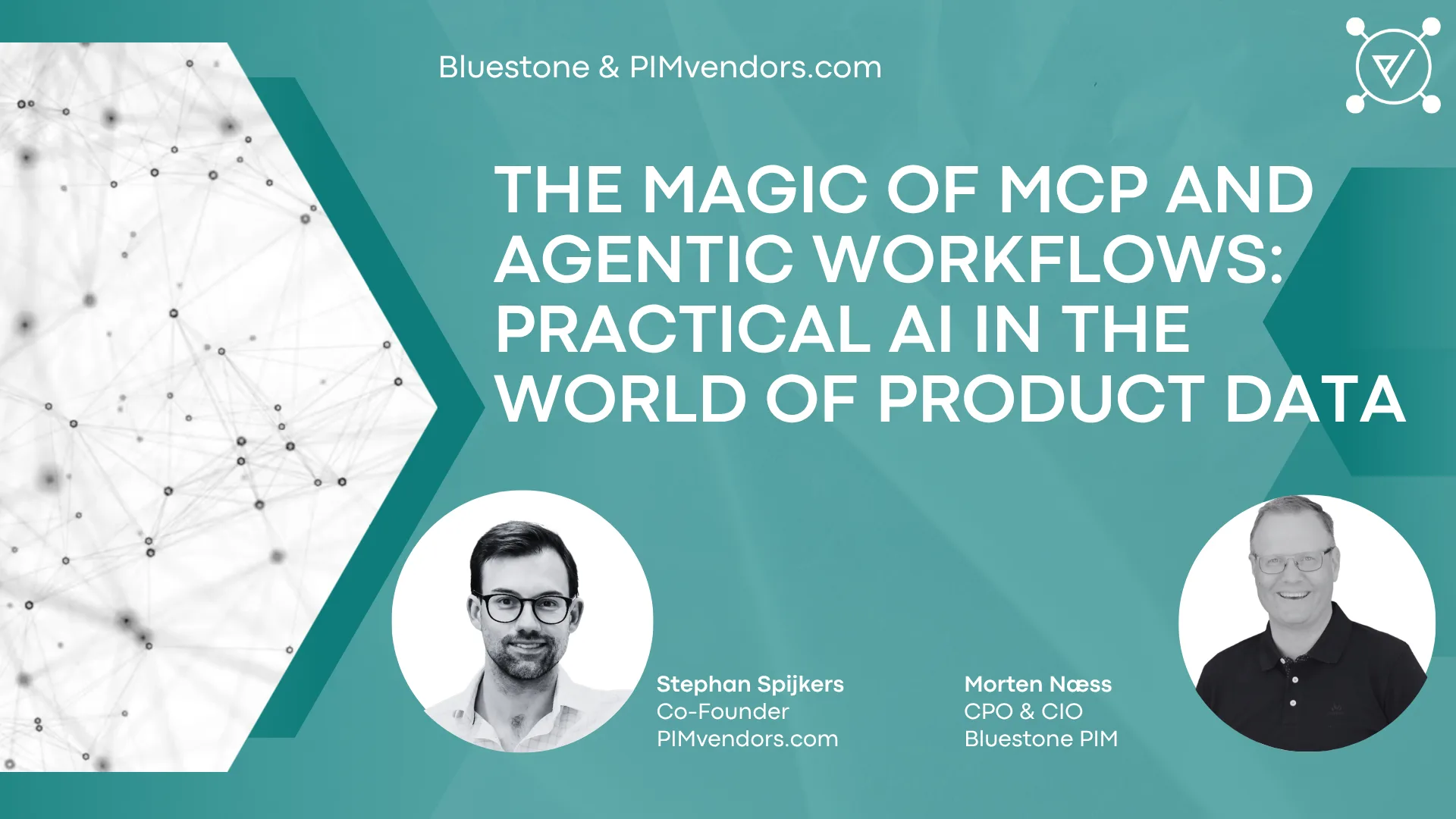
Agentic AI is not a future roadmap item for PIM teams — it is the current architectural decision that will determine which organizations remain visible in AI-mediated search and commerce, and which do not. In this PIMvendors.com webinar, Stephan Spijkers (Co-Founder, PIMvendors.com) sits down with Morten Næss (Chief Product & Innovation Officer, Bluestone PIM) to move past the buzzwords and into the practical reality of what agentic AI and MCP mean for product data teams building systems today.
The session covers four layers of AI readiness in PIM, the mechanics of why product data quality is now binary in AI-driven search, a live demonstration of Bluestone PIM’s MCP tooling, and a working example of a custom UI vibe-coded with Claude Code in a single afternoon — a capability that did not exist before Christmas.
Speakers:
Stephan Spijkers – Co-Founder, PIMvendors.com
Morten Næss – Chief Product & Innovation Officer, Bluestone PIM
Watch the Full Webinar:
Key Takeaways:
AI readiness in PIM operates across four distinct layers, and most organizations are only working on the first. The layers run from content enrichment and translation, through agentic workflows that operate inside the PIM system itself, through the API and MCP layer that surfaces product data to external agents, and finally to the IT architecture that determines whether any of that is possible at scale. Organizations investing heavily in layer one — better descriptions, faster translations — while ignoring layers three and four are optimizing for a workflow that agents will automate within two years anyway.
Agentic commerce makes product data quality binary. Human shoppers fill in gaps, tolerate missing attributes, and make charitable assumptions. Agents do not. An AI evaluating products for a buyer scores on completeness, structure, and relational context — and if a product does not meet the threshold, it is not surfaced at all. There is no page two in an agentic buying journey. Google’s AI overview now covers 100% of product searches, and the same ruthless filtering logic applies. Organizations that have not started closing their data quality gaps are already losing visibility they cannot yet measure.
MCP is the protocol that connects AI agents to PIM systems — and it changes the role of the UI. Model Context Protocol gives AI agents structured, permissioned access to PIM functionality without requiring a human to log in and operate the interface. Morten’s live demonstration shows Bluestone PIM’s MCP tools in action: an agent querying, enriching, and acting on product data directly. The practical implication is that the traditional PIM user interface becomes one access mode among many, not the primary one. PIM vendors that do not expose robust headless APIs and MCP tooling will find their systems sidelined as organizations build agentic workflows around them.
Vibe coding has collapsed the barrier between PIM data and custom user experience. Stephan built and deployed a functioning application over a long weekend using Claude Code, with no active coding experience for the prior fifteen years. Morten’s team built a custom product UI on top of Bluestone PIM’s headless API in an afternoon. Neither of these outcomes was realistic before the current generation of AI coding tools. The strategic implication for PIM buyers is direct: a composable, API-first PIM is now a prerequisite for teams that want to build channel-specific experiences, agent-facing interfaces, or custom workflows without waiting on vendor roadmaps or development sprints.
SaaS PIM is becoming a toolbox, not a destination. The session closes on a point that reframes the vendor selection conversation: organizations should evaluate PIM solutions not on the quality of their out-of-the-box UI, but on the quality of their API surface, their MCP tooling, and their governance model for data accessed by agents. The UI is temporary. The data layer and its accessibility are what compound over time. CPOs and CTOs who treat this cycle as a UX upgrade are solving the wrong problem.
The time to start is now, and the entry point is experimentation. Morten’s closing advice: start talking to Claude. If you tried AI tools four months ago and found them limited, try again today — the ecosystem is moving fast enough that the experience has changed materially. Stephan’s framing: build the tools for future you. The foundation being laid now, through headless APIs, MCP integrations, and agentic workflows, is what the next version of your organization will operate on. CPOs, CTOs, and CIOs who are not running their own experiments are not just behind — they are building their intuition on stale assumptions.
👉 Wondering whether your PIM architecture is ready for AI agents and the next wave of commerce?
Compare PIM solutions and book a call with our team:
