Signal
The Single Source Podcast EP 6: The Foundation of AI: Why Data Quality Is Non-Negotiable
Nathalie · 2026-04-22 · 3 min read
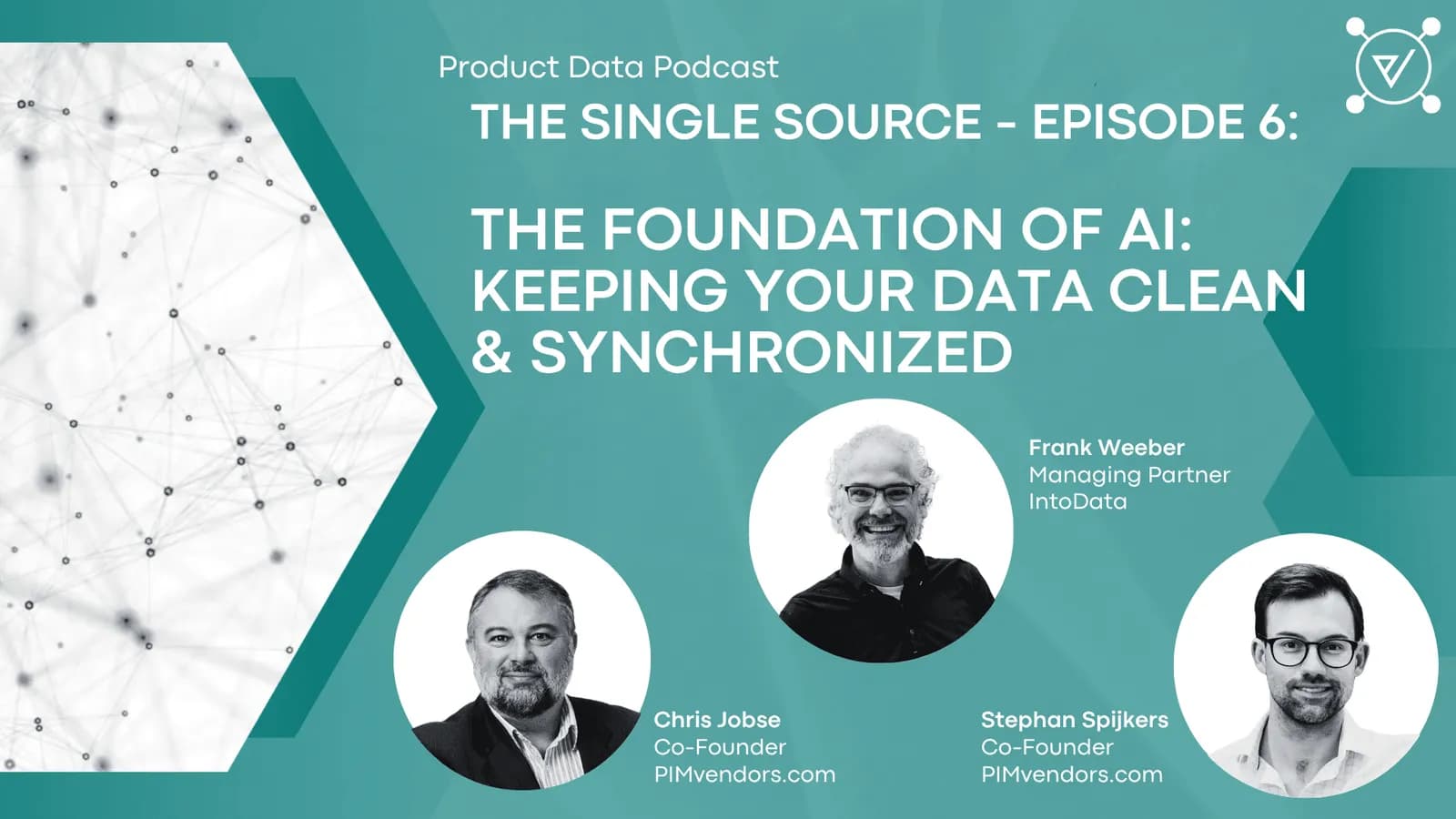
Every AI initiative eventually runs into the same wall: the data underneath it wasn't ready. In this episode of The Single Source Podcast, Stephan Spijkers and Chris Jobse from PIMvendors.com sit down with Helen Grimster, Director of Marketing at Syndigo, to address the conversation most organizations skip on their way to AI deployment - the actual state of their product data.
The discussion covers why data quality remains the defining constraint on AI performance, what it takes to establish real ownership across teams, and how to build the kind of data foundation that makes AI output reliable rather than risky.
Speakers:
Frank Weeber – Managing Partner, IntoData
Stephan Spijkers – Co-Founder, PIMvendors.com
Chris Jobse – Co-Founder, PIMvendors.com
Watch the Full Episode
The full session is available on the PIMvendors YouTube channel. If your organization is preparing a data foundation for AI - or trying to understand why current AI outputs are falling short - this episode covers the practical realities most vendor conversations skip.
Key Takeaways:
Data quality determines whether AI accelerates growth or amplifies existing problems. Deploying AI on top of incomplete, inconsistent, or ungoverned product data doesn't produce better outputs - it produces worse outputs at higher speed and scale. The quality of the foundation sets the ceiling on everything built above it.
Ownership is the hidden bottleneck. In most organizations, responsibility for data quality is fragmented across teams with no single accountable owner. That fragmentation is not a minor governance issue - it is the primary reason quality initiatives stall and data debt compounds over time.
AI hallucinations are frequently a data problem, not a model problem. When AI systems produce inaccurate or inconsistent outputs, the root cause is often the training and reference data fed into them. Investing in model sophistication before addressing data quality is the wrong sequence.
"Good data" requires a channel-specific definition. What passes as complete and accurate for an internal ERP system fails the standard required for e-commerce, marketplace syndication, or print. Organizations need explicit quality criteria per channel - a single universal definition is insufficient.
Managing multiple versions of truth demands clear governance. As product data flows across systems, suppliers, and channels, conflicting records accumulate. Establishing which source is authoritative - and enforcing that hierarchy - is a prerequisite for coherent AI integration.
Data quality is an operational process, not a one-time project. Organizations that treat data quality as a cleanup initiative will clean up the same data repeatedly. Sustainable quality requires embedded workflows, measurable standards, and ongoing accountability - not periodic remediation sprints.
Gamification and cross-functional collaboration are underused levers. Motivating teams to maintain quality at scale requires more than governance policies. Structured incentives and cross-departmental alignment consistently outperform top-down mandates in sustaining data quality over time.
👉 Not sure where your product data stands today? Compare PIM solutions and book a call with our team at pimvendors.com
Diagnostic
Do you actually need a PIM?
Run the complexity index before you budget software or hire an SI.
Budget
Model a first-pass TCO
Translate catalog shape into a three-year cost range in under ten minutes.