Core
Europe’s Packaging Rule Is a Data Problem, Too
stephan · 2026-04-23 · 11 min read
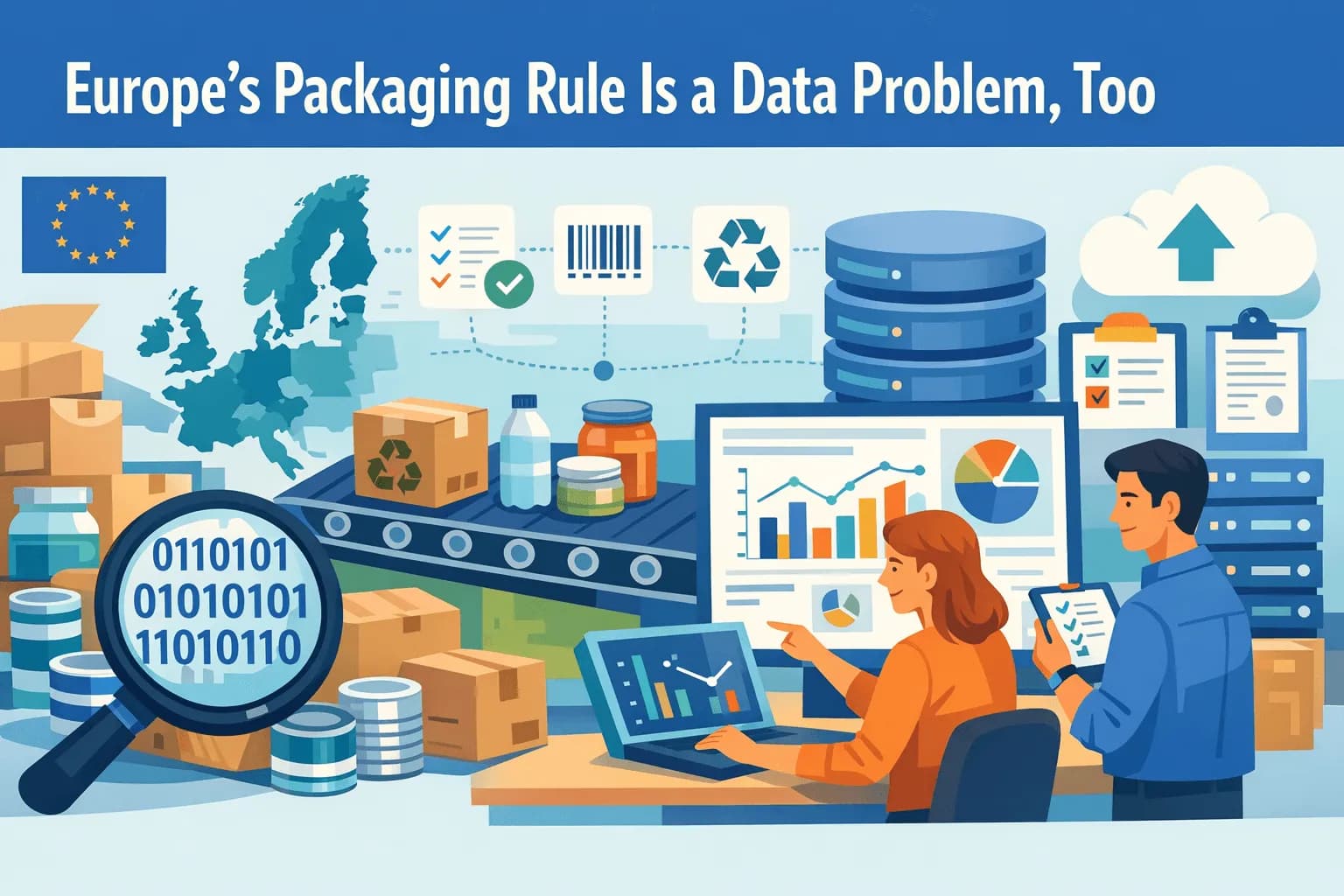
PPWR is here: Europe just made packaging data everyone’s problem
Europe’s new Packaging and Packaging Waste Regulation (PPWR) quietly crossed a line in early 2025: it stopped being a draft and became law. On paper, it’s about bottles, boxes, and plastic films. In practice, it’s about data, standards, and how every product record in Europe is going to get a lot more complicated - and a lot more important.
PPWR is being sold as a circular-economy milestone: less waste, more reuse, more recycling, fewer national loopholes. But under the hood, it’s effectively a massive, mandatory upgrade to how brands track, structure, and share product and packaging information. For PIM, DAM, and ERP vendors, this isn’t a side quest. It’s the next release cycle.
From directive to regulation: the era of “good enough” is over
To understand why PPWR feels like a break with the past, you have to look at the older rules it’s replacing or extending:
-
PPWD (Packaging and Packaging Waste Directive, 1994): the original framework that set recovery and recycling targets, but left each EU member state to decide how to implement them. Result: a patchwork of national systems and inconsistent data demands.
-
SUPD (Single-Use Plastics Directive): a more targeted strike on single-use plastics, especially beverage bottles, with specific reduction targets and recycled-content obligations.
PPWR does two important things:
-
It replaces the PPWD entirely with a regulation - meaning it’s directly applicable and harmonized across the EU, not interpreted 27 different ways.
-
It builds on SUPD without overriding it. SUPD remains lex specialis for its scope, but PPWR pulls in key elements like recycled-content targets and reporting obligations for plastic beverage bottles.
The upgrade from a directive to a regulation is not just a legal nuance. It means all brands and manufacturers selling into the EU will deal with effectively the same rules, data fields, and expectations, regardless of Member State. The era of “we’ll handle that locally” is ending. The era of “configure it once, roll it out everywhere” is beginning - if your systems can keep up.
What PPWR actually wants: circular packaging by design
PPWR’s political narrative is clear: reduce environmental impact, push up recycling quality, and engineer packaging systems around circularity instead of disposal. In concrete terms, that translates into:
-
Stricter recyclability and design-for-recycling requirements for packaging materials and formats.
-
Minimum recycled content targets for specific packaging types (notably plastics).
-
Reuse and refill targets for certain sectors, forcing companies to rethink their packaging portfolios.
-
High-quality collection and sorting systems, including expansion of deposit return schemes (DRS) and improved separate collection (GAS in some contexts).
-
Harmonized labeling and reporting rules, tying physical packaging to consistent, machine-readable information frameworks.
From a sustainability lens, it’s a long-overdue correction. From an information-systems lens, it means your product record now needs to know a lot more about its packaging - and that data has to be accurate, auditable, and portable across borders.
Compliance is infrastructure - and infrastructure is data
On the surface, the near-term PPWR challenges look very physical: new sorting facilities, upgraded DRS infrastructure, revamped logistics for reuse models. But each of these is underpinned by a quieter dependency: clean, structured, and interoperable product and packaging data.
Core pain points for companies will include:
-
Infrastructure investment: You can’t scale modern DRS or high-quality sorting without robust identification - think standardized barcodes, digital watermarks, or other machine-readable IDs linked back to authoritative product and packaging records.
-
Cost of transition: Hitting recycled-content and reuse mandates will be expensive, which is why economic tools like eco-modulated fees are being used to reward better design and more recyclable materials. To calculate those fees, regulators need credible, structured data from producers.
-
Value-chain coordination: Brand owners, fillers, converters, recyclers, retailers, and waste operators all need to be looking at the same truth: what is this package, what’s in it, how should it be treated, and who’s responsible?
-
Imports under the same microscope: Non-EU producers shipping into Europe are not getting a pass. Imported packaging will need to meet the same rules - and provide the same level of data.
This is where PIM and related systems move from “nice to have” to “licensed to operate.” Word docs, scattered Excel files, and one-off local compliance databases can’t carry this load anymore.
Deadlines are close enough to hurt
PPWR is officially law. Most of the heavy-duty obligations start landing in the second half of 2026, with some nuances and staggered timings depending on the provision.
That looks far away until you map it to reality:
-
Packaging redesign cycles can run 18–24 months.
-
ERP/PIM replatforming or re-architecture is often a multi-year effort.
-
Data cleanup projects routinely overrun, because nobody truly knows how bad their packaging metadata is until they open the door.
Any organization still treating PPWR as “something Regulatory will handle later” is already behind. This is joint work for sustainability, packaging development, IT, and master data teams, and it needs to start with a brutally honest audit: what packaging fields do we track today, in which systems, at what quality, and against which standards?
Why PPWR is secretly a PIM story
The most significant impact of PPWR sits where sustainability policy intersects with information architecture. For the broader PIM market, the signal is loud and clear: static, commerce-only product data models are over.
New mandatory dimensions for the product record
PPWR effectively demands that the “definition of a product” expands to include rich, structured packaging information, for every SKU and every market. PIM systems will increasingly need to handle:
-
Detailed material composition for each packaging component (bottle, cap, label, liner, secondary and tertiary packaging).
-
Recycled content percentages by material and by component, with versioning over time.
-
Reusability and recyclability attributes aligned to EU-wide criteria rather than local interpretations.
-
Regulatory classification and obligations (e.g., which rules from PPWR, SUPD, or other regulations apply to this packaging).
-
Links to physical identifiers like barcodes, QR codes, or digital watermarks that tie the physical item back to a digital record.
This is specialized data. It requires controlled vocabularies, shared taxonomies, and clear governance. Expect to see more standardized attribute models emerge - and more pressure on PIM vendors to support them out of the box.
From omnichannel to “omni-regulation”
PIM platforms were built to ensure that every sales channel gets correct product information. Under PPWR, the audience broadens: data needs to serve regulators, recyclers, deposit operators, eco-modulation schemes, and B2B partners, not just consumers.
That means:
-
Multiple regulatory views of the same product: the data exposed to a recycling operator is very different from what a webshop needs, and PIM will need to handle those facets cleanly.
-
Machine-readable, standardized exports for reporting and inter-system exchange - CSV and PDF dumps won’t cut it.
-
Near-real-time updates as packaging specs evolve to meet targets; stale regulatory data can quickly become a compliance risk.
“Omnichannel” is evolving into “omni-ecosystem”: one central product and packaging truth, syndicated to very different domains with very different stakes.
How PIM and ERP vendors will evolve
PPWR will accelerate a set of trends that were already bubbling under in the PIM/ERP market.
PIM becomes eco-PIM
We can expect PIM vendors to double down on:
-
Prebuilt packaging data models that reflect EU regulatory attributes as first-class citizens, not custom fields hacked in later.
-
Regulatory content packs for PPWR, SUPD, and national overlays, with updatable rulesets that drive validation and workflows.
-
Auditability and traceability for packaging changes: who altered a material, when, and what that means for compliance and reporting.
-
Partnerships or integrations with LCA tools, DRS operators, and EPR (Extended Producer Responsibility) schemes.
The vendors that treat sustainability attributes as core master data - not bolt-ons - will gain a real advantage.
ERP and PLM move closer to PIM territory
Packaging specs often live in PLM or ERP, while PIM owns the commercial-facing data. PPWR blurs those lines. Companies will need:
-
Tighter integration between PLM, ERP, and PIM, so that material-level changes flow reliably into regulatory and market-facing views.
-
Shared master-data governance across engineering, compliance, and marketing teams.
-
Clear ownership models - someone has to be accountable for “packaging truth” across systems.
We’re likely to see more vendors pitch themselves as a backbone for “product and packaging master data” rather than narrowly PIM, PLM, or ERP.
DAM’s quiet role: giving circularity a face
At first glance, digital asset management (DAM) sits far away from legislative text. But as packaging changes, visuals change. Labels will need new icons, deposits and recycling flows will need clear consumer instructions, and reuse systems will hinge on easily understood assets.
Expect DAM systems to be pulled into the loop via:
-
Versioned packaging artwork tied tightly to specific product and packaging configurations in PIM.
-
Localization of compliance labeling across EU languages, all synchronized to the same core packaging data.
-
Assets for DRS and reuse schemes, where consumer communication can make or break return rates.
The connection between “this is the official regulatory packaging spec” and “this is the graphic on the shelf” will need to be explicit and traceable. That’s a PIM–DAM handshake problem.
Global ripple effects: PPWR as template, not exception
PPWR isn’t happening in a vacuum. It lands in the middle of global talks about a plastics treaty and a broader rethinking of how materials move through economies. Its combination of ambition and harmonization makes it a likely template, or at least a reference point, for other regions.
For global brands and global tech stacks, that creates two layers of pressure:
-
Standardization pressure: If the EU can agree on a harmonized packaging framework, other major markets may follow with their own data requirements. Supporting 10 different regulatory attribute sets in parallel is a non-trivial design challenge for PIM and ERP.
-
Exporting “EU-grade” data rigor: Once companies do the hard work to meet PPWR standards, there’s little incentive to maintain a lower bar elsewhere. Expect “EU-ready packaging data” to become the default template globally.
PPWR is Europe’s law, but it is also a signal to the global software ecosystem: design product data models with regulation and circularity in mind, or risk becoming obsolete as policy catches up.
From compliance burden to product advantage
It’s easy to see PPWR purely as a compliance headache. But it also reframes packaging - and the data around it - as a competitive asset.
-
Design feedback loops: When material choices, recyclability scores, and reuse performance are captured as structured data, they can actually inform better packaging design and procurement decisions.
-
Transparency as a feature: Brands that can surface credible environmental and circularity data at product level, powered by their PIM stack, can differentiate in B2B tenders and with increasingly skeptical consumers.
-
Innovation in collection and sorting: Companies that plug into advanced sorting and take-back systems will be dealing with machine-readable IDs and data feedback. That means closer technical integration between operational tech and information systems.
In that sense, the regulation is doing what regulators rarely manage: forcing an upgrade to the underlying data infrastructure of the consumer economy, and then making that infrastructure useful beyond a PDF sent to a ministry.
Where the PIM market goes next
Looking ahead, several trends in the PIM and broader product data space are likely to accelerate because of PPWR:
-
More vertical-specific PIM solutions tailored to FMCG, food & beverage, and packaging-intensive industries, with deep regulatory and sustainability content baked in.
-
Stronger standards work around packaging taxonomies and data models (think GS1 extended attributes, industry consortia models), which PIM vendors will have to support natively.
-
Embedded compliance intelligence - rules engines that flag non-compliant packaging configurations directly in the PIM workflow, rather than treating compliance as an external black box.
-
Increased cooperation between PIM, PLM, and sustainability platforms, with shared APIs and data lakes built explicitly for regulatory and lifecycle reporting.
PPWR doesn’t just push companies to rethink packaging. It forces the software industry to rethink what it means to “know” a product - and to build systems that can keep pace with regulations that will only get more complex.
Source: https://www.tomra.com/nl-nl/about-tomra/circular-economy/ppwr-eu-packaging-regulation
Diagnostic
Do you actually need a PIM?
Run the complexity index before you budget software or hire an SI.
Budget
Model a first-pass TCO
Translate catalog shape into a three-year cost range in under ten minutes.