



The decision about which system serves as the first entry point for product information looks like an IT question. It is not. The choice between ERP-first and PIM-first directly determines how quickly an organisation brings new products to market, how many errors reach customer-facing channels, and to what degree commercial teams can operate independently without structural reliance on IT. Product Information Management has travelled in thirty years from a heavy on-premise niche product to a cloud-based engine that enables organisations of every size to manage their product information strategically. Understanding that evolution is understanding why the configuration of the application landscape has become a boardroom conversation.
Why this is urgent now
The product data challenge has made a qualitative leap in scale and complexity over the past several years. Ten years ago, a mid-sized retailer had to serve two channels: a webshop and a print catalogue. Today, the same company expects its product information to be consistent, current and channel-specific across its own platform, Amazon, marketplaces, Google Shopping, retail media networks, mobile apps and — where applicable — in-store displays. Every one of those channels imposes its own requirements on format, attribute structure and content quality.
The consequences for organisations that still manage product information primarily through their ERP system are predictable and costly: high error rates in channel output, slow time-to-market for product launches, and a structural dependence on IT for what is essentially commercial work. Analysis of e-commerce implementations in the Benelux market shows that companies with a structured, PIM-driven approach achieve return rates up to 25% lower than comparable organisations without a central product data layer — simply because customers receive the products they expected based on the product page. That is not an IT KPI. That is a margin conversation.
1. Thirty years of product data: from paper catalogue to AI-driven pipeline
Product Information Management has followed a development path that runs almost parallel to the broader digitalisation of the economy, but at its own, sometimes laborious, pace. In the 1980s and 1990s, “product information management” meant paper catalogues, spreadsheets and early relational databases. Every sales channel had its own version of reality: the sales team worked with different specifications than the printer, who in turn used different data than the first website. Inconsistency was not the exception; it was the operational norm.
The rise of e-commerce in the late 1990s created demand for a single authoritative source for product data. The first PIM systems — Stibo Systems STEP and what would later become Informatica Product 360 — were emphatically enterprise products: heavy, on-premise, and affordable only for companies of the scale of Philips, Bosch or Unilever. Integration with ERP systems, Digital Asset Management and early webshop platforms ran via XML and ETL processes that required specialised technical knowledge and months of implementation time.
The democratisation of PIM began around 2010 with the rise of SaaS architectures and open-source alternatives. Akeneo, founded in 2013, dramatically lowered the barrier to entry and made PIM financially accessible to the mid-market. Annual costs fell from hundreds of thousands of euros to pricing models of 10,000 to 50,000 euros for mid-sized organisations. Platforms such as Plytix went further still with a freemium model that also served smaller e-commerce players. Where PIM in 2005 was found exclusively in large manufacturers and retailers, by 2020 it was a realistic option for any organisation with a professional online presence — including B2B wholesalers, FMCG brands and technical distributors.
What distinguishes the current generation of PIM fundamentally from its predecessors is the integration of artificial intelligence and automation into the daily workflow. Where content enrichment ten years ago meant editors typing product descriptions by hand, modern PIM environments now offer automated attribute extraction from supplier documentation, AI-generated product descriptions based on technical specifications, automated quality scoring per SKU and per channel, and multilingual publishing without manual translation processes. Concrete applications proven in production environments include automatic category assignment based on incoming supplier descriptions, detection of missing mandatory attributes before publishing, and generation of SEO-optimised product titles based on defined writing rules per channel. AI accelerates the pipeline; it does not replace governance. Organisations that deploy AI without a clear data structure and clear ownership simply accelerate the production of inconsistent output. The practical implication for operations is that teams of twenty content staff for a catalogue of 100,000 SKUs have in many cases been reduced to eight to twelve FTEs — provided the process design is sound.
2. PIM in the application landscape: what it is and what it is not
The positioning of PIM within an application landscape is frequently misunderstood in practice, leading to scope overlap, duplicate data management and political disputes over system ownership. Three boundaries are essential to draw clearly.
First: PIM is not an ERP. An ERP system (SAP, Oracle, Microsoft Dynamics) serves as the system of record for operational data: stock, purchase prices, bill of materials, financial postings. ERP is built for transaction efficiency and internal business processes. Its data model is rigid; its user interface is designed for accountants and supply-chain managers — not for content editors. PIM is built for the opposite: flexible data modelling, rich content attributes, workflow management for enrichment, and controlled publication to external channels.
Second: PIM is not MDM. Master Data Management governs all master data in an organisation — customers, suppliers, products, locations. MDM is the broader discipline; PIM is the specialised execution for commercial product data. In large organisations, both coexist: MDM ensures the consistency of master data across all business processes, while the PIM manages the marketing layer and channel-specific outputs built on top of that master data. Scope overlap is a governance question, not a reason to eliminate either system.
Third: PIM is not a DAM. Digital Asset Management handles media files — images, videos, technical drawings. PIM and DAM work complementarily: the PIM manages metadata, content structure and channel-specific publishing rules; the DAM manages the assets themselves. For organisations with a large media library, the integration between the two is not optional — it is the infrastructure for controlled omnichannel publishing.
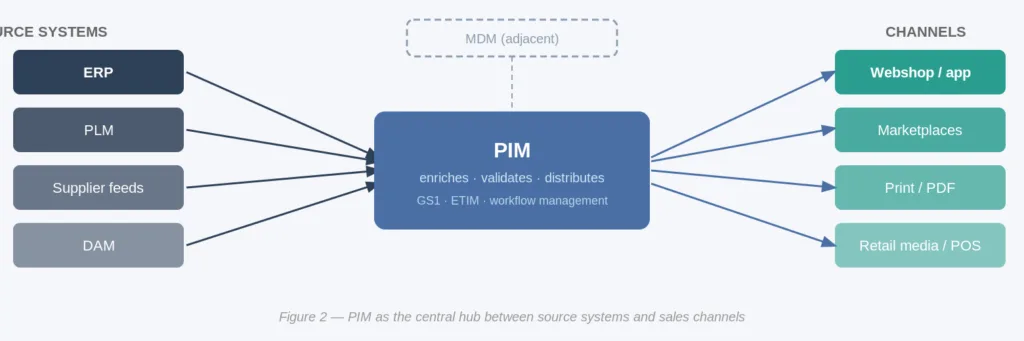
The ideal position of PIM in the application landscape is that of central hub between source systems — ERP, supplier data feeds, PLM — and sales channels: webshops, marketplaces, print production, retail media. The PIM enriches, validates and distributes. In the European market, data standards are not peripheral to this. GS1 (the international standard for product identification and data exchange in the retail chain) and ETIM (the classification standard for technical and electrotechnical products, dominant in the Benelux and DACH regions) determine whether an organisation can connect to the procurement systems of major retailers and distributors. A PIM that does not natively support these standards is not a mature option for many sectors — regardless of how sophisticated the interface or how competitive the licence price.
3. The strategic choice: ERP-first versus PIM-first
The most fundamental architecture decision in product data management is not which PIM system to select, but where the first registration of a product takes place. That sounds like a technical detail; it is in reality a decision about who controls the commercial processes and how quickly an organisation can act on product launches, assortment changes and channel expansion.
ERP-first is the historically grown approach, a legacy from an era when the ERP was the only enterprise information system worth implementing. In this model, the ERP registers the base product data — SKU, technical description, price, weight — after which that information flows downstream to adjacent systems, including the PIM. The advantage is operational consistency: one system is the authority, financial and logistical data are synchronised with product identity. For organisations with a stable, internally driven production process, this model has historically been defensible.
The downside of ERP-first is structural and grows more painful as channel complexity increases. ERP systems are not designed for marketing data. A standard SAP installation offers limited support for multilingual product texts, channel-specific attributes, or the approval workflows required for controlled publishing. Marketing teams in an ERP-first environment face a permanent dependence on IT for what is essentially their day-to-day work: making products publishable. Time-to-market for new articles in ERP-first organisations runs on average two to four times longer than in comparable companies with a PIM-first approach. That is not an academic estimate; it is a pattern that appears consistently across implementation projects at wholesalers, FMCG brands and mid-sized retailers in the Benelux.
PIM-first reverses the order. Product registration begins in the PIM, which is designed for ease of use, workflow control and multi-channel output. The base feed to the ERP — for logistics and financial purposes — follows as a derived step. This model gives commercial teams the autonomy to do what they are good at, without IT as a permanent intermediary. Validation rules, approval flows and quality scoring are built into the PIM process itself, so errors are intercepted before data reaches channels rather than after. The error reduction in channel output that organisations report when transitioning to PIM-first sits structurally between 40% and 65%.
The critical success factor for PIM-first is governance: who owns which data, which fields are mandatory before publishing, and who authorises the transition from “in progress” to “live”? Organisations that implement PIM-first without formalising this governance layer simply relocate the chaos from the ERP to the PIM. The technology does not solve the organisational problem; it only makes it more visible. A successful PIM-first implementation requires at minimum a clear data model, a RACI for data ownership per field group, and publishing criteria defined per channel before go-live. In practice, this means organisations must have answers before vendor selection to questions such as: which attributes are mandatory for each sales channel, who validates technical specifications, and how are conflicts between ERP and supplier feed resolved?
For organisations currently operating ERP-first and considering a transition, a gradual approach is more effective than a big-bang replacement. The most successful transition patterns begin by building a PIM alongside the existing ERP — initially for the enrichment layer and channel output, while registration still takes place in the ERP. Once the data model is stable and the governance structure is established, first registration shifts step by step to the PIM, starting with the product categories with the highest channel complexity. This limits transition risk, keeps the ERP operationally reliable, and allows the commercial team to build the capability base that a PIM-first way of working requires.
4. Trade or production: the business model determines the architecture
The choice between ERP-first and PIM-first cannot be applied uniformly to all organisations. The nature of the business model — trade versus production — largely determines which architecture is logical and which integrations are necessary.
A trading company or distributor sells products manufactured elsewhere. Product data comes from suppliers, in varying formats and of widely differing quality. The company’s own ERP is a financial-logistics instrument without any inherent marketing functionality — it is built to process purchase orders, inventory and invoices, not to manage product descriptions. For these organisations, PIM-first is the most logical choice: the PIM becomes the primary system for receiving, normalising and enriching supplier data, after which the required base feed flows to the ERP. A Dutch technical wholesaler with 120,000 active articles from four hundred suppliers has no ERP system capable of managing that data stream while simultaneously providing channel-specific publishing to Bol.com, its own partner portal and printed trade literature. That is by definition PIM work, and any other model amplifies operational overhead.
A manufacturer or producer faces a different starting point. The ERP contains technical specifications, bill of materials, production orders and procurement data that are closely intertwined with product identity. That operational data is authoritative: there is no benefit in registering a production article primarily in a PIM when the ERP manages the production logic and technical specifications. Yet here too a shift is visible. More and more manufacturers are giving the marketing or product management team a PIM as the primary working environment for the commercial layer — descriptions, specification sheets, translations and channel-specific variants — while technical base data is synchronised from the ERP via a bidirectional integration. This hybrid model combines the accuracy of the ERP for operational data with the flexibility and ease of use of the PIM for everything that faces the customer.
The practical question for every organisation is therefore not “do we need a PIM”, but “which data must be registered where first, and who is responsible for the quality of which data field?” That question sets priorities in the design, determines which system integrations are necessary, and makes clear which teams need process adjustment and training. Organisations that skip that question before selecting a PIM vendor are building a technical solution on top of an organisational problem that will outlast the implementation.
5. When things go wrong: four pitfalls that threaten every PIM implementation
Most PIM implementations that fail or significantly underperform do not do so because of the wrong vendor choice. They fail because of four organisational mistakes that recur consistently, regardless of the platform selected.
The first and most common mistake is governance that is only configured after go-live. Teams do not know who is responsible for which data field, there are no publishing criteria defined per channel, and the PIM is loaded with data whose quality is insufficient to publish. The result is an expensive system that is just as chaotic as the situation before it, with the added frustration that the chaos is now visible to everyone. The remedy: governance is not a post-implementation task; it is a precondition for implementation.
The second mistake is underestimating integration complexity. Vendors typically present connectors with SAP, Oracle or Microsoft Dynamics as standard and quickly realisable. In practice, enterprise ERP integrations require careful data model mapping, agreements on synchronisation frequency, and the resolution of inconsistencies between the two systems that have accumulated over years. An integration that takes two weeks in a vendor demo takes on average two to four months in production. Organisations that do not have their own IT architects independently estimate the integration effort risk significant budget and schedule overruns.
The third mistake is migrating before cleaning. Organisations that transfer existing ERP data directly and unprocessed to the PIM introduce a new system filled with years of accumulated errors: duplicate articles, missing attributes, inconsistent categorisation, outdated descriptions. The rule of thumb is simple: a PIM implementation should not begin until the data quality in the source systems has been audited and a concrete clean-up plan — with owner, deadline and acceptance criteria — has been approved.
The fourth mistake is treating change management as a communications project. PIM touches the working practices of marketing, product management, procurement and IT simultaneously. Without an owner at management level — typically a CDO, head of e-commerce or equivalent — the project stalls in internal priority conflicts the moment the first resistance arises. The technical implementation is typically the least complex part of a PIM programme. Organisational adoption is where most time and attention must go.
6. From theory to practice: an illustrative scenario
A Dutch manufacturer of industrial luminaires with approximately 15,000 SKUs had operated for years with SAP as the central authority for all product data. The technical data — power consumption, IP rating, dimensions, photometric files — were accurate and up to date in SAP. Marketing descriptions, product photographs and downloadable installation manuals were managed in a combination of SharePoint folders and Excel sheets that differed by department. The result: every product launch required four to six weeks of lead time to publish across the company’s webshop, installer partner portal and printed project catalogue, driven largely by coordination overhead between IT, marketing and product management.
Following implementation of a PIM with a bidirectional SAP integration — technical base data from SAP, enrichment and publishing management from the PIM — average time-to-market fell to one and a half weeks. The marketing and product team could independently manage, enrich and approve content for publishing without IT involvement in routine tasks. The error rate in channel output dropped by approximately 55%, measured as the number of post-publication corrections in the first year after go-live versus the year before. The investment in the PIM platform and integration had paid back within fourteen months through reduced operational costs and a demonstrably higher conversion rate on the company’s redesigned product pages.
PIM architectuur choice: a business decision, not an IT discussion
PIM has evolved in thirty years from a niche instrument for large manufacturers to a strategic infrastructure decision for every organisation that sells products across multiple channels. The architecture choice — ERP-first or PIM-first, and how the two systems work together — has a direct impact on time-to-market, error reduction in customer-facing channels and the operational autonomy of commercial teams. The right question for C-level decision-makers is not which PIM system scores best in a vendor comparison, but which data flows are today the bottleneck in the productivity of their commercial organisation.
That conversation does not begin at a vendor demonstration. It begins with an honest audit of current data flows: where are products first registered, who is responsible for which data field, how many manual handoffs exist between registration and publishing, and how many errors are corrected per channel after go-live? The answers to those questions determine which architecture is logical, which vendor fit is appropriate, and which organisational preconditions a successful implementation requires. Whoever skips that analysis and jumps straight to tool selection is buying technology for a problem they have not yet fully understood.
The organisations that extract the most competitive advantage from their product data over the next three to five years will not be those with the most expensive PIM system. They will be the organisations that now invest in the combination of a clear data model, unambiguous ownership and an architecture that enables commercial teams to operate independently. PIM is the means, not the end. The end is serving the market faster, more accurately and at lower cost than the competition — across every channel, in every language, at any time.
