
Signal
Single Source Ep. 9: Agents Need a Product Record They Can Call
Nathalie · 2026-05-26 · Updated 2026-10-19 · 4 min read
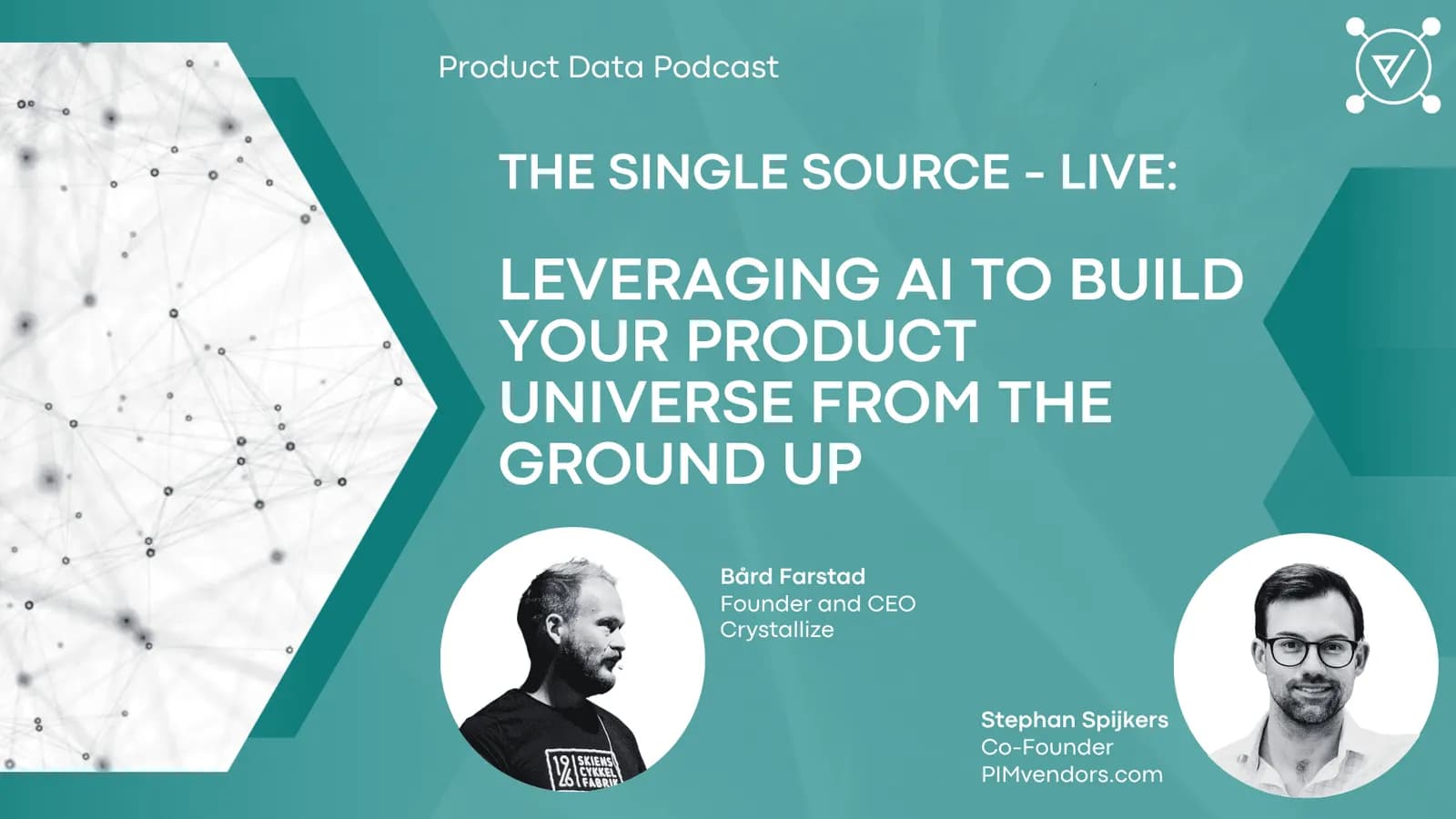
An agent that cannot read your product record in time skips the product. That is the point of episode 9 of The Single Source, where Crystallize CEO Bård Farstad sits with PIMvendors co-founders Stephan Spijkers and Chris Jobse.
The old path, enrich in the PIM and push a thinner copy to the storefront, drops the fields an agent actually uses. Specs, story, media, price and variant links have to live in one backend, with an API that describes itself. The commerce stack guide shows where that backend sits next to the storefront, and why a second copy of the catalog is the version agents never see.
Crystallize is a headless, GraphQL PIM and commerce platform. Farstad walks through how it is built around Skills, AI agents and MCP, and what that asks of any team that wants agents to shop its catalog. He calls the result a product universe: one record, built so both developers and agents can call it.
Speakers
- Stephan Spijkers, Co-Founder, PIMvendors.com
- Chris Jobse, Co-Founder, PIMvendors.com
- Bård Farstad, CEO, Crystallize
What the episode argues
The baseline Farstad describes is strict. Structured, semantically correct product data has to come back in milliseconds. If the agent cannot find and interpret it inside that window, it moves on. The product is gone before a person opens a page.
The classical handoff is what he treats as an integration tax. The PIM enriches, pushes to a commerce platform, and that platform serves the storefront. Each hop keeps only the fields both systems share, and the architecture cannot serve the channels agents use. A single headless backend, one API, one data model, one MCP, removes those hops. The guide to headless and composable commerce is the longer version of that split, if you are weighing a storefront-led stack against a record agents can call.
Farstad also describes AI inside the platform itself: data modeling, bulk import from spreadsheets, SEO enrichment, plugin development, RFP responses and bug resolution in Slack. On his account, work that took days of developer time, or an external consultant, is now drafted in minutes and then reviewed. He says the pace since late 2024 is a break with the old rhythm: major features shipping daily rather than weekly. Take that as Crystallize's account of its own platform, not as a benchmark for a business case.
The buying journey, in his telling, is already two tracks, and both need the same record. Experiential purchases (cars, furniture, fashion) still need a brand-controlled place to look around. Functional purchases (spare parts, consumables, repeat orders) are moving to channels where Claude or ChatGPT filters the set before anyone visits the store. A record that only serves one track means you are absent from the other. AI-ready product data sets out what an agent has to be able to answer from that record.
Model choice is the cost lever he thinks most teams skip. Translation, classification and bulk field enrichment can run on lighter models. Data modeling, architecture choices and one-shot plugin generation need a stronger model. Mapping the task to the model, instead of sending everything to the largest one, is where the bill stays under control.
What to do with this
Farstad's view is that architecture is now a leadership decision. On his timeline, teams that cannot expose a structured record through an agent-compatible interface within 12 months get filtered out at discovery, and their own people cannot run the same workflows. That 12-month line is his judgment.
The trade-off of his single-backend answer is concrete. You give up a specialist PIM and a specialist storefront, each with its own model. You gain one place that developers and agents both call. If that trade is wrong for your channels, do not copy the architecture. Do copy the test. An agent has to get a complete, current answer from your record without a person in the middle.
Score vendors on that test before the agent demo. The data model and the API come first, which PIM features and capabilities breaks down.
Diagnostic
Do you actually need a PIM?
Run the complexity index before you budget software or hire an SI.
Budget
Model a first-pass TCO
Translate catalog shape into a three-year cost range in under ten minutes.