


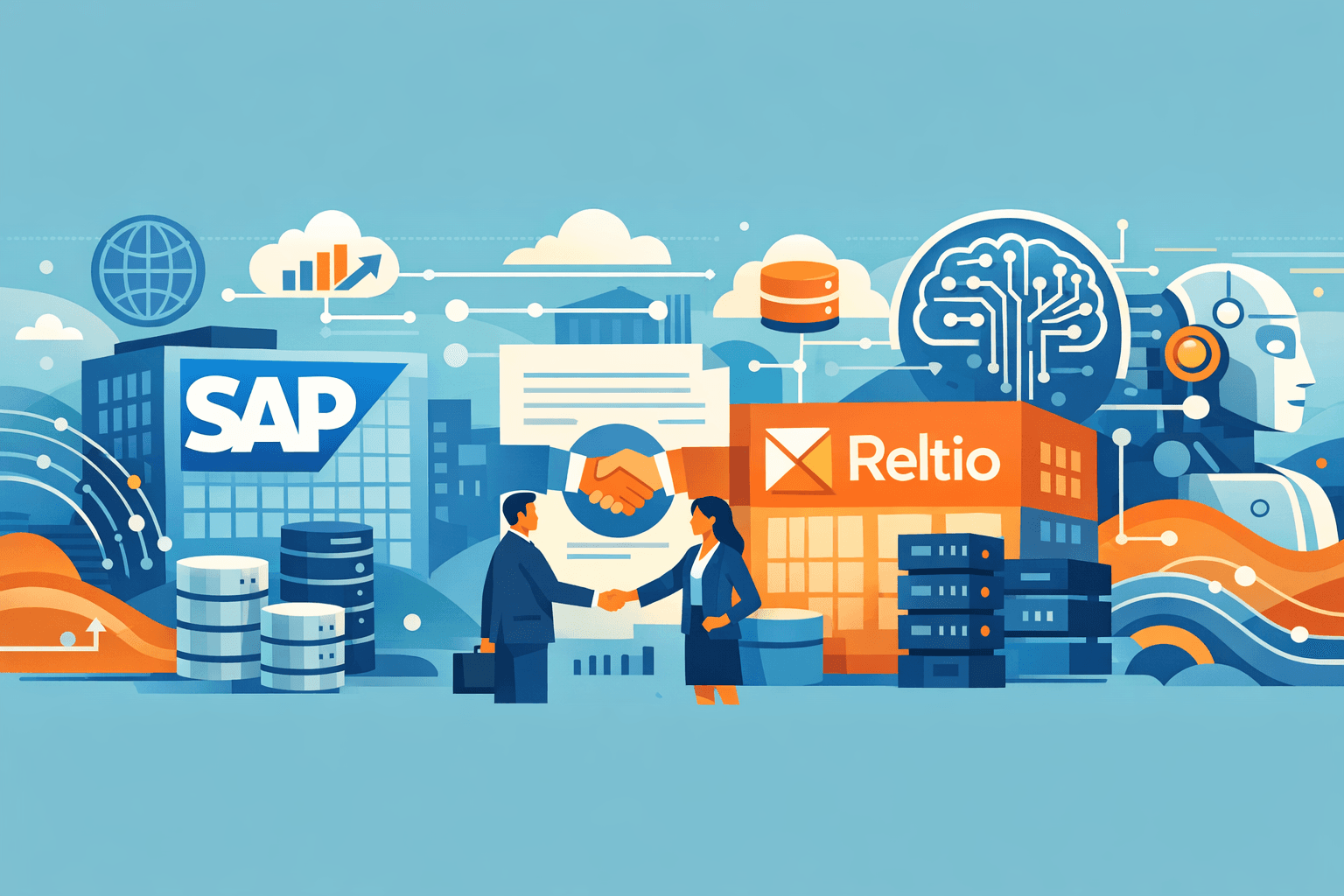
Enterprise AI has a new gatekeeper, and it’s not a model vendor—it’s SAP buying its way deeper into the data plumbing. SAP has agreed to acquire Reltio, a long-time specialist in cloud-native master data management (MDM) and data unification. On paper, it’s a straightforward deal: SAP wants Reltio’s tech to make both SAP and non-SAP data “AI-ready.” In practice, it says a lot about where the PIM, MDM, and broader enterprise data markets are headed.
The AI moment is exposing ugly data
The logic behind this acquisition is blunt: generative and agentic AI are only as useful as the data they’re allowed to chew on. Enterprises are learning, quickly and sometimes painfully, that their data is scattered across CRM, ERP, DAM, PLM, e-commerce platforms, homegrown databases, data lakes that turned into swamps, and a sprawl of PIM systems.
That fragmentation doesn’t just hurt reporting—it actively breaks AI. If your customer, product, and supplier records are duplicated, contradictory, or incomplete, no LLM or “AI agent” can magically reconstruct reality. Reltio’s core pitch has always been to fix that reality: unify, cleanse, and govern structured and unstructured enterprise data, then overlay it with an “intelligent data graph” and AI-based entity resolution so you can actually trust it.
SAP’s plan is to pull that capability into its Business Data Cloud and turn it into an engine for “enterprise-wide agentic AI,” where autonomous or semi-autonomous agents can operate across finance, supply chain, sales, and beyond—on top of a single, trusted layer of business context. In other words, SAP doesn’t just want to store your data; it wants to define the canonical version of your truth for AI.
What Reltio actually brings to SAP
Reltio isn’t a new logo chasing AI hype. It’s spent more than a decade living in the messy intersection of MDM, customer data, and product and supplier information—squarely where PIM, ERP, and CRM collide. The platform was built for heterogeneous, multi-vendor environments, which is exactly what most SAP shops actually look like.
Key pieces SAP gets from Reltio include:
- AI-based entity resolution: matching and merging records that refer to the same customer, product, supplier, location, or employee across wildly different systems.
- Intelligent Data Graph: a graph-based layer that captures relationships and context between entities—who bought what, from whom, under which terms, in what channel.
- Cloud-native, AI-native architecture: designed to operate at enterprise scale, with low-latency data delivery and hooks into modern AI workflows.
- Industry velocity packs: prebuilt models and configurations for regulated and data-heavy sectors including life sciences, healthcare, and financial services.
For SAP, this is a shortcut. Instead of slowly evolving classic MDM tools and bolting on “AI,” it acquires a platform that was built from the start to run across mixed technology stacks and real-time use cases. For Reltio, it’s a bigger distribution channel and the chance to become core plumbing for one of the largest enterprise software ecosystems on the planet.
Customers get two paths: inside SAP, and outside it
The practical question for customers is simple: does this lock Reltio tighter inside SAP, or does it stay open to the rest of the stack?
SAP is saying the right thing here: the Reltio portfolio will remain available as a standalone product, and buyers will be able to license it separately or packaged with SAP offerings. That matters because most large enterprises don’t live in an SAP monoculture. They have Oracle order systems, Salesforce CRM, niche PIM platforms for commerce, and a zoo of homegrown or vertical tools.
If SAP keeps its word, Reltio becomes a neutral “system of context” that can unify data across SAP and non-SAP systems—and then feed that into SAP’s analytics, Joule and Joule Agents, and other AI layers. That’s the sweet spot: one master view of products, customers, suppliers, and locations serving both traditional analytics and the new wave of AI-driven experiences.
The risk, as always in mega-acquisitions, is that roadmap priorities tilt toward deep SAP integration at the expense of the broader ecosystem. How open Reltio remains in practice will be watched closely by customers who deliberately chose it because it wasn’t tied to a single suite.
Partners and integrators: from projects to platforms
Reltio’s partner network—consultancies, SIs, data specialists—has been crucial in getting its platform deployed across industries. Those partners have made a living stitching together data that never wanted to live together in the first place.
With SAP folding Reltio into Business Data Cloud, that work doesn’t go away; it becomes more strategic. There’s a much clearer enterprise story emerging: unify data, map relationships, enforce governance, then expose that as a service layer into AI agents, analytics, and operational apps. For partners, that’s an opportunity to shift from one-off data projects to repeatable AI-ready data architectures built on top of a standard platform.
The flip side is competitive pressure. SAP’s move reinforces a trend: the big suites—SAP, Microsoft, Oracle, Salesforce—are expanding “upstream” into territory that used to be dominated by independent MDM, PIM, and CDP vendors. Partners that depended on stitching together disparate tools might find more of that pattern formalized inside a single stack.
What this signals for the PIM and MDM market
This deal isn’t just M&A noise; it’s a signal flare for the PIM and MDM world.
For years, PIM sat mostly in the commerce channel: product content, attributes, digital assets, channel syndication. MDM was the more expansive, drier cousin—governing golden records for customers, products, suppliers, and locations. Reltio’s positioning in “context intelligence” basically erases that line and pushes toward something bigger: a unified, graph-aware data layer that feeds everything from pricing engines to marketing automation to agentic AI.
A few clear trends emerge from this move:
- MDM is becoming AI infrastructure
What used to be a compliance and quality exercise now sits at the foundation of AI roadmaps. If your product data is dirty, your AI-generated catalogs will be wrong. If your customer data is fragmented, your AI “advisor” will be untrustworthy. MDM is morphing from background hygiene to front-and-center AI-enabling tech. - PIM will be pulled closer to core data platforms
Product information can no longer be treated as an island sitting in a commerce stack. SAP’s acquisition of Reltio points toward PIM tightly coupled with master data, reference data, and relationship graphs—rather than as a standalone content hub. Expect more vendors to pitch integrated “product data clouds” rather than classic PIM modules. - Suite gravity is increasing
Big platforms are racing to own the full path: from raw data to trusted entities to AI agents. That’s going to squeeze best-of-breed PIM and MDM providers to either specialize deeply—by vertical, by use case, by data domain—or find their own alliances and ecosystems to plug into. - Graphs and relationships beat flat records
Reltio’s Intelligent Data Graph is not a side feature; it’s the whole point. AI needs relationships: which supplier supports which plant, which product is bundled with which services, which content variants map to which regional SKUs. The PIM tools still thinking only in terms of lists, attributes, and hierarchies are going to feel increasingly dated next to graph-native approaches. - Real-time and low latency become table stakes
Agentic AI operating inside ERP, commerce, or supply chain can’t wait for overnight batch jobs to resolve identities or synchronize product data. Reltio’s emphasis on low-latency delivery and real-time data activation is a preview of where the bar is moving.
Implications for PIM buyers and practitioners
If you’re responsible for PIM, product content, or data governance, this is yet another reminder that your world is converging with MDM, CDP, and AI platform strategy.
Some practical takeaways:
- Think “system of context,” not just “system of record.” Reltio’s language here matters. The future isn’t one more record store; it’s a contextual layer that connects customer, product, supplier, and content data into a shape AI can understand.
- Plan for mixed ecosystems, even if you love your suite. SAP is promising that Reltio will stay friendly to non-SAP sources. When you evaluate PIM and MDM, assume a heterogeneous future—multiple ERPs, multiple commerce stacks, multiple AI tools—and choose platforms that don’t collapse as soon as you step outside a single vendor’s garden.
- Don’t silo AI projects from data foundations. Agentic AI pilots that ignore master data, governance, and graph relationships are going to hit limits fast. The Reltio acquisition is SAP effectively saying: you can’t separate the two anymore.
- Watch for “AI-native” as more than a buzzword. AI-native in this context isn’t just plugging into an LLM. It’s using AI to resolve entities, infer relationships, keep data quality in motion, and surface context automatically. That’s different from older PIM/MDM platforms that bolt AI on at the UI layer.
Reltio’s mission at a bigger scale
Reltio’s leadership is framing this as an acceleration, not a pivot. The mission—help enterprises unify fragmented data into trusted, usable context—stays the same. What changes is scale and reach: SAP’s Business Data Cloud as the default stage for Reltio’s “system of context,” feeding Joule and Joule Agents and whatever AI interfaces SAP rolls out next.
The transaction is expected to close in Q2 or Q3 of 2026, pending regulatory approvals. After that, Reltio becomes a core component of SAP’s data platform while remaining available as a standalone product “for the foreseeable future.” The foreseeable part is doing a lot of work there, but it does at least recognize the realities of mixed vendor environments.
For the broader market, this feels like another step in a clear trend: PIM and MDM are no longer niche back-office tools. They’re the substrate on which enterprise AI will succeed—or fail. Vendors that can’t deliver trusted, graph-aware, real-time data across domains will find themselves increasingly sidelined as AI ambitions grow.
Source: https://www.reltio.com/resources/blog/a-new-chapter-for-reltio/
