
Core
Crystallize Alternatives: 7 PIM Solutions to Compare
Stephan Spijkers · 2026-10-11 · 9 min read
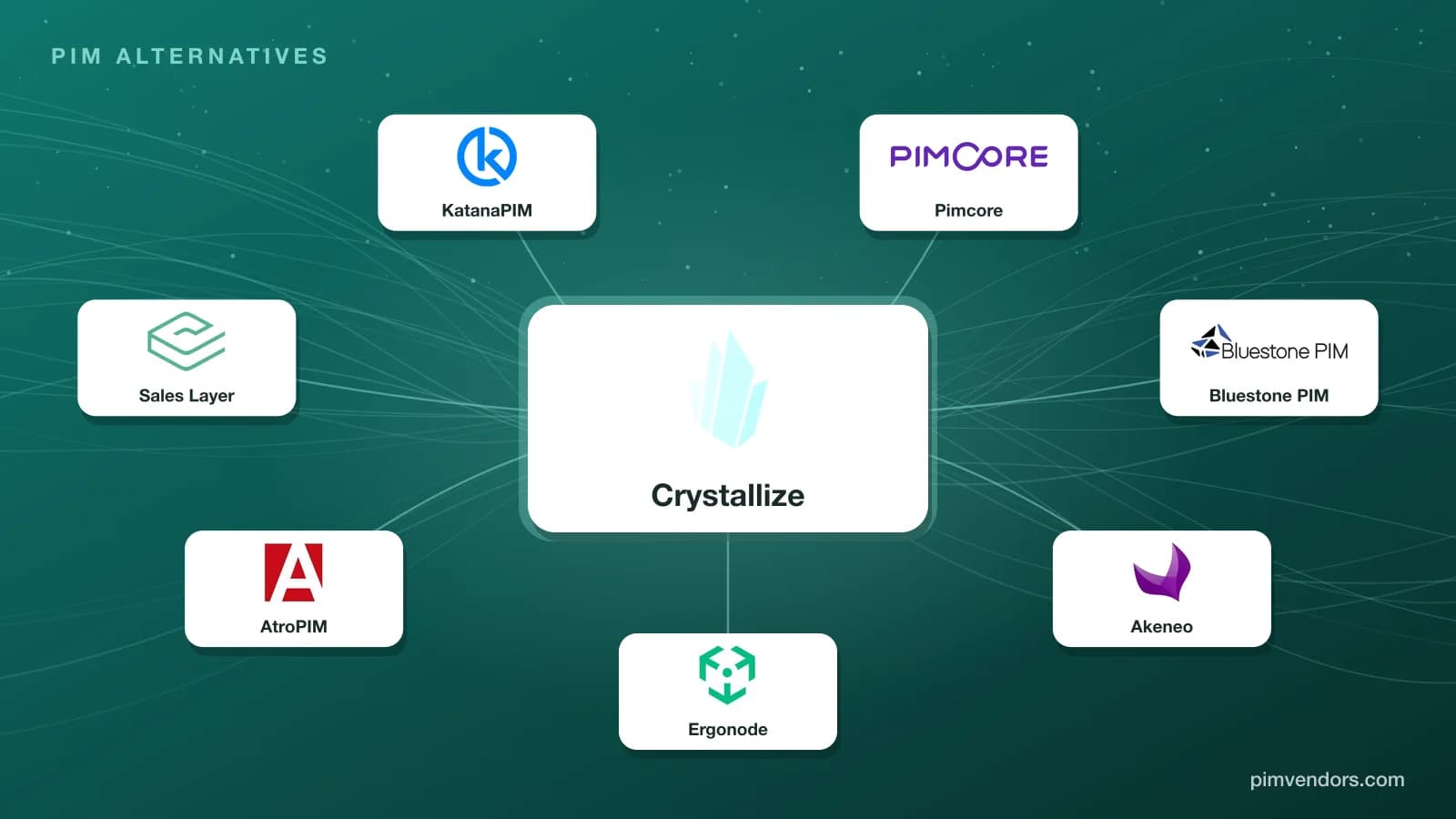
Crystallize appeals to teams that want to build their own storefront on an API, with product data, content and commerce in one backend. Teams reopen the decision when the job shifts toward classic catalog work, marketplaces or an ERP-led product flow, or when the engineering team that built the shop moves on. This page covers what Crystallize does, why buyers compare alternatives, and seven alternatives ordered by fit for typical Crystallize buyers. Fit and watch-out notes come from the analyst assessments on our vendor profiles.
What Crystallize is and who it fits
Crystallize is a Norwegian company, founded in 2017, that sells a headless backend for product information, content and commerce as SaaS. Product data, content and media share one model, read and written through a GraphQL API, with webhooks and Flows (stages, permissions per stage, scheduled publishing) for event-driven integrations. It supports subscriptions and multi-market pricing natively, offers multilingual content down to component level, and adds AI translation and enrichment through Flare, billed as metered tokens. It pairs with frontend frameworks such as Next.js, Astro, Nuxt and SvelteKit, and with payment providers such as Stripe and Adyen.
Our analyst assessment puts its best fit with digital-native direct-to-consumer or B2B commerce teams that want one composable backend for structured product storytelling, subscriptions, multi-market pricing and custom storefronts, where PIM is equal to content and commerce and engineers are available. The strengths listed are flexible product modeling (including configurator and bill-of-materials patterns), strong GraphQL reading and writing, one model for content, product and media, native subscription commerce, Flows and webhooks, transparent base pricing tiers, and unlimited users and languages on paper.
Crystallize is also widening its scope: it is expanding to Sweden through an investment in the order management vendor Hantera (our analysis).
Why teams look for a Crystallize alternative
- You need a pure PIM that feeds everything else. Our analyst notes that Crystallize is not a pure PIM for ERP-centric catalog operations, or for architectures where the PIM feeds every other system, unless you adopt its commerce stack or build heavy middleware.
- Marketplaces, GDSN or ETIM become requirements. None of them is native, so budget a custom build or choose a system that has them.
- The engineering capacity is gone. Crystallize fits teams with developers. A team that mainly needs a business-user interface and ready connectors may be better served elsewhere.
- Workflows get heavier. Flows cover stages, permissions and publishing, but the profile notes they are not a full enterprise workflow suite.
- You want to self-host. Crystallize is sold as SaaS and cloud-hosted, not on-premise. Teams that need to run the system on their own infrastructure look at open-source or open-core options.
Crystallize alternatives at a glance
- Pimcore: best for one open-core platform for PIM, DAM, content and commerce, with self-hosting.
- Bluestone PIM: best for a headless, MACH-based PIM in a composable stack with large catalogs.
- Akeneo: best for an API-first PIM with a large ecosystem and supplier onboarding.
- Ergonode: best for a headless PIM with an enrichment interface for marketers and a DAM included.
- AtroPIM: best for an open-source PIM that your developers configure and host.
- Sales Layer: best for a marketer-friendly SaaS PIM with marketplace and shop connectors.
- KatanaPIM: best for a SaaS PIM with published pricing next to Shopify, Magento or Shopware.
The alternatives
Pimcore
Pimcore is an Austrian open-core platform that combines PIM, MDM, DAM, a customer data platform, and content and commerce on one API-first data layer, with REST, GraphQL and webhooks. It is the closest match in scope: like Crystallize it treats product data, content and commerce as one model, but you can self-host it, run it in a private cloud or use Pimcore's managed Enterprise PaaS.
Our analyst sees the best fit with mid-market and enterprise manufacturers, brands and retailers, often in DACH and the EU, that have a technical team or an integrator budget.
Check: open-core is not free at enterprise scale. The Community edition is free only for companies under €5 million in annual revenue, and the customer data platform and commerce need the Enterprise edition. Ownership is changing: Tenzing agreed to buy a majority stake (our analysis), so ask about roadmap and licence terms.
Bluestone PIM
Bluestone PIM is a Norwegian SaaS PIM built on MACH principles: microservices, API-first, cloud-native and headless. It handles variants, bundles and product families, with validation rules, completeness scoring, a native DAM and AI tools for enrichment and translation.
It fits when you leave Crystallize because you want a dedicated PIM that feeds any commerce platform, marketplaces and the ERP in a composable stack. Its profile targets mid-market and enterprise organizations with large catalogs.
Check: our analyst assessment says to evaluate it on deployment effort, proof of standards support and commercial transparency. It is a PIM only, so subscriptions, checkout and pricing logic stay in your commerce platform.
Akeneo
Akeneo is a French PIM with open-source roots, sold mainly as SaaS through its Product Cloud. Our analyst sees the best fit with brands, retailers and wholesalers that put multichannel product experience, API-first architecture, enrichment productivity and supplier onboarding first.
Compared with Crystallize it is a pure product record with completeness and quality tooling, a broad app ecosystem, a Supplier Data Manager and a product DAM, built to feed many channels.
Check: GS1, ETIM and DPP need explicit proof in a proof of concept, often through partners, and it does not replace multidomain MDM. Commerce stays in your shop platform.
Ergonode
Ergonode is a Polish SaaS PIM built on Symfony and Vue.js, headless and API-first, with an open-source edition next to the SaaS. It aims at mid-sized companies, digital-first brands, e-commerce retailers and direct-to-consumer brands, which overlaps with Crystallize's audience.
The difference is the split of work: content teams get a visual enrichment interface, developers get the API. Our analyst lists the interface, the API and headless delivery, the included DAM, a published price ladder and AI content tools as strengths.
Check: it is not proven as enterprise multidomain MDM or as GS1-native, and the maturity of its supplier portal is unclear.
AtroPIM
AtroPIM is a German open-source PIM and master data hub under GPLv3, also sold as SaaS, that runs on-premise or in the cloud. Our analyst sees the best fit with organizations that need a highly configurable product and master data hub, value self-hosting, and have internal developers or a trusted integrator.
Much of its data model, fields, layouts and API can be configured without code, it includes a DAM, and modules add ETIM and BMEcat. The module and support pricing is transparent, with no per-seat fee on the core.
Check: verify GDSN before you treat it as a retail option, and note that the supplier portal is permissions and process rather than a ready onboarding product.
Sales Layer
Sales Layer is a Spanish SaaS PIM for small and mid-market companies, known for fast onboarding and an interface that marketers can use without IT. It has pre-built connectors for Amazon, Shopify, Magento, BigCommerce and PrestaShop, quality scoring, an OData API and procurement punchout for Ariba.
It fills the gap our analyst names for Crystallize: marketplace syndication without a custom build.
Check: GS1 and GDSN are not native and come through a partner at extra cost. It is not MACH-certified, and its API relies on polling with rate limits, so a composable team should compare its API and event model with Bluestone or Akeneo.
KatanaPIM
KatanaPIM is a Dutch SaaS PIM for small and mid-market merchants, wholesalers and distributors, with published tier pricing and the API on every plan. It offers import and mapping tools, workflows, specification groups for variant-heavy catalogs, and a partner list that covers Shopify, Magento, Shopware, WooCommerce and Exact.
It fits teams that want a usable PIM next to a standard shop platform instead of building on a headless backend.
Check: GS1, ETIM and GDSN run through partner middleware, and native AI is largely absent, so budget for it separately. Marketplace export runs through integrators.
How to choose, and how to switch
Map what runs on Crystallize
List the product shapes and components, every frontend and integration that queries the GraphQL API, the Flows and webhooks, and the commerce functions you use, such as subscriptions and multi-market pricing.
Decide whether commerce moves too
If commerce stays in Crystallize, you only add or swap a PIM. If it leaves, you replace product data, content and commerce, and the shortlist changes. Write down the must-haves either way.
Shortlist three and demo with your own data
Give each vendor one real product shape with variants, one frontend query and one channel export. Let both developers and content editors score the work.
Migrate with a parallel run
Export the data through the API, map it to the new model, and repoint one frontend or channel at a time while both systems run.
Time the contract
Check renewal dates and notice periods first, so the proof of concept and the parallel run fit before the renewal date.
Compare more PIM systems
Compare these and other systems in the PIM profile overview, or get a free shortlist based on your scale, sector and must-haves with the PIM Scan. For related comparisons, see open-source PIM compared and Pimcore alternatives.
Where to go from here
Frequently asked questions
What are the best Crystallize alternatives?
Pimcore if you want product data, content and commerce on one platform you can also self-host. Bluestone PIM, Akeneo or Ergonode if you want a dedicated headless PIM next to your commerce platform. AtroPIM for an open-source PIM your developers configure, and Sales Layer or KatanaPIM for a SaaS PIM with channel connectors and less development work.
What is Crystallize?
Crystallize is a Norwegian SaaS backend that combines headless PIM, content and commerce, with a GraphQL API, subscriptions, multi-market pricing and webhooks. It is built for digital-native B2B and direct-to-consumer teams that build their own storefronts and have engineers available.
Is Crystallize a PIM?
It is a headless backend in which PIM is one part, next to content and commerce. Our analyst notes that it is not a pure PIM for ERP-centric catalog operations or for architectures where the PIM feeds every other system, unless you adopt its commerce stack or build heavy middleware.
Is there an open-source alternative to Crystallize?
Yes. Pimcore is open-core under its own licence, with a free Community edition for companies under €5 million in annual revenue. AtroPIM is open source under GPLv3, and Ergonode offers an open-source edition next to its SaaS. All three can be self-hosted.
Which Crystallize alternative handles marketplace syndication?
Crystallize has no native marketplace syndication. Sales Layer has pre-built connectors for Amazon, Shopify, Magento and other channels, and KatanaPIM exports to marketplaces through integration partners. For every option, test the marketplaces you sell on with your own data.
Which alternative works as a PIM next to Shopify or another shop platform?
KatanaPIM, Sales Layer and Ergonode connect to platforms such as Shopify, Magento and Shopware. Bluestone PIM and Akeneo fit when the shop is one of many systems in a composable stack. In each case commerce functions such as checkout and subscriptions stay in the shop platform.
How do you move off Crystallize?
List the product shapes, the frontends and integrations that query the GraphQL API, the Flows and webhooks, and the commerce functions you use. Decide whether commerce moves too, demo three systems with your own data, migrate with a parallel run, and repoint each frontend before you switch Crystallize off.
Diagnostic
Do you actually need a PIM?
Run the complexity index before you budget software or hire an SI.
Budget
Model a first-pass TCO
Translate catalog shape into a three-year cost range in under ten minutes.