
Core
DynamicWeb Alternatives: 7 PIM Solutions to Compare
Stephan Spijkers · 2026-10-11 · 9 min read
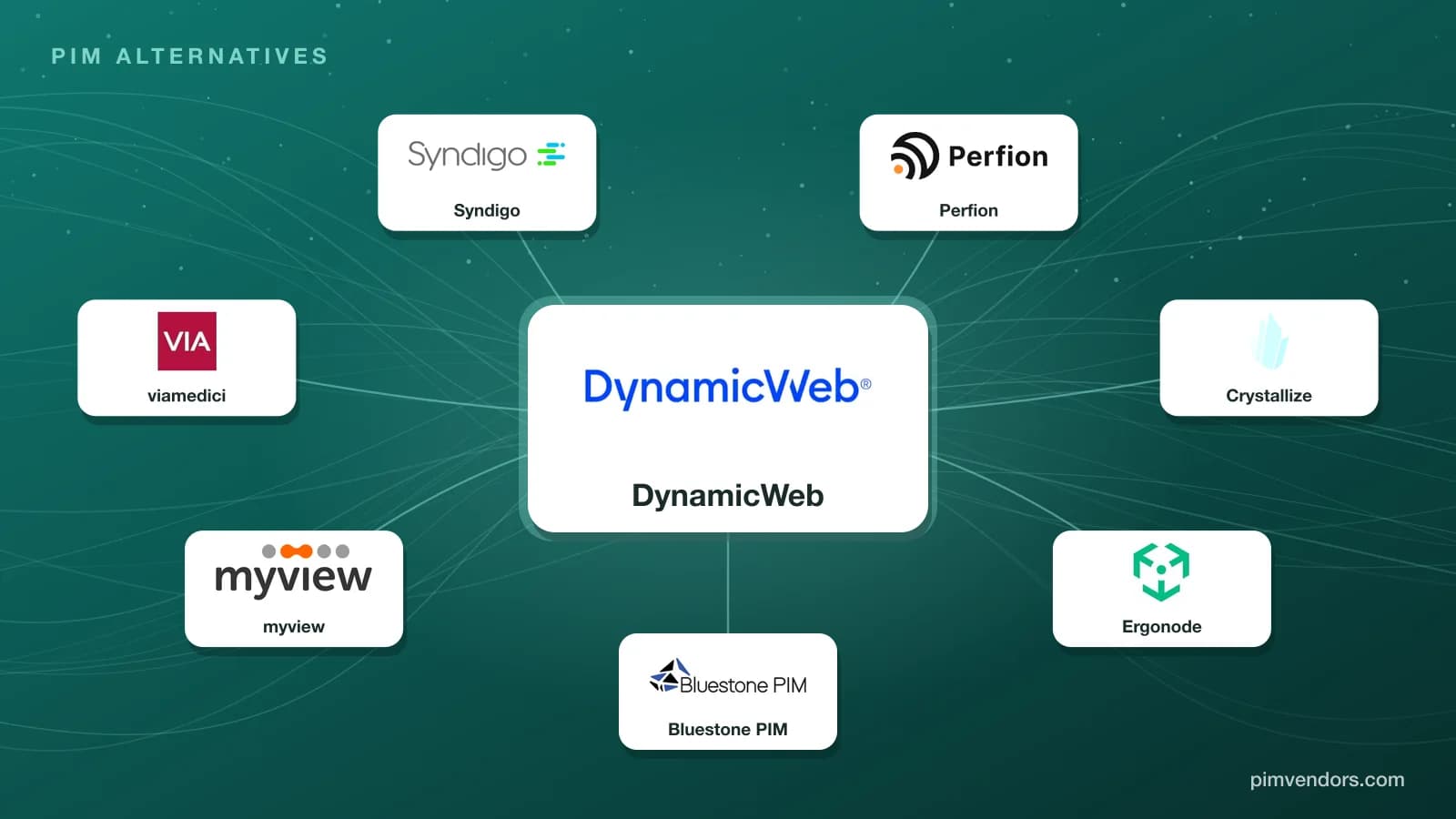
This guide is for teams that run DynamicWeb, or have it on a shortlist, and want to know what else fits. It covers what DynamicWeb does and for whom, the reasons teams look further, seven alternatives in order of fit for typical DynamicWeb buyers, and how to switch. Founding years, headquarters and the fit and watch-out notes come from each system's vendor profile.
What DynamicWeb is and who it fits
DynamicWeb is a Danish software company, founded in 1999, that sells a .NET suite combining PIM, e-commerce, CMS and digital marketing. It runs as SaaS, cloud-hosted or on-premise. According to our profile, the PIM part covers:
- Product modeling: variants, inheritance, bundles, unit conversion and warehouses.
- Enrichment tools: bulk editing (GridEdit), completeness rules, dashboards and workflows.
- Localization: multilingual fields with built-in translation and AI assistance.
- Publications: PDF datasheets, price lists and catalogs, with an EasyCatalog and InDesign path.
- APIs and headless delivery at suite level, next to DynamicWeb's own shop and dealer portals.
Our analyst assessment puts its best fit with mid-market B2B and B2C organizations standardized on Microsoft Dynamics that want one platform for web, commerce, marketing and catalog enrichment, including print and dealer portals, and that accept that deep PIM and standards work may need integrators. The profile names industrial goods, consumer electronics and distribution as typical sectors.
Why teams look for a DynamicWeb alternative
- A dedicated PIM next to another shop. DynamicWeb is a suite first. Teams that run, or plan, a different commerce platform or several shops often want a PIM that feeds all of them. Our profile notes that PIM-only buyers must validate the endpoints and feeds they need.
- Standards. For GS1, GDSN and ETIM, our analyst advises you to assume partner work unless proven. Technical wholesalers and suppliers to retailers may want these built in.
- Master data management. The analyst assessment advises shortlisting DynamicWeb as a PIM only if the scope is enrichment and syndication, not MDM.
- No Microsoft Dynamics. Much of DynamicWeb's case rests on its Dynamics story. On another ERP, that advantage is smaller.
- Engineering data. Full manufacturing bills of materials and engineering configuration are not evidenced as part of the PIM core.
DynamicWeb alternatives at a glance
- Perfion: best for a dedicated PIM with native Microsoft Dynamics integration and print.
- Crystallize: best for direct-to-consumer and B2B teams that want product data, content and commerce in one headless backend.
- Ergonode: best for a standalone SaaS PIM with a marketer-friendly interface and published pricing.
- Bluestone PIM: best for a composable, API-first PIM that feeds several shops and channels.
- myview: best for technical B2B catalogs with ETIM, BMEcat and print publishing.
- Viamedici: best for enterprise manufacturers that need MDM, configurable products and print catalogs.
- Syndigo: best when retailer compliance and GDSN drive the project.
The alternatives
Perfion
Perfion is a Danish PIM, founded in 2003, available as SaaS, cloud-hosted or on-premise, and often chosen by Microsoft Dynamics users.
- Where it fits differently: it keeps the Dynamics connection, with real-time integration for Dynamics NAV, AX and 365, but as a dedicated PIM that can feed any shop. Our analyst also sees a fit for companies on SAP Business One. Flexible relational modeling, a built-in DAM, strong print and publications, low-code automation (Actions) and an optional supplier portal make it a close functional match for DynamicWeb's PIM part.
- Check: it is not a digital shelf or high-volume marketplace suite: syndication is connectors plus custom exports. GDSN needs a data pool or middleware.
Crystallize
Crystallize is a Norwegian headless commerce backend, founded in 2017, that keeps product data, content and media in one place behind GraphQL APIs.
- Where it fits differently: like DynamicWeb, it puts product data, content and commerce in one system, but headless, for teams that build their own storefronts. It suits direct-to-consumer and B2B teams with subscriptions, multi-market pricing and engineers available. Base pricing tiers are published.
- Check: it is not a PIM for ERP-centric catalog operations, and it has no native GDSN, ETIM or marketplace syndication. Without engineering capacity, it is the wrong pick.
Ergonode
Ergonode is a Polish SaaS PIM, founded in 2018, with an enrichment interface built for marketers and a headless, API-first architecture.
- Where it fits differently: it fits teams that move their shop to another platform and want a standalone PIM with plugins for Magento, Shopware, WooCommerce and Shopify, a product DAM included and published pricing. It is aimed at mid-market digital brands and retailers.
- Check: it is not proven as GS1-native or as an MDM, and the maturity of its supplier portal is unclear. If you publish datasheets or catalogs from DynamicWeb today, test how you would do that from Ergonode.
Bluestone PIM
Bluestone PIM is a Norwegian SaaS PIM, founded in 2013, built on MACH principles: microservices, API-first, cloud-native and headless.
- Where it fits differently: it suits mid-market and enterprise manufacturers, distributors and retailers that move from a suite to a composable stack and want the PIM to feed several shops, marketplaces and markets. It has a native DAM with a PDF generator, three-level product families and bundles.
- Check: our analyst assessment asks you to test deployment effort, proof of standards support and commercial transparency. In a composable setup, you build or buy each connector, including the one to Dynamics.
myview
myview is a German PIM, founded in 1998, available as SaaS, cloud-hosted or on-premise, with a long track record in technical product communication.
- Where it fits differently: it suits DACH and European manufacturers and distributors with technical, variant-rich catalogs, such as lighting, HVAC and industrial components. A deep library of industry exports (BMEcat, ETIM, ECLASS), print and database publishing, a Camunda-based workflow engine, translation management and a headless layer (xom) for portals and configurators cover the standards work DynamicWeb leaves to partners.
- Check: it is not a GDSN or retail syndication PIM without an external data pool, and supplier onboarding runs through imports and integration, not a supplier portal.
Viamedici
Viamedici is a German enterprise vendor, founded in 1996, that combines PIM, MDM, DAM and a product configurator (CPQ), as SaaS, cloud-hosted or on-premise.
- Where it fits differently: it fits manufacturers that have outgrown a mid-market suite: complex, configurable products, multilingual print and digital catalogs, ETIM and ECLASS, and governed master data with a golden record and supplier portal. Its ERP connectors include Microsoft Dynamics, next to its deeper SAP integration.
- Check: it targets enterprises only and is not a lean composable PIM, so budget for suite complexity and integrator cost. Evidence for GDSN and GS1 retail syndication is thin.
Syndigo
Syndigo is a US platform that combines PIM, MDM and content syndication with a large network of retailers and other recipients, and it is a certified GDSN data pool.
- Where it fits differently: it fits manufacturers whose growth runs through large retailers, in consumer goods, foodservice, health and beauty or hardlines, where retailer compliance, GDSN and enhanced product page content drive revenue. That is standards work DynamicWeb leaves to partners.
- Check: it is not a classic PIM: authoring and composable APIs are secondary to the network, its best fit is large brands and retailers, and the content hub and Riversand MDM are two integration surfaces, so plan an architecture review.
How to choose and switch
Decide what leaves
Only the PIM part, or the whole suite with shop, CMS and dealer portals. This decision changes the shortlist and the size of the project more than any feature.
List what DynamicWeb does today
Product models, completeness rules, workflows, translations, publications, the Dynamics integration and every shop or portal that reads product data. The guide on where ERP stops and PIM starts helps split the work between systems.
Demo with your own data
Give each shortlisted vendor one real product group with variants, one publication such as a datasheet or price list, and a live sync with your ERP. Let the people who enrich products today score the work.
Migrate in slices
Move one product group or one channel at a time, run it in parallel with DynamicWeb, and compare the output until it matches.
Switch off last
Only when every shop, portal and publication runs from the new system. Plan the end of the contract around that date.
Compare more systems
Compare these and other systems in the PIM profile overview, or get a free shortlist for your scale, sector and must-haves from the PIM Scan. For the wider market, see best PIM software, and for budgets, our PIM cost comparison.
Where to go from here
Frequently asked questions
What is DynamicWeb PIM?
DynamicWeb PIM is the product information part of DynamicWeb, a Danish suite founded in 1999 that combines PIM, e-commerce, CMS and digital marketing in one platform. It runs as SaaS, cloud-hosted or on-premise, and is strongest for mid-market B2B and B2C companies on Microsoft Dynamics.
What are the best DynamicWeb alternatives?
For a dedicated PIM next to Microsoft Dynamics, Perfion. For product data and commerce in one headless backend, Crystallize. For a standalone SaaS PIM next to another shop platform, Ergonode or Bluestone PIM. For technical catalogs with ETIM and print, myview. For enterprise MDM and configurable products, Viamedici, and for retailer networks and GDSN, Syndigo.
Is DynamicWeb a PIM or an e-commerce platform?
Both, but our analyst assessment calls it a suite product first. It makes sense to shortlist it as a PIM only if your scope is enrichment and syndication, not master data management, and if you value having web, commerce and catalog work in one platform.
Which PIM works best with Microsoft Dynamics?
DynamicWeb itself has a tight Dynamics story. Perfion has native, real-time integration with Dynamics NAV, AX and 365. Viamedici lists Microsoft Dynamics among its ERP connectors, next to its deeper SAP integration. Test the integration on your own Dynamics version and data in the demo.
How does DynamicWeb PIM integrate with an ERP?
Its strongest integration story is with Microsoft Dynamics. For other ERP systems, commerce platforms, DAM and integration platforms, our profile advises you to confirm the specific connectors during shortlisting, and PIM-only buyers should validate the endpoints and feeds they need.
Does DynamicWeb support GS1, GDSN and ETIM?
Assume partner work unless the vendor proves otherwise, according to our analyst assessment. If ETIM and BMEcat are central, compare myview. If retailers require GDSN, compare Syndigo, which operates a GDSN data pool.
Can you replace only DynamicWeb's PIM and keep its shop?
That depends on how far your shop and portals rely on the PIM inside the suite. Ask DynamicWeb how its commerce takes product data from an external PIM, and ask the new PIM vendor for a connector or a reference. Without one, you build and maintain that feed yourself.
How do you move off DynamicWeb PIM?
Decide first whether only the PIM leaves or the whole suite. Then list product models, completeness rules, workflows and publications, demo the shortlist with your own data, migrate one product group or channel at a time with a parallel run, and switch off when every shop, portal and publication runs from the new system.
Diagnostic
Do you actually need a PIM?
Run the complexity index before you budget software or hire an SI.
Budget
Model a first-pass TCO
Translate catalog shape into a three-year cost range in under ten minutes.