
Core
Pimalion Alternatives: 7 PIM Solutions to Compare
Stephan Spijkers · 2026-10-11 · 8 min read
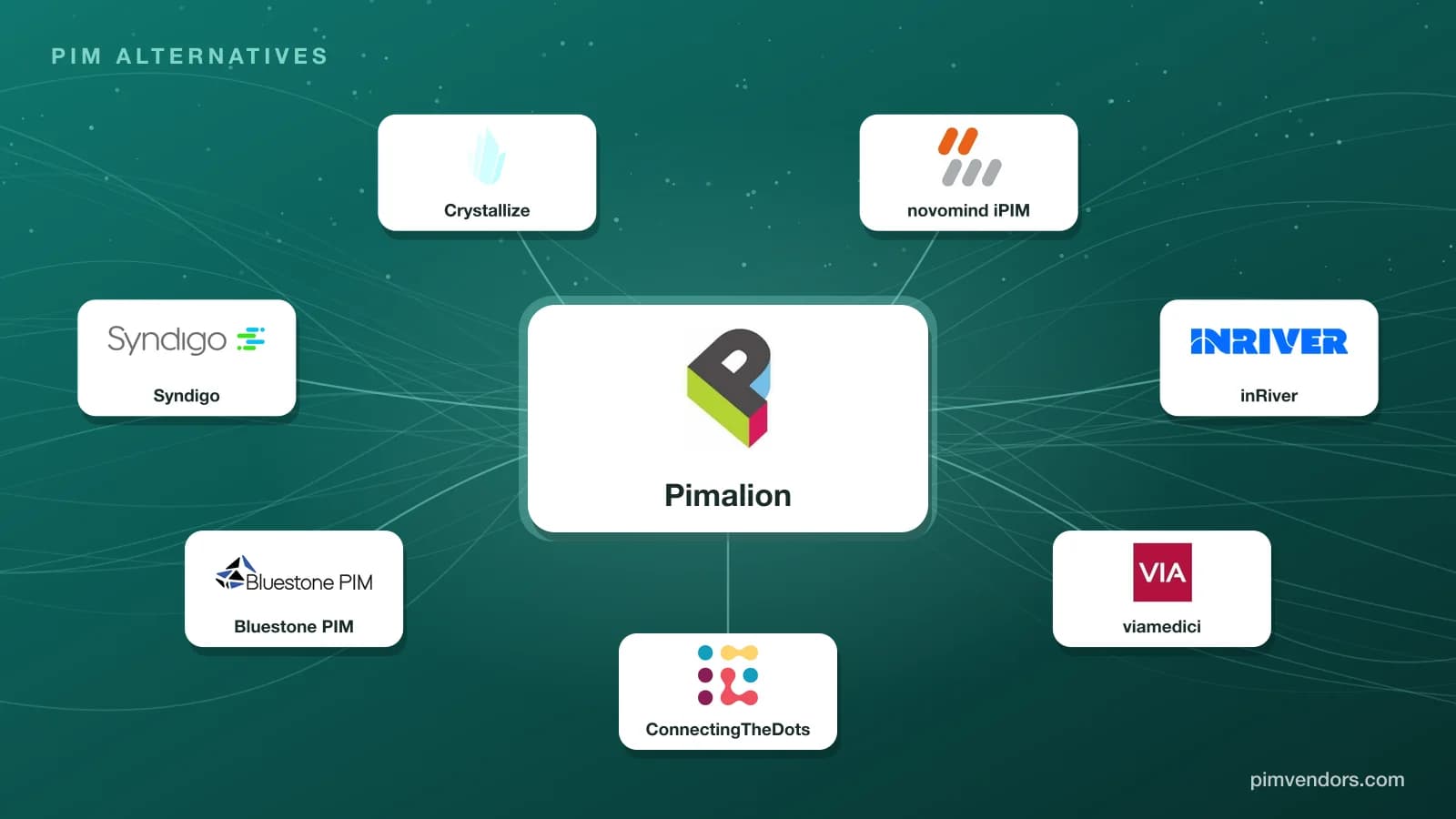
Pimalion is one of the few PIMs that start from print. For a marketing team that produces catalogs and in-store material every season, that is the reason to choose it. For a team whose channels have moved online, it can be the reason to look again. This guide covers what Pimalion does, why teams compare it, and seven alternatives with what to check for each.
What Pimalion is and who it fits
According to our Pimalion profile, Pimalion is a Belgian platform, sold as SaaS or cloud-hosted to mid-market and enterprise companies in Europe. It combines:
- PIM: bundles and collections, channel-specific product masters, calculated fields, and completeness by destination (web, print, digital).
- DAM: a full asset library with rights, IPTC metadata, transformations, duplicate detection and cloud drive sync.
- Print publishing: its core competency, with InDesign and EasyCatalog, catalog and product builders, point-of-sale material and PDF pipelines.
- Review workflows: multi-stage reviewer workflows with annotations and reminders.
- Brand portal: for sharing content with sales networks and partners.
The profile places it with companies in retail, wholesale and manufacturing that publish printed catalogs, brochures or technical datasheets, often in several languages and for several brands. Its users are retail marketing, studio and catalog teams.
Why teams look for a Pimalion alternative
Our analyst assessment of Pimalion is short: evaluate it on deployment effort, standards proof and commercial transparency. Those three points, and the profile itself, explain most reasons to compare.
- Print is shrinking in your channel mix. Pimalion's core competency is print. If webshops and marketplaces now carry most of your sales, a PIM built around syndication or APIs may fit better.
- You need proof of standards. The profile does not evidence GS1, GDSN or ETIM support, so a supplier or manufacturer with those requirements should ask for proof.
- You need named integrations. The profile advises confirming ERP, commerce, DAM and integration platform connectors during shortlisting.
- You need a translation management system. The profile shows multilingual content, but no named TMS integration.
Pimalion alternatives at a glance
- Retail and wholesale with print and supplier onboarding: novomind iPIM.
- Print, PDF and marketplaces from one governed model: inRiver.
- Industrial catalogs and configurable products around SAP: Viamedici.
- Benelux retail, wholesale and multi-brand e-commerce: ConnectingTheDots.
- A composable, API-first stack: Bluestone PIM.
- Supplier content and retailer compliance: Syndigo.
- A headless storefront where print plays no role: Crystallize.
The alternatives
The seven options are ordered by fit for a team that uses Pimalion for print, DAM and retail content. Fit and watch-out notes come from the analyst assessment on each profile.
novomind iPIM
novomind iPIM is the PIM of novomind, a German vendor, sold as SaaS, cloud-hosted or on-premise.
It is the closest match for a retail or wholesale team. Our analyst assessment puts its best fit with mid-to-large European retailers, wholesalers and buying cooperatives with hundreds of supplier catalogs, and lists governed supplier onboarding, a BPMN workflow engine, native DAM and a strong print and InDesign path among its strengths.
Check: syndication and real-time publishing often assume novomind's own iMARKET and iSHOP. Ask what you need beyond the PIM for your shop and marketplaces.
inRiver
inRiver is a Swedish SaaS PIM that runs on Microsoft Azure.
It fits manufacturers, brands and wholesalers with complex catalogs and many channels and marketplaces that need print and PDF from the same governed model, plus digital shelf analytics inside the PIM. Its analyst assessment calls print and publishing depth rare among PIMs, which makes it a fit for a team that wants to keep print and grow online.
Check: pricing is quote-only with indexed renewals, so model three to five years. GS1, GDSN and ETIM often run through partner extensions.
Viamedici
Viamedici is a German enterprise suite that combines PIM, MDM, DAM and configure-price-quote, sold as SaaS, cloud-hosted or on-premise.
It fits SAP-centric manufacturers and industrial distributors with configurable products and multilingual print and digital catalogs. Its profile lists automated creation of catalogs, price lists and brochures with InDesign integration, and its assessment names print and catalog heritage among its strengths. It is enterprise-only.
Check: it is not a lean PIM, so budget for suite complexity and integrator costs. Evidence for GDSN and GS1 retail syndication is thin.
ConnectingTheDots
ConnectingTheDots is a Dutch SaaS PIM for mid-market and enterprise companies.
Our analyst assessment puts its best fit with Benelux retailers, wholesalers and multi-brand e-commerce with messy supplier data, where fast catalog operations and channel-specific pricing matter. Its main strength is automated supplier onboarding. It publishes to webshops, marketplaces such as bol.com and Amazon, and print catalogs.
Check: compare its print output with what Pimalion produces for you today. GS1, GDSN and ETIM publication run through a partner.
Bluestone PIM
Bluestone PIM is a Norwegian SaaS PIM built on microservices, with an API-only, MACH-certified architecture.
It fits mid-market and enterprise manufacturers, distributors and omnichannel retailers that want a PIM component in a composable stack. It has native DAM with a CDN and a PDF generator, validation rules, completeness scoring and AI for enrichment and translation.
Check: the profile describes a PDF generator, not an InDesign catalog workflow, so test it with one of your catalog templates. Our analyst also advises testing deployment effort, standards proof and commercial terms.
Syndigo
Syndigo is a US platform that combines PIM, MDM and content syndication with a large retailer network, and it operates a certified GDSN data pool.
It fits a different side of retail: enterprise teams in consumer goods, foodservice, health and beauty and hardlines, and retail vendor-management teams, where retailer compliance, GDSN and enhanced product page content drive revenue. For a retailer, it is a way to receive validated content from suppliers.
Check: it is not a print tool, and authoring is secondary to the network. The content hub and the Riversand MDM are two integration surfaces, so plan an architecture review.
Crystallize
Crystallize is a Norwegian headless platform that combines PIM, content and commerce behind a GraphQL API, for small and mid-market companies.
It fits a brand or retailer that has moved from catalogs to its own storefronts, with product storytelling, subscriptions and multi-market pricing in one backend, and developers in house.
Check: it has no print engine and no native GDSN, ETIM or marketplace syndication. Only consider it if print and data pools are out of scope.
How to choose, and how to switch
Map your channels and their share
List every output Pimalion produces: catalogs, leaflets, point-of-sale material, datasheets, webshop and marketplace feeds. Note which ones grow and which ones shrink. The PIM RFP guide helps turn the list into requirements.
Shortlist by the channel that matters most
If print stays central, start with novomind iPIM, inRiver and Viamedici. If online channels lead, add ConnectingTheDots and Bluestone PIM.
Demo with your own catalog pages
Give each vendor a product family, its assets and one real catalog spread, and score every demo on the same script.
Migrate the DAM and one product group first
Move the assets with their rights and metadata, then one product group, and run the old and new output side by side.
Switch print last, then end the contract
Move the print output only when the templates are rebuilt and checked, and plan the contract end around that date.
Compare more options
Compare these and other systems in the PIM profile overview, or get a free shortlist for your requirements with the PIM scan. Our list of PIM solutions for retail covers the wider field.
Where to go from here
Frequently asked questions
What is Pimalion?
Pimalion is a Belgian PIM with integrated DAM, a brand portal and automated print publishing, sold as SaaS or cloud-hosted to mid-market and enterprise companies in Europe. Its core strength is print: InDesign and EasyCatalog catalogs, point-of-sale material and PDF output from the same product data.
Who is Pimalion for?
Our profile describes retail, wholesale and manufacturing companies whose marketing, studio and catalog teams produce printed catalogs, brochures, point-of-sale material and technical datasheets, often across several languages, brands and countries.
What are the best Pimalion alternatives?
For retail and wholesale with print and supplier onboarding, novomind iPIM. For print and marketplaces from one model, inRiver. For industrial catalogs around SAP, Viamedici. For Benelux retail and wholesale, ConnectingTheDots. For a composable stack, Bluestone PIM. For supplier content to retailers, Syndigo. For a headless storefront, Crystallize.
Which Pimalion alternative is strongest for print catalogs?
Among these seven, novomind iPIM, inRiver and Viamedici have the clearest print story on their profiles: an InDesign path for novomind, print and PDF from the governed model for inRiver, and catalog publishing with InDesign integration for Viamedici. Test each with one of your own catalog templates.
Is there a Benelux alternative to Pimalion?
ConnectingTheDots is a Dutch SaaS PIM for mid-market and enterprise retailers, wholesalers and multi-brand e-commerce in the Benelux. Its strength is automated supplier onboarding. Check how deep its print output goes compared with what Pimalion produces for you today.
What should you check before you leave Pimalion?
Your print templates, your DAM with its rights and metadata, and your review workflows. Templates are tied to the data model, so rebuilding them is often the largest single task in a move away from a print-led PIM.
How do you switch from Pimalion?
List your channels, templates, assets and workflows, decide which ones the new system must cover, demo with your own catalog pages, migrate the DAM and one product group at a time, and switch the print output last, after a parallel run.
Diagnostic
Do you actually need a PIM?
Run the complexity index before you budget software or hire an SI.
Budget
Model a first-pass TCO
Translate catalog shape into a three-year cost range in under ten minutes.