
Core
Signifikant Alternatives: 7 PIM Solutions to Compare
Stephan Spijkers · 2026-10-11 · 9 min read
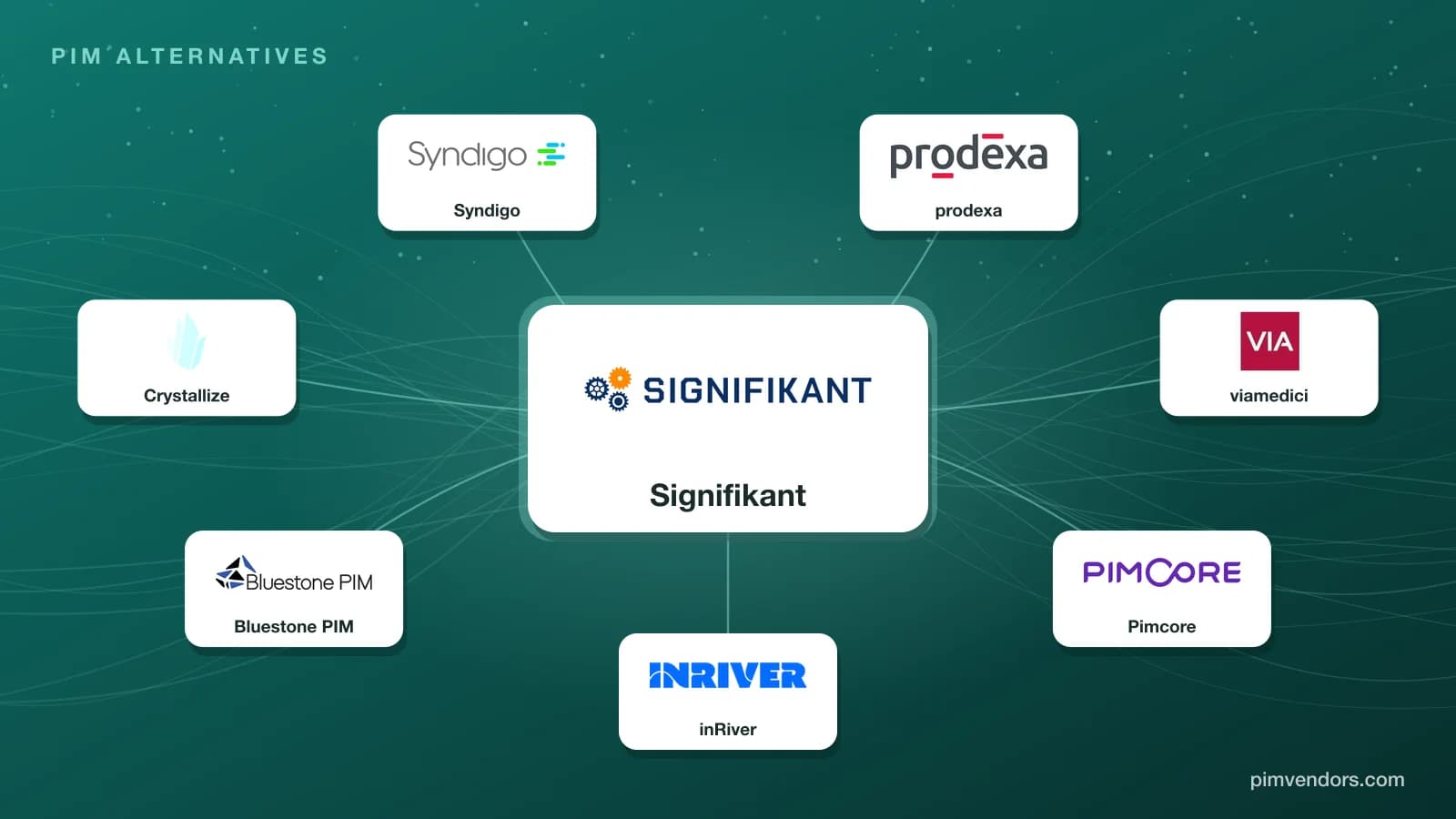
This guide is for manufacturers that run Signifikant, or have it on a shortlist, and want to know what else fits. It covers what Signifikant does and for whom, the reasons teams look further, seven alternatives in order of fit for typical Signifikant buyers, and how to switch. Founding years, headquarters and the fit and watch-out notes come from each system's vendor profile.
What Signifikant is and who it fits
Signifikant is a Swedish software company, founded in 2004, with a .NET platform for aftermarket and service information. It runs cloud-hosted or on-premise and integrates with ERP systems such as SAP and Microsoft Dynamics, and with PLM and CAD. It covers:
- An aftermarket data model: kits, superseded parts, the step from engineering to service bill of materials, and filtering by machine and serial number.
- Illustrated parts catalogs: exploded views and 2D and 3D drawings, in a web viewer and offline.
- Service documentation: manuals, repair guides and service bulletins linked to the parts.
- Portals and ordering: dealer and technician portals with optional parts e-commerce.
- Modules for claims, assets and ticketing, and a newer content API.
Its best fit is with manufacturers and OEMs whose aftermarket revenue and uptime depend on identifying the right spare part and on service documentation, especially heavy equipment, industrial machinery and long-lived capital goods. We covered the approach in our recap on aftermarket service delivery with PIM.
Why teams look for a Signifikant alternative
- The job is not only aftermarket. Signifikant is the wrong tool for retail PIM and for programs led by marketplace syndication. Manufacturers that also need sales-side product content for webshops, distributors and marketplaces need a PIM for that part.
- Standards. GS1, GDSN and ETIM publishing are outside its fit. Parts suppliers that must deliver to data pools or technical wholesalers need them somewhere.
- Operations. Custom ERP integration and the work of running on-premise (SQL Server, IIS and sizing for PDF publishing) are the main watch-outs. Teams that want SaaS look further.
- Automotive data. Parts suppliers that must publish to TecDoc and identify parts by vehicle look for automotive-specific depth.
- A different parts webshop. Some teams want a commerce backend they control for parts ordering, with their own storefront.
Signifikant alternatives at a glance






| Alternatives to Signifikant | Built for | Industry | Runs as | Founded | Go-live (estimate) |
|---|---|---|---|---|---|
| Today: Signifikant | Mid-market, Enterprise | Manufacturing | Cloud-hosted, On-premise | 2004 | 20 weeks |
| prodexa | Mid-market, Enterprise | Manufacturing, Wholesale | SaaS, Cloud-hosted | 2000 | 20 weeks |
| Viamedici | Mid-market, Enterprise | Manufacturing, Wholesale | SaaS, Cloud-hosted, On-premise | 1999 | 20 weeks |
| Pimcore | Small business, Mid-market, Enterprise | Manufacturing, Retail | Open source, Cloud-hosted, On-premise | 2009 | 16 weeks |
| inRiver | Mid-market, Enterprise | Manufacturing, Retail, Wholesale | SaaS, Cloud-hosted | 2007 | 20 weeks |
| Bluestone PIM | Mid-market, Enterprise | Retail, Manufacturing | SaaS, Cloud-hosted | 2016 | 20 weeks |
| Crystallize | Small business, Mid-market, Enterprise | Retail | SaaS, Cloud-hosted | 2017 | 16 weeks |
| Syndigo | Mid-market, Enterprise | Retail, Manufacturing | SaaS, Cloud-hosted | 1973 | 20 weeks |
- prodexa: best for automotive aftermarket data, deep bills of materials and technical catalogs.
- Viamedici: best for SAP-centric manufacturers with configurable products and print catalogs.
- Pimcore: best for building your own parts or dealer portal on an open-core data platform.
- inRiver: best for sales-side product content, print and PDF next to an aftermarket system.
- Bluestone PIM: best for a SaaS, API-first PIM without on-premise operations.
- Crystallize: best for a custom parts webshop with B2B commerce in one backend.
- Syndigo: best for parts and products sold through retailers that require GDSN and validated content.
The alternatives
prodexa
prodexa is a German PIM, DAM and publishing suite, founded in 2000 as jCatalog and run as prodexa GmbH since 2019, sold as SaaS or cloud-hosted.
- Where it fits differently: it is the closest match for automotive parts. Its strengths include automotive aftermarket depth (TecDoc, vehicle identification by VIN), a deep variant, bill-of-materials and pricing model, ETIM and ECLASS, supplier catalog onboarding and print output. It can cover the sales catalog and the parts catalog in one system. Entry SaaS pricing is published.
- Check: exploded views and service documentation are not among its documented features, so test with your own illustrated assemblies. It is not a safe pick for an API-first, composable setup without accepting its documented API limits.
Viamedici
Viamedici is a German enterprise vendor, founded in 1999, that combines PIM, MDM, DAM and a product configurator (CPQ), as SaaS, cloud-hosted or on-premise.
- Where it fits differently: it suits SAP-centric manufacturers with complex, configurable products that want governed product master data, a configurator and multilingual print and digital catalogs from one vendor, with ETIM and ECLASS. It covers the sales side of the product record that Signifikant does not aim at.
- Check: it is not an aftermarket parts system, so ask how it would handle superseded parts and serial-aware filtering. It is not a lean PIM, so budget for suite complexity and integrator cost.
Pimcore
Pimcore is an Austrian open-core data platform, founded in 2009, for PIM, DAM, master data and web and portal content, self-hosted, in a private cloud or as managed PaaS.
- Where it fits differently: it suits manufacturers with a technical team or integrator that want to model parts, assets and documents themselves and build their own parts or dealer portal on one data layer, with ETIM and ECLASS support and full control over deployment.
- Check: open-core does not mean free at enterprise scale, so check the licence thresholds and which features need the Enterprise edition. Ask for paid references in your own sector, and for how superseded parts and serial-aware filtering would be built.
inRiver
inRiver is a Swedish SaaS PIM on Microsoft Azure, founded in 2007, for manufacturers, brands and wholesalers with complex catalogs.
- Where it fits differently: it handles the sales side well: an elastic model for products, variants, bundles and components, print and PDF output, and syndication to webshops and marketplaces. For an OEM that needs that job next to Signifikant, or instead of a self-built sales catalog, it is a strong comparison, and it runs as SaaS.
- Check: it is not an aftermarket parts system. Pricing is quote-only with indexed renewals, and GS1, GDSN and ETIM are often partner extensions.
Bluestone PIM
Bluestone PIM is a Norwegian SaaS PIM, founded in 2016, built on MACH principles: microservices, API-first, cloud-native and headless.
- Where it fits differently: it removes on-premise operations entirely. Its data model includes bundles with quantities and product relations, and its native DAM handles images, documents, video and 3D, which helps with manuals and drawings. Portals and webshops read the data through its APIs.
- Check: test deployment effort, proof of standards support and commercial transparency. Aftermarket features such as superseded parts and serial-aware filtering are not documented, so they become integration or build work.
Crystallize
Crystallize is a Norwegian headless commerce backend, founded in 2017, that keeps product data, content and media in one place behind GraphQL APIs.
- Where it fits differently: if the main goal is a modern parts webshop with your own storefront, it combines product data and B2B commerce, and its model supports configurator and bill-of-materials patterns. It needs engineers to build the storefront. Base pricing tiers are published.
- Check: it targets small and mid-market companies, it is not a PIM for ERP-centric catalog operations, and it has no native GDSN, ETIM or marketplace syndication. Illustrated catalogs and service documentation are not among its documented features.
Syndigo
Syndigo is a US platform that combines PIM, MDM and content syndication with a large network of retailers and other recipients, and it is a certified GDSN data pool. Its markets include automotive and industrial manufacturing.
- Where it fits differently: it fits parts makers and manufacturers that sell through retailers and distributors that demand validated content and GDSN, which is exactly the job Signifikant is not built for.
- Check: it is not a classic PIM and not an aftermarket parts catalog. Authoring and composable APIs are secondary to the network, and it has two integration surfaces, so plan an architecture review.
How to choose and switch
Decide: replace or add
Either a new system takes over the aftermarket job, or you keep Signifikant for parts and service and add a PIM for sales-side content. Most of the alternatives here are better at the second.
Inventory parts, documents and portals
List the parts structures, superseded parts and kits, illustrations, service documents, portals, users and the integrations with ERP, PLM and CAD.
Test with your hardest assembly
Give each shortlisted vendor one real machine with its service bill of materials, exploded views, a superseded part and a serial-number range. Let a dealer or technician try to find and order the right part.
Migrate one product line at a time
Move one product line, run the old and new portal in parallel, and compare what dealers and technicians find in each.
Switch off last
Only when every portal, catalog and integration runs from the new system, and when dealers have moved over. Plan the end of the contract around that date.
Compare more systems
Compare these and other systems in the PIM profile overview, or get a free shortlist for your scale, sector and must-haves from the PIM Scan. For the wider manufacturing market, see our PIM solutions for manufacturing.
Where to go from here
Frequently asked questions
What is Signifikant?
Signifikant is a Swedish software company, founded in 2004, whose platform manages aftermarket information for manufacturers and OEMs: spare parts structures, illustrated parts catalogs, service documentation and dealer and technician portals, with optional parts ordering. It runs cloud-hosted or on-premise.
What are the best Signifikant alternatives?
Few systems are like-for-like. For automotive aftermarket data, prodexa. For governed product data next to SAP, Viamedici. To build your own parts portal, Pimcore. For sales-side catalogs and print, inRiver, and for a SaaS composable PIM, Bluestone PIM. For a parts webshop, Crystallize, and for selling through retailers, Syndigo.
Is Signifikant a PIM?
It is a PIM built for the aftermarket. It combines product structures, service documentation and parts catalogs, which goes beyond a classic PIM. It is also the wrong tool for retail PIM, GS1 or ETIM publishing and marketplace syndication.
What is aftermarket PIM?
Product information management for spare parts and service. It answers which part fits which machine, often by serial number, which parts replace older ones, and which kits exist, and it delivers exploded views, manuals and service bulletins to dealers, technicians and customers, often with parts ordering.
Can a regular PIM handle spare parts?
Partly. Most PIMs can hold parts, relations and bundles, and some, such as prodexa, have a deep bill-of-materials model. Superseded parts, filtering by machine and serial number, and illustrated catalogs built from engineering structures are where an aftermarket system is specialized. Test that with your hardest assembly.
Does Signifikant run as SaaS?
It runs cloud-hosted or on-premise. On-premise means running SQL Server and IIS yourself and sizing servers for PDF publishing, which is a watch-out. Ask Signifikant which hosted option fits your scale.
Should you run a PIM next to Signifikant?
It can make sense. Signifikant is the wrong tool for retail PIM and marketplace syndication, and most PIMs do not cover its aftermarket parts model. If you need both, decide which system owns which data, and connect both to the ERP and PLM.
How do you switch from Signifikant?
Inventory the parts structures, illustrations, documents, portals and integrations with ERP, PLM and CAD. Test the shortlist with your hardest assembly, migrate one product line at a time, keep the old portal running in parallel, and switch off when dealers and technicians work in the new one.
Diagnostic
Do you actually need a PIM?
Run the complexity index before you budget software or hire an SI.
Budget
Model a first-pass TCO
Translate catalog shape into a three-year cost range in under ten minutes.