
Core
SyncForce Alternatives: 7 PIM Solutions to Compare
Stephan Spijkers · 2026-10-11 · 8 min read
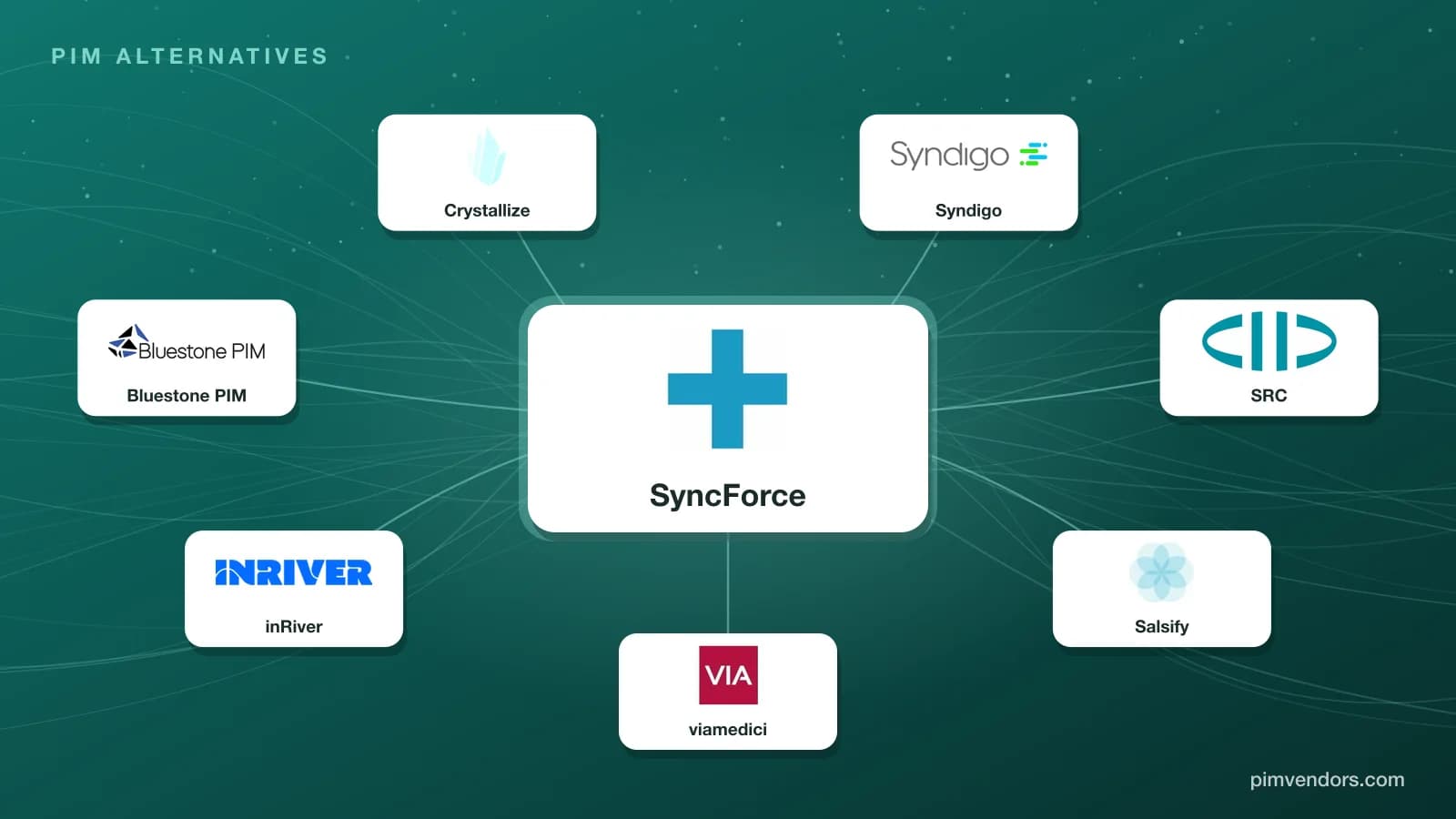
SyncForce sits in a narrow part of the PIM market: the brand manufacturer that has to get packaged products from development to retailer shelves and data pools. That focus is its strength, and also the reason some teams outgrow it or never fit it. This guide covers what SyncForce does, why teams look elsewhere, and seven alternatives with what to check for each.
What SyncForce is and who it fits
According to our SyncForce profile, SyncForce is a Dutch platform, sold as SaaS or cloud-hosted to mid-market and enterprise companies in Europe. The profile describes it as a circular PIM for consumer packaged goods, with these capabilities:
- Product and packaging model: a "golden hierarchy" of trade units, product and packaging linked, and a packaging bill of materials for packaging rules such as the EU's PPWR.
- Stage-gate workflows: new product development, proofing and approval, with gate meetings.
- Validation: mandatory fields, channel and customer checks, and a GS1 preflight before publication.
- GS1 and GDSN: an integrated connector to named data pools.
- Document automation and DAM: leaflets, price lists, shelf cards and labels, plus an integrated DAM.
Our analyst assessment puts its best fit with packaged-goods manufacturers of €100 million or more in food, pet, home and personal care, and building and DIY. They have complex trade hierarchies, frequent packaging and regulatory changes, and distribution in Europe that leans on GS1 data pools. The strengths it lists are the product, packaging and logistics model, an evidenced GDSN connector, stage-gate workflows, document automation, ISO 27001 and a long record with manufacturers.
Why teams look for a SyncForce alternative
- You are not a packaged-goods manufacturer. The analyst assessment names SMB, retail, fashion, automotive and engineer-to-order as poor fits.
- You want a headless or composable setup. The assessment warns that headless and composable buyers will run into constraints in the read API and its releases.
- You are expanding. The profile notes that adding a new sector or market to the GDSN connection is a project, so growth into new countries or data pools adds work each time.
- You need a full brand DAM. The integrated DAM is not benchmarked against enterprise DAM systems.
None of these is a complaint about the product. They are signs that the job has moved away from what SyncForce is built for.
SyncForce alternatives at a glance
- GDSN, a retailer network and enhanced content: Syndigo.
- Benelux GS1 sector compliance and data pools: SRC.
- Brand-side syndication to retailers and digital shelves: Salsify.
- SAP-centric manufacturers with MDM needs: Viamedici.
- Print, marketplaces and shelf analytics from one model: inRiver.
- A composable, API-first stack: Bluestone PIM.
- A headless D2C storefront backend: Crystallize.
The alternatives
The seven options are ordered by fit for SyncForce's typical buyer, a packaged-goods manufacturer. Fit and watch-out notes come from the analyst assessment on each profile, where one exists.
Syndigo
Syndigo is a US platform that combines PIM, MDM and content syndication with a large retailer network, and it operates a certified GDSN data pool.
It is the closest alternative on the outbound side. Our analyst assessment puts its best fit with enterprise consumer goods, foodservice, health and beauty and hardlines teams where retailer compliance, GDSN and enhanced product page content drive revenue. Riversand adds MDM for customer, vendor and location data.
Check: the profile does not describe packaging models or stage-gate development, so test those if you use them in SyncForce. Authoring and composable APIs are secondary to the network, and the content hub and Riversand MDM are two integration surfaces. See our Syndigo comparison.
SRC
SRC is a Dutch, standards-first PIM, sold as SaaS or cloud-hosted to mid-market and enterprise companies.
Our analyst assessment puts its best fit with Benelux retailers, wholesalers and suppliers whose requirements center on GDSN and GS1 sector compliance, ETIM and 2BA, PS in foodservice and supplier portals. It lists a long standards engineering history, maintained standard data models, a native DAM for GS1 images and Dutch retail references. For a Dutch or Belgian food manufacturer, it covers the data pool side that SyncForce covers.
Check: SRC is a small vendor, and the assessment flags uncertainty about its portfolio after the consolidation with AGENA3000. Test packaging and product development depth.
Salsify
Salsify is a product experience management platform that helps brands manage product content and syndicate it to retailers, distributors and digital channels.
Our profile describes its focus as consumer goods brands and manufacturers that sell through many retailer channels and need content tuned per channel for the digital shelf. That makes it an alternative when retailer and marketplace content matters more than packaging and development workflows.
Check: the profile does not give an analyst assessment. Ask for proof of GDSN publication to the European data pools you use, for references from packaged-goods manufacturers in your markets, and for how it handles packaging data.
Viamedici
Viamedici is a German enterprise suite that combines PIM, MDM, DAM and configure-price-quote, sold as SaaS, cloud-hosted or on-premise.
It fits SAP-centric manufacturers with complex products, multilingual print and digital catalogs, and a need for governed master data outside SAP. It also offers multidomain MDM with a golden record and a supplier portal, for master data beyond products.
Check: the assessment calls evidence for GDSN and GS1 retail syndication thin, which matters for a packaged-goods manufacturer. It is not a lean composable PIM, so budget for suite complexity and integrator costs.
inRiver
inRiver is a Swedish SaaS PIM that runs on Microsoft Azure.
It fits manufacturers, brands and wholesalers with complex catalogs and many channels and marketplaces, with print and PDF from the same governed model and digital shelf analytics inside the PIM. It suits a brand whose channel mix has moved toward marketplaces and its own sites.
Check: GS1, GDSN and ETIM often run through partner extensions, not natively. Pricing is quote-only with indexed renewals, so model three to five years.
Bluestone PIM
Bluestone PIM is a Norwegian SaaS PIM built on microservices, with an API-only, MACH-certified architecture.
It answers the headless and composable concern directly: it is API-only, with a claim of parity between the user interface and the API. It fits mid-market and enterprise manufacturers, distributors and retailers with variants, bundles and product families, and it has native DAM, validation rules and completeness scoring.
Check: our analyst advises testing deployment effort, proof of standards support and the commercial terms. Ask how GDSN publication and packaging data would run.
Crystallize
Crystallize is a Norwegian headless platform that combines PIM, content and commerce behind a GraphQL API, for small and mid-market companies.
It is not a like-for-like replacement. It fits a brand whose new job is a D2C or B2B storefront with structured product storytelling, subscriptions and multi-market pricing, with its own developers.
Check: it has no native GDSN, ETIM or marketplace syndication, so your data pool publication has to run elsewhere.
How to choose, and how to switch
Write down what SyncForce does for you
List the trade hierarchies, packaging data, development workflows, documents and data pool connections in use, and who works with each. The PIM RFP guide helps turn that list into requirements.
Shortlist by the job, not the brand
If the data pool side matters most, start with Syndigo and SRC. If retailer content matters most, Salsify and inRiver. If APIs matter most, Bluestone PIM.
Demo with your own products
Give each vendor a product with several packaging levels, a recent packaging change and a data pool publication, and score the demos on the same script.
Migrate one product group at a time
Move one brand or category, publish it in parallel from both systems, and compare what the data pools and retailers receive.
Switch the GDSN connection last
Agree the contract end date around the day the last data pool connection moves, not the other way round.
Compare more options
Compare these and other systems in the PIM profile overview, or get a free shortlist for your requirements with the PIM scan. Our list of PIM solutions for manufacturing covers the wider field.
Where to go from here
Frequently asked questions
What is SyncForce?
SyncForce is a Dutch PIM platform for brand manufacturers, sold as SaaS or cloud-hosted to mid-market and enterprise companies in Europe. It links product development, packaging, regulatory approval and syndication to retailers and GS1 data pools in one environment, with an integrated DAM and document automation.
What is SyncForce Circular PIM?
Our profile lists SyncForce's platform as a circular PIM for consumer packaged goods. The idea is one record that runs from R&D and packaging design through regulatory approval to retail syndication, built around a product and packaging model with packaging bills of materials and stage-gate workflows for new products.
Who is SyncForce for?
Our analyst assessment puts its best fit with packaged-goods manufacturers of €100 million or more in food, pet, home and personal care, and building and DIY, with complex trade hierarchies, frequent packaging and regulatory changes, and GS1-heavy distribution in Europe. It names SMB, retail, fashion, automotive and engineer-to-order as poor fits.
What are the best SyncForce alternatives?
For GDSN and a retailer network, Syndigo. For Benelux GS1 sector compliance and data pools, SRC. For brand-side syndication to retailers, Salsify. For SAP-centric manufacturers, Viamedici. For print and marketplaces from one model, inRiver. For a composable stack, Bluestone PIM. For a headless D2C backend, Crystallize.
What is the difference between SyncForce and Syndigo?
SyncForce starts inside the manufacturer: product development, packaging and approval, then publication to data pools. Syndigo starts at the recipients: it operates a GDSN data pool and a large retailer network, with PIM and Riversand MDM around it. Compare them on the recipients you must reach and on how much of your product development you want in the same system.
Is SRC an alternative to SyncForce?
For many Dutch and Belgian manufacturers, yes. Both are Dutch and built around GS1 standards and data pools. SRC adds ETIM, 2BA and PS in foodservice, and supplier portal references from Dutch retail. Check packaging and product development depth, and ask about SRC's portfolio plans after its consolidation with AGENA3000.
What do you lose when you leave SyncForce?
Check three things: the product and packaging model with its trade hierarchies, the stage-gate and proofing workflows for new products, and the GDSN connections to your data pools. Most PIMs model packaging less deeply, so test those three in every demo.
How do you switch from SyncForce?
List your trade hierarchies, packaging data, workflows, documents and data pool connections. Decide which of them the new system must cover, run a demo with your own products, migrate one product group at a time with a parallel publication, and switch the GDSN connection last.
Diagnostic
Do you actually need a PIM?
Run the complexity index before you budget software or hire an SI.
Budget
Model a first-pass TCO
Translate catalog shape into a three-year cost range in under ten minutes.