


For years, B2B organisations have treated their ERP as the single source of truth for product data. It was a reasonable assumption—ERP centralises transactions, inventory, and pricing, so why not product content too? The answer is becoming increasingly clear: ERP was never designed for configurable products, rich technical specifications, multi-channel content distribution, or the self-service expectations of today’s B2B buyer. As digital wholesale commerce matures, the gap between what ERP can handle and what the market now demands is widening fast.
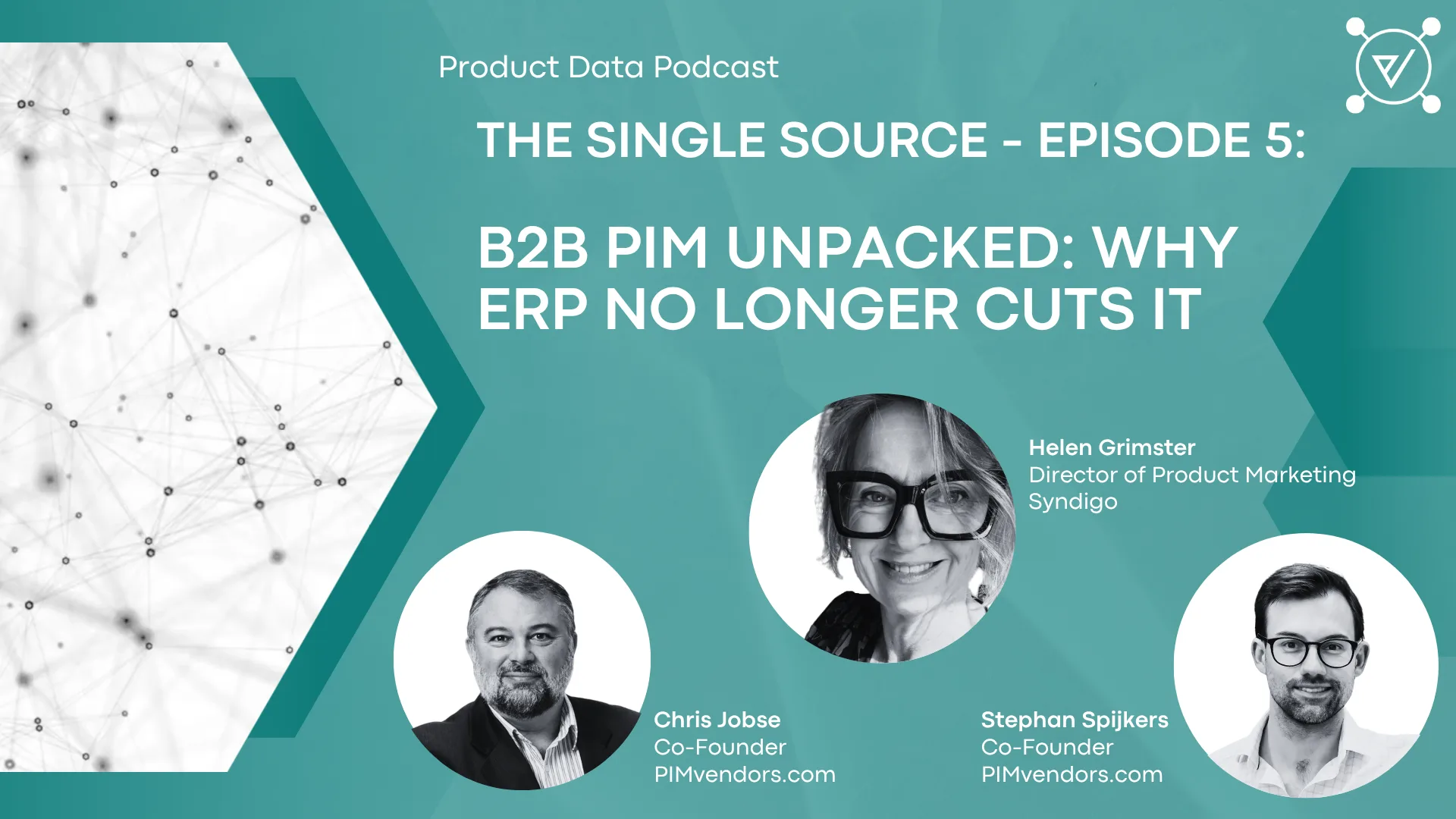
In this episode of The Product Data Podcast, Chris Jobse and Stephan Spijkers, Co-Founders of PIMvendors.com, sit down with Helen Grimster, Director of Product Marketing at Syndigo, to unpack what that gap looks like in practice, and what it takes to close it.
Speakers:
Chris Jobse — Co-Founder, PIMvendors.com
Stephan Spijkers — Co-Founder, PIMvendors.com
Helen Grimster — Director of Product Marketing, Syndigo
B2B PIM is a fundamentally different problem than B2C
Most PIM implementations have been designed with retail in mind: clean attribute sets, relatively standardised content requirements, and a single direction of data flow toward the consumer. B2B breaks every one of those assumptions. Products are configurable, often highly technical, and frequently sold through multiple channels simultaneously—each with its own data requirements. The complexity is not incremental; it is structural. Organisations that approach B2B PIM as a variation of B2C PIM consistently underestimate scope and overrun both budget and timeline.
ERP handles transactions. PIM handles content. They are not interchangeable.
The distinction between ERP and PIM is not a matter of preference — it is a matter of purpose. ERP governs administrative and financial processes: order management, inventory, pricing, and logistics. PIM governs product content: attributes, descriptions, images, classifications, and channel-specific data packages. When organisations try to stretch ERP to cover content management, they end up with data that is technically accurate but commercially unusable — correct SKU numbers attached to product records that cannot support a self-service buyer journey. Identifying the tipping point at which a dedicated PIM becomes necessary is one of the most important decisions a B2B digital commerce team will make.
Standards, CPQ, and the self-service imperative
Three forces are reshaping B2B product data requirements at the same time. First, industry standards like ETIM and BMEcat are becoming non-negotiable for trading with distributors and partners at scale — organisations without structured classification face growing barriers to market access. Second, CPQ integration demands product data that is structured well enough to drive automated configuration and quoting; poor data upstream means broken quote processes downstream. Third, and most consequentially, the rise of self-service portals means B2B buyers now expect to find, configure, and order products without sales intervention — a standard that only well-structured, complete product data can meet.
Key Takeaways
- ERP is not a substitute for PIM in B2B commerce. The two systems serve distinct purposes and must work in parallel, not in competition.
- B2B PIM complexity significantly exceeds B2C. Configuration depth, technical classification, and multi-stakeholder data requirements demand a purpose-built approach.
- Industry standards like ETIM and BMEcat are market-access requirements, not optional enhancements. Organisations without structured classification are already at a disadvantage.
- CPQ integration only works when the underlying product data is structured correctly. PIM is the prerequisite, not an add-on.
- Self-service portals are raising the floor for B2B product data quality. If buyers cannot find and configure products independently, they will find a competitor who lets them.
- The tipping point for PIM adoption in B2B is earlier than most organisations expect. By the time data complexity becomes painful, the cost of inaction is already significant.
Watch the full episode on the PIMvendors YouTube channel.
Not sure which PIM solution fits your B2B setup? Visit pimvendors.com to compare vendors, or book a free call with our consultants to map the right approach for your organisation.
