


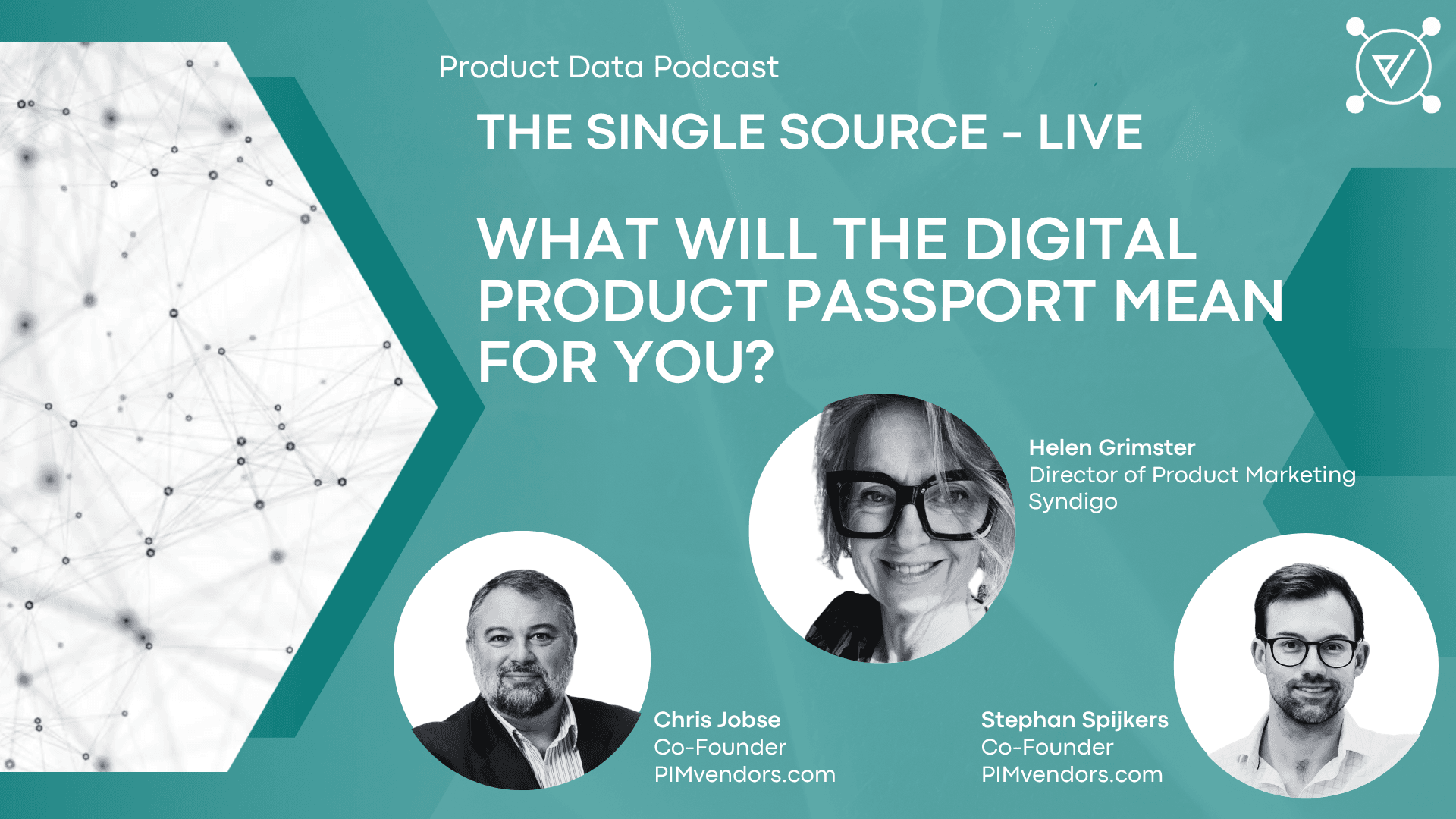
The Digital Product Passport (DPP) is moving from regulatory concept to operational reality. Under the EU Ecodesign for Sustainable Products Regulation (ESPR), a growing list of product categories will be required to carry a machine-readable digital record covering material composition, origin, environmental impact, repairability, and end-of-life guidance, accessible to consumers and regulators via a QR code, NFC tag, or RFID chip. Batteries lead the phased rollout in 2027, with textiles, furniture, consumer electronics, and additional categories following through 2030.
In this session, Stephan Spijkers (Co-Founder, PIMvendors.com) is joined by Helen Grimster (Director of Product Marketing, Syndigo) to unpack what the DPP requires in practice: how the passport is structured, which identifiers matter, who owns the data, and where the commercial opportunity sits for organisations that move early.
Speakers:
Chris Jobse — Co-Founder, PIMvendors.com
Stephan Spijkers — Co-Founder, PIMvendors.com
Helen Grimster — Director of Product Marketing, Syndigo
The DPP is a structural data programme
Most organisations underestimate the scope of what the DPP demands. The passport is a structured, machine-readable record covering verified material composition, lifecycle data, environmental impact metrics, recycled content percentages, and repairability information. It is accessed through a unique product identifier carried on a QR code, NFC tag, or RFID chip, and it must remain current throughout the product’s life. None of this works on top of scattered spreadsheets or fragmented supplier documents. Compliance requires a structured product data backbone with clear governance, version control, and supplier data flows built in from the start. Organisations approaching the DPP as a labelling or marketing task consistently misjudge the build, the timeline, and the cost.
Batch versus item: the identifier decision shapes everything downstream
One of the most consequential design choices for any DPP implementation is the granularity of the unique identifier. Batch-level identifiers are cheaper to assign and easier to manage, but they limit traceability and serviceability after sale. Item-level identifiers enable per-unit history, authentication, and repair tracking, which carry significantly more value for high-margin, high-risk, or regulated goods, at a meaningfully higher operational cost. The right choice depends on product category, expected lifecycle, fraud exposure, and the use cases the business wants the DPP to support beyond compliance. Settling this early avoids expensive rework when supplementing acts under the ESPR clarify category-specific obligations.
Data ownership and integration determine compliance readiness
A DPP only works when product data flows reliably across the full value chain. Manufacturers, suppliers, distributors, and retailers each hold parts of the required record, and gaps at any point compromise the passport for the finished product. Two operational implications follow. First, internal data ownership must be assigned and enforced; without a defined owner for material, sustainability, and lifecycle attributes, accuracy degrades quickly under audit conditions. Second, integration between PIM, ERP, PLM, and supplier portals is no longer optional, because the DPP requires data to be collected, validated, and published continuously rather than at product launch. The organisations furthest along treat the DPP as a supply chain data programme, with PIM serving as the orchestration layer.
Early movers convert compliance into commercial advantage
Compliance defines the minimum, while the data infrastructure built to meet it can do considerably more. The same structured product data required for the DPP supports authenticity verification for high-value goods, substantiated sustainability claims, post-sale service and repair workflows, and resale or recommerce models. Smaller retailers and challenger brands that build clean DPP data from the outset also gain access to channels and partners that increasingly require verified product information as a precondition for trade. Consumer scan rates on DPP QR codes remain modest today, but they are climbing as DPP-equipped categories reach the shelf; brands offering richer behind-the-code experiences will capture a disproportionate share of trust and loyalty as the standard normalises.
Key Takeaways
- The DPP is a structured, machine-readable data record with regulatory and audit obligations. Treating it as a labelling exercise leads to under-investment in the data infrastructure compliance actually requires.
- Batch-level versus item-level identifiers is a strategic decision with downstream consequences for traceability, servicing, and anti-counterfeit use cases. The right answer is category- and use-case-dependent and should be resolved early.
- Regulatory scope is expanding in phased waves through 2030. Organisations selling into the EU should map their product categories against the published and expected rollout timeline now, not in the year of enforcement.
- Data ownership is the single biggest internal blocker. Without a defined owner for each DPP-relevant attribute, accuracy and completeness will not hold under audit.
- PIM is the orchestration layer for DPP compliance. Most existing PIM implementations were not designed for verified supplier data flows or lifecycle records and will need extension rather than replacement.
- Smaller retailers and challenger brands have a structural opportunity: building DPP-ready data from a clean baseline is faster and cheaper than retrofitting it across a legacy estate.
- The investments required for DPP compliance and for AI-augmented product data largely overlap. Funding a single data foundation for both objectives delivers better return than running them as separate workstreams.
- Consumer-facing QR scan rates are still maturing, but early-mover brands with rich, verified content will gain a lasting trust advantage as DPP adoption scales across categories.
Not sure how the Digital Product Passport will land in your product portfolio?
Visit pimvendors.com to compare PIM solutions built for DPP compliance, or book a free call with our consultants to scope a practical readiness plan for your organisation.
