


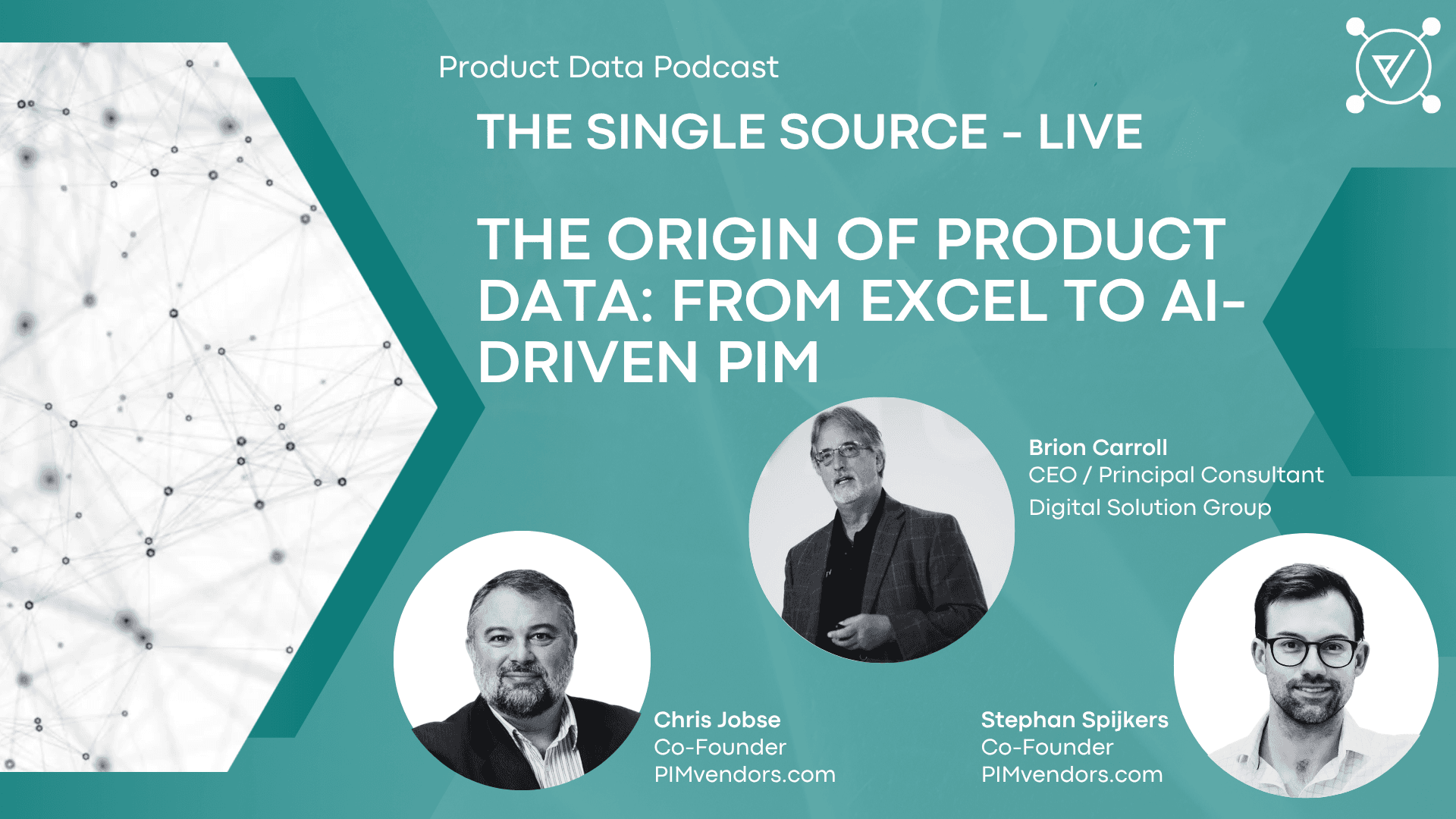
Most organizations did not design their product data for AI. They inherited it from spreadsheets, ERPs, and a decade of accumulated workarounds. In this episode of The Single Source Podcast, Stephan Spijkers and Chris Jobse from PIMvendors.com sit down with Brion Carroll to trace how product data has moved from Excel to AI-driven PIM, and what that shift demands of the underlying architecture.
The discussion covers the boundary between PIM, PLM, and PDM, the rise of “product memory” as the foundation for AI agents, and what data governance actually requires once AI moves from pilot into production.
Speakers:
Brion Carroll – CEO / Principal Consultant
Stephan Spijkers – Co-Founder, PIMvendors.com
Chris Jobse – Co-Founder, PIMvendors.com
Watch the Full Episode
The full session is available on the PIMvendors YouTube channel. If your organization is rethinking how product data feeds AI agents and downstream commerce, this episode addresses the structural questions most vendor pitches skip.
Key Takeaways:
PIM, PLM, and PDM serve distinct functions and cannot be collapsed into one system. Each governs a different slice of the product data lifecycle: PDM owns engineering and design intent, PLM manages lifecycle stages and change control, and PIM commercializes product content for channels and customers. Organizations that blur these boundaries see their architectures break once AI workloads enter the picture, because AI agents cannot resolve conflicting definitions of what “the product” actually is.
Product memory is the architectural layer that makes AI agents reliable. A generic data lake stores product information without preserving the relationships, hierarchies, and provenance that agents need to produce trustworthy answers. A product memory layer encodes those relationships explicitly and treats them as first-class infrastructure. Implementations that build this layer deliberately consistently outperform implementations that point AI at undifferentiated product data.
Data governance is the precondition for any AI value in product data. Without explicit ownership, agreed definitions, and channel-specific quality criteria, AI accelerates inconsistency rather than reducing it. Governance defines what good data means in each context, who is accountable for it, and how it is maintained over time. Layering AI on top of ungoverned data produces opaque outputs built on inconsistent inputs, at scale.
Data quality sets the ceiling on AI output value. Sophisticated models do not compensate for incomplete attributes, missing relationships, or stale records. They amplify them at scale. Investing in model selection before investing in data cleanup is the wrong sequence, and one of the most common reasons AI pilots fail to reach production.
AI agents deliver value only when embedded in a governed workflow. Agents that operate against ungoverned product data create more remediation work than they prevent. The episode reframes agents as workflow participants with defined inputs, outputs, and validation checks rather than as autonomous assistants pointed at a generic dataset. That framing changes how organizations should scope their first AI deployments in PIM.
Data relationships carry more AI value than raw attributes. Most product data programs focus on attribute completeness. The higher-leverage work sits in the relationships between products, components, channels, and compliance requirements. AI extracts disproportionate value from well-structured relational data and very little from flat attribute lists. Architectures that prioritize relational integrity early scale far better once AI agents arrive.
AI-ready architecture is iterative by design. Schemas, channel requirements, and agent capabilities all change continuously. Treating the data architecture as a fixed deliverable guarantees obsolescence within the first product cycle. Ongoing iteration, maintenance, and budget allocation are part of the architecture itself, not separate initiatives. Organizations that plan for this from day one avoid the expensive replatforming cycles that catch rigid implementations later.
👉 Wondering whether your product data architecture is ready for AI agents and the next wave of PIM?
Compare PIM solutions and book a call with our team at pimvendors.com
