


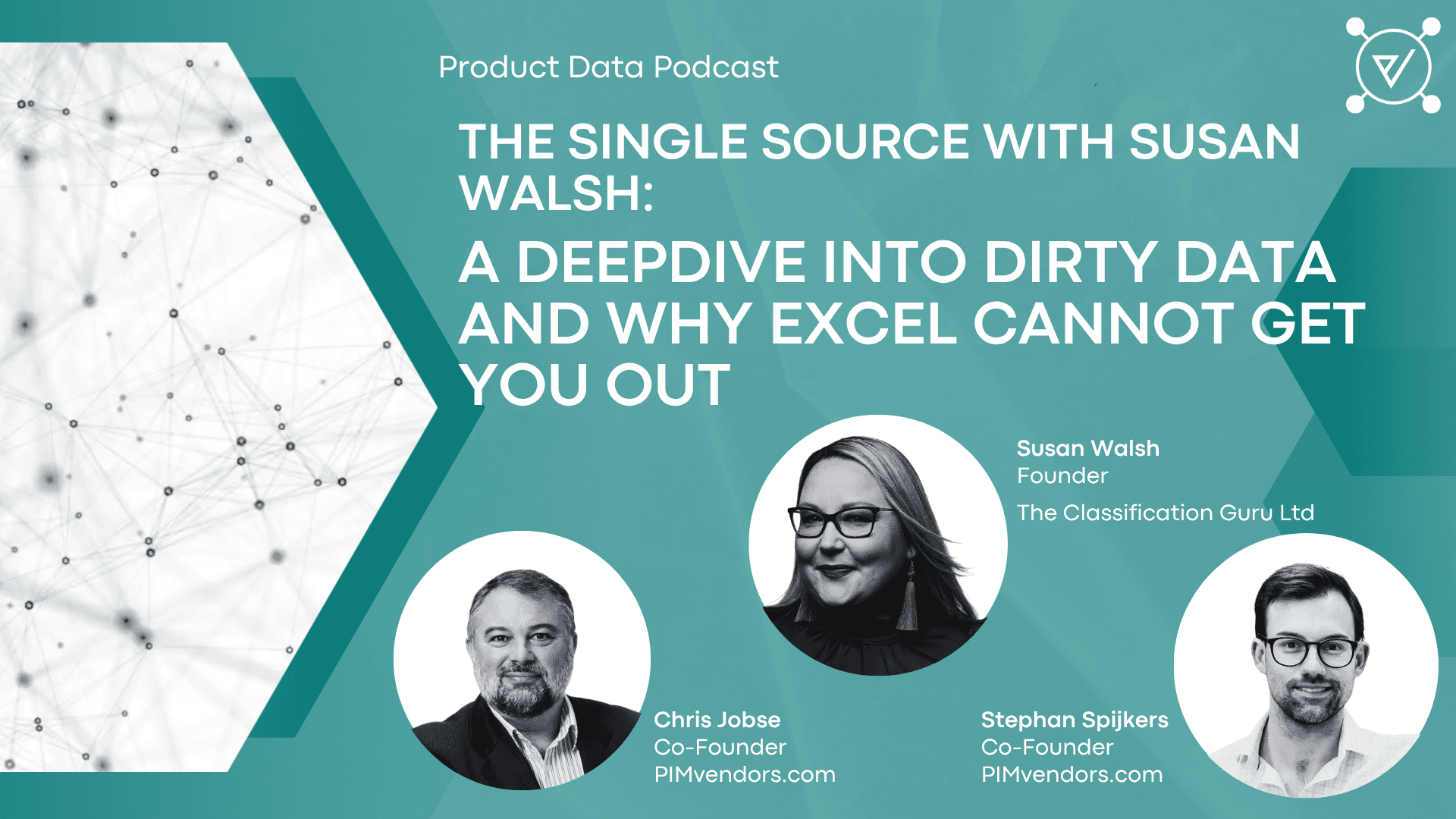
Every organization has dirty data. Few quantify what it actually costs them — in delayed launches, failed integrations, and AI implementations that produce confident-sounding nonsense at scale.
In our latest PIMvendors podcast session, we break down the real mechanics of data quality: why it degrades, who owns it, and what to do about it before automation amplifies the problem.
Speakers:
Stephan Spijkers – Co-Founder, PIMvendors.com
Chris Jobse – Co-Founder, PIMvendors.com
Susan Walsh – Founder, The Classification Guru Ltd
📺 Watch the full episode on our YouTube channel:
Key Takeaways:
-
- Data quality is an investment with measurable ROI, not a maintenance task. Organizations that treat it as overhead consistently underperform those that fund it as a strategic capability. The conversation puts concrete framing around how to build the business case internally.
- AI amplifies whatever data quality you already have. Clean inputs produce actionable outputs. Dirty inputs produce errors at scale with higher confidence. Every AI initiative should start with a data quality audit, not a model selection.
- Your biggest data risk is undocumented processes and “hidden heroes.” These are the people who manually fix broken data streams without anyone knowing. When they leave, the system breaks and nobody understands why. Knowledge sharing and process documentation are non-negotiable safeguards.
- Mergers and acquisitions are where data quality problems compound fastest. Integrating two systems means integrating two sets of assumptions, taxonomies, and quality standards. Without a deliberate data integration strategy, you inherit the worst of both organizations.
- Data ownership requires explicit assignment, not assumption. When nobody formally owns data quality, everybody assumes someone else does. The session outlines how to establish clear accountability structures that actually hold.
- Centralized governance and departmental autonomy are not mutually exclusive. The most effective organizations build a central framework for standards and definitions while giving business units the operational flexibility to manage day-to-day data decisions within those guardrails.
- Standardization today is future-proofing for tomorrow. Investing in consistent data structures, naming conventions, and category management now reduces the cost of every future system migration, integration, or automation initiative.
Ready to take action on your data quality?
Book a call with the PIMvendors team and we’ll help you assess your current data landscape, identify the highest-impact improvements, and build a roadmap to get there.
