
Core
AtroPIM Alternatives: 7 PIM Solutions to Compare
Stephan Spijkers · 2026-10-11 · Updated 2026-10-12 · 9 min read
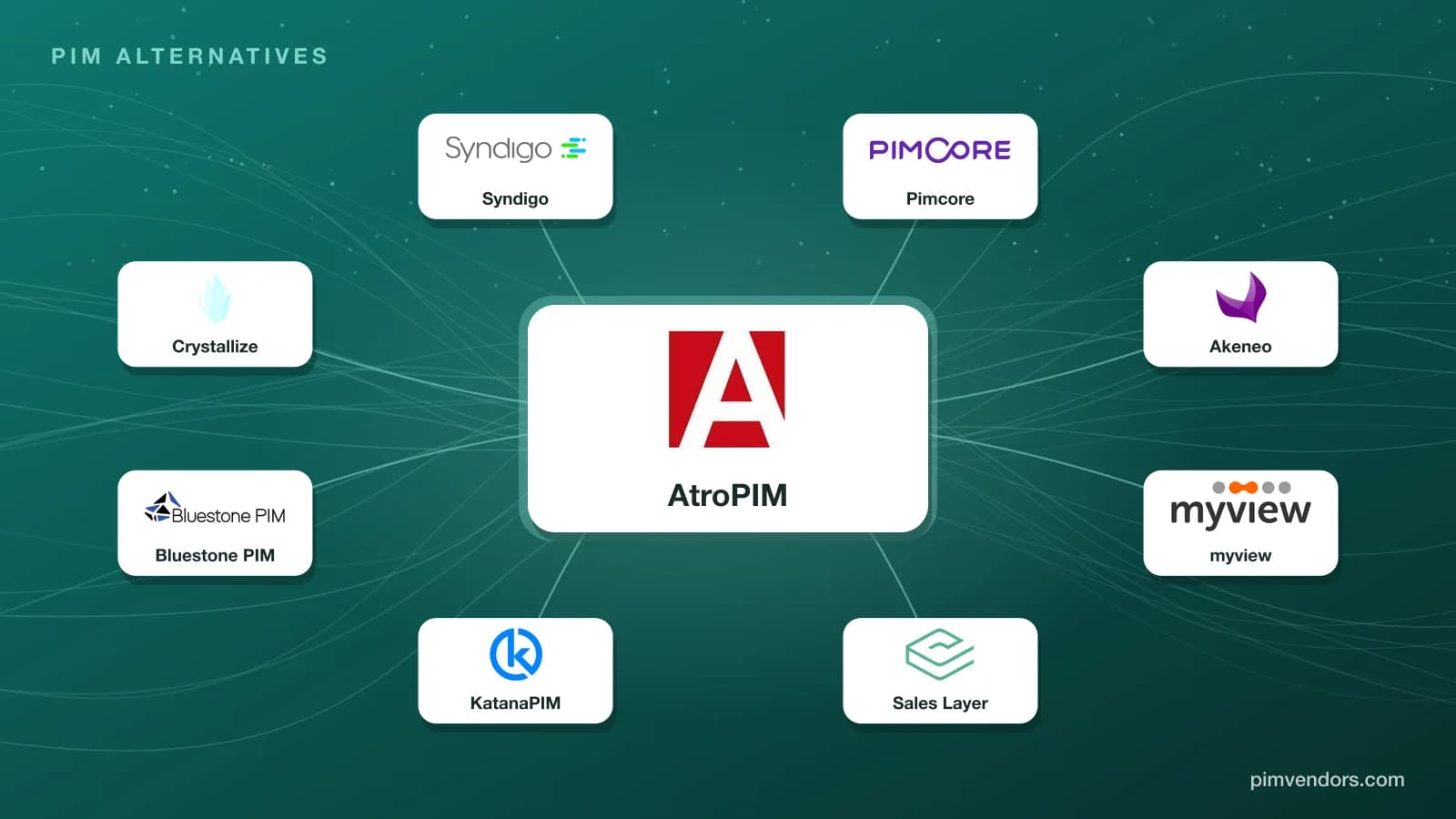
AtroPIM comes up when teams look for an open source PIM they can shape to their own data. The same flexibility is why some teams look further: it asks for developers, and it leaves some turnkey features to you. This guide covers what AtroPIM is, why teams look at alternatives, seven options by situation, and how to switch.
What AtroPIM is and who it fits
AtroPIM comes from AtroCore in Regensburg, Germany, and was founded in 2018. According to our AtroPIM profile, it is open source under GPLv3 and is also offered as SaaS, on premise and cloud-hosted, built on the AtroCore platform in PHP. It targets small and mid-market companies and is active in Europe. The profile lists:
- Configurability: custom entities, fields and layouts, with API parity, and many changes without code.
- Product modeling with hierarchical variants, classifications, channel-scoped attributes and relations.
- Master data beyond product: suppliers, assets and contracts on the same instance, with clusters, golden records and merge rules. Fuzzy matching is a premium module.
- Native DAM, a PDF generator and an InDesign adapter for print catalogs. AtroPIM showed print catalogs and PDFs straight from the PIM in one of our lightning demos.
- Exchange modules for ETIM and BMEcat.
Our analyst places AtroPIM with organizations, often European B2B or industrial companies, that need a highly configurable product and master data hub, value GPLv3 and self-hosting, and have internal developers or a trusted integrator. Its strengths include transparent module and support pricing, with no per-seat fee on the core.
Why teams look for an AtroPIM alternative
The reasons below come from our analyst's assessment and the profile, not from complaints.
- No developers in house. AtroPIM assumes internal developers or a trusted integrator. Without them, a SaaS PIM that marketing teams run on their own is the safer choice.
- A supplier portal out of the box. AtroPIM's supplier portal is permissions and process, not a turnkey supplier onboarding product.
- GDSN. Our analyst found GS1 and GDSN automation in the marketing but no public GDSN product. Verify it before a retailer's data pool requirement decides your selection.
- A large app ecosystem. AtroPIM is not aimed at buyers who need a large marketplace of ready apps.
- Scale. AtroPIM targets small and mid-market companies.
- Running it yourself. Self-hosting means hosting, upgrades and security are your job or a partner's. AtroCore also sells SaaS, so check that option before you switch vendors.
AtroPIM alternatives at a glance
- Pimcore: best for an open-core platform with PIM, DAM and content at mid-market and enterprise scale.
- Akeneo: best for a SaaS PIM with a broad app ecosystem and supplier onboarding.
- myview: best for technical manufacturers with ETIM, BMEcat and print catalogs.
- Sales Layer: best for a SaaS PIM that marketing teams run without developers.
- KatanaPIM: best for a SaaS PIM with published pricing for merchants.
- Bluestone PIM: best for large catalogs in a composable stack.
- Crystallize: best for a headless commerce backend with PIM.
The alternatives
Pimcore
Pimcore is an Austrian open-core platform, founded in 2010 and built on PHP and Symfony, that combines PIM, DAM, master data and content, and runs self-hosted, in a private cloud or as a managed service. Our analyst places it with mid-market and enterprise manufacturers, brands and retailers, often in DACH and the EU, with a technical team or an integrator budget. Its ETIM and eCl@ss classification is credible.
- Where it differs: the same open, self-hosted approach as AtroPIM, at a larger scale and with content and portals in the same platform.
- Check: open-core is not free at enterprise scale. Check the licence thresholds, audits and which features need the Enterprise edition, and ask for paying customers in your sector. Ownership matters too: see what Tenzing buying Pimcore changes for buyers.
Akeneo
Akeneo is a French PIM, founded in 2013, with open-source roots. It is sunsetting its free Community Edition, so today it is a paid SaaS product (Product Cloud). Our analyst places it with mid-market and enterprise brands, retailers and wholesalers that put multichannel product experience, an API-first architecture, enrichment productivity and supplier onboarding first.
- Where it differs: a broad ecosystem and a supplier data onboarding product, where AtroPIM's supplier portal is permissions and process.
- Check: moving from AtroPIM to Akeneo means moving from self-hosting to SaaS; if you want to keep running the software yourself, Pimcore is the closer fit. Akeneo does not replace a multidomain MDM, so plan where AtroPIM's supplier or contract records go. GS1, ETIM and digital product passport support need proof in a proof of concept, often through a partner. See our Akeneo alternatives.
myview
myview is a German modular PIM for technical product communication, offered as SaaS, on premise or cloud-hosted. Our analyst places it with mid-market manufacturers and distributors in DACH and the EU with technically complex, variant-rich catalogs, such as lighting, HVAC and industrial components, that need PIM and DAM, BMEcat, ETIM and ECLASS, and print and catalog automation.
- Where it differs: ready-made modules for a deep library of industry exports, print automation and workflows built on Camunda, where AtroPIM leaves more of the configuration to you or your integrator.
- Check: it is not a GDSN or retail syndication PIM without an external data pool, and supplier onboarding is import and integration, not a portal. Our profiles estimate a longer deployment than for AtroPIM.
Sales Layer
Sales Layer is a Spanish SaaS PIM, founded in 2013, known for an interface that marketing teams can run, quick onboarding and prebuilt connectors to Shopify, Magento, Amazon and other channels. Our analyst places it with mid-market manufacturers, brands, distributors and B2B suppliers that want a fast, marketer-friendly PIM, with quality scoring and optional Ariba punchout.
- Where it differs: a SaaS product that works without a development team, where AtroPIM rewards in-house developers.
- Check: GS1 and GDSN are not native and come through a partner at extra cost. It is not MACH-certified, and its API relies on polling with rate limits, so compare the API if you build a composable stack.
KatanaPIM
KatanaPIM is a Dutch SaaS PIM for small and mid-market merchants, wholesalers and distributors, with published tier pricing and the API on every plan.
- Where it differs: a ready SaaS product for merchants on Magento, Shopify or Shopware, where AtroPIM is a configurable platform for B2B and industrial data. Both publish their pricing.
- Check: ETIM, GS1 and GDSN run through partner middleware, where AtroPIM has its own ETIM and BMEcat modules, and native AI is largely absent. See our KatanaPIM alternatives.
Bluestone PIM
Bluestone PIM is a Norwegian SaaS PIM on a microservice, API-first architecture, for mid-market and enterprise manufacturers, distributors and retailers with large catalogs and a composable commerce stack.
- Where it differs: built for larger catalogs and more markets, with validation rules, completeness scoring, a DAM and AI tools in the product.
- Check: deployment effort, proof of standards support and commercial terms. It runs as SaaS, so check the hosting model if self-hosting was your reason for AtroPIM. It is a PIM, not a master data hub, so non-product records need another home.
Crystallize
Crystallize is a Norwegian headless backend that combines PIM, content and commerce behind a GraphQL API. Our analyst places it with digital-native direct-to-consumer and B2B commerce teams that build custom storefronts and have engineers available.
- Where it differs: a flexible data model like AtroPIM's, but built to power a storefront you build yourself rather than to feed an ERP-centric landscape.
- Check: it is not a pure PIM for ERP-centric catalog work, and it has no native ETIM, GDSN or marketplace syndication.
How to choose and switch
Decide on licence and hosting
Open source you host yourself, open-core with paid editions, or SaaS. This decision halves the shortlist. Our open source PIM comparison covers what each model asks of your team.
Inventory your configuration
List the custom entities, fields, layouts and workflows, the modules you use (ETIM, BMEcat, PDF, DAM), the records beyond product data, and every integration. Configuration does not move between products, so this list is the real scope of the switch.
Shortlist two or three systems
Match your reasons to the alternatives above, and drop any system that fails a hard requirement on paper.
Demo with your own data
Give each vendor one real product family, including one custom entity and one export you depend on, such as BMEcat or a print catalog.
Migrate and switch off
Export through AtroPIM's REST API, rebuild the model in the new system, and run both in parallel per channel until the output matches. Then end the SaaS subscription or support contract.
Compare and shortlist
Compare these and other systems in the PIM profile overview, or answer a few questions in the free PIM Scan for a ranked shortlist. Related guides:
- Open source PIM compared: Pimcore, AtroPIM and other open options side by side.
- Pimcore alternatives: the other open-core comparison.
- Cloud or on-premise PIM: how to choose a hosting model.
Where to go from here
Frequently asked questions
What is AtroPIM?
AtroPIM is a PIM and master data hub from AtroCore in Regensburg, Germany, founded in 2018. It is open source under GPLv3 and is also offered as SaaS. It is highly configurable, with custom entities, native DAM, print output and modules for ETIM and BMEcat, and suits teams with developers or a trusted integrator.
Is AtroPIM open source?
Yes. AtroPIM is published under GPLv3, so you can run and change it yourself. AtroCore also sells it as SaaS, plus paid modules and support. Our analyst notes transparent module and support pricing and no per-seat fee on the core.
What are the best AtroPIM alternatives?
Pimcore is the closest open-core alternative. Akeneo is sunsetting its Community Edition, so treat it as a SaaS option. myview fits technical manufacturers with ETIM, BMEcat and print catalogs. Sales Layer and KatanaPIM are SaaS options for teams without developers. Bluestone PIM fits large catalogs in a composable stack, and Crystallize teams that build their own storefront.
What is the difference between AtroPIM and Pimcore?
Both are open and can be self-hosted. AtroPIM is GPLv3 open source for small and mid-market companies and focuses on configurable product and master data. Pimcore is open-core for mid-market and enterprise companies and combines PIM, DAM and content in one platform. Check Pimcore's licence thresholds and which features need its Enterprise edition.
What is the difference between AtroPIM and Akeneo?
Akeneo is sunsetting its free Community Edition and sells a paid SaaS product, with a broad app ecosystem and a supplier onboarding product. AtroPIM is GPLv3 open source you can still self-host, with deeper configurability and master data beyond product. Akeneo does not replace a multidomain MDM, and GS1 or ETIM support needs proof in a proof of concept.
Is there an AtroPIM alternative that needs no developers?
Yes. Sales Layer and KatanaPIM are SaaS products that marketing and e-commerce teams can run without a development team. KatanaPIM publishes its pricing. Both run GS1, GDSN and ETIM through partners.
Does AtroPIM support GDSN?
Our analyst assessment found GS1 and GDSN automation in AtroPIM's marketing but no public GDSN product. Verify it before a retailer's data pool requirement decides your selection. None of the alternatives on this page lists native GDSN on its profile either, so plan a data pool next to the PIM if a retailer requires one.
Diagnostic
Do you actually need a PIM?
Run the complexity index before you budget software or hire an SI.
Budget
Model a first-pass TCO
Translate catalog shape into a three-year cost range in under ten minutes.