
Core
KatanaPIM Alternatives: 7 PIM Solutions to Compare
Stephan Spijkers · 2026-10-11 · 8 min read
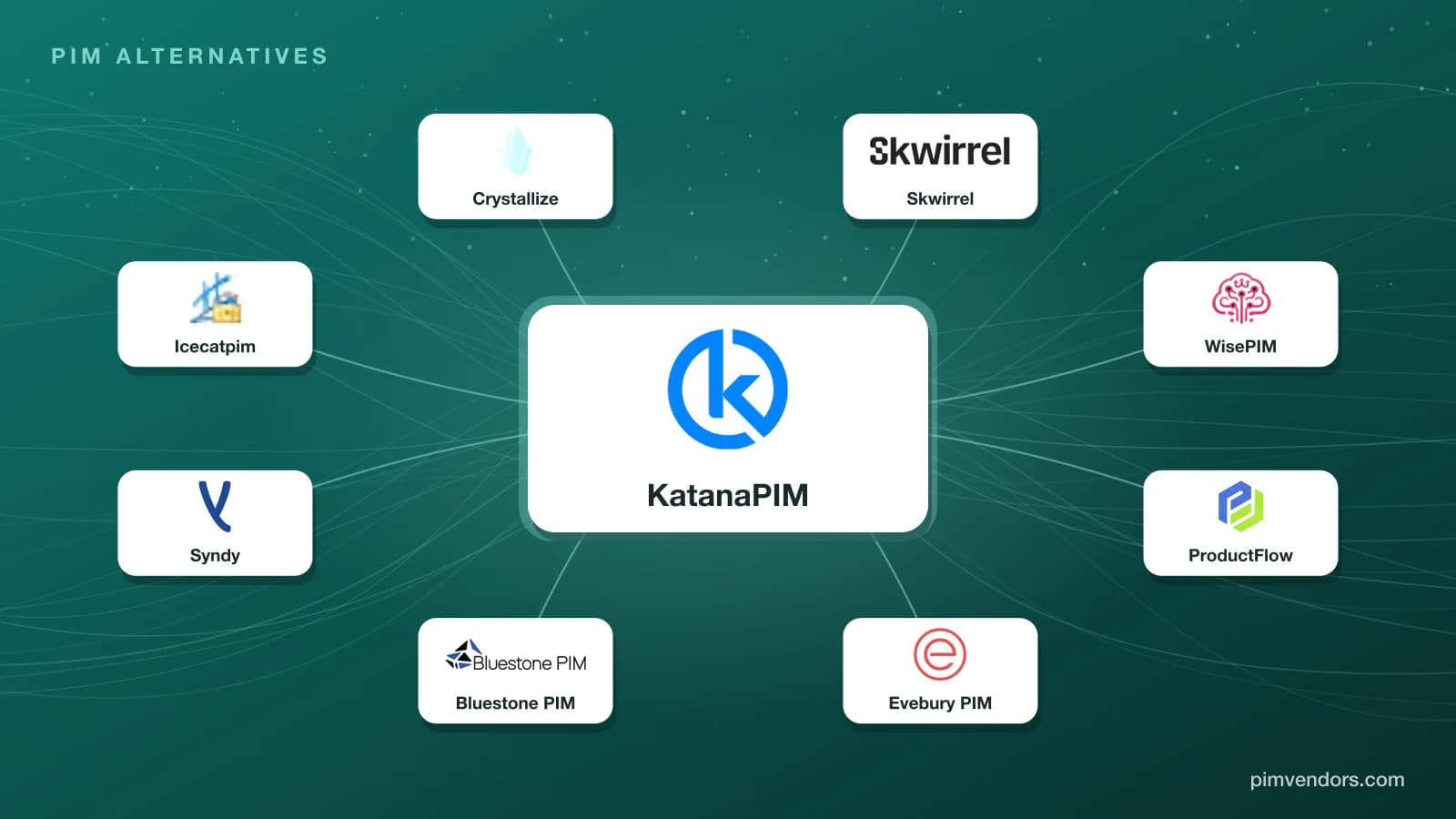
KatanaPIM is one of the Dutch SaaS PIMs that merchants consider when they move product data out of spreadsheets. Teams compare it with other systems when they select a first PIM, and again when a standard, a channel or growth asks for something it does not do natively. This guide covers what KatanaPIM is, why teams look at alternatives, seven options by situation, and how to switch.
What KatanaPIM is and who it fits
According to our KatanaPIM profile, KatanaPIM is a SaaS PIM from the Netherlands, active in the Benelux and the rest of Europe, for small and mid-market companies. Its users are manufacturers, wholesalers and retailers in sectors such as fashion, home goods, electronics and general retail. The profile lists:
- Product modeling with variants, content inheritance, specification groups and category automations.
- Workflow with configurable steps and roles, and a completeness list per channel.
- Import and mapping through Feedmapper and Automap.
- Integrations with Exact, Business Central, Shopify, Magento, Shopware, WooCommerce and others. Many run through partners rather than prebuilt plugins.
- Images and attachments, with external DAMs such as Brandfolder and pixx.io as an option.
Our analyst places KatanaPIM with mid-market merchants, wholesalers and distributors in the Benelux and the EU on Magento, Shopify or Shopware with Exact or a similar ERP. They need a usable SaaS PIM, transparent list pricing and variant-heavy catalogs, and they export to marketplaces through integrators. Customer cases on the profile include the furniture brand Polewolf and the luggage brand SUITSUIT.
Why teams look for a KatanaPIM alternative
Our analyst lists two watch-outs for KatanaPIM. The profile's scale and integration model explain the rest.
- A standard must be built in. GS1, ETIM and GDSN run through partner middleware. For a wholesaler that must deliver ETIM data, or a manufacturer that must pass GS1 checks, a PIM with the standard built in removes a link from the chain.
- AI inside the PIM. Native AI is largely absent. Our analyst advises to budget separately for tools such as Alumio, Fozzels or OpenAI.
- Marketplaces are the main channel. KatanaPIM exports to marketplaces through integrators. Sellers who live on Bol.com and Amazon may want listings, offers and orders in one tool.
- Brand-to-retailer syndication. Brands that deliver content to many retailers in each retailer's format need a different workflow than merchants feeding their own shop.
- Scale. KatanaPIM targets small and mid-market companies, and its workflows are not enterprise process management.
KatanaPIM alternatives at a glance
- Skwirrel: best for technical wholesale where ETIM and 2BA are mandatory.
- WisePIM: best for AI enrichment, translation and ETIM auto-fill.
- ProductFlow: best for sellers whose main channel is marketplaces.
- Evebury PIM: best for food and non-food manufacturers that need a ready data model and GS1 checks.
- Bluestone PIM: best for large catalogs and many markets in a composable stack.
- Syndy: best for brands that send content to retailers in each retailer's format.
- Crystallize: best for teams that build their own storefront on a headless backend.
The alternatives
Skwirrel
Skwirrel is a Dutch SaaS PIM for technical products, active in the Benelux and DACH. Our analyst places it with technical wholesalers, distributors and manufacturers where ETIM classification and exchange with 2BA or a similar data pool are mandatory.
- Where it differs: ETIM and the data pool are built in, where KatanaPIM uses partners. It also offers a JSON-RPC API with webhooks and a data quality dashboard.
- Check: our analyst calls it the wrong tool for GS1-led consumer goods and marketplace-first selling. It is a small vendor, so validate service levels and support hours. See our Skwirrel alternatives.
WisePIM
WisePIM is a Dutch SaaS PIM built around AI: attribute extraction, generated descriptions and translation, plus fast onboarding of supplier feeds. The profile also lists ETIM release import, ETIM auto-fill, BMEcat export and quality rules per channel.
- Where it differs: AI enrichment and translation are the core of the product, where KatanaPIM relies on external tools.
- Check: our analyst says to evaluate it on deployment effort, proof of standards support and commercial transparency. The vendor's accuracy claims for AI classification are not independently tested, and configurable or engineering product structures are not evidenced, so test both on your own data.
ProductFlow
ProductFlow is a Dutch PIM and marketplace management platform. Our analyst places it with European marketplace-led merchants, especially on Bol.com, where it is a Gold Partner.
- Where it differs: listings, offers, orders and repricing per marketplace in one login, with a broad European connector library, where KatanaPIM reaches marketplaces through integrators.
- Check: it is not a fit for GDSN, ETIM, digital product passport or master data programs, and our analyst rates its workflow, DAM and golden record depth as weak.
Evebury PIM
Evebury PIM is a Dutch SaaS PIM, founded in 2022, for food and non-food manufacturers. It comes with a pre-built data model, so you start without a long modeling project. The profile lists GS1 message pre-validation, packaging hierarchies, ingredients and recipes, and four-eyes approval on critical fields.
- Where it differs: a ready data model for manufacturers and GS1 checks in the product, where KatanaPIM is built for merchants and uses partners for GS1.
- Check: our analyst says to evaluate it on deployment effort, proof of standards support and commercial transparency. Task management depends on the tier, and file storage is not a full DAM.
Bluestone PIM
Bluestone PIM is a Norwegian SaaS PIM on a microservice, API-first architecture, for mid-market and enterprise manufacturers, distributors and retailers with large catalogs across markets, brands and channels.
- Where it differs: built for a larger scale and a composable stack, with validation rules, completeness scoring, a DAM and AI tools for content and translation in the product.
- Check: deployment effort, proof of standards support and commercial terms. Ask for a multi-year quote, so you can compare it with KatanaPIM's published pricing.
Syndy
Syndy is a Dutch PIM and DAM platform, part of the Icecat group, built for content exchange between brands, suppliers and retailers. It maps product content to retailer-specific formats and scores completeness, with FMCG, DIY, toys and healthcare among its sectors.
- Where it differs: it is built for brands that deliver to many retailers, while KatanaPIM is built for merchants that feed their own channels.
- Check: our analyst says to evaluate it on deployment effort, proof of standards support and commercial transparency. Ask which of your retailers it reaches today.
Crystallize
Crystallize is a Norwegian headless backend that combines PIM, content and commerce behind a GraphQL API. Our analyst places it with digital-native direct-to-consumer and B2B commerce teams that build custom storefronts and have engineers available.
- Where it differs: product data, content and commerce sit in one backend for a storefront you build yourself, where KatanaPIM feeds an existing shop.
- Check: it is not a pure PIM for ERP-centric catalog work, and it has no native GDSN, ETIM or marketplace syndication.
How to choose and switch
Name the gap
A standard, AI, marketplaces, retailer syndication or scale. If you cannot name one, compare first whether a partner integration closes the gap inside KatanaPIM.
Inventory what KatanaPIM does today
List the attributes, specification groups, variants, workflows, Feedmapper mappings, stores and exports, and every connector with the party that built it. The PIM RFP guide helps turn this into requirements.
Shortlist two or three systems
Match the gap to the alternatives above, and drop any system that fails a hard requirement on paper.
Demo with your own data
Give each vendor one variant-heavy product family and two real channels. If a standard is the reason to switch, include an ETIM or GS1 export in the test.
Migrate per channel, then end the subscription
Move one store or channel at a time and compare the output with KatanaPIM until it matches. End the subscription after the last channel has moved.
Compare and shortlist
Compare these and other systems in the PIM profile overview, or answer a few questions in the free PIM Scan for a ranked shortlist. Related guides:
- Beeyond alternatives: another Dutch PIM and its alternatives.
- What AI inside a PIM actually does: what to test before you pay for AI.
- PIM migration insights with KatanaPIM: a podcast on how migrations run.
Where to go from here
Frequently asked questions
What is KatanaPIM?
KatanaPIM is a Dutch SaaS PIM for small and mid-market merchants, wholesalers and distributors in the Benelux and the rest of Europe. It handles variants, specification groups, workflows and import mapping, and connects to ERP and commerce platforms such as Exact, Shopify, Magento and Shopware. It publishes its tier pricing and includes the API on every plan.
What are the best KatanaPIM alternatives?
It depends on the gap you want to close. Skwirrel and WisePIM fit technical catalogs with ETIM, Evebury PIM fits food and non-food manufacturers that need GS1 checks, ProductFlow fits marketplace sellers and Syndy brands that supply retailers. Bluestone PIM fits companies that outgrow the mid-market, and Crystallize teams that build their own storefront.
Does KatanaPIM support ETIM, GS1 and GDSN?
Through partners. Our analyst assessment notes that GS1, ETIM and GDSN run through partner middleware in KatanaPIM and are easy to overstate on integration pages. If one of these standards is mandatory for you, ask for a demo of the full chain, or compare a PIM that has it built in, such as Skwirrel for ETIM.
Does KatanaPIM have built-in AI?
Our analyst assessment says native AI is largely absent in KatanaPIM, so budget for external tools for AI content and translation. If AI enrichment is the main reason to switch, WisePIM is built around it. Test any AI output on your own products before you decide.
Which KatanaPIM alternative fits marketplace sellers?
ProductFlow. KatanaPIM exports to marketplaces through integrators, while ProductFlow manages listings, offers, orders and repricing per marketplace in one tool, with Bol.com as its home ground. It is not a fit for ETIM, GDSN or master data programs.
Is there a KatanaPIM alternative for larger companies?
Bluestone PIM is built for mid-market and enterprise companies with large catalogs, many markets and a composable commerce stack. Check deployment effort, proof of standards support and commercial terms, and compare a multi-year quote with KatanaPIM's published pricing.
How do you switch from KatanaPIM?
Write down the gap you want to close, list the data model, mappings, stores, exports and connectors you use, and find out who built each connector. Test two or three alternatives with one real product family, migrate one channel at a time with a parallel run, and end the subscription after the last channel has moved.
Diagnostic
Do you actually need a PIM?
Run the complexity index before you budget software or hire an SI.
Budget
Model a first-pass TCO
Translate catalog shape into a three-year cost range in under ten minutes.