
Core
Ergonode Alternatives: 7 PIM Solutions to Compare
Stephan Spijkers · 2026-10-11 · Updated 2026-10-12 · 9 min read
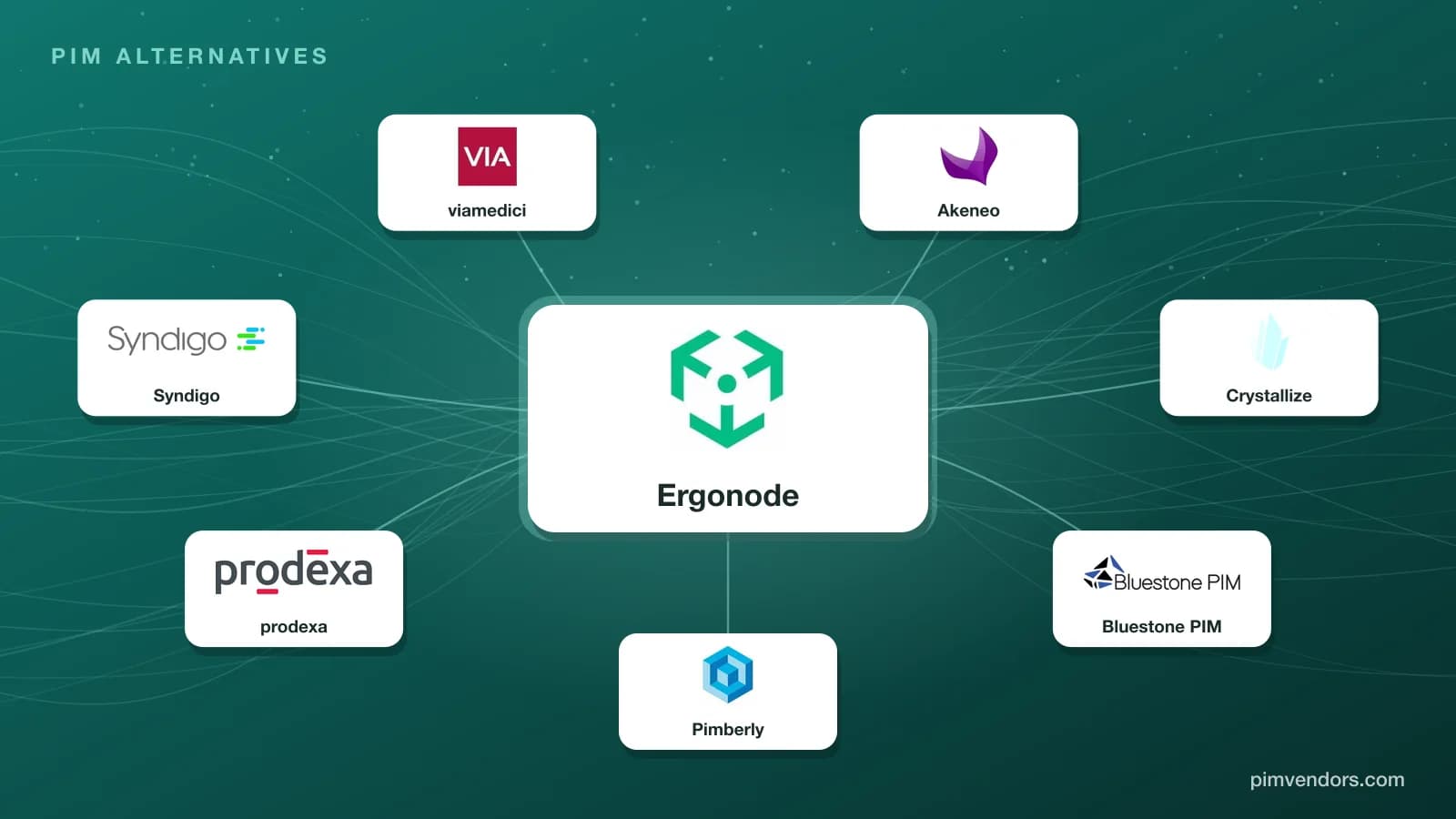
This guide is for teams that use Ergonode, or have it on a shortlist, and want to see what else fits. It covers what Ergonode does and for whom, the reasons teams look further, seven alternatives in order of fit for typical Ergonode buyers, and how to switch. Founding years, headquarters and the fit and watch-out notes come from each system's vendor profile.
What Ergonode is and who it fits
Ergonode is a Polish PIM, founded in 2018 and built on Symfony and Vue.js. It runs as SaaS or cloud-hosted, with the SaaS version hosted in European data centers. According to our profile, it offers:
- A content-first interface for marketers, content teams and product managers.
- A headless, REST API-first architecture, with webhooks and plugins for Magento, Shopware, WooCommerce and Shopify.
- Custom product templates for attribute sets and relationships per category.
- Collaboration tools: tasks, comments and approval workflows inside the PIM.
- A product DAM included, plus localization and AI support for content work.
Our analyst assessment puts its best fit with mid-market digital brands and retailers that want an enrichment interface people like to use, API and headless delivery and an included DAM, with transparent SaaS pricing. The profile names fashion, electronics, home and lifestyle and direct-to-consumer brands as typical sectors.
Why teams look for an Ergonode alternative
- Retailer standards. Our analyst does not see Ergonode as proven GS1-native. Brands whose retailers start to require GDSN need a data pool or a partner, or a different platform.
- Supplier onboarding. The maturity of its supplier portal is unclear in our assessment. Retailers and distributors that take in many supplier catalogs want that part proven.
- Enterprise master data. Ergonode is not proven as a multidomain MDM. Companies that need a governed golden record across domains look at MDM-class platforms.
- Self-hosting and licence. Ergonode describes an open-source edition, but our profile lists the software as proprietary SaaS. Teams that must self-host need to confirm the edition and licence, or choose a platform with a clear on-premise option.
- Technical catalogs. The profile does not mention industrial classification such as ETIM or ECLASS, which manufacturers and wholesalers of technical products often need.
- Commerce in the same backend. Some direct-to-consumer teams would rather run product data, content and checkout in one headless system than connect a PIM to a separate shop.
Ergonode alternatives at a glance
- Akeneo: best for a like-for-like PIM with supplier onboarding and a broad ecosystem.
- Crystallize: best for direct-to-consumer and B2B teams that want product data, content and commerce in one headless backend.
- Bluestone PIM: best for a composable SaaS PIM for multi-market mid-market and enterprise catalogs.
- Pimberly: best for PIM and DAM in one platform for retailers and brands that sell globally.
- prodexa: best for technical catalogs with ETIM, ECLASS, supplier catalogs and print.
- Syndigo: best when retailer compliance and GDSN start to drive the project.
- Viamedici: best for SAP-centric enterprises that need PIM, MDM and DAM from one vendor.
The alternatives
Akeneo
Akeneo is a French PIM, founded in 2013 and also built on Symfony, sold as SaaS (Product Cloud). It is sunsetting its open-source Community Edition. It serves companies from small to enterprise.
- Where it fits differently: it is the closest match to Ergonode in approach, with an API-first record and enrichment at the center. It adds a productized supplier data manager, completeness and quality tooling, a native DAM and a broad partner ecosystem, and it is active globally, where Ergonode is active in Europe.
- Check: it does not replace a multidomain MDM, and GS1, ETIM and digital product passport support need proof in a proof of concept, often through a partner. Compare pricing for the edition you would actually need. If self-hosting is why you are leaving Ergonode, Akeneo will not solve that now that its Community Edition is being sunset.
Crystallize
Crystallize is a Norwegian headless commerce backend, founded in 2017, that keeps product data, content and media in one place behind GraphQL APIs.
- Where it fits differently: for a direct-to-consumer brand, it can replace both the PIM and part of the commerce stack, with structured product storytelling, subscriptions and multi-market pricing behind custom storefronts. Like Ergonode, it publishes its base pricing tiers.
- Check: it needs engineering capacity, it is not a PIM for ERP-centric catalog operations, and it has no native GDSN, ETIM or marketplace syndication, so budget a custom build or rule those needs out early.
Bluestone PIM
Bluestone PIM is a Norwegian SaaS PIM, founded in 2013, built on MACH principles: microservices, API-first, cloud-native and headless.
- Where it fits differently: it targets mid-market and enterprise manufacturers, distributors and retailers with large catalogs across several markets, brands and channels. It has a native DAM, three-level product families and bundles, validation and completeness scoring, and AI tools for enrichment and translation. It suits teams that outgrow a mid-market PIM inside a composable stack.
- Check: our analyst assessment asks you to test deployment effort, proof of standards support and commercial transparency. In a composable setup, the connectors are yours to build or buy.
Pimberly
Pimberly is a UK SaaS PIM, founded in 2015 and built on AWS, that manages product data and digital assets in one platform.
- Where it fits differently: it targets mid-market and large retailers, brands, distributors and manufacturers with multi-category catalogs and global e-commerce, with AI-assisted enrichment, channel-specific content and localization. It is active globally, which matters if your growth is outside Europe.
- Check: the profile gives no detailed analyst assessment, only the standard advice: test deployment effort, proof of standards support and commercial terms.
prodexa
prodexa is a German PIM, DAM and publishing suite, founded in 2019 on a long product lineage, for manufacturers, distributors and retailers in the DACH region and Europe.
- Where it fits differently: where Ergonode centers on content for consumer brands, prodexa centers on technical catalogs: ETIM and ECLASS, supplier catalog onboarding with self-service, print and PDF output, a deep variant and pricing model, and automotive aftermarket data. Its entry SaaS pricing is published.
- Check: it is not a safe pick for an API-first, composable PIM without accepting its documented API limits, and its GDSN and digital product passport claims need a proof of concept.
Syndigo
Syndigo is a US platform that combines PIM, MDM and content syndication with a large network of retailers and other recipients, and it is a certified GDSN data pool.
- Where it fits differently: it fits when your growth runs through large retailers: consumer goods, foodservice, health and beauty and hardlines brands where retailer compliance, GDSN and enhanced product page content drive revenue. That is the area where Ergonode is weakest.
- Check: our analyst calls it less ideal as a first PIM for a direct-to-consumer brand without trade-network pain. Authoring and composable APIs are secondary to the network, and it has two integration surfaces, so plan an architecture review.
Viamedici
Viamedici is a German enterprise vendor, founded in 1996, that combines PIM, MDM, DAM and a product configurator (CPQ), as SaaS, cloud-hosted or on-premise.
- Where it fits differently: it is only relevant if you have outgrown a mid-market PIM by a wide margin: SAP-centric manufacturers and industrial distributors with configurable products, multilingual print and digital catalogs, ETIM and ECLASS, and a need for governed master data with a golden record and supplier portal.
- Check: it is not a lean composable PIM, so expect suite complexity and integrator cost well above an Ergonode project. Evidence for GDSN and GS1 retail syndication is thin.
How to choose and switch
Name the gap
GS1 or GDSN, supplier onboarding, MDM, self-hosting, technical classification or commerce in one backend. The gap decides which part of this list you need.
Shortlist three
Pick by scale, sector and the gap, and compare published pricing where it exists. The PIM cost comparison gives ranges per segment.
Demo with your own data
Give each vendor one real product family with variants and assets, and the channel that gives you the most trouble. Let the marketers who use Ergonode today score the interface.
Migrate in slices
Export templates, products and assets through the API, map them to the new model, and move one category or channel at a time with a parallel run.
Switch off last
Turn Ergonode off only when every shop, marketplace and feed runs from the new system, and time that date to your notice period.
Compare more systems
Compare these and other systems in the PIM profile overview, or get a free shortlist for your scale, sector and must-haves from the PIM Scan. If open source is part of the question, read our open source PIM comparison, and for the wider market, best PIM software.
Where to go from here
Frequently asked questions
What are the best Ergonode alternatives?
Akeneo is the closest like-for-like PIM. Crystallize fits direct-to-consumer teams that want product data and commerce in one headless backend. Bluestone PIM and Pimberly fit growing mid-market and enterprise catalogs. prodexa fits technical catalogs with ETIM and supplier catalogs, Syndigo fits retailer networks and GDSN, and Viamedici fits SAP-centric enterprises that need MDM.
Is Ergonode open source?
Ergonode describes an open-source edition for developers and self-hosting next to a commercial SaaS version. Our profile lists the software as proprietary and the deployment as SaaS or cloud-hosted, so confirm which edition you can self-host, and under which licence, before you plan to run it yourself.
Ergonode vs Akeneo, which one fits?
Both are PIMs on Symfony with open-source roots and an API-first approach. Ergonode puts its weight on an enrichment interface for marketers, an included DAM and published pricing, mainly in Europe. Akeneo adds productized supplier onboarding, completeness tooling and a broad ecosystem, and is active globally. For GS1 and ETIM, ask both for proof in a proof of concept.
Is Ergonode or Salsify better for a mid-market company?
They do different jobs. Ergonode is a PIM for enriching product data and delivering it to your own channels. Salsify is a product experience platform for consumer goods brands that syndicate content to a broad network of retailers. If retailer syndication is the main job, compare Salsify and Syndigo. If your own webshops and marketplaces are, compare Ergonode and Akeneo.
Does Ergonode support GS1 and GDSN?
Our analyst assessment does not see Ergonode as proven GS1-native. If a retailer requires GDSN, plan for a data pool or a partner connection, or compare a platform that operates a GDSN data pool, such as Syndigo.
Does Ergonode have workflows for content approval?
Yes. Its profile lists built-in collaboration with task assignment, comments and approval workflows. If several teams or countries approve content, test that flow with your own roles in the demo.
When is Ergonode still the right choice?
When you are a mid-market digital brand or retailer that wants an enrichment interface marketers use without developers, API and headless delivery, a product DAM included and published pricing, and you do not run a regulated GDSN or MDM program.
How do you switch from Ergonode to another PIM?
Export the attribute templates, products and assets, map them to the new data model, replace each shop and marketplace connector, migrate one category or channel at a time with a parallel run, and switch Ergonode off when every channel runs from the new system.
Diagnostic
Do you actually need a PIM?
Run the complexity index before you budget software or hire an SI.
Budget
Model a first-pass TCO
Translate catalog shape into a three-year cost range in under ten minutes.