
Core
Evebury PIM Alternatives: 7 PIM Solutions to Compare
Stephan Spijkers · 2026-10-11 · 9 min read
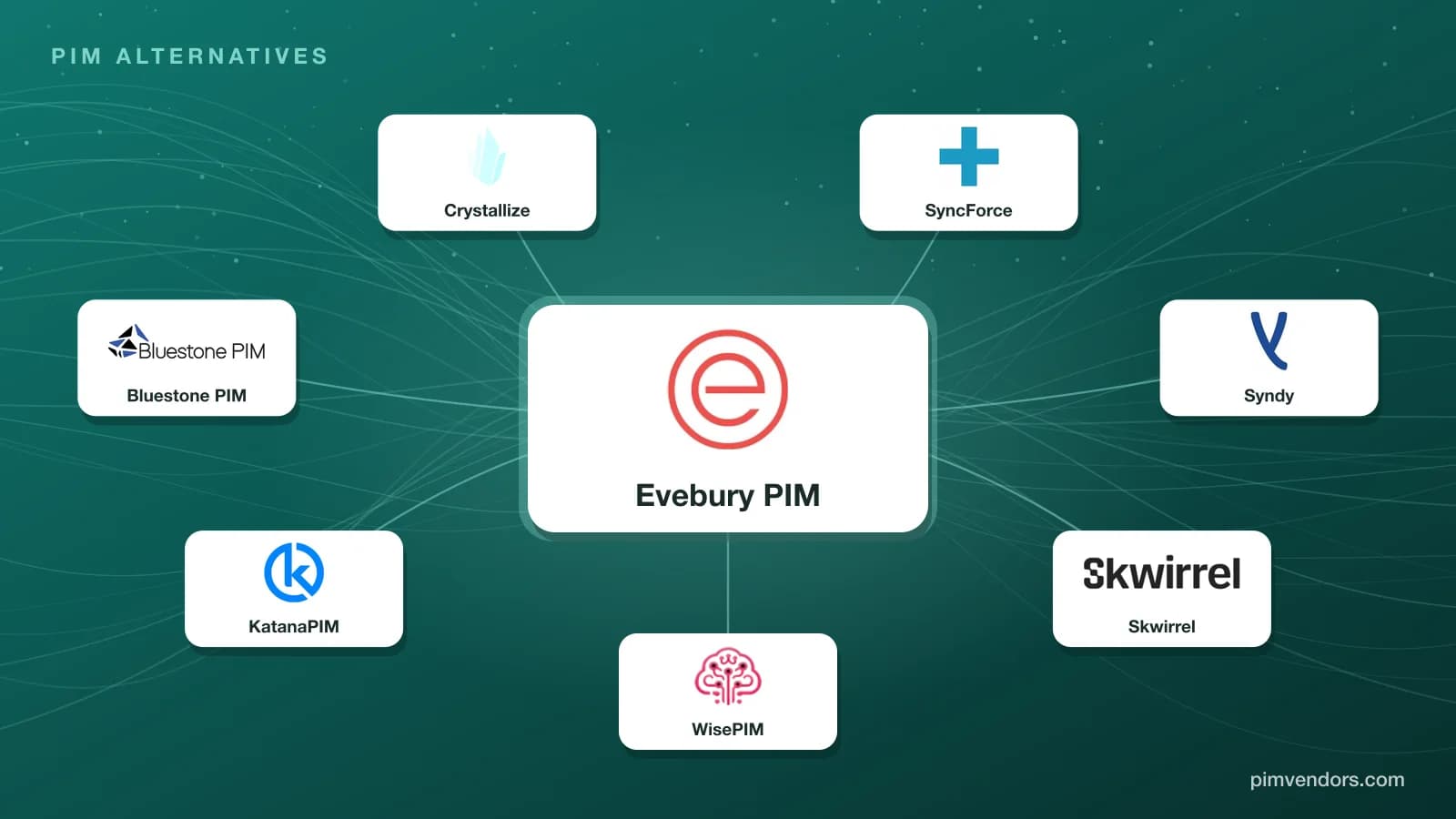
Evebury PIM is a young Dutch PIM that gives manufacturers a ready-made data model instead of a blank one. Teams look at alternatives before they sign, when they outgrow the model, or when a new requirement appears, such as ETIM data for a wholesaler or a full DAM for marketing. This guide covers what Evebury PIM is, why teams look for an alternative, and seven PIM systems to compare, each with what to check.
What Evebury PIM is and who it fits
Evebury PIM is a Dutch SaaS PIM, founded in 2022, active mainly in the Benelux. According to our Evebury PIM profile, it covers:
- A pre-built data model: smart objects, packaging hierarchies, ingredients and recipes for food, and weight roll-up across linked packaging.
- Validation: a rule engine, unit-aware validation, GS1 message pre-validation, and re-validation of translations when the source text changes.
- Workflow: tasks on fields, approval before information is shared with customers, and a four-eyes check on critical fields.
- Languages: unlimited languages on every tier.
- Files: storage per tier, with linked files and assets included in exports.
The profile places it with small and mid-market manufacturers whose product data is as complex as an enterprise's, and who want an out-of-the-box setup instead of a long customization project. Our manufacturing overview puts it with smaller food and consumer goods manufacturers that publish to GS1 data pools.
Why teams look for an Evebury PIM alternative
Our profile has no full analyst assessment for Evebury yet, so the reasons below come from the profile's capability notes, scale and deployment:
- A young vendor. Founded in 2022. Some buyers want a longer track record, or at least references in their own sector and a clear view of the roadmap.
- DAM depth. Files are stored per tier and exported with products, but it is not a full DAM with renditions, rights management or a CDN.
- History and structures. Audit logs are on every tier, but record-level version history with rollback is not documented, and there is no public evidence of full manufacturing BOMs or configurable products.
- Translation and tasks. There is no evidence of a connector to a translation management system, and task management depends on the tier.
- Scale and footprint. It is SaaS only, aimed at small and mid-market companies, and active mainly in the Benelux. Larger manufacturers with heavy packaging and regulatory change, or teams outside the Benelux, may look at systems built for that.
Evebury PIM alternatives at a glance
- SyncForce: larger food and packaged-goods manufacturers with complex trade hierarchies and GS1 data pools.
- Syndy: brands that deliver content to many retailers, each in its own format.
- Skwirrel: technical non-food manufacturers and wholesalers that need ETIM and the 2BA data pool.
- WisePIM: teams whose bottleneck is enrichment and translation, with ETIM support.
- KatanaPIM: a general, usable SaaS PIM with published pricing and webshop and ERP connectors.
- Bluestone PIM: manufacturers moving to a composable stack with large catalogs.
- Crystallize: a manufacturer that also sells direct through its own storefront and has engineers.
The alternatives
The order follows fit for typical Evebury PIM buyers, starting with the closest match. Fit and check notes come from each system's profile.
SyncForce
SyncForce is a Dutch PIM, founded in 2005, for brand manufacturers in food, personal care, consumer goods and chemicals, sold as SaaS or cloud-hosted. It combines product and packaging data, stage-gate development, document automation and GS1 publication in one suite.
- Fits better when: you are a larger packaged-goods manufacturer. Our analyst puts its best fit with manufacturers of €100 million and up, with complex trade hierarchies, many packaging and regulatory changes and EU distribution through GS1 data pools. Its GDSN connector is evidenced, with named data pools such as Trade Connectors and Atrify.
- Check: our analyst says it is not for SMBs, retail or fashion, buyers who want a headless or composable setup will run into limits in its read API and release model, and a new sector or market is set up as a project.
Syndy
Syndy is a Dutch PIM and DAM platform, founded in 2013 and part of the Icecat Group, built for content exchange between brands and retailers.
- Fits better when: you supply many retailers in FMCG, DIY, toys or healthcare, each with its own content template. Syndy maps content to retailer-specific formats, sources content from suppliers, scores completeness and includes a DAM for images, 360-degree views and video.
- Check: our profile has no full analyst assessment yet and does not describe a GS1 data pool connection. Ask how it reaches the data pools your retailers use, and ask for references with those retailers.
Skwirrel
Skwirrel is a Dutch SaaS PIM, founded in 2015, for technical wholesalers, distributors and manufacturers in the Benelux and the DACH region.
- Fits better when: you make or sell technical non-food products and must deliver ETIM classification and exchange data through a pool such as 2BA. It adds transparent entry pricing, a JSON-RPC API with webhooks and a data quality dashboard.
- Check: our analyst calls it the wrong tool for GS1 and GDSN-led consumer goods, so it does not cover Evebury's food use case. It is a small vendor, so validate SLAs and support hours.
WisePIM
WisePIM is a Dutch SaaS PIM with AI at its core, founded in 2024, for retailers, distributors and brands with large assortments and many supplier feeds.
- Fits better when: your bottleneck is enrichment and translation rather than packaging data. It offers AI enrichment and attribute extraction, ETIM release import and BMEcat export, quality rules per channel, and translation with glossaries and linguistic review.
- Check: it is even younger than Evebury and our profile has no full analyst assessment yet. Configurable or BOM structures are not evidenced, and its accuracy claims for AI classification have not been tested independently.
KatanaPIM
KatanaPIM is a Dutch SaaS PIM, founded in 2018, for small and mid-market merchants, wholesalers and distributors.
- Fits better when: you want a general, usable SaaS PIM with published tier pricing, the API on every plan, practical import and mapping tools, and connectors for webshops and ERP systems such as Exact. It also markets modules for the digital product passport and GPSR.
- Check: GS1, ETIM and GDSN run through partner middleware, so a food manufacturer must test the data pool route. Native AI is largely absent.
Bluestone PIM
Bluestone PIM is a Norwegian SaaS PIM, founded in 2013, built on microservices with an API-only, MACH-certified architecture, for the mid-market and enterprise.
- Fits better when: you are a manufacturer growing past what a pre-built model covers, with large catalogs, variants, bundles and many channels, and you want a native DAM with a CDN and AI tools for enrichment and translation.
- Check: its profile describes a flexible model, not a pre-built food model, so plan the modeling work. Our analyst lists deployment effort, proof of standards support such as GS1, and commercial terms as the points to test.
Crystallize
Crystallize is a Norwegian headless commerce backend, founded in 2017, that combines PIM, content and commerce behind a GraphQL API.
- Fits better when: you are a manufacturer that also sells direct to consumers through its own storefront, for example with subscriptions, and you have engineers to build it. Its base pricing tiers are published.
- Check: it has no native GDSN, ETIM or marketplace syndication, so on its own it does not replace Evebury's GS1 route. If you publish to data pools, you would need another system or a custom build for that part.
How to choose and switch
List what Evebury PIM does for you
The data model, packaging hierarchies, ingredient data, GS1 messages and the data pools you publish to, your channels, users and approval steps. Mark what is a must-have.
Decide which standards must be native
GS1 and GDSN, ETIM, BMEcat: decide which must be in the product and which may come from a partner. If you are a food manufacturer that publishes to a data pool, start there.
Demo with your own data
Give each vendor one real product family with packaging levels and, if it applies, one GS1 publication to a test environment. Let the people who maintain the data score the work.
Migrate in slices with a parallel run
Move one product family or channel at a time, and compare the output of Evebury PIM and the new system until it matches. The PIM RFP guide helps turn the results into requirements.
Settle the contract and the cut-over date
Compare three to five years of cost with our PIM cost comparison, and set the switch-off date by your notice period.
Compare more PIM systems
Compare these and other systems in the PIM profile overview, or answer a few questions in the free PIM Scan for a ranked shortlist based on your scale, sector and must-haves.
- Top 10 PIM solutions for manufacturing: Evebury PIM and other manufacturing PIMs side by side.
- Data pools and syndication round table: practitioners on GDSN and syndication.
- ETIM 10.0: what the release means for technical product data.
Where to go from here
Frequently asked questions
What is Evebury PIM?
Evebury PIM is a Dutch SaaS PIM, founded in 2022, for small and mid-market food and non-food manufacturers. It comes with a pre-built data model, including packaging hierarchies and ingredients for food, and validates GS1 messages before they go out, so teams can start without a long implementation project.
What are the best Evebury PIM alternatives?
SyncForce for larger food and packaged-goods manufacturers, Syndy for brands that supply many retailers, Skwirrel and WisePIM for technical products with ETIM, KatanaPIM for a general SaaS PIM with published pricing, Bluestone PIM for a composable stack and Crystallize for a manufacturer that also sells through its own storefront.
Which alternatives handle GS1 and data pools for food manufacturers?
SyncForce has an evidenced GDSN connector with named data pools such as Trade Connectors and Atrify, aimed at larger packaged-goods manufacturers. For most other alternatives on this page, GS1 runs through a partner or is not described, so test the full route to your data pool in a demo.
Is Evebury PIM only for food manufacturers?
No. Its profile covers food and non-food manufacturers, with B2B and B2C channels. If you make technical non-food products and need ETIM classification, also compare Skwirrel, which works with ETIM and the 2BA data pool, and WisePIM, which imports ETIM releases and exports BMEcat.
Does Evebury PIM include a DAM?
It stores files per tier and includes linked files and assets in exports, but its profile notes it is not a full DAM with renditions, rights management or a CDN. Bluestone PIM has a native DAM with a CDN, and Syndy and SyncForce include a DAM in the platform.
Evebury PIM or SyncForce, which one fits?
Both are Dutch and built for manufacturers that publish through GS1 data pools. Evebury targets small and mid-market companies with a ready-made model. SyncForce targets larger packaged-goods manufacturers with complex trade hierarchies and many packaging and regulatory changes, and adds stage-gate development and document automation. It is not built for SMBs.
Is Evebury PIM a safe choice as a young vendor?
Evebury was founded in 2022 and our profile does not have a full analyst assessment yet. That is not a verdict, but it is a reason to check the roadmap, the support model and references in your own sector, and to test integration and standards in a discovery workshop before you sign.
How do you switch from Evebury PIM to another PIM?
List your data model, packaging hierarchies, GS1 messages, data pools, channels and users. Shortlist three systems, demo them with one of your own product families including a GS1 publication, migrate in slices with a parallel run, and agree the cut-over date with your data pool provider and your contract's notice period.
Diagnostic
Do you actually need a PIM?
Run the complexity index before you budget software or hire an SI.
Budget
Model a first-pass TCO
Translate catalog shape into a three-year cost range in under ten minutes.