
Core
10 Inriver PIM Alternatives for Product Management
Stephan Spijkers · 2025-04-14 · Updated 2026-10-13 · 16 min read
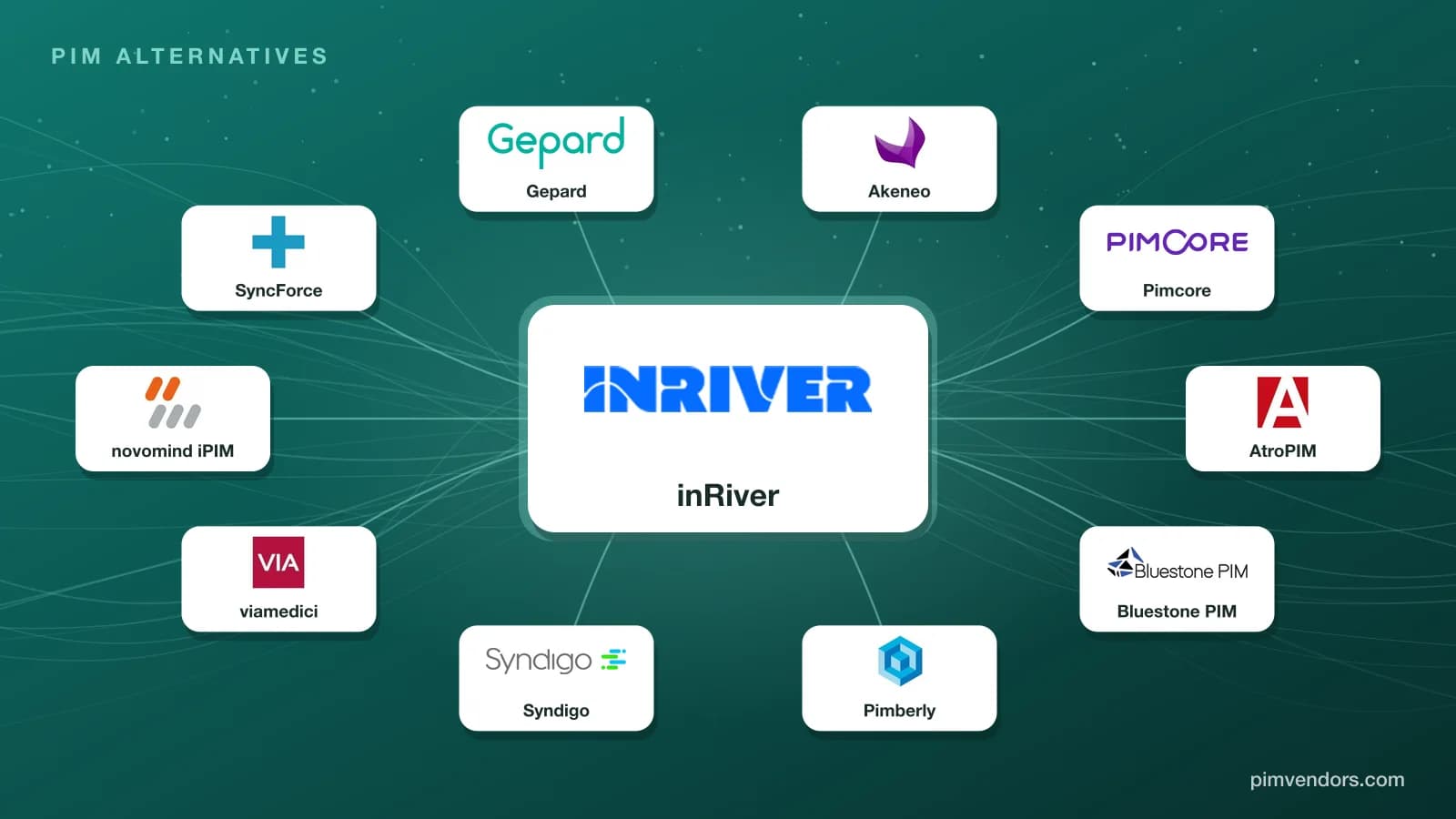
This guide is for teams that run inRiver, or have it on a shortlist, and want to know what else fits. The reasons teams look further tend to be commercial or architectural: the pricing model, standards that run through partners, a deployment that is SaaS only, or a scope that is larger than they need. Below you find what inRiver does and for whom, those reasons in more detail, ten alternatives in order of fit for typical inRiver buyers, and how to switch without losing a channel along the way. Founding years, headquarters and the fit and watch-out notes come from each system's vendor profile.
What inRiver is and who it fits
inRiver is a Swedish PIM vendor, founded in 2007. Its platform runs as SaaS on Microsoft Azure, with an open API layer, connectors for commerce platforms such as Adobe Commerce and Salesforce Commerce Cloud, and an App Marketplace for more connectors. The product has five core parts, and together they explain why companies that publish to many channels at once put it on their shortlist:
- An elastic data model for products, variants, bundles and components, which matters when the same item is sold on its own, as part of a set and as a spare part.
- Marketplace and channel syndication, for example to Amazon and Google Shopping through prebuilt connectors, so the PIM sends content to those channels itself.
- Digital shelf analytics inside the PIM, which shows how products appear on retailer and marketplace pages from the same system where the content is maintained.
- Print and PDF output from the same governed model as the digital channels, so catalogs and data sheets stay in step with the webshop.
- Workflows, localization and content planning for launches and seasonal campaigns, which helps teams that bring a new range to several markets at once.
Its best fit is with mid-market and enterprise manufacturers, brands and wholesalers that have complex catalogs and many channels and marketplaces, need print and digital from one model, and want shelf analytics inside the PIM. Those buyers should be willing to fund an implementation partner and partner connectors, because that is how inRiver projects usually run. Typical sectors are industrial manufacturing, consumer goods, automotive and fashion.
Why teams look for an inRiver alternative
Pricing and renewals are the most common trigger. inRiver's pricing is quote-only, with indexed renewals, so you only learn the full cost through a sales process and the price at renewal moves with an index. The sensible way to compare is to model three to five years of total cost, including connectors and partner work, and that model is often what starts the comparison. A team that sees the figure for the later years next to its original budget naturally wants to know what else the market offers for that money.
Standards are the second reason. GS1, GDSN and ETIM are often partner extensions in inRiver instead of native features. For a supplier to supermarkets that must publish through a data pool, or an industrial manufacturer whose wholesalers demand ETIM-classified data, that means an extra party, an extra contract and an extra place where data can go wrong. Those companies often prefer a system that has the standard built in.
Deployment is the third. inRiver runs as SaaS or cloud-hosted, so teams that need on-premise or self-hosting, because of IT policy or rules about where data may be stored, have to look elsewhere. This works as a simple yes-or-no criterion: when self-hosting is a hard requirement, inRiver drops off the list before anyone compares features.
The fourth reason is the number of parties in the project. App Marketplace connectors vary in scope and commercial terms, and implementations usually run through a partner. An inRiver project can therefore involve the vendor, an implementation partner and one or more connector providers, each with its own contract and its own support desk. If you want fewer parties in the project, compare how much each alternative delivers itself.
Finally, the scope can simply be too large. A direct-to-consumer brand with one custom storefront, or a team that only needs enrichment and a few channels, may pay for print, analytics and syndication depth it never uses. For that team a lighter PIM or a headless commerce backend can cover the job with less to implement and maintain.
inRiver alternatives at a glance











| Alternatives to inRiver | Built for | Industry | Runs as | Founded | Go-live (estimate) |
|---|---|---|---|---|---|
| Today: inRiver | Mid-market, Enterprise | Manufacturing, Retail, Wholesale | SaaS, Cloud-hosted | 2007 | 20 weeks |
| Akeneo | Small business, Mid-market, Enterprise | Retail, Wholesale | SaaS, Open source, Cloud-hosted | 2013 | 16 weeks |
| Bluestone PIM | Mid-market, Enterprise | Retail, Manufacturing | SaaS, Cloud-hosted | 2016 | 20 weeks |
| Pimberly | Mid-market, Enterprise | Retail, Manufacturing | SaaS, Cloud-hosted | 2015 | 20 weeks |
| Syndigo | Mid-market, Enterprise | Retail, Manufacturing | SaaS, Cloud-hosted | 1973 | 20 weeks |
| Viamedici | Mid-market, Enterprise | Manufacturing, Wholesale | SaaS, Cloud-hosted, On-premise | 1999 | 20 weeks |
| novomind iPIM | Mid-market, Enterprise | Retail, Wholesale | SaaS, Cloud-hosted, On-premise | 2000 | 20 weeks |
| SyncForce | Mid-market, Enterprise | Manufacturing | SaaS, Cloud-hosted | 1999 | 20 weeks |
| Gepard | Mid-market, Enterprise | Retail, Wholesale | SaaS, Cloud-hosted | 2005 | 20 weeks |
| ConnectingTheDots | Mid-market, Enterprise | Retail, Wholesale | SaaS, Cloud-hosted | 2008 | 8 weeks |
| Crystallize | Small business, Mid-market, Enterprise | Retail | SaaS, Cloud-hosted | 2017 | 16 weeks |
The map above places inRiver and each alternative by the company size it is built for and by industry: retail, manufacturing or wholesale. Read the row for your own industry first: it shows quickly which options stay close to inRiver and which ones move you to a different kind of system. The list below gives the main reason to consider each one, in the same order as the detailed sections.
- Akeneo is the most like-for-like option: an API-first PIM with completeness tooling and supplier onboarding.
- Bluestone PIM is a composable, microservice-based SaaS PIM with a native DAM.
- Pimberly offers PIM and DAM in one SaaS platform for retailers, brands and manufacturers.
- Syndigo fits when retailer compliance, GDSN and enhanced content drive the project.
- Viamedici fits SAP-centric manufacturers with configurable products and print catalogs.
- novomind iPIM fits European retailers and wholesalers that onboard many supplier catalogs.
- SyncForce fits packaged goods manufacturers with GDSN and packaging data.
- Gepard fits when mapping and syndicating to many endpoints is the main job.
- ConnectingTheDots fits Benelux retailers and wholesalers with messy supplier data.
- Crystallize fits direct-to-consumer and B2B teams that want product data, content and commerce in one headless backend.
The alternatives
Akeneo
Akeneo is a French PIM, founded in 2013, sold as SaaS (Product Cloud). It is sunsetting its open-source Community Edition, so teams leaving inRiver to self-host should look at Pimcore or AtroPIM instead. Its strengths are its API-first heritage, completeness and quality tooling, a broad ecosystem, and supplier data onboarding and DAM as products within its Product Cloud.
Akeneo serves a similar buyer to inRiver, mid-market and enterprise brands, retailers and wholesalers with many channels, and it also reaches smaller companies. The difference is in emphasis. Akeneo puts more weight on enrichment productivity and supplier onboarding, where inRiver puts more weight on print output and digital shelf analytics. A wholesaler that receives product data from many suppliers and spends most of its effort making that data complete and consistent will find Akeneo's focus closer to its daily work, while a manufacturer that still prints catalogs will miss inRiver's print output.
GS1, ETIM and digital product passport support need explicit proof in a proof of concept, often through a partner, which is the same question you have with inRiver. Moving to Akeneo therefore does not solve a standards problem on its own. Akeneo does not replace a multidomain MDM either.
Bluestone PIM
Bluestone PIM is a Norwegian SaaS PIM, founded in 2016, built on MACH principles: microservices, API-first, cloud-native and headless. It targets the same mid-market and enterprise manufacturers, distributors and retailers as inRiver.
What it brings is a native DAM (images, video, documents, 3D and PDF generation), three-level product families, bundles, and AI features for enrichment and translation. It suits teams that build a composable commerce stack and want the PIM to be one service in it. A retailer that replaces its webshop platform with separate services for storefront, search and checkout would use Bluestone as the product data service and connect the other services to it through the API.
Test deployment effort, proof of standards support and commercial transparency. In a composable setup the connectors are yours to build or buy, so a channel that you now reach through an inRiver App Marketplace connector may need integration work of its own. Count those channels before you compare the cost.
Pimberly
Pimberly is a UK SaaS PIM, founded in 2015 and built on AWS, that manages product data and digital assets in one platform. It targets mid-market and large retailers, brands, distributors and manufacturers with multi-category catalogs and global e-commerce, with AI-assisted enrichment, channel-specific content and localization.
Print publishing is not documented, so it fits best where digital channels are the main output. For an inRiver customer that uses the print and PDF output, that is the first thing to settle: either print moves to another tool, or Pimberly is the wrong replacement. A retailer that sells across many categories in several countries and stopped printing catalogs years ago will not miss it.
Its fit is less well documented, so test deployment effort, proof of standards support (GS1, GDSN, ETIM) and commercial terms. Ask for the demo to cover your most complex category and a localized version of it, because that is where a multi-category catalog shows its weak spots.
Syndigo
Syndigo is a US platform that combines PIM, MDM and content syndication with a large network of retailers and other recipients. It is a certified GDSN data pool, and it owns Riversand (MDM) and, since 2025, 1WorldSync.
inRiver is a PIM with syndication, while Syndigo is built around the recipients. It fits enterprise teams in consumer goods, foodservice, health and beauty, hardlines and retail vendor management, where retailer compliance, GDSN and enhanced product page content drive revenue. That is the area where inRiver often relies on partners. A personal care brand that sells mostly through large retail chains, each with its own content requirements, gets the network and the data pool from one vendor instead of combining a PIM with partner extensions.
Authoring and composable APIs are secondary to the network, so if your team writes a lot of its own content, test that work as carefully as the retailer connections. The content hub and the Riversand MDM are two integration surfaces, so plan an architecture review. Our Syndigo vs competitors covers the details.
Viamedici
Viamedici is a German enterprise vendor, founded in 1999, that combines PIM, MDM, DAM and a product configurator (CPQ), as SaaS, cloud-hosted or on-premise.
It suits SAP-centric manufacturers and industrial distributors with complex, configurable products and multilingual print and digital catalogs, especially in the DACH region with ETIM and ECLASS requirements. Unlike inRiver, it offers on-premise deployment and multidomain MDM with a golden record and a supplier portal. For a machine builder whose wholesalers require ETIM data and whose product structure lives in SAP, that combination covers ground that inRiver leaves to partners or to other systems.
It is not a lean composable PIM, so budget for suite complexity and integrator cost. Evidence for GDSN and GS1 retail syndication is thin, which matters if part of your range also goes to retailers.
novomind iPIM
novomind iPIM is a German PIM for retail and wholesale, founded in 2000, available as SaaS, cloud-hosted or on-premise.
It is built for mid-size and large European retailers, wholesalers and buying cooperatives with hundreds of supplier catalogs. Its strengths are governed supplier onboarding with data quality management, a BPMN workflow engine, a native DAM and a print path through InDesign, with hosting in Germany. A buying cooperative that collects product data from many suppliers for its members, checks it and then publishes it in print and online is the typical case. For that kind of organization the inbound flow from suppliers is the main workload, and that is where novomind puts its weight.
Syndication and real-time publishing often assume novomind's own marketplace and shop products (iMARKET and iSHOP), so check how well it feeds a shop or marketplace from another vendor. Its GDSN certification covers receiving data. If you also need to publish through a data pool, plan a separate data pool connection for that.
SyncForce
SyncForce is a Dutch PIM, founded in 1999, built for brand manufacturers of packaged goods.
Its data model covers product, packaging and logistics hierarchies, with stage-gate workflows for new product development, document automation and an integrated GDSN connector. For food, pet, household and personal care, and DIY manufacturers with heavy data pool distribution in Europe, that is native work that inRiver often leaves to partners. A pet food producer that regularly launches new recipes and pack sizes goes through the same steps each time: approve the product, build the packaging hierarchy, publish to the data pool. SyncForce is built around that cycle.
SyncForce's own FAQ says it is not for SMB, retail, fashion, automotive or engineer-to-order companies. Headless and composable buyers will hit limits in its read API and release model, so it is a poor match when the PIM must also feed a custom storefront.
Gepard
Gepard is a European PIM and content syndication platform, in business since 2005, with mapping and syndication at its core.
It fits teams whose main problem is getting supplier, ERP and content-provider data mapped and sent to many retailer, marketplace and regulatory endpoints, including EU compliance feeds such as EPREL and industrial flows such as ETIM and 2BA. It has a connector path for Mirakl marketplaces and a free tier for small trials. For a team that bought inRiver mainly for its syndication, Gepard puts that job at the center, with the mapping between sources and endpoints as the core of the work. A distributor of electrical products that delivers ETIM data through 2BA and sends other content to marketplaces deals with exactly that every day.
It is not a safe pick for a headless or composable PIM without API due diligence, and its pages on GDSN, digital product passports and GPSR lean on marketing and services. Require a proof of concept that publishes your own products to the endpoints you need.
ConnectingTheDots
ConnectingTheDots is a Dutch SaaS PIM, founded in 2008, focused on the Benelux.
Its clearest strength is automated supplier onboarding, which suits retailers, wholesalers and multi-brand e-commerce with messy inbound supplier data, including Icecat, Onetrail and fashion supplier feeds. The vendor stays close to the implementation, which helps a mid-market team without PIM specialists of its own. A Benelux webshop that sells products from many brands, each delivering its data in a different way, is the kind of company it is built for.
It is not an enterprise multidomain MDM or a deep manufacturing PIM with bills of materials, and GS1, GDSN and ETIM publication depend on a partner (Qmica), so budget for that mapping. A manufacturer that uses inRiver for complex product structures will probably find it too light.
Crystallize
Crystallize is a Norwegian headless commerce backend, founded in 2017, that keeps product data, content and media in one place behind GraphQL APIs.
It fits direct-to-consumer and B2B teams that build their own storefronts, sell subscriptions or need multi-market pricing, and have engineers available. For a team that uses inRiver mainly to feed one custom webshop, it can replace the PIM and part of the commerce stack. Base pricing tiers are published, so you can estimate the cost before you talk to sales.
It is not a PIM for ERP-centric catalog operations, and it has no native GDSN, ETIM or marketplace syndication. If you need those, budget a custom build or rule it out early, before the demo stage.
How to choose and switch
Write down why you are leaving
Name the reason: cost, standards, deployment model or scope. Each reason points to a different part of this list. Standards point to SyncForce, Syndigo or Viamedici, a need for on-premise points to vendors that offer it, such as Viamedici and novomind iPIM, and a smaller scope points to Crystallize or a lighter PIM. Agree on the reason internally before you contact vendors, otherwise each stakeholder judges the demos on a different question.
Inventory what inRiver does today
List the entity model, channels and marketplaces, App Marketplace connectors, print templates, workflows and digital shelf reports, and who uses each one. Mark what is used every day and what was set up once and then forgotten, because the second group may not need to move at all. The PIM RFP guide helps turn that list into requirements.
Shortlist three and demo with your own data
Give each vendor one real product family with variants, two channels with different rules and, if you print, one catalog page. Let the people who maintain product content score the work. Ask each vendor to rebuild part of your entity model in the demo, because that shows quickly whether your structure fits the new system or has to be redesigned.
Migrate in slices
Move one product family or one channel at a time, run it in parallel with inRiver, and compare the output until it matches. Start with a channel that is important but simple, and leave print and the most demanding marketplaces for later, when the team knows the new system.
Time the switch to the contract
Switch inRiver off only when every channel, connector and print process runs from the new system. Plan that date around the renewal, and work back from the notice period to see when the selection has to start.
Compare more systems
Compare these and other systems in the PIM profile overview, or get a free shortlist for your scale, sector and must-haves from the PIM Scan. For the wider market, see best PIM software, and for budgets, our PIM cost comparison.
Where to go from here
Frequently asked questions
What are the best inRiver alternatives?
It depends on why you are leaving. For a like-for-like PIM, compare Akeneo, Bluestone PIM and Pimberly. For retailer networks and GDSN, look at Syndigo, and at SyncForce if you manufacture packaged goods. For SAP-centric industrial manufacturers, Viamedici fits. For retail and wholesale with many suppliers, compare novomind iPIM and ConnectingTheDots. For syndication-led programs, Gepard fits, and for a headless commerce backend, Crystallize.
Who are inRiver's main competitors?
The closest competitors are other SaaS PIMs for mid-market and enterprise brands, manufacturers and retailers, such as Akeneo, Bluestone PIM, Pimberly and Contentserv. Where retailer compliance and GDSN drive the project, network platforms such as Syndigo and Salsify compete with it.
Akeneo vs inRiver, which one fits?
Both are PIMs for mid-market and enterprise brands, retailers and wholesalers with many channels. inRiver puts more weight on syndication, digital shelf analytics and print and PDF output from one model. Akeneo puts more weight on an API-first record, completeness tooling and supplier onboarding; its open-source Community Edition is being sunset, so like inRiver it is a SaaS choice. For both, ask for proof of GS1 and ETIM support in a proof of concept.
How much does inRiver cost?
inRiver does not publish prices. Pricing is quote-only, with indexed renewals, so ask for a quote that covers three to five years, including connectors, partner extensions and the implementation partner, and compare alternatives on the same period.
Does inRiver support GS1, GDSN and ETIM?
Often through partner extensions rather than natively. If GDSN is a hard requirement, compare Syndigo, a certified GDSN data pool, and SyncForce, which has an integrated GDSN connector, and ask inRiver which partner you would use.
Does inRiver support syndication to Amazon and other marketplaces?
It offers marketplace and channel syndication to Amazon, Google Shopping and other channels through prebuilt connectors and APIs, plus digital shelf analytics. Connectors from its App Marketplace vary in scope and commercial terms, so confirm each channel you need.
Is there a mid-market alternative to inRiver?
Yes. Akeneo also serves smaller companies, ConnectingTheDots serves the Benelux mid-market, and Crystallize suits smaller direct-to-consumer and B2B teams with engineers. Check what you would lose, such as print and PDF output and digital shelf analytics.
How do you migrate away from inRiver?
Inventory the entity model, channels, connectors, print templates and workflows, demo the shortlist with your own data, migrate one product family or channel at a time with a parallel run, and switch inRiver off only when every channel and connector runs from the new system. Plan that date around the renewal.
Diagnostic
Do you actually need a PIM?
Run the complexity index before you budget software or hire an SI.
Budget
Model a first-pass TCO
Translate catalog shape into a three-year cost range in under ten minutes.