
Core
OmniStock Alternatives: 7 PIM Solutions to Compare
Stephan Spijkers · 2026-10-11 · 8 min read
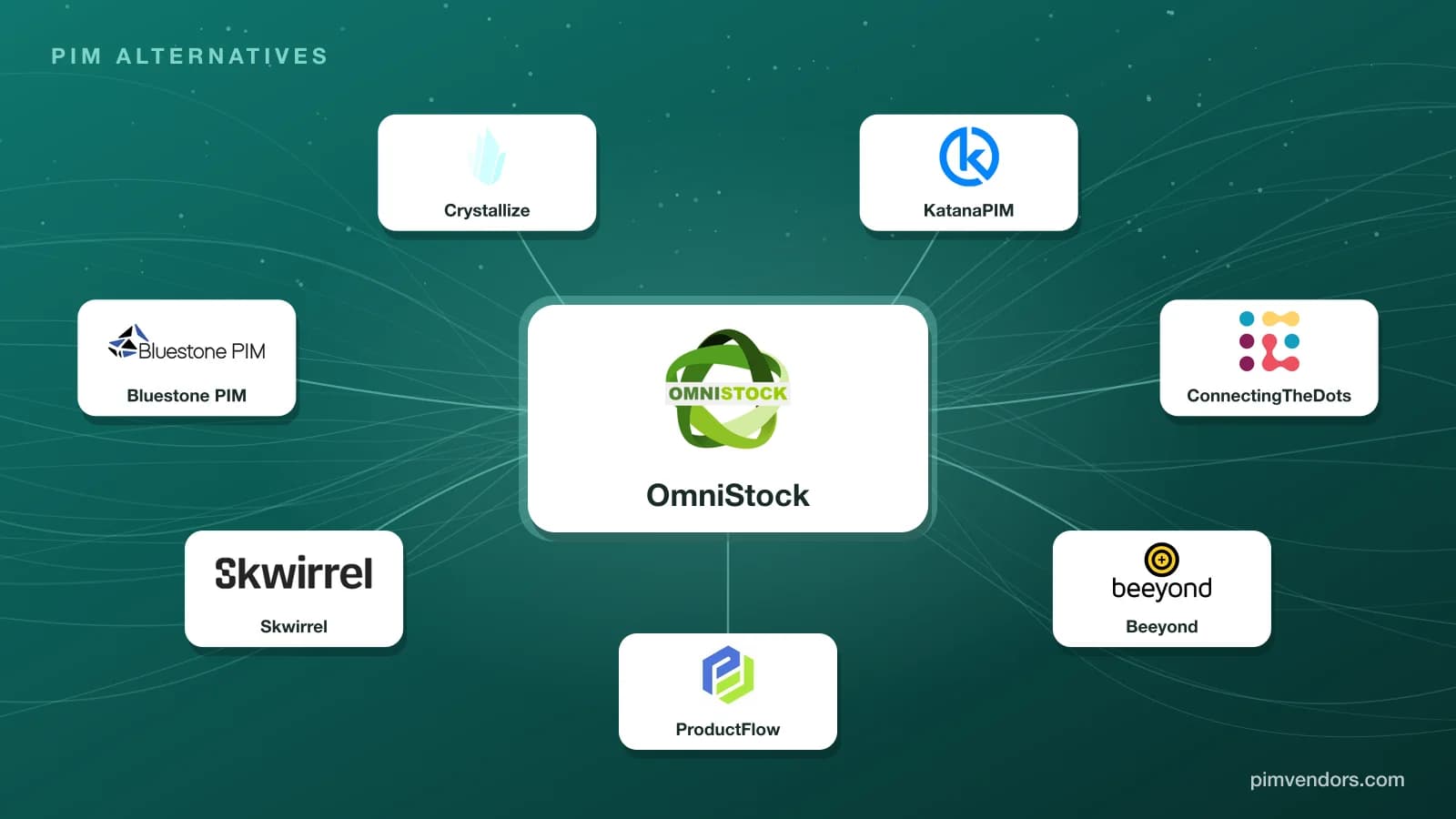
OmniStock is built for Benelux retailers and wholesalers that turn many supplier feeds into one webshop catalog. Teams that use it reopen the choice when they change their commerce platform, when marketplaces become their main channel, or when a contract comes up for renewal. This guide covers what OmniStock does, why teams look for an alternative, seven alternatives ordered by fit, and how to switch.
What OmniStock is and who it fits
OmniStock is a Dutch PIM, sold as SaaS or cloud-hosted to small and mid-market companies, and active mainly in the Benelux. According to our OmniStock profile, it covers:
- Supplier data integration: imports product feeds in Excel, CSV, XML or through an API, and maps them to your own product structure.
- Rule-based enrichment: fills missing values, generates descriptions and applies consistent formatting.
- Multichannel export: publishing to Magento, Shopify, WooCommerce, marketplaces and print catalogs through output templates.
- Assets, translations and workflows: a DAM for images and documents, translation management, approval flows and role-based editing.
Our analyst places OmniStock with Benelux mid-market retailers and wholesalers on Magento, or committed to it, who juggle several supplier and content feeds and scheduled catalog changes for promotions, and who may also use or evaluate OmniStock's order management system for omnichannel fulfillment. Its strengths include modeling of separate sources with traceability, a practical supplier portal, Magento-native integration, proof of campaign scheduling at Expert, a margin-aware catalog case at Gezonderwinkelen, clear package limits for scoping and a long local retail track record.
Why teams look for an OmniStock alternative
- You leave Magento. The Magento-native integration is OmniStock's strongest story. Teams that move to Shopify, Shopware or a headless storefront should test the other connectors in depth, and compare.
- You move to an API-first or composable stack. Our analyst does not see OmniStock as a safe pick for public API-first or composable commerce without a review of its API package.
- Marketplaces become your main channel. Marketplace syndication is feed-assisted, often with an integrator, rather than deep native syndication.
- You expand beyond the Benelux. The profile lists activity in fewer than five countries. Teams with many markets check languages, support and references abroad.
OmniStock alternatives at a glance
- KatanaPIM: best for Benelux merchants and wholesalers on Magento, Shopify or Shopware who want published pricing.
- ConnectingTheDots: best for Benelux retailers and wholesalers with many, messy supplier feeds.
- Beeyond: best for smaller wholesalers and retailers that want a lightweight PIM with marketplace and print exports.
- ProductFlow: best for merchants that sell mainly through marketplaces such as bol.
- Skwirrel: best for technical wholesalers where ETIM and 2BA are required.
- Bluestone PIM: best for mid-market and enterprise teams moving to a composable commerce stack.
- Crystallize: best for teams that replace Magento with their own storefront on a headless backend.
The alternatives
The fit and watch-out notes come from each vendor profile and its analyst assessment, where it has one.
KatanaPIM
KatanaPIM is a Dutch SaaS PIM, founded in 2018. It is the closest alternative for OmniStock's buyers: our analyst places it with mid-market Benelux and EU merchants, wholesalers and distributors on Magento, Shopify or Shopware with Exact or a similar ERP, who need a usable SaaS PIM for catalogs with many variants and specifications. Pricing per tier is published, the API is on every plan, and its import and mapping tools are practical. It also suits teams that move from Magento to Shopify or Shopware.
Check: marketplace export often runs through integrators, GS1, ETIM and GDSN run through partner middleware, and native AI is largely absent.
ConnectingTheDots
ConnectingTheDots is a Dutch SaaS PIM, founded in 2008. Our analyst places it with mid-market and enterprise Benelux retailers, wholesalers and multi-brand e-commerce with messy inbound supplier data, where fast catalog operations, channel-specific pricing and a vendor-close implementation matter, especially with Icecat, Onetrail or fashion supplier feeds. Automated supplier onboarding is its clearest strength, which is the same problem OmniStock solves, at a larger scale.
Check: GS1, GDSN and ETIM publication depend on the partner Qmica, so budget for it. It is not an enterprise multidomain MDM, and its scale starts at mid-market.
Beeyond
Beeyond is a Dutch cloud PIM, founded in 2010, for small and mid-market wholesalers, retailers and manufacturers in the Benelux. Its profile describes category and attribute management, channel-specific exports with templates for Amazon, bol and printed brochures, and API connections to ERP systems and to webshops such as Magento and Shopify. It fits smaller teams that want a lighter PIM with modular add-ons.
Check: the profile gives no detailed analyst assessment, so test deployment effort, proof of standards support and commercial terms, and ask how it handles many supplier feeds.
ProductFlow
ProductFlow is a Dutch platform, founded in 2018, for marketplace operations. Our analyst places it with EU merchants, especially on bol, who want one login for listing content, offers, orders and repricing. Its strengths are a PIM interface built for marketplaces, bol Gold Partner status, a broad library of European marketplace connectors and a built-in repricer. It covers the marketplace side where OmniStock relies on feeds and integrators.
Check: it is not a fit for GDSN, ETIM or MDM programs, and enterprise PIM depth, such as workflows, DAM and a golden record, is limited. Some teams run it next to a PIM rather than instead of one.
Skwirrel
Skwirrel is a Dutch SaaS PIM, founded in 2015, for technical products. Our analyst places it with Benelux and DACH technical wholesalers, distributors and manufacturers where ETIM classification and 2BA exchange are mandatory, with an ERP and Magento or WooCommerce on the sales side. Its strengths are deep ETIM and data pool fit, published entry pricing, a JSON-RPC API with webhooks and a data quality dashboard.
Check: it is the wrong tool for GS1 and GDSN-led consumer goods, enterprise MDM or marketplace-first syndication. It is a small vendor, so validate service levels and support hours.
Bluestone PIM
Bluestone PIM is a Norwegian SaaS PIM, founded in 2013, built on a microservice, API-first architecture and MACH-certified. It fits mid-market and enterprise manufacturers, distributors and omnichannel retailers with large catalogs, several brands or markets and a composable commerce stack. It is the option for a team that leaves a Magento-centric setup for a composable one.
Check: deployment effort, proof of standards support and commercial terms. It targets mid-market and enterprise, so it is a bigger step for a small team.
Crystallize
Crystallize is a Norwegian headless commerce backend with PIM, founded in 2017, with a GraphQL API. It fits direct-to-consumer and B2B teams that want one composable backend for product content, subscriptions, multi-market pricing and their own storefronts, with engineers available. It is an option when you replace Magento with a custom storefront rather than another shop platform.
Check: it is not a pure PIM for catalog operations centered on the ERP, and there is no native GDSN, ETIM or marketplace syndication.
How to choose and switch
List your feeds, rules and exports
Write down every supplier feed and its format, the enrichment rules and scheduled campaigns, the assets and translations, and every export to webshops, marketplaces and print. Add the ERP and order management links.
Decide which job the new system does
A PIM for one webshop and many suppliers, a marketplace operations tool, a technical PIM with ETIM, or a composable backend. Your commerce platform choice for the next years usually decides this.
Shortlist three and demo with your own supplier files
Give each vendor three real supplier files in different formats and one scheduled campaign. Let the people who maintain the catalog score the mapping and enrichment work.
Migrate one channel at a time
Move one webshop or one marketplace at a time, and compare the output of OmniStock and the new system until they match.
Settle the contract
Check your notice period and data export terms, and model three years of subscription, connectors and services. Our PIM cost comparison gives ranges per segment.
Compare OmniStock alternatives side by side
Compare these and other systems in the PIM profile overview, or answer a few questions in the free PIM Scan for a ranked shortlist based on your scale, sector and must-haves.
- Magento PIM guide: what a PIM adds to a Magento stack.
- Marketplaces: 3 options to connect: manual, through your PIM, or through a syndicator.
- Top 10 PIM solutions for wholesale: the wider wholesale shortlist.
Where to go from here
Frequently asked questions
What is OmniStock PIM?
OmniStock is a Dutch PIM for wholesalers, retailers and e-commerce companies that combine product data from many suppliers. It imports supplier feeds, enriches content with rules, manages assets and translations, and exports to webshops, marketplaces and print. It runs as SaaS or cloud-hosted, mainly in the Benelux.
Who is OmniStock for?
Our analyst places it with Benelux mid-market retailers and wholesalers on Magento, or committed to it, who juggle several supplier and content feeds and scheduled catalog changes for promotions, and who may also use OmniStock's order management for omnichannel fulfillment.
What are the best OmniStock alternatives?
For Benelux merchants and wholesalers, KatanaPIM and ConnectingTheDots, and Beeyond for smaller teams. For marketplace sellers, ProductFlow. For technical wholesale with ETIM and 2BA, Skwirrel. For composable or headless stacks, Bluestone PIM and Crystallize.
Does OmniStock only work with Magento?
No. Its profile lists exports to Magento, Shopify, WooCommerce, marketplaces and print catalogs, and connectors to ERP systems such as Exact, SAP and Microsoft Dynamics. Our analyst sees the Magento-native integration as its strongest story, so teams that leave Magento should test the other connectors in depth.
Is OmniStock a PIM or an order management system?
OmniStock PIM is a product information management system. The analyst assessment also mentions OmniStock's order management system for omnichannel fulfillment, which some PIM customers use or evaluate. If you use both, decide whether the order management stays before you replace the PIM.
How do you switch from OmniStock to another PIM?
List every supplier feed, enrichment rule, scheduled campaign and export, decide which job the new system must do, test three systems with your own supplier files, migrate one channel at a time with a parallel run, and switch OmniStock off only when every feed and export runs from the new system.
Diagnostic
Do you actually need a PIM?
Run the complexity index before you budget software or hire an SI.
Budget
Model a first-pass TCO
Translate catalog shape into a three-year cost range in under ten minutes.