
Core
prodexa Alternatives: 7 PIM Solutions to Compare
Stephan Spijkers · 2026-10-11 · 9 min read
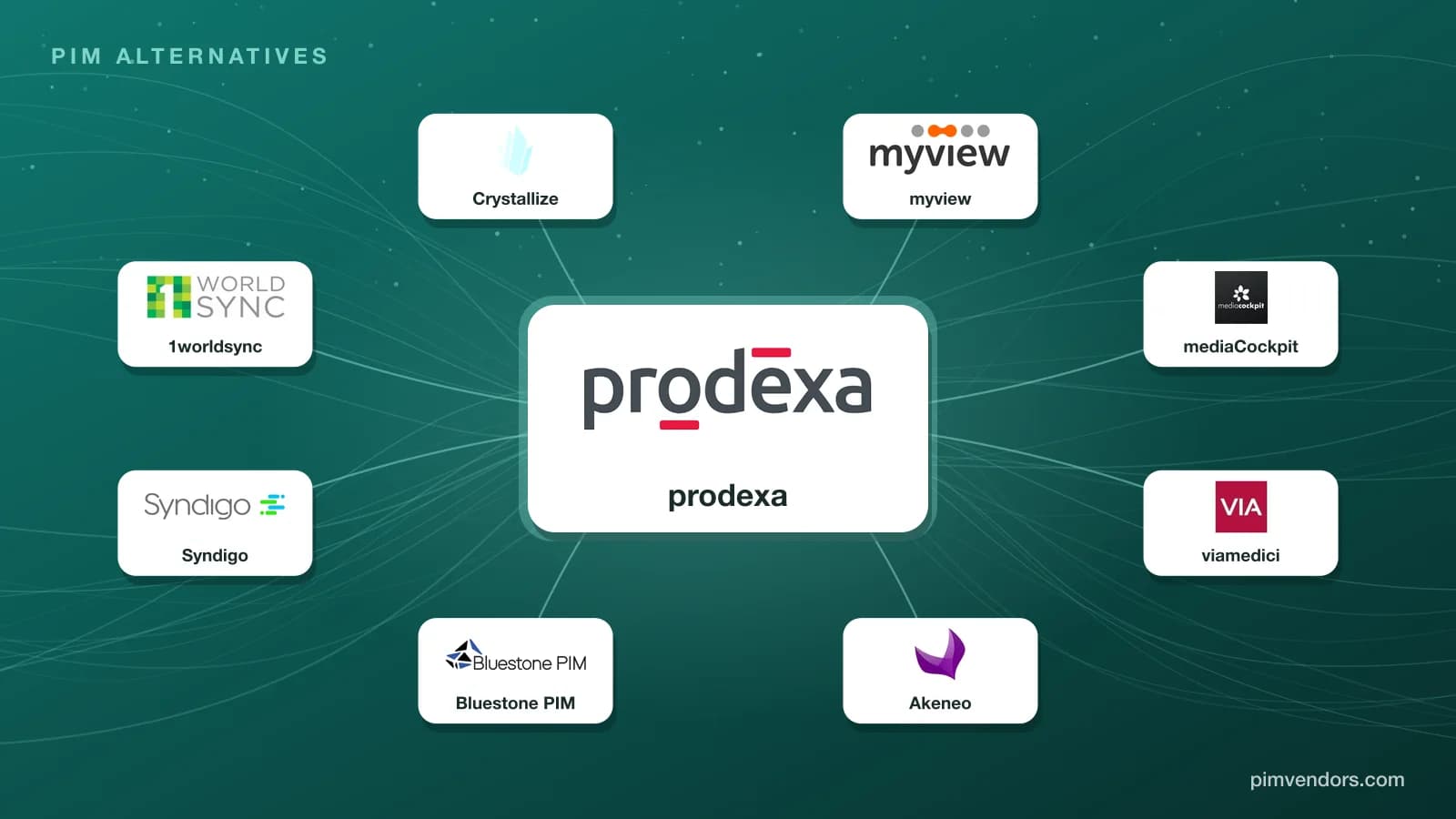
prodexa is a familiar name for industrial manufacturers and distributors in the DACH region that need classified product data, supplier catalogs and print. Teams reopen the decision when their architecture or their channels change. This page covers what prodexa does, why buyers compare alternatives, and seven alternatives ordered by fit for typical prodexa buyers. Fit and watch-out notes come from the analyst assessments on our vendor profiles.
What prodexa is and who it fits
prodexa is a German PIM and PXM vendor whose team comes from OpusCapita and jCatalog. Its prodexa Cloud suite, sold as SaaS or cloud-hosted, combines PIM, DAM, cross-media publishing and supplier onboarding. It supports ECLASS and ETIM, rule-based enrichment and translation, print through Adobe InDesign and Illustrator via priint:comet, guided selling portals and feed exports, with connectors to ERP systems such as SAP and Microsoft Dynamics.
Our analyst assessment puts its best fit with DACH and EU manufacturers or distributors that work with industrial classifications, onboard supplier catalogs, publish print catalogs, or serve the automotive aftermarket with TecDoc data. It suits teams that want a broad suite more than a composable headless PIM. The strengths listed are a deep model for variants, bills of materials and pricing, supplier catalog flows, the export engine and an InBetween print path, automotive depth, transparent entry-level SaaS pricing, and the long jCatalog lineage.
Why teams look for a prodexa alternative
- You want an API-first, composable PIM. Our analyst calls prodexa not a safe pick for that architecture unless you accept its documented API limits.
- Retailers require GDSN. The analyst treats GDSN, DPP and PPWR at prodexa as claims to prove in a proof of concept, and does not see prodexa as a retail syndication leader.
- You prefer best-of-breed over one suite. prodexa's fit is with teams that want PIM, DAM, publishing and supplier onboarding together. If you want to choose each part separately, that strength matters less.
- Your scope grows beyond product data. The profile describes a PIM, PXM and DAM suite. If supplier or other master data must be governed in the same place, compare MDM-class suites.
prodexa alternatives at a glance
- myview: best for DACH manufacturers with technical, variant-rich catalogs, industry exports and print.
- mediaCockpit: best for PIM, DAM and print publishing close together, with ETIM and ECLASS depth.
- Viamedici: best for SAP-centric enterprises that want PIM, MDM, DAM and CPQ from one vendor.
- Akeneo: best for an API-first PIM with supplier data onboarding and quality tooling.
- Bluestone PIM: best for a composable, API-first commerce stack with large catalogs.
- Syndigo: best for brands that sell through retailers and need GDSN and validated syndication.
- Crystallize: best for B2B commerce teams that build their own storefront on a headless backend.
The alternatives
myview
myview is a German PIM for manufacturers and distributors with technically complex, variant-rich catalogs, sold as SaaS, on-premise or cloud-hosted. It is the closest like-for-like option: our analyst points to the same DACH industrial buyers, especially in lighting, building services and industrial components.
It offers PIM and DAM, a deep library of industry exports (BMEcat, ETIM, ECLASS), print and database publishing, and master data led by the ERP. A Camunda-based workflow manager, a translation manager and the optional xom layer for portals and configurators complete it.
Check: supplier onboarding runs through imports and integrations, not a supplier portal, which matters if supplier catalogs are why you chose prodexa. It is not built for GDSN or FMCG retail without an external data pool.
mediaCockpit
mediaCockpit is a German PIM, DAM and publishing system by Bertsch Innovation, sold as SaaS, cloud-hosted or on-premise. Our analyst sees the best fit with EU mid-market to enterprise manufacturers, retailers and publishers that need PIM, DAM and publishing close together, especially print through InDesign and B2B exchange in BMEcat and ETIM.
The strengths listed are ETIM and ECLASS depth with e-proCAT, live print through mediapublisher and priint, GDSN through the partner b-synced, and flexible modeling and workflows.
Check: it is not a lightweight composable PIM. API documentation is gated, users describe the interface as dated, and marketplace syndication is narrower than in feed-first tools. Licensing is quote-based.
Viamedici
Viamedici is a German enterprise suite that combines PIM, multidomain MDM with a golden record and supplier portal, DAM, and a configurator with CPQ, sold as SaaS, cloud-hosted or on-premise. It fits the enterprise end of prodexa's market: SAP-centric manufacturers and industrial distributors with configurable products, multilingual print and digital catalogs, ETIM and ECLASS, and governed master data outside SAP.
Our analyst lists a credible SAP RFC integration and print heritage through viaPUBLISH among its strengths.
Check: the profile targets enterprises only, so smaller prodexa customers will find it heavy. Plan for suite complexity and system integrator cost. Evidence for GDSN and GS1 retail syndication is thin, and CatalogExpress is partner middleware.
Akeneo
Akeneo is a French PIM with open-source roots, sold mainly as SaaS through its Product Cloud. Our analyst sees the best fit with mid-market and enterprise brands, retailers and wholesalers that put multichannel product experience, API-first architecture, enrichment productivity and supplier onboarding first.
Where prodexa leads on industrial classification and print, Akeneo leads on API heritage, completeness and quality tooling, ecosystem breadth, and a Supplier Data Manager and product DAM that are now sold as products.
Check: GS1, ETIM and DPP need explicit proof in a proof of concept, often through partners, and it does not replace multidomain MDM. The profile does not list print publishing, so test catalog output early.
Bluestone PIM
Bluestone PIM is a Norwegian SaaS PIM built on microservices with an API-only architecture, for mid-market and enterprise manufacturers, distributors and omnichannel retailers. It handles variants, bundles and product families, with validation rules, completeness scoring, a native DAM and AI tools for enrichment and translation.
It answers the main watch-out on prodexa: if your next stack is composable, Bluestone is built to sit among many other systems through its APIs.
Check: our analyst assessment says to evaluate it on deployment effort, proof of standards support and commercial transparency. Ask for proof of the ETIM or ECLASS versions you use, and test print output in the demo.
Syndigo
Syndigo is a US platform that combines PIM, MDM, DAM and content syndication with a network of retailers, and it is a certified GDSN data pool. Its profile lists automotive and industrial manufacturing among its industries, next to consumer goods, retail, healthcare and foodservice. Since September 2025 it also includes 1WorldSync; see our analysis of the deal.
It fits when retailer requirements and GDSN, the gap our analyst names for prodexa, become the main job.
Check: Syndigo is not a classic PIM. Authoring and composable APIs come second to network compliance, and the content hub and the Riversand MDM are two integration surfaces. Ask for references with industrial classification and print in your sector.
Crystallize
Crystallize is a Norwegian SaaS backend that combines headless PIM, content and commerce, with a GraphQL API, multi-market pricing and subscriptions. Our analyst sees the best fit with digital-native B2B or direct-to-consumer commerce teams that build their own storefront and have engineers available, and lists flexible product modeling, including configurator and bill-of-materials patterns, as a strength.
It is an option if leaving prodexa means moving product data and B2B commerce onto one API-first backend.
Check: it has no native ETIM, GDSN or marketplace syndication, and it is not a pure PIM for ERP-centric catalog operations. If classification exports and print catalogs are why you use prodexa, Crystallize does not replace them.
How to choose, and how to switch
Write down what prodexa does for you
List the classification standards and versions, the supplier catalog flows, the print templates, the feeds and portals, the ERP integrations, and who uses each part. This tells you which parts must move and which you can drop.
Turn it into requirements
Rank the must-haves: ETIM or ECLASS versions, BMEcat, TecDoc, print, supplier onboarding, GDSN and API needs. The PIM RFP guide helps turn them into questions vendors must answer.
Shortlist three and demo with your own data
Give each vendor one real product family with variants and classes, one supplier file and one print output. Let the people who maintain the data score the work.
Plan the migration in slices
Map and clean the data model and the class mappings, then move one product family or channel at a time, with a parallel run until the exports match.
Time the contract
Check renewal dates and notice periods first, so the proof of concept and the parallel run fit before the renewal date.
Compare more PIM systems
Compare these and other systems in the PIM profile overview, or get a free shortlist based on your scale, sector and must-haves with the PIM Scan. For the wider market, see best PIM software and our guide to PIM for manufacturing.
Where to go from here
Frequently asked questions
What are the best prodexa alternatives?
For DACH industrial catalogs with ETIM, BMEcat and print, myview and mediaCockpit are the closest. Viamedici fits SAP-centric enterprises that need MDM and CPQ. Akeneo and Bluestone PIM fit teams that want an API-first or composable PIM, Syndigo fits retailer syndication and GDSN, and Crystallize fits a headless B2B commerce backend.
What is prodexa?
prodexa is a German PIM and PXM vendor. Its prodexa Cloud suite combines PIM, DAM, cross-media publishing and supplier onboarding, with ECLASS and ETIM support, print through Adobe InDesign and feed exports. Its team comes from OpusCapita and jCatalog.
Who is prodexa a good fit for?
Our analyst assessment points to DACH and EU manufacturers and distributors with industrial classifications, supplier catalog onboarding, print and catalog publishing, or automotive aftermarket data such as TecDoc, and to teams that want a broad suite more than a composable headless PIM.
Is there an API-first alternative to prodexa?
Yes. Our analyst calls prodexa not a safe pick for an API-first or composable PIM unless you accept its documented API limits. Akeneo and Bluestone PIM are built API-first, and Crystallize offers a GraphQL backend for product, content and commerce. Check classification and print support in each.
Which prodexa alternatives support ETIM and ECLASS?
myview, mediaCockpit and Viamedici all list ETIM and ECLASS support, and myview and mediaCockpit add BMEcat exports and print publishing. For Akeneo and Bluestone PIM, ask for proof of the classification versions you need in a proof of concept.
Does prodexa support GDSN?
Our analyst treats GDSN, DPP and PPWR at prodexa as claims to prove in a proof of concept, and does not see prodexa as a retail syndication leader. If retailers require GDSN from you, compare Syndigo, which is a certified GDSN data pool.
How do you switch from prodexa to another PIM?
Inventory the classification mappings, supplier catalog flows, print templates, feeds and portals that run on prodexa. Turn them into requirements, demo three systems with your own data, migrate one product family or channel at a time with a parallel run, and plan the switch around the contract dates.
Diagnostic
Do you actually need a PIM?
Run the complexity index before you budget software or hire an SI.
Budget
Model a first-pass TCO
Translate catalog shape into a three-year cost range in under ten minutes.