
Core
Sales Layer Alternatives: 7 PIM Solutions to Compare
Stephan Spijkers · 2026-10-11 · Updated 2026-10-12 · 9 min read
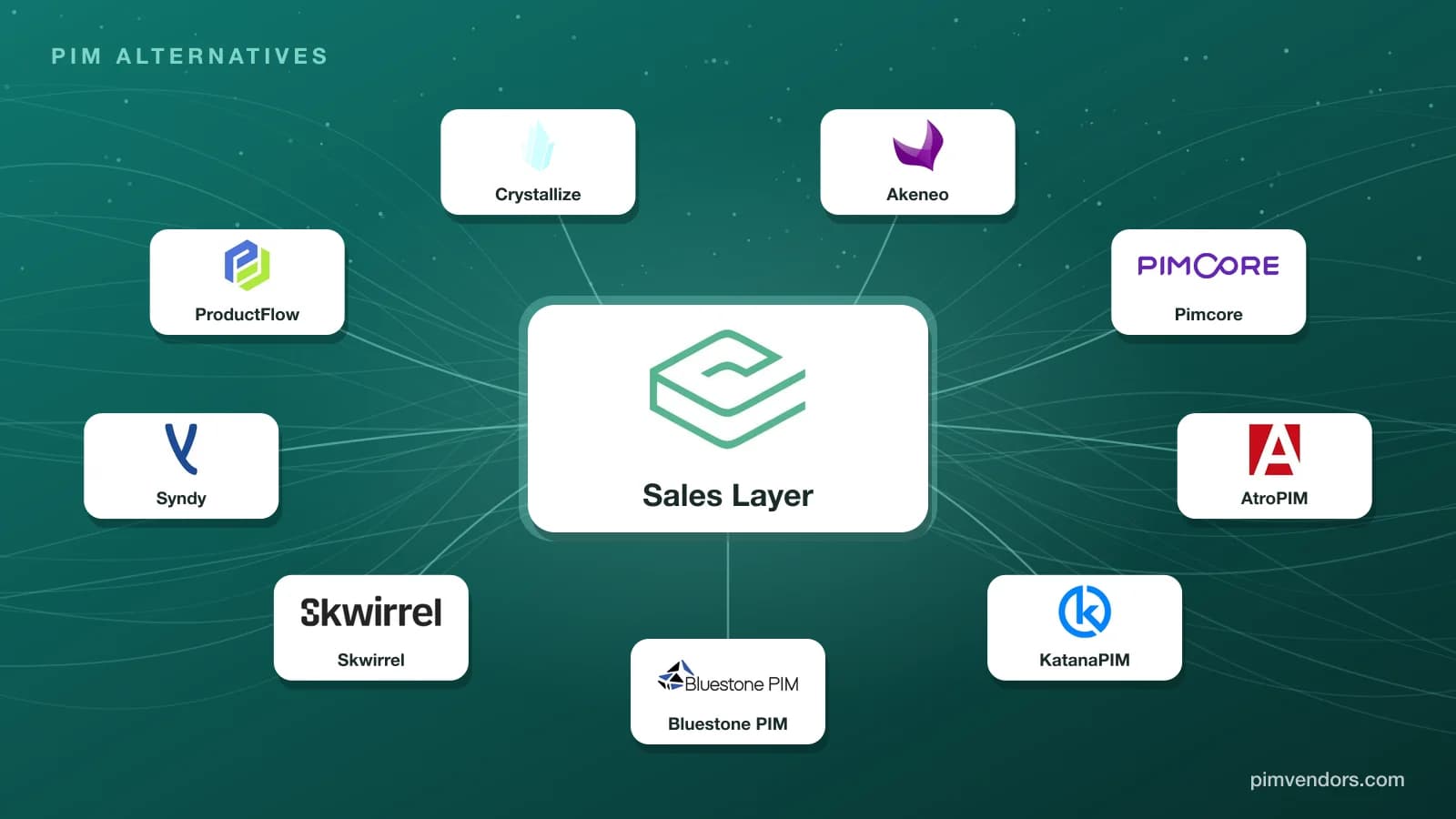
Sales Layer is often the first PIM a growing company looks at: it is quick to start with and connects to the big webshop platforms and marketplaces. Teams reopen the choice when their requirements grow, for example when a wholesaler asks for ETIM data, a retailer requires GDSN, or the IT team moves to a composable stack. This guide covers what Sales Layer is, why teams look for an alternative, and seven PIM systems to compare, each with what to check.
What Sales Layer is and who it fits
Sales Layer is a Spanish software company, founded in 2013, that sells a cloud PIM as SaaS. According to our Sales Layer profile, it covers:
- A central product hub: product information, images, documents and attributes in one place.
- Ready connectors: Amazon, Shopify, Magento, BigCommerce, PrestaShop and more.
- Data validation: error detection, completeness scoring and version control.
- Workflows: roles, approvals and comments.
- Languages and currencies: localized content without duplicating products.
- API and exports: an OData API and custom exports.
Our analyst places Sales Layer with mid-market manufacturers, brands, distributors and B2B suppliers that want a fast, marketer-friendly PIM with Amazon, Google and Shopify connectivity, quality scoring and, optionally, Ariba punchout for procurement. The strengths named: usability and onboarding backed by a large number of reviews, a clear feature matrix per tier, an OData API with changelogs, and AI agents with a review mode.
Why teams look for a Sales Layer alternative
The watch-outs in our analyst assessment, plus the profile's scale and deployment, give the usual reasons:
- Standards through a partner. GS1 and GDSN are not native: they run through a partner such as Qmica, at extra cost, and the same goes for ETIM. Our analyst also warns that the marketing pages can give procurement teams the wrong impression, so check in a demo what is native.
- The API model. You poll the API within rate limits, there is no full event-driven integration, and Sales Layer is not MACH-certified. Teams that build a composable stack compare it with Bluestone PIM and Akeneo.
- SaaS only. There is no on-premise or self-hosted option.
- Scale. Sales Layer targets small and mid-market companies. If you are growing into enterprise scale, compare systems built for it.
- A specialist job. Marketplace operations with orders and repricing, or delivering content to retailers in their own templates, are jobs that specialist tools cover more directly.
Sales Layer alternatives at a glance
- Akeneo: an API-first SaaS PIM with a large ecosystem and supplier onboarding.
- KatanaPIM: a usable SaaS PIM with published pricing, for merchants and wholesalers on Magento, Shopify or Shopware.
- Bluestone PIM: a composable, API-only PIM for mid-market and enterprise catalogs.
- Skwirrel: technical wholesalers and manufacturers that must deliver ETIM data and exchange it through a data pool such as 2BA.
- Syndy: brands and suppliers that send content to many retailers, each in its own format.
- ProductFlow: marketplace-led sellers who want listings, orders and repricing in one tool.
- Crystallize: direct-to-consumer teams that build their own storefront and have engineers.
The alternatives
The order follows fit for typical Sales Layer buyers, starting with the closest match. Fit and check notes come from each system's profile.
Akeneo
Akeneo is a French PIM, founded in 2013, sold as SaaS (Product Cloud) for companies from small to enterprise. It is sunsetting its open-source Community Edition.
- Fits better when: you build a composable stack and want an API-first PIM with completeness and quality tooling, supplier data onboarding and a native DAM for product assets. Our analyst names Akeneo as the benchmark for Sales Layer's API story. With the Community Edition being sunset, Akeneo is no longer a self-hosted route; if you need to self-host, look at Pimcore or AtroPIM.
- Check: as with Sales Layer, GS1, ETIM and digital product passport support needs proof in a proof of concept and often runs through a partner. It does not replace a multi-domain MDM. More in our Akeneo alternatives.
KatanaPIM
KatanaPIM is a Dutch SaaS PIM, founded in 2018, for small and mid-market merchants, wholesalers and distributors in the Benelux and the rest of Europe.
- Fits better when: you want a similarly usable SaaS PIM with published tier pricing and the API on every plan, practical import and mapping tools, workflows and specification groups for variant-heavy catalogs, and connections to Magento, Shopify, Shopware and ERP systems such as Exact.
- Check: GS1, ETIM and GDSN run through partner middleware, as with Sales Layer, and native AI is largely absent, so budget separately for AI tooling.
Bluestone PIM
Bluestone PIM is a Norwegian SaaS PIM, founded in 2013, built on microservices with an API-only, MACH-certified architecture.
- Fits better when: you are growing into mid-market or enterprise scale, run a composable commerce stack, and manage large catalogs with variants, bundles and many relations. It includes a native DAM and AI tools for enrichment and translation.
- Check: it targets the mid-market and enterprise, so expect a bigger project than a typical Sales Layer start. Our analyst lists deployment effort, proof of standards support and commercial terms as the points to test.
Skwirrel
Skwirrel is a Dutch SaaS PIM, founded in 2015, for technical wholesalers, distributors and manufacturers in the Benelux and the DACH region.
- Fits better when: ETIM classification and exchange through a data pool such as 2BA are mandatory in your market. Skwirrel has both at its core, where Sales Layer needs a partner, and adds transparent entry pricing, a JSON-RPC API with webhooks and a data quality dashboard.
- Check: our analyst calls it the wrong tool for GS1 and GDSN-led consumer goods and for marketplace-first syndication. It is a small vendor, so validate SLAs and support hours.
Syndy
Syndy is a Dutch PIM and DAM platform, founded in 2013 and part of the Icecat Group, built for content exchange between brands and retailers.
- Fits better when: you are a brand or supplier in FMCG, DIY, toys or healthcare that delivers content to many retailers, each with its own template. Syndy maps content to retailer-specific formats, sources content from suppliers and scores completeness.
- Check: our profile has no full analyst assessment yet. Ask for references with your own retailers, and test deployment effort, standards support and commercial terms.
ProductFlow
ProductFlow is a Dutch platform, founded in 2018, that combines listing content, offers, orders and repricing for marketplace sellers.
- Fits better when: marketplaces such as bol, Amazon, Zalando or Kaufland are your main channel and no webshop or ERP acts as the source of truth. You edit content per marketplace instead of building a central data model first.
- Check: it is not a fit for GDSN, ETIM, digital product passport or MDM programs, and its workflows, DAM and golden record are weaker than in a classic PIM.
Crystallize
Crystallize is a Norwegian headless commerce backend, founded in 2017, that combines PIM, content and commerce behind a GraphQL API.
- Fits better when: you are a direct-to-consumer or B2B team that builds its own storefront, sells subscriptions or prices per market, and has engineers available. Its base pricing tiers are published.
- Check: it has no native GDSN, ETIM or marketplace syndication, so it does not replace Sales Layer's ready connectors. If marketplaces matter, budget for custom work or rule it out early.
How to choose and switch
Export what Sales Layer holds
The data model, completeness rules, channel mappings, and every connector and export in use. This is the scope of your migration and the start of your requirements.
Decide what must be native
GS1 and GDSN, ETIM, marketplace connectors, an event-driven API: decide which you need in the product and which may come from a partner. That decision narrows the shortlist more than any feature list.
Demo three systems with your own data
Give each vendor one real product family and two of your channels. Let the people who maintain product content score the work, and ask to see the standards and connectors you need running, not on a slide.
Migrate one channel at a time
Run Sales Layer and the new system in parallel per channel, and compare the output until it matches. The PIM RFP guide helps you turn the result into contract requirements.
Time the switch to the renewal date
Check the notice period, and leave enough time before renewal for the demos and a parallel run.
Compare more PIM systems
Compare these and other systems in the PIM profile overview, or answer a few questions in the free PIM Scan for a ranked shortlist based on your scale, sector and must-haves.
- Best PIM software: the wider market overview, with Sales Layer in the e-commerce top 10.
- The top PIM solutions for Shopify: if Shopify is your main channel.
- Top 10 PIM solutions for wholesale: for distributors and wholesalers.
Where to go from here
Frequently asked questions
What is Sales Layer?
Sales Layer is a Spanish SaaS PIM, founded in 2013, known for an easy interface and ready-made connectors. It targets small and mid-market manufacturers, brands, distributors and B2B suppliers that want their product data under control quickly and publish to webshops and marketplaces such as Amazon and Shopify.
What are the best Sales Layer alternatives?
Akeneo for an API-first PIM with a large ecosystem, KatanaPIM for a usable SaaS PIM with published pricing, Bluestone PIM for a composable stack, Skwirrel for technical wholesale with ETIM, Syndy for brands that supply many retailers, ProductFlow for marketplace sellers and Crystallize for direct-to-consumer teams with their own storefront.
How long does a Sales Layer implementation take?
It depends on your data model, the number of connectors and whether you need a partner for GS1, GDSN or ETIM. Sales Layer runs only as SaaS, so there is nothing to install, and it positions itself as quick to implement. Ask for a reference with a similar catalog and channel mix, and ask who does the implementation work: Sales Layer itself or a partner.
Does Sales Layer support GS1, GDSN and ETIM?
Not natively. Our analyst assessment notes that GDSN and ETIM run through a partner such as Qmica, at extra cost. If ETIM is mandatory in your market, compare Skwirrel, which has ETIM classification and data pool exchange at its core.
Sales Layer or Akeneo, which one fits?
Both serve brands, manufacturers and distributors that publish to many channels. Sales Layer leads on ease of use and ready connectors, with an OData API that you poll within rate limits. Akeneo is API-first, with a large ecosystem and supplier onboarding, sold as SaaS now that it is sunsetting its Community Edition. Our analyst advises buyers who build a composable stack to compare Sales Layer's API and event model with Akeneo and Bluestone.
Is there a Sales Layer alternative for marketplace sellers?
ProductFlow. The Dutch platform combines listing content per marketplace with offers, orders and repricing in one login, with a strong focus on bol and other European marketplaces. It is not a fit for GDSN, ETIM or MDM programs.
Which Sales Layer alternatives publish their prices?
Our profiles note published tier pricing for KatanaPIM, with the API on every plan, transparent entry pricing for Skwirrel and published base tiers for Crystallize. Compare three to five years of cost in every case, including connectors and any partner for standards.
How do you switch from Sales Layer to another PIM?
Export your data model, completeness rules and channel mappings, and list every connector and export you use. Shortlist three systems, demo them with one of your own product families, migrate one channel at a time with a parallel run, and plan the switch around your renewal date.
Diagnostic
Do you actually need a PIM?
Run the complexity index before you budget software or hire an SI.
Budget
Model a first-pass TCO
Translate catalog shape into a three-year cost range in under ten minutes.