
Core
SAP S/4HANA and PIM Integration Options: Vendor Connectors and iPaaS Compared
Stephan Spijkers · 2026-10-20 · 20 min read
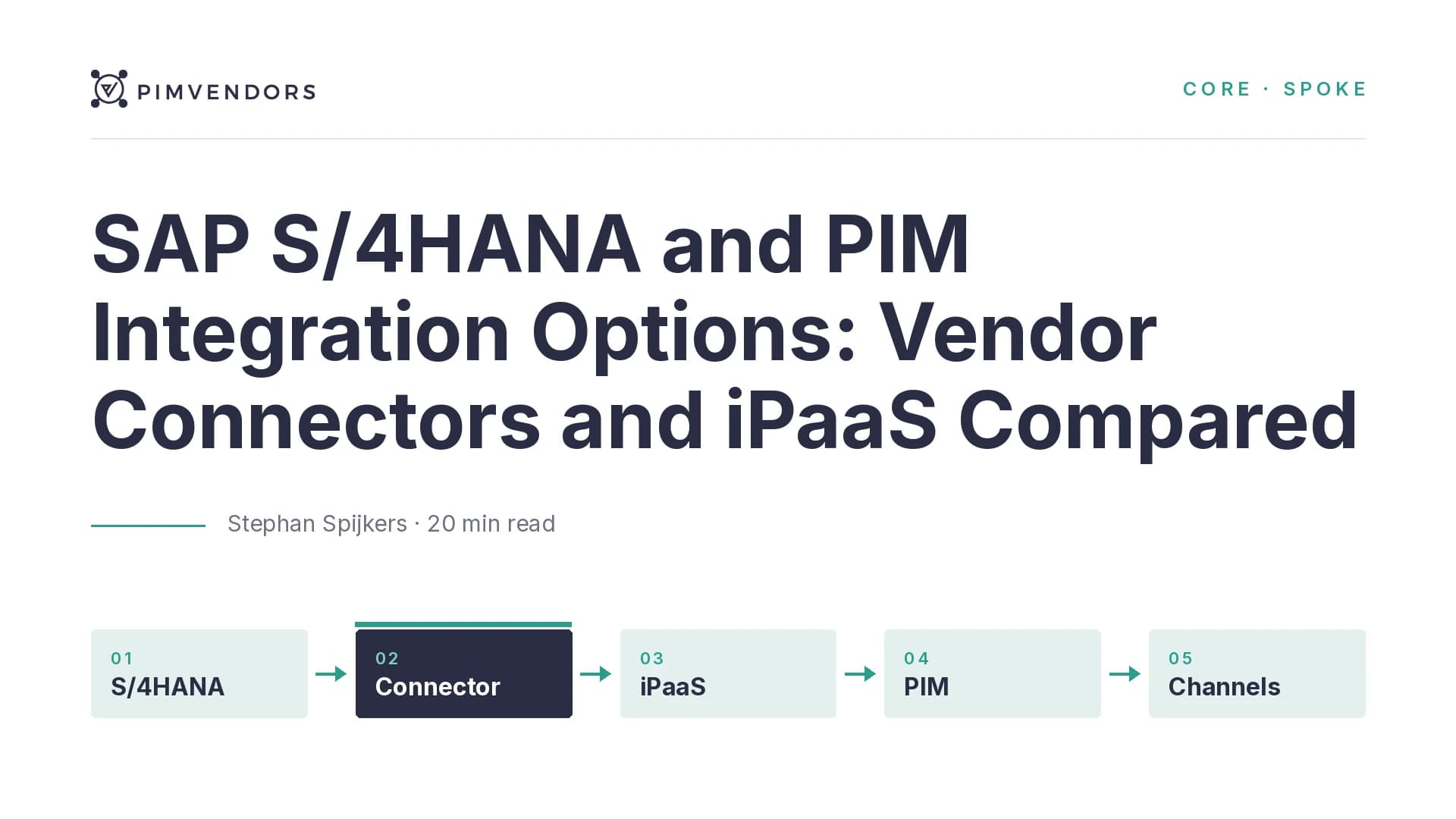
A PIM can connect to SAP S/4HANA through the PIM vendor's own connector, through a partner or project integration, or through an integration platform (iPaaS) that also connects other systems. The routes differ in who builds the integration, who maintains it after SAP or the PIM changes, and which S/4HANA editions they are documented for. Those points are one part of a PIM evaluation, next to how well the PIM fits the product data model, the team that will work in it and the channels it has to feed. This page describes six PIM vendors' SAP routes and six iPaaS platforms on the same points, with the source behind each claim. For the wider SAP picture, including how product data is split between S/4HANA, PIM, MDM and PLM, see PIM for SAP S/4HANA.
What separates the integration options
The first difference is ownership. An integration changes when SAP releases an update, when the PIM vendor changes its API and when the customer's material master changes. Whoever owns the integration carries that work every year, so two integrations with the same set-up cost can have very different running costs. Some vendors include maintenance in the subscription, some leave it to the customer and some leave it to a partner contract.
The second difference is the S/4HANA edition. SAP runs S/4HANA as Cloud Public Edition, Cloud Private Edition and on premise. Public Edition is multi-tenant. Customers extend it through key-user tools, and classic ABAP changes to SAP objects are not available there. Private Edition and on premise still allow classic ABAP extensions, which SAP does not recommend (SAP Learning). The practical consequence: a connector documented on Public Edition works with SAP's released interfaces. A Private Edition or on-premise system with years of custom fields behaves differently and is usually tested on its own.
Five integration routes
The options sort into five routes by who builds and maintains the integration. The edges are approximate, because every vendor also works with integration partners.
- Vendor-maintained connector. The PIM vendor builds the connector and presents it as kept current with SAP releases. The customer carries less maintenance, and the documented edition scope is narrow. inRiver.
- Customer-maintained blueprint. The vendor delivers prebuilt integration content, and the customer or its partner configures, extends and maintains it in its own SAP tools. The customer has the most control and carries the SAP work. Akeneo.
- Vendor connector on SAP's classic interfaces. The vendor connects through IDoc or RFC, the interfaces SAP customers have used since R/3 and ECC. Stibo Systems and Viamedici.
- Tailored or partner-built integration. The integration is built for the customer's system, by the vendor or a partner. That suits a heavily customized SAP system and leaves maintenance to whoever the contract names. Pimcore and Bluestone PIM.
- iPaaS. A separate integration platform connects S/4HANA, the PIM and other systems through its own connectors, and the mappings run inside that platform. SAP Integration Suite, Boomi, MuleSoft, Workato, Celigo and Alumio.
PIM vendor connectors
Each PIM vendor is described on the same five points. Where a point is not on a public page we could open, the section says so. Country, product type and deployment below follow the vendor profiles in this directory.
inRiver: vendor-maintained, certified on BTP
inRiver is a Swedish SaaS PIM for manufacturers, brands and wholesalers. In May 2026 it announced an SAP-certified S/4HANA Cloud Connector, built with SAP BTP, for companies running SAP S/4HANA Public Cloud (inRiver press release).
Read the certification sentence carefully. The headline and the opening paragraph say the S/4HANA Cloud Connector is certified by SAP as built with SAP BTP. Later in the same release, the sentence that names SAP's Integration and Certification Center says SAP ICC certified inRiver's SAP Commerce Cloud Connector as built with SAP BTP, and integrated with S/4HANA Cloud Public Edition. The two sentences name different products. Confirm with inRiver which product holds which certification.
- Who builds it: inRiver. The release says the S/4HANA Cloud Connector needs no custom development or iFlow build-out.
- Who maintains it: inRiver. Its SAP overview calls the connector inRiver-maintained and says connector maintenance is included when SAP updates (inRiver SAP overview).
- S/4HANA editions: the pages we opened describe S/4HANA Public Cloud. Private Edition and on-premise support are not documented there.
- Where it is listed: inRiver says the connector is offered as an add-on to its PIM on the SAP Store. Confirm the live listing on the store before you treat that sentence as current. We did not open a store page for it.
- Not documented on these pages: the add-on price, whether customers need their own SAP BTP subscription, and which material master fields and directions the connector covers.
One name causes confusion in SAP searches. The inRiver Integration Framework is inRiver's general framework for building outbound adapters. Its community article says it turns the customer's data model into a standard integration model, supports delta processing, and delivers product, bundle, catalog and value-list data as JSON (inRiver community). It is not the SAP connector. A project described as "IIF for SAP" is a custom build on that framework.
Akeneo: a blueprint the customer runs in Integration Suite
Akeneo is a French open-core PIM, offered as SaaS, with open-source roots. Its accelerators for SAP S/4HANA are prebuilt iFlows that the customer imports into its own SAP Integration Suite on SAP BTP (Akeneo App Store). Material data moves from S/4HANA to Akeneo in batches. Updates in Akeneo go back to SAP through events from Akeneo's Event Platform.
- Who builds it: Akeneo delivers the iFlows and the mapping logic. The customer's team or implementation partner configures authentication, filters and the mapping between SAP fields and the Akeneo data model.
- Who maintains it: the customer. Akeneo describes the accelerator as a blueprint. Its blog says this replaces an earlier model in which Akeneo owned and maintained the SAP connection, and that customers can now change the integration without waiting for a vendor release (Akeneo blog).
- S/4HANA editions: Akeneo's architecture page lists S/4HANA on premise or in the cloud as the source, and recommends SAP Cloud Connector for on-premise systems. The outbound trigger in SAP (the IDoc or service call that sends the data) and eventing on the SAP side are outside the package (Akeneo Help Center).
- Where it is listed: on the Akeneo App Store, version 1.0, published 31 October 2025, with the price listed as free. The listing's requirements name Akeneo PIM Enterprise Edition (SaaS), SAP BTP and SAP Integration Suite. The same listing names Growth, Advanced and Premium as supported packages, so confirm which editions the accelerator actually runs on. An SAP Store listing for the S/4HANA accelerators is not mentioned on these pages.
- Requirements: the App Store requirement line names Enterprise Edition (SaaS), plus SAP BTP, Integration Suite access, and a partner or in-house Integration Suite skills. The free App Store price is the accelerator package, not the SAP BTP or Integration Suite license.
The trade-off is control against workload. An SAP-skilled team gets control over the mapping and does not wait for vendor releases. The maintenance after every SAP and Akeneo change lands on that team. Akeneo alternatives compares Akeneo with other PIMs on criteria beyond SAP.
Stibo Systems: IDoc connectors for the material master
Stibo Systems is a Danish vendor of multidomain master data management. Its STEP platform covers product, supplier and customer data. Its SAP connector for the material master uses IDoc MATMAS05 and is listed for R/3, ECC and S/4HANA (Stibo Systems). A separate CREMAS connector is listed in the same gallery (Stibo Systems). CREMAS is SAP's vendor-master message.
- Who builds it: Stibo Systems, which is named as the developer in its connectivity gallery.
- Who maintains it: not stated on the connector page.
- S/4HANA editions: listed as S/4HANA without an edition. Public Edition support is not stated. The interface the page names is IDoc MATMAS05.
- Where it is listed: STEP 10.0 achieved SAP-certified integration with SAP NetWeaver on 16 September 2020, for exchanging material, customer and vendor master data with S/4HANA (Stibo Systems). The press release does not say the certification has been renewed for current STEP or S/4HANA releases. The connector page does not point to an SAP Store listing.
- Not documented on these pages: whether the 2020 certification still covers the current releases.
Stibo Systems also lists MuleSoft in the same connectivity gallery (Stibo Systems), which matters for companies that already run MuleSoft. Stibo alternatives compares STEP with other enterprise options, and the MDM guide explains where MDM and PIM part ways.
Viamedici: RFC connectivity from an MDM and PIM suite
Viamedici is a German vendor of PIM and MDM software for manufacturers, sold as its EPIM platform. Viamedici states that EPIM integrates in both directions with SAP and SAP S/4HANA (Viamedici). Its MDM page says VIA/MDM has native SAP RFC connectivity to ECC 6, S/4HANA and SAP CRM for material-master exchange (Viamedici).
- Who builds it: Viamedici, as part of its platform.
- Who maintains it: not stated on these pages.
- S/4HANA editions: Viamedici names S/4HANA without an edition. RFC calls classic SAP function modules. Public Edition support is not stated.
- Where it is listed: the EPIM page calls the platform SAP-certified and does not name the certification, the release or the edition (Viamedici EPIM). The pages do not point to an SAP Store listing.
- Not documented on these pages: the type and release of the certification the EPIM page refers to.
Viamedici and Stibo Systems are the SAP-centric options on our SAP Commerce Cloud (Hybris) alternatives page, which covers the commerce side of the same SAP setup.
Pimcore: partner-built on SAP Cloud Integration
Pimcore is an Austrian open-core platform for PIM, DAM and digital experience. Pimcore describes SAP integration as API-led connectivity, delivered with partners, and mentions reusable accelerators (Pimcore). The packaged option we found comes from a partner. diva-e's Pimcore SAP Connector runs on SAP Cloud Integration on SAP BTP, uses OData on the SAP side and REST APIs on the Pimcore side, and diva-e writes that there is currently no standardized integration between Pimcore and SAP ERP (diva-e).
- Who builds it: a Pimcore partner, as a project or with a partner product such as diva-e's connector.
- Who maintains it: the partner or the customer's team, depending on the contract. The connector page does not fix that split.
- S/4HANA editions: diva-e names S/4HANA without an edition.
- Where it is listed: the pages we opened do not point to an SAP Store listing.
- Not documented on these pages: which partners have delivered S/4HANA integrations, at what scale, and what partner maintenance covers after an SAP or Pimcore release.
Pimcore suits companies with developers who want control over the data model and the integration. Pimcore alternatives covers that choice outside SAP.
Bluestone PIM: a tailored integration per customer
Bluestone PIM is a Norwegian SaaS PIM with an API-only architecture. Its pages do not describe a named, packaged SAP connector. The Connectivity Suite builds a bidirectional integration with SAP, Oracle or Microsoft Dynamics per customer, mapped to that customer's fields, from patterns used on earlier projects. Bluestone states that every function in the PIM is available through the API (Bluestone PIM, integration page).
- Who builds it: Bluestone PIM, through its Connectivity Suite.
- Who maintains it: not stated on these pages.
- S/4HANA editions: not stated, including which S/4HANA interface the integration uses.
- Where it is listed: the pages do not point to an SAP Store listing.
- Not documented on these pages: named S/4HANA reference projects and a typical build time.
Bluestone argues that a standard connector makes too many assumptions about a customer's SAP data. That argument fits a heavily customized system. It also means build time for a standard one. Bluestone alternatives compares it with other composable PIMs.
An iPaaS between SAP and the PIM
An iPaaS is hosted middleware between S/4HANA, the PIM and the other systems a company runs. It connects to each system through a connector, maps and converts the data, routes it, retries failed messages and monitors the flows in one place. SAP and the PIM then connect once to the platform, instead of to each other and to every channel separately.
The route is at its most useful when several systems exchange product data, such as S/4HANA, a PIM, a webshop, marketplaces, a warehouse system and a CRM. Connections, mappings and error handling are reused, monitoring sits in one view, and one system can be replaced without rebuilding every connection. Our guide to PIM costs notes that a headless shop front and an iPaaS decouple the shop from one back end, which keeps a later switch possible. With one ERP and one PIM, the platform adds a subscription, an environment someone has to run, and another party between SAP and the PIM when data does not arrive. The notes below describe what each platform documents. They are not a shortlist.
Ownership of the mappings is the structural difference from a PIM vendor connector. Alumio states that its connectors handle authentication and API calls, and that mappings, data conversions and workflows are configured separately in the platform (Alumio). The iPaaS vendor maintains its connectors. SAP and the PIM vendor maintain their APIs. The mapping between S/4HANA's material structure and the PIM's data model belongs to whoever builds and runs the flows: the customer's integration team or an integration partner.
The platforms below are not PIM systems. They have no profile in our directory. Each one is described on the same five points, limited to pages we could open.
SAP Integration Suite
- What it is: SAP's own iPaaS. SAP's product page describes it as a cloud service that covers application integration, API management, event-driven integration and B2B, with hybrid connectivity to on-premise and private cloud systems (SAP).
- S/4HANA connectivity: native to SAP. The same page describes prebuilt integrations and adapters for SAP and third-party systems.
- PIM connectors or use: Akeneo's S/4HANA accelerators run in the customer's Integration Suite, inRiver's connector is built with SAP BTP, and diva-e's Pimcore SAP Connector runs on SAP Cloud Integration. Sources are in the vendor sections above.
- Who builds and maintains the mappings: the customer or its SAP partner, for its own integration flows. For prebuilt content such as Akeneo's accelerators, the content provider delivers the starting point and the customer maintains the configured flows.
- Hosting model: a cloud service on SAP BTP, with hybrid connectivity to on-premise and private cloud systems, as SAP's product FAQ describes it.
Boomi
- What it is: a third-party iPaaS. Integrations are built as processes that call connector operations.
- S/4HANA connectivity: the SAP S/4HANA OData connector supports OData V2 APIs on SAP S/4HANA Cloud and SAP S/4HANA, with create, get, query, update and delete operations. Boomi states that OData V4 APIs are not supported by this connector, and that it is published as an open-source connector (Boomi).
- PIM connectors or use: Boomi's connector page does not document a connector for the PIMs on this page. A Boomi partner describes a project that connected inRiver to SAP through Boomi and Solace for product and inventory synchronisation (NeosAlpha). That is a partner project, not a Boomi PIM connector.
- Who builds and maintains the mappings: the customer or its Boomi partner, in Boomi processes.
- Hosting model: not taken further here. The connector page we opened describes the OData connector and does not set out the runtime options.
MuleSoft
- What it is: Salesforce's Anypoint Platform. Integrations are built as Mule applications.
- S/4HANA connectivity: the Anypoint Connector for SAP S/4HANA OData supports the OData APIs of S/4HANA Cloud and S/4HANA on premise, including queries, functions and batch requests (MuleSoft).
- PIM connectors or use: Stibo Systems lists MuleSoft in its connectivity gallery (Stibo Systems). We did not find a MuleSoft documentation page for the other PIMs on this page.
- Who builds and maintains the mappings: the customer's MuleSoft developers or a MuleSoft partner, in the Mule applications.
- Hosting model: not taken from a deployment page we opened. MuleSoft documents the OData connector. Where the applications run is a separate choice.
Workato
- What it is: a third-party iPaaS. Integrations are built as recipes with triggers and actions.
- S/4HANA connectivity: the SAP OData connector covers on-premise SAP systems, S/4HANA Cloud Private Edition and S/4HANA Cloud Public Edition, with OData V2 and V4 APIs. The documentation names API_PRODUCT_SRV as an example service, and an on-prem agent for systems behind a firewall (Workato). A separate SAP RFC connector covers RFC calls, BAPIs and IDoc exchange (Workato).
- PIM connectors or use: a documented Akeneo connector (Workato) and an inRiver integrations page that lists triggers such as a new or updated record (Workato). The inRiver page is a product page, not connector documentation, and it does not say who built or maintains the connector.
- Who builds and maintains the mappings: the customer or its partner, in Workato recipes.
- Hosting model: a cloud platform, with an on-prem agent for SAP systems behind a corporate firewall, as the OData connector page describes.
Celigo
- What it is: a third-party iPaaS (integrator.io).
- S/4HANA connectivity: the SAP S/4HANA connection supports Cloud public edition, Cloud private edition and on premise, with API versions v2 and v4. On-premise connections use an on-premise agent installed on the customer's network (Celigo).
- PIM connectors or use: a documented Akeneo connection (Celigo).
- Who builds and maintains the mappings: the customer or its Celigo partner, in integrator.io flows.
- Hosting model: the connection guide describes a cloud product plus an on-premise agent for on-premise S/4HANA. A separate SAP partner-listing page for Celigo was not available when we checked, so this section does not rely on it.
Alumio
- What it is: an iPaaS that documents connectors for ERP, PIM and commerce systems. Its platform page for Pimberly describes how those connectors work.
- S/4HANA connectivity: a documented SAP S/4HANA OData connector with subscriber and publisher steps (Alumio docs). Alumio also sells an SAP API plugin for R/3, ECC and S/4HANA. Alumio describes that plugin as an SAP-certified ABAP stack (Alumio). That wording is Alumio's. We did not find a matching certification record on an SAP page we could open, so treat it as the vendor's statement.
- PIM connectors or use: documented connectors for Akeneo (Alumio docs) and inRiver (Alumio docs), and a connector for Pimberly on Alumio's platform page.
- Who builds and maintains the mappings: Alumio states that its connectors handle authentication and API communication, and that mappings, data conversions and workflows are configured separately in the platform. That configuration sits with the customer or an Alumio partner.
- Hosting model: not stated beyond the platform pages we opened. The S/4HANA docs describe the connector package, not a data-residency option.
What a listing and a certification each tell you
A marketplace listing and a certification are easy to mix up, and vendor copy sometimes does. inRiver's May 2026 release is the clearest example on this page. It says the S/4HANA Cloud Connector is offered as an add-on on the SAP Store, and that the connector is certified by SAP as built with SAP BTP. The sentence that names SAP's Integration and Certification Center attributes that certification to the SAP Commerce Cloud Connector, integrated with S/4HANA Cloud Public Edition. Ask which product was tested, against which release, and for which edition.
Stibo Systems' September 2020 release is specific in a different way. It says STEP 10.0 achieved SAP-certified integration with SAP NetWeaver, for material, customer and vendor master data with S/4HANA. It does not say the certification has been renewed. Viamedici's EPIM page says "SAP-certified" and does not name a certification at all.
The pages for Akeneo, Pimcore and Bluestone PIM that we opened do not point to an SAP Store listing for an S/4HANA connector. That is not the same as proof that no listing exists. Confirm the store yourself if a listing is part of the decision.
Points buyers often compare
The descriptions above leave open points for every option. Buyers usually settle them in the demo and the RFP. The PIM RFP guide shows why a precise scope, such as a named SAP S/4HANA system with its custom extensions, helps a vendor price the real work. For the SAP part, the points below are the ones that change the running cost.
- Maintenance: which party updates the integration after an SAP release and after a PIM release, and what that costs per year, in euros.
- Edition and release: the certification, if any, the release it covers, and reference customers on the same S/4HANA edition.
- SAP interface: IDoc, RFC, OData or business events, and which one carries the initial load and which the daily changes.
- Platform subscription: whether an SAP BTP or third-party iPaaS subscription is needed, and whose contract it sits on.
- Mapping ownership: who changes the mapping when the material master or the PIM data model changes.
- Own data in the demo: an export of one product group with variants, units and two languages shows how the data arrives in the PIM and reaches one channel. Bringing your worst supplier file to the PIM demo explains why a buyer's own data shows more than the vendor's sample.
Trade-offs across the routes
Each route moves work to a different party.
- Vendor-maintained connector: less maintenance for the customer, and the scope is what the vendor has built and documented. For inRiver, confirm which product the certification sentence refers to.
- Customer-maintained blueprint: more control over the mapping, with the SAP integration work carried in-house or by a partner.
- IDoc and RFC connectors: familiar to SAP teams that already run those interfaces. Edition support, especially Public Edition, still has to be confirmed.
- Tailored or partner-built integration: fits a customized SAP system. Maintenance depends on the contract with the vendor or the partner.
- iPaaS: reuse and central monitoring when many systems exchange data, with an extra subscription and the mappings owned by the customer or its integration partner. With one ERP and one PIM, that extra platform is a cost to weigh, not a default.
Every PIM vendor named here has a profile in the PIM solutions directory, with fit and watch-out notes. The iPaaS platforms do not, because they are not PIM systems. For the generic split between ERP and PIM behind all of this, read where ERP stops and PIM starts.
Where to go from here
Frequently asked questions
Which PIM has a certified SAP S/4HANA connector?
inRiver's May 2026 release says its S/4HANA Cloud Connector is certified by SAP as built with SAP BTP, for companies running S/4HANA Public Cloud. The same release says SAP's Integration and Certification Center certified inRiver's SAP Commerce Cloud Connector as built with SAP BTP and integrated with S/4HANA Cloud Public Edition. The two sentences name different products, so confirm which certification applies to which connector. Stibo Systems announced in September 2020 that STEP 10.0 had achieved SAP-certified integration with SAP NetWeaver, for exchanging material, customer and vendor master data with S/4HANA. Certifications differ in scope, release and edition.
What is the Akeneo SAP S/4HANA accelerator?
A package of prebuilt integration flows (iFlows) that the customer imports into its own SAP Integration Suite on SAP BTP. Material data moves from S/4HANA to Akeneo in batches, and updates in Akeneo go back to SAP through Akeneo's Event Platform. The Akeneo App Store lists Akeneo PIM Enterprise Edition (SaaS) as a requirement, and the same listing names Growth, Advanced and Premium as supported packages, so confirm the edition in the quote. The customer or its partner configures and maintains the flows.
Is the inRiver Integration Framework an SAP connector?
No. The inRiver Integration Framework is inRiver's general framework for outbound integrations. It supports delta processing and delivers product, bundle, catalog and value-list data as JSON. inRiver's SAP products named in its May 2026 release are the S/4HANA Cloud Connector and the SAP Commerce Cloud connector.
Does Pimcore have an SAP connector?
Pimcore describes SAP integration as API-led connectivity delivered with partners. The packaged option we found is a partner product: the Pimcore SAP Connector from diva-e, which runs on SAP Cloud Integration and uses OData on the SAP side. diva-e itself writes that there is currently no standardized integration between Pimcore and SAP ERP.
What is an iPaaS in an SAP and PIM integration?
An integration platform as a service is hosted middleware that connects S/4HANA, the PIM and other systems through connectors, and runs the mappings, routing and monitoring between them. SAP Integration Suite is SAP's own iPaaS. Boomi, MuleSoft, Workato, Celigo and Alumio are third-party platforms that document S/4HANA connectors. They are not PIM systems, and this site has no profile for them.
Which iPaaS platforms document both S/4HANA and PIM connectors?
Workato, Celigo and Alumio document both an S/4HANA connector and an Akeneo connector. Alumio also documents an inRiver connector, and Workato publishes an inRiver integrations page. Boomi and MuleSoft document S/4HANA connectors. A documented PIM connector from those two vendors, for the PIMs on this page, is not something we found in their own docs. Stibo Systems lists MuleSoft in its connectivity gallery, and a Boomi partner has published a project that connected inRiver to SAP through Boomi.
Who maintains the mappings in an iPaaS setup?
The party that builds and runs the integration flows, usually the customer's integration team or an integration partner. Alumio states that its connectors handle authentication and API calls, and that mappings are configured separately in the platform. The iPaaS vendor maintains its connectors. SAP and the PIM vendor maintain their APIs.
Does an SAP Store listing prove a connector works?
A listing and a certification answer different questions, and a vendor's own wording can mix them. inRiver says its S/4HANA Cloud Connector is offered as an add-on on the SAP Store, and a separate sentence in the same release attributes an SAP Integration and Certification Center certification to the SAP Commerce Cloud Connector. Ask which product was certified, on which release, and for which S/4HANA edition.
Diagnostic
Do you actually need a PIM?
Run the complexity index before you budget software or hire an SI.
Budget
Model a first-pass TCO
Translate catalog shape into a three-year cost range in under ten minutes.