
Core
Syndy Alternatives: 7 PIM Solutions to Compare
Stephan Spijkers · 2026-10-11 · 9 min read
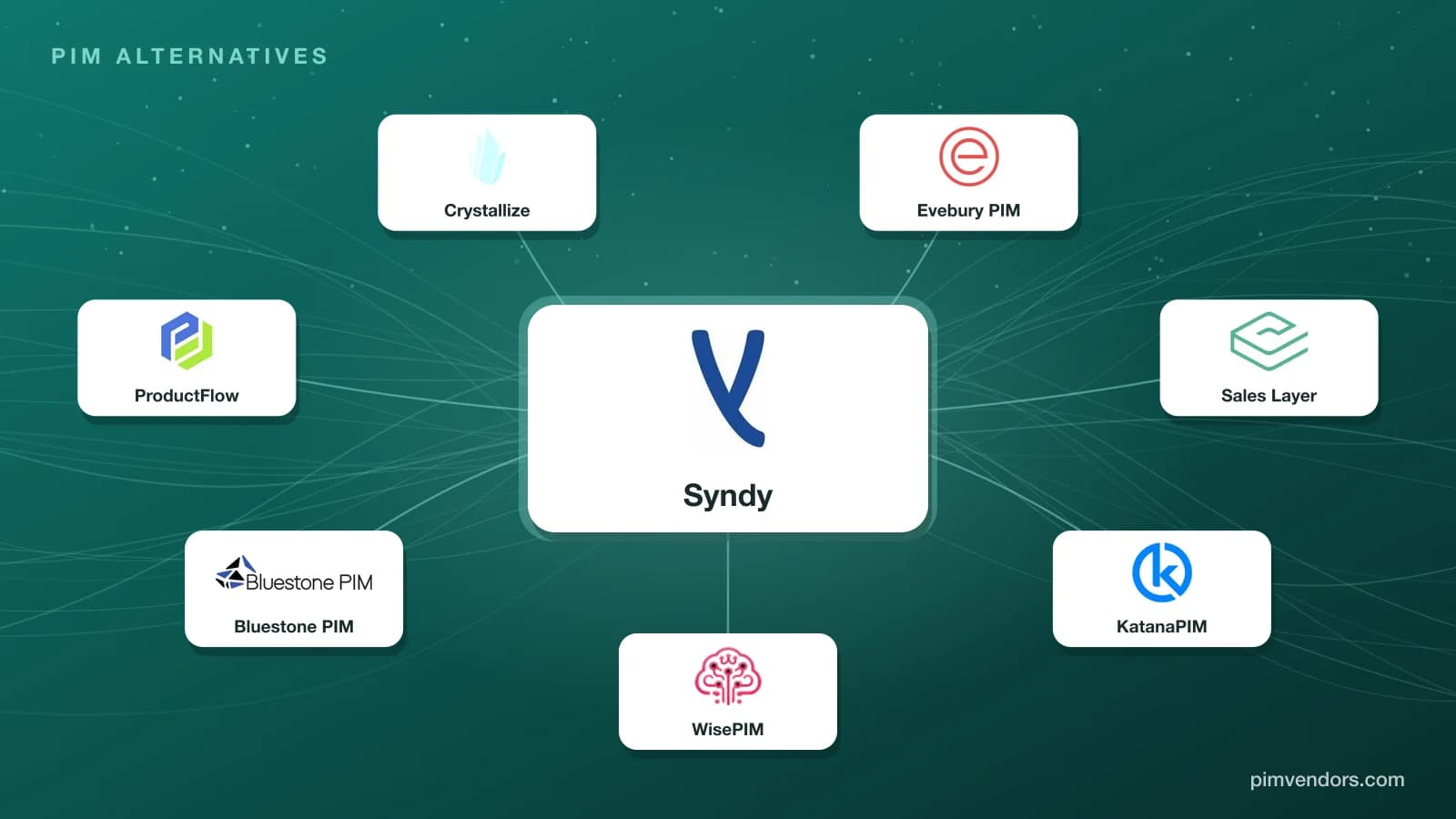
Syndy is built for brands and retailers that exchange product content. Teams that use it reopen the choice when their channels change, when a contract comes up for renewal, or when they need more from a PIM than retailer content exchange. This guide covers what Syndy does, why teams look for an alternative, seven alternatives ordered by fit, and how to switch.
What Syndy is and who it fits
Syndy is a Dutch company, founded in 2013 and part of the Icecat Group. According to our Syndy profile, it is a SaaS platform that combines PIM and DAM for supplier and retailer ecosystems. It covers:
- PIM and DAM in one environment: descriptions, specifications, images, 3D and 360-degree views and video.
- Content sourcing and collaboration: direct content exchange with suppliers, aligned to each retailer's needs.
- Content mapping and exports: prebuilt export templates for retailer-specific formats, including API syndication.
- Completeness scoring: real-time insight into missing or incomplete attributes.
- Multilingual and multi-country setups: country and language configuration with central control.
The profile places it with brands, retailers and distributors in FMCG, DIY, toys and healthcare that handle many SKUs, many content sources and several languages. It lists small and mid-market companies as its main scale, and it is active in Europe.
Our analyst note for Syndy is short: evaluate it on deployment effort, proof of standards support and commercial transparency. Those three questions apply to every alternative below as well.
Why teams look for a Syndy alternative
- Your channels change. Syndy is built around the exchange between suppliers and retailers. A brand that now sells mostly through its own webshop or through marketplaces may need a PIM for its own channels, or a marketplace tool, more than retailer templates.
- You need a PIM that runs your own catalog. The profile advises confirming ERP, commerce, DAM and iPaaS connectors during shortlisting. If those links are the heart of your project, compare systems built around them.
- Your retailers require GDSN. The profile does not list GDSN. If a retailer requires it, check how Syndy or an alternative reaches a certified data pool.
- You need another deployment model. Syndy is listed as SaaS only.
- You grow into an enterprise program. Teams that add master data or many markets often move to platforms built for midmarket and enterprise scale.
Syndy alternatives at a glance
- Evebury PIM: best for food and non-food manufacturers that want a ready-made data model.
- Sales Layer: best for manufacturers and brands that want a marketer-friendly SaaS PIM with marketplace and shop connectors.
- KatanaPIM: best for Benelux merchants and wholesalers on Magento, Shopify or Shopware with published pricing.
- WisePIM: best for retailers and distributors that onboard many supplier feeds and want AI help with attributes and translations.
- Bluestone PIM: best for mid-market and enterprise teams that build a composable commerce stack.
- ProductFlow: best for brands and merchants that sell mainly through marketplaces such as bol.
- Crystallize: best for brands that move from retailers to their own storefronts.
The alternatives
The fit and watch-out notes come from each vendor profile and its analyst assessment, where it has one.
Evebury PIM
Evebury PIM is a Dutch SaaS PIM, founded in 2022, for food and non-food manufacturers. Its profile describes a fully modeled data structure with the essential product attributes out of the box, meant to shorten the implementation, and support for both B2B and B2C channels. It fits manufacturers on the supplier side of Syndy's network that want their own product record with a ready-made model, rather than a platform built around retailer exchange.
Check: the profile gives no detailed analyst assessment, so test deployment effort, proof of standards support and commercial terms. Ask which retailers, data pools and formats it delivers to today. The profile lists activity in the Benelux.
Sales Layer
Sales Layer is a Spanish SaaS PIM, founded in 2013. Our analyst places it with mid-market manufacturers, brands, distributors and B2B suppliers that want a fast, marketer-friendly PIM, connectivity to Amazon, Google and Shopify, quality scoring and, optionally, Ariba punchout. Its strengths are usability and onboarding, a clear feature matrix per tier and an OData API with changelogs. Where Syndy is built around retailer exchange, Sales Layer is a general PIM with many channel connectors.
Check: GS1 and GDSN are not native and run through a partner at extra cost. The API works with polling and rate limits rather than events, so composable buyers should compare it with API-first systems.
KatanaPIM
KatanaPIM is a Dutch SaaS PIM, founded in 2018. Our analyst places it with mid-market Benelux and EU merchants, wholesalers and distributors on Magento, Shopify or Shopware with Exact or a similar ERP, who need a usable SaaS PIM for catalogs with many variants and specifications. Pricing per tier is published and the API is on every plan, and import and mapping tools are practical. It suits the retailer and wholesaler side of Syndy's market, where the job is your own webshop and channels.
Check: GS1, ETIM and GDSN run through partner middleware, and marketplace export often runs through integrators. Native AI is largely absent, so budget separately if you need it.
WisePIM
WisePIM is a Dutch SaaS PIM, founded in 2024, with AI-assisted enrichment. Its profile places it with retailers, distributors and brands that work with large assortments and many supplier feeds, with AI attribute extraction, bulk import, translation and distribution to webshops and marketplaces. That makes it a fit for retailers that use Syndy mainly to collect supplier content.
Check: it is a young vendor and the profile gives no detailed analyst assessment, so test deployment effort, proof of standards support and commercial terms, and ask for references at your scale.
Bluestone PIM
Bluestone PIM is a Norwegian SaaS PIM, founded in 2013, built on a microservice, API-first architecture and MACH-certified. It fits mid-market and enterprise manufacturers, distributors and omnichannel retailers with large catalogs, several brands or markets and a composable commerce stack. It is the option for a team that outgrows a retailer exchange platform and wants its PIM to feed every other system.
Check: deployment effort, proof of standards support and commercial terms. Retailer-specific formats are not prebuilt the way Syndy's export templates are, so ask who builds and maintains them.
ProductFlow
ProductFlow is a Dutch platform, founded in 2018, for marketplace operations. Our analyst places it with EU merchants, especially on bol, who want one login for listing content, offers, orders and repricing. Its strengths are a PIM interface built for marketplaces, bol Gold Partner status, a broad library of European marketplace connectors and a built-in repricer. It fits brands whose sales have moved from retailers to marketplaces.
Check: it is not a fit for GDSN, ETIM, digital product passport or MDM programs, and enterprise PIM depth, such as workflows, DAM and a golden record, is limited.
Crystallize
Crystallize is a Norwegian headless commerce backend with PIM, founded in 2017, with a GraphQL API. It fits direct-to-consumer and B2B teams that want one composable backend for product content, subscriptions, multi-market pricing and their own storefronts, with engineers available. Base pricing tiers are published.
Check: there is no native GDSN, ETIM or marketplace syndication. Retailer syndication is Syndy's core job, so Crystallize replaces Syndy only when that job has moved to your own storefronts.
How to choose and switch
List your retailers, formats and sources
Write down every retailer and marketplace you send content to, the export template or format each one uses in Syndy, and every supplier or content source you collect from. Add the ERP and webshop links you need.
Decide which job the new system does
Exchange with retailers as a brand, collection of supplier content as a retailer, or a PIM for your own channels. Some teams need two tools: a PIM plus a syndication or data pool service.
Shortlist three and demo with your own data
Give each vendor one real product family with assets, and two retailer formats with different rules. Let the people who maintain content score the work.
Migrate one retailer at a time
Export products, assets and mappings, rebuild each retailer format in the new system, and run old and new in parallel until the output matches.
Settle the contract
Check your notice period and data export terms, and model three years of subscription, connectors and services. Our PIM cost comparison gives ranges per segment.
Compare Syndy alternatives side by side
Compare these and other systems in the PIM profile overview, or answer a few questions in the free PIM Scan for a ranked shortlist based on your scale, sector and must-haves.
- Top 10 PIM solutions for retail: the wider retail shortlist.
- Data pools and syndication round table: practitioners on GDSN and syndication.
- Salsify alternatives: the enterprise options for brands that sell through retailers.
Where to go from here
Frequently asked questions
What is Syndy?
Syndy is a Dutch SaaS platform, founded in 2013 and part of the Icecat Group, that combines PIM and DAM for content exchange between brands and retailers. Brands use it to source, enrich, validate and send product content in each retailer's format. Retailers use it to collect content from their suppliers.
Who is Syndy for?
Consumer goods manufacturers, food and beverage brands, toy companies and retail chains that send product content to several retailers and marketplaces, especially in FMCG, DIY, toys and healthcare. Its profile lists small and mid-market companies as its main scale.
Is Syndy part of Icecat?
Yes. Our Syndy profile describes it as an Icecat Group company. If that link matters for your content sources or your contract, ask Syndy how the two work together for you.
What are the best Syndy alternatives?
For brands and manufacturers, compare Evebury PIM and Sales Layer. For retailers and wholesalers with many supplier feeds, KatanaPIM and WisePIM. For a composable stack, Bluestone PIM. For marketplace sellers, ProductFlow. For brands that move to their own storefronts, Crystallize.
Does Syndy replace a GDSN data pool?
The profile describes retailer-specific export templates, content mapping and API syndication. It does not list GDSN. If your retailers require GDSN, ask Syndy and every alternative how they reach a certified data pool, and whether that costs extra.
Is Syndy a PIM or a syndication tool?
Both. It holds product data and digital assets like a PIM, but its workflow is built around the exchange between suppliers and retailers: sourcing content, mapping it to retailer formats, scoring completeness and publishing it. A classic PIM is built around your own product record and your own channels.
How do you switch from Syndy to another PIM?
List every retailer format and content source you use, decide which job the new system must do, test three systems with your own product family, rebuild the retailer export templates, run old and new in parallel per retailer, and switch off Syndy only after the last retailer runs from the new system.
Diagnostic
Do you actually need a PIM?
Run the complexity index before you budget software or hire an SI.
Budget
Model a first-pass TCO
Translate catalog shape into a three-year cost range in under ten minutes.