
Core
Trimit Alternatives: 7 PIM Solutions to Compare
Stephan Spijkers · 2026-10-11 · 9 min read
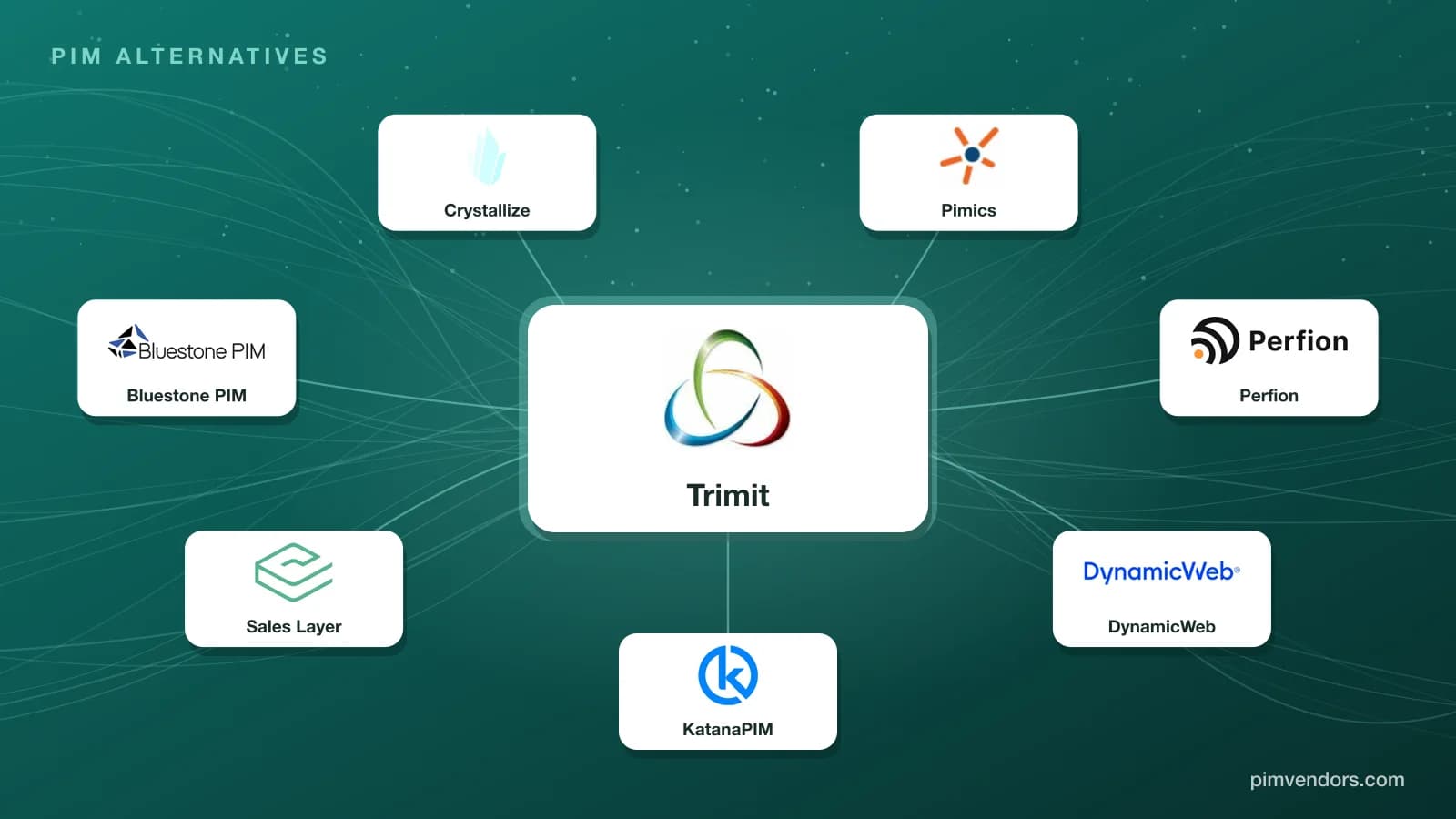
Trimit comes up when fashion and furniture companies that run, or plan to run, Microsoft Dynamics 365 Business Central look for a way to manage product data. Its alternatives fall into three groups: PIM inside Business Central, a separate PIM connected to it, and a commerce suite with PIM. This guide is written for buyers on Microsoft Dynamics. It covers what Trimit is, why teams look at alternatives, seven options, and how to switch.
What Trimit is and who it fits
According to our Trimit profile, Trimit is a business management and product information solution built on Microsoft Dynamics 365 Business Central, designed for fashion, apparel, furniture and interior companies. Its PIM sits in the same ERP environment as order management and financials, so products, variants, stock, pricing and orders share one system. It is proprietary, runs as SaaS or on premise, is active in Europe and has been in business since 1990.
The profile names these buyers:
- Fashion and apparel brands with seasonal collections, size and colour variants and style configurations.
- Furniture and interior companies with configurable products, complex attribute sets and material options.
- Mid-market companies on Business Central, or moving to it, that want industry-specific PIM built in.
- Retail and wholesale companies that publish to their own webshop and to third-party retailers.
Our profile has no analyst assessment of Trimit yet, so ask for references with a similar catalog and channel mix.
| System | What it owns | Who works in it | The question it answers |
|---|---|---|---|
| PIMProduct information managementPIM guide | Sellable product content: attributes, descriptions, asset links, translations and channel versions. | E-commerce, marketing, category and product content teams. | Is this product complete and ready to sell on this channel? |
| ERPEnterprise resource planningERP guide | Transactions and operations: orders, stock, purchasing, pricing and finance. | Finance, supply chain, purchasing and sales operations. | What did we buy, make, sell, ship and invoice? |
Trimit lets Business Central do both jobs. Each alternative below draws that line in a different place. Our guide on where ERP stops and PIM starts covers the split in more detail.
Why teams look for a Trimit alternative
The reasons below follow from what Trimit is, not from complaints.
- Business Central is not, or no longer, the ERP. Trimit is built on Business Central, so it comes with that ERP.
- The range goes beyond fashion and furniture. Trimit is an industry solution. A company that adds other categories may prefer a PIM without a sector focus.
- Marketing wants its own workspace. In Trimit, product content lives in the ERP. Teams that enrich content for many channels, languages and marketplaces sometimes want a separate PIM with channel exports, completeness checks and a DAM.
- A composable or headless stack. Teams that build their own storefront or connect many services through APIs look at API-first PIMs and headless commerce backends.
Trimit alternatives at a glance
- Pimics: best for keeping PIM inside Business Central without a sector focus.
- Perfion: best for a separate PIM with deep Microsoft Dynamics integration, DAM and print.
- Dynamicweb: best for webshop, content and PIM in one suite next to Dynamics.
- KatanaPIM: best for a SaaS PIM with published pricing for merchants and brands.
- Sales Layer: best for a marketer-friendly SaaS PIM with channel connectors.
- Bluestone PIM: best for large catalogs in a composable stack.
- Crystallize: best for direct-to-consumer brands that build their own storefront.
The alternatives
Pimics
Pimics is a PIM built natively inside Microsoft Dynamics 365 Business Central, for small and mid-market manufacturers, distributors and retailers. Changes in the ERP flow through to product data automatically, so ERP and PIM work as one system.
- Where it differs: the same architecture as Trimit, PIM inside Business Central, but without a sector focus. Its profile names manufacturing, distribution and retail rather than fashion or furniture.
- Check: our profile has no analyst assessment or capability detail yet. Ask for a demo with your own variant structure, such as size, colour or material, and for references in your sector.
Perfion
Perfion is a Danish PIM known for its Microsoft Dynamics integration. Its profile lists real-time synchronization with Dynamics NAV, AX and Dynamics 365, and it runs as SaaS, on premise or cloud-hosted. Our analyst places it with mid-market to enterprise manufacturers, distributors and wholesalers with complex relational catalogs, heavy Dynamics or SAP Business One footprints, and a need to align print, e-commerce and ERP.
- Where it differs: a separate PIM with its own DAM, print publications, low-code automation and an optional supplier portal, while Business Central keeps the transactions.
- Check: confirm the connector for Business Central specifically. Configuration is often partner-led, it is not a marketplace syndication suite, and GDSN needs a data pool or middleware.
Dynamicweb
Dynamicweb is a Danish suite that combines PIM, e-commerce, content management and marketing. Our analyst places it with mid-market B2B and B2C organizations standardized on Microsoft Dynamics that want one platform for web, commerce, marketing and catalog enrichment, with print publications and dealer portals in the same stack.
- Where it differs: Trimit adds PIM to the ERP, Dynamicweb adds it to the webshop. It fits best when you replace or build the webshop too.
- Check: it is a suite first, so treat it as a PIM only if the scope is enrichment and syndication, not master data. Assume partner work for GS1, GDSN or ETIM.
KatanaPIM
KatanaPIM is a Dutch SaaS PIM for small and mid-market merchants, wholesalers and brands, with published tier pricing and the API on every plan. Fashion and home goods are among its sectors, and its customer cases include the furniture brand Polewolf and the luggage brand SUITSUIT.
- Where it differs: a separate SaaS PIM with variants, specification groups and import mapping, next to your ERP rather than inside it. Its integration list includes Business Central.
- Check: many listed integrations run through partners rather than prebuilt plugins, so confirm who builds and maintains the Business Central connection. Native AI is largely absent. See our KatanaPIM alternatives.
Sales Layer
Sales Layer is a Spanish SaaS PIM, founded in 2013, with prebuilt connectors to Shopify, Magento, Amazon and other channels. Its profile names retailers and direct-to-consumer brands with frequent updates and seasonal collections among its users, and our analyst places it with mid-market manufacturers, brands and distributors that want a fast, marketer-friendly PIM.
- Where it differs: built for marketing and e-commerce teams that enrich and publish without IT, with completeness scoring and multilingual content.
- Check: its profile does not list a Business Central connector, so ask how the ERP link works. GS1 and GDSN come through a partner at extra cost, and the API relies on polling with rate limits.
Bluestone PIM
Bluestone PIM is a Norwegian SaaS PIM on a microservice, API-first architecture, for mid-market and enterprise manufacturers, distributors and omnichannel retailers with large catalogs. Fashion and apparel and home improvement are among the industries on its profile, and it models variant groups, product families and bundles.
- Where it differs: a PIM for a composable stack and many markets, with product content held apart from Business Central and a DAM and AI tools in the product.
- Check: deployment effort, proof of standards support and commercial terms, and how it connects to Business Central through its API or Extension Hub.
Crystallize
Crystallize is a Norwegian headless backend that combines PIM, content and commerce behind a GraphQL API. Its profile names direct-to-consumer brands selling lifestyle goods among its users, and its product model supports configurator patterns.
- Where it differs: it fits a fashion or furniture brand that sells direct through a storefront it builds itself, with product storytelling and, for furniture, configurators.
- Check: our analyst calls it not a pure PIM for ERP-centric catalog work without adopting its commerce stack or heavy middleware, and it needs engineering capacity. For a company run on Business Central, that is the first question.
How to choose and switch
Decide where product data lives
Inside Business Central, in a separate PIM connected to it, or in a commerce suite. This choice splits the seven alternatives into groups.
Inventory what Trimit does for product data
List the collections, size, colour and material variants, configurations, attributes, channels and integrations, and which of them also drive orders and stock. The PIM RFP guide helps turn this into requirements.
Shortlist two or three systems
Match your choice from step one to the alternatives above, and drop any system that fails a hard requirement on paper.
Demo with your own data
Give each vendor one seasonal collection or one configurable furniture line, connected to a Business Central test environment, and two real channels.
Migrate per channel, then adjust the contracts
Run the old and new setup in parallel per channel until the output matches. Then change or end the Trimit scope with your partner.
Compare and shortlist
Compare these and other systems in the PIM profile overview, or answer a few questions in the free PIM Scan for a ranked shortlist. Related guides:
- PIM for fashion and apparel: what fashion brands need from product data.
- PIM for furniture retail: variants, materials and configurable products.
- How to select the right PIM: the full selection method.
Where to go from here
Frequently asked questions
What is Trimit?
Trimit is a business management and product information solution built on Microsoft Dynamics 365 Business Central, for fashion, apparel, furniture and interior companies. Its PIM sits in the same ERP environment as order management and finance, so products, variants, stock, pricing and orders share one system. It runs as SaaS or on premise.
What are the best Trimit alternatives?
It depends on where you want product data to live. Pimics keeps PIM inside Business Central. Perfion is a separate PIM with deep Microsoft Dynamics integration, and Dynamicweb combines PIM with a webshop. KatanaPIM and Sales Layer are SaaS PIMs next to the ERP, Bluestone PIM fits large catalogs, and Crystallize brands that build their own storefront.
Which PIM works with Microsoft Dynamics 365 Business Central?
Pimics and Trimit run inside Business Central. Perfion lists real-time synchronization with Dynamics NAV, AX and Dynamics 365 on its profile, and Dynamicweb is aimed at companies standardized on Microsoft Dynamics. KatanaPIM lists Business Central among its integrations, partly through partners. For any separate PIM, confirm the Business Central connector and who maintains it.
Do you need a separate PIM next to Business Central?
Not always. If product data mainly serves orders, stock and a webshop, PIM inside Business Central, as in Trimit or Pimics, keeps one system. A separate PIM pays off when marketing teams enrich content for many channels, languages and marketplaces, or when you need a DAM, print output or a composable stack.
What is the difference between Trimit and Pimics?
Both put PIM inside Microsoft Dynamics 365 Business Central. Trimit is an industry solution for fashion, apparel, furniture and interior, with functions for collections, variants and configurable products. Pimics is a PIM for Business Central users in manufacturing, distribution and retail, without a sector focus.
Which PIM fits fashion and apparel companies?
On Business Central, Trimit is built for fashion and apparel. Outside the ERP, KatanaPIM, Sales Layer and Bluestone PIM all name fashion among their sectors, and Crystallize suits fashion brands that sell direct through their own storefront. Test seasonal collections and size and colour variants in every demo.
Which PIM fits furniture companies?
Furniture asks for configurable products, materials and options. Trimit covers that inside Business Central. KatanaPIM counts the furniture brand Polewolf among its customers, and Crystallize supports configurator patterns for brands that sell direct. Bring one configurable product line to every demo.
How does Perfion compare with Trimit?
Trimit puts PIM inside Business Central with an industry layer for fashion and furniture. Perfion is a separate PIM that synchronizes with Microsoft Dynamics, with its own DAM, print publications and an optional supplier portal. Perfion suits companies that want a separate workspace for product content, often with partner-led configuration.
Diagnostic
Do you actually need a PIM?
Run the complexity index before you budget software or hire an SI.
Budget
Model a first-pass TCO
Translate catalog shape into a three-year cost range in under ten minutes.