
Core
Utopis Alternatives: 7 PIM Solutions to Compare
Stephan Spijkers · 2026-10-11 · 9 min read
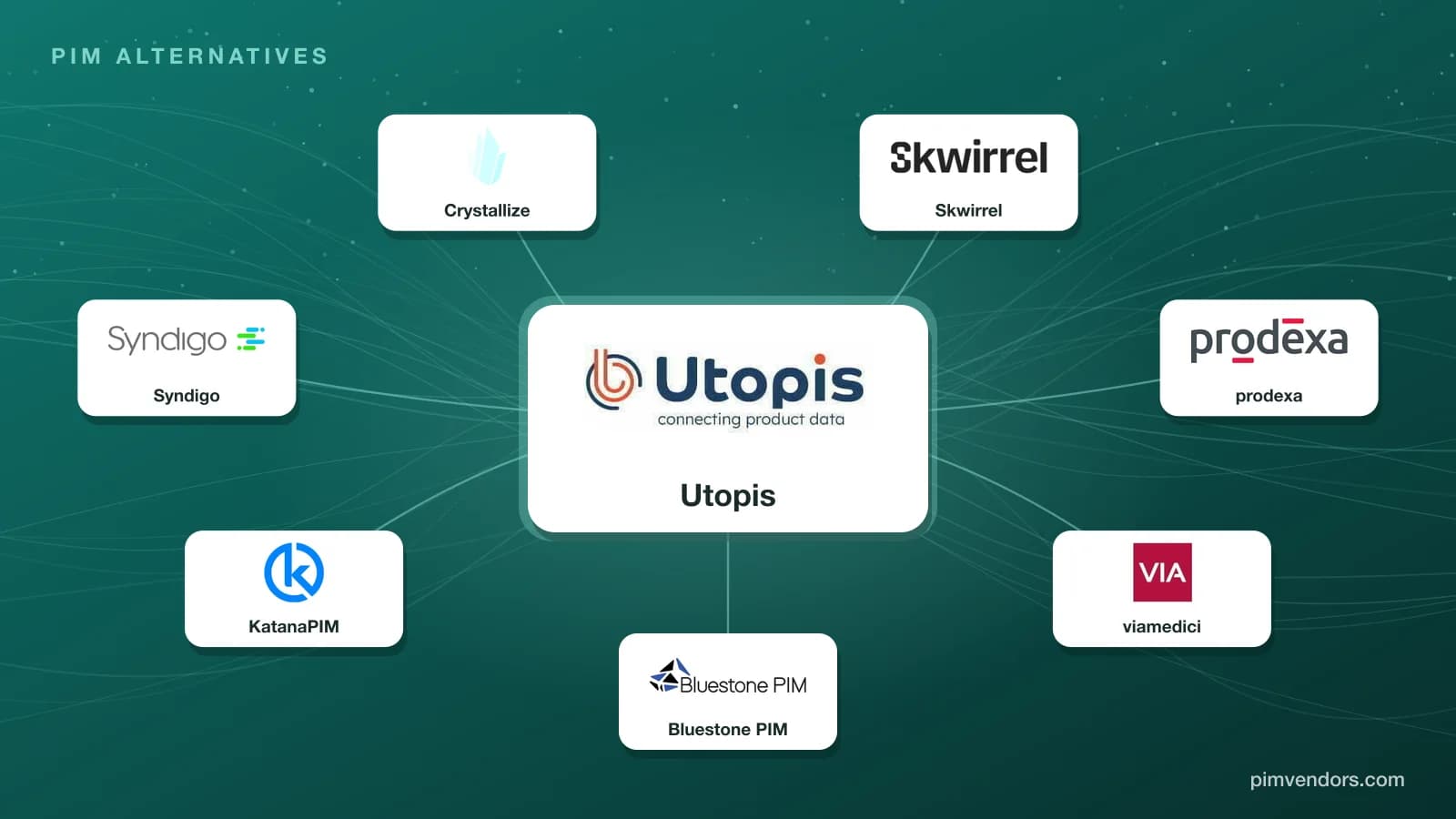
Utopis is a familiar name for building and installation manufacturers in the Netherlands and Belgium. It is built for a specific job: getting technical product data, classified to ETIM, to wholesalers, specifiers and installers. Teams reopen the choice when that job changes. This guide covers what Utopis does, why teams look elsewhere, seven alternatives with the situation each one fits, and how to switch.
What Utopis is and who it fits
According to our Utopis profile, the Utopis Platform is a PIM developed for the construction and installation sector, sold as SaaS from the Netherlands. It structures and publishes technical product data to digital and print channels for manufacturers, wholesalers and suppliers. The profile lists:
- ETIM classification: full support for the European Technical Information Model.
- Sector standards: BIM, GS1 and DICO, plus Dutch specification formats such as STABU, RAW and NL-SfB, and declarations of performance (DoPs).
- Data governance: rules that check completeness and flag issues.
- Publishing: to webshops, apps, marketplaces and print through templates and APIs, with content blocks you write once and reuse.
- Digital asset management: technical drawings, manuals and safety sheets linked to products.
- REST APIs: for ERP, e-commerce and other systems.
Our analyst assessment puts its best fit with construction or installation manufacturers in the Benelux and the neighbouring DACH markets that publish ETIM-classified data to 2BA, produce specification texts and DoPs, and offer configurators or advice tools, especially when the ERP holds the logistics data and marketing wants a vendor that guides delivery. The strengths listed are deep modelling of construction systems, the ETIM, DICO and Dutch specification stack, rich outputs, involvement in the standards community, and a pragmatic role next to the ERP.
Why teams look for a Utopis alternative
- Retail and marketplaces become the main channel. Our analyst calls Utopis the wrong tool for a retail marketplace PIM. If web shops and marketplaces take over from wholesale, the job has changed.
- GS1 GDSN comes first. Programs where GDSN is the core requirement are also outside its best fit.
- Master data beyond products. Utopis is not a global multidomain MDM.
- Support and roadmap. The team is small, and our analyst advises validating 24/7 support and the roadmap before you sign or renew.
- Growth outside the Benelux. The profile lists the Benelux as its footprint and calls the platform most relevant for Dutch-speaking markets, although it supports international expansion. If you roll out across Europe, check local standards and support.
Utopis alternatives at a glance
- Technical PIM with ETIM and 2BA for small and mid-sized companies: Skwirrel
- Industrial PIM with ETIM, ECLASS, supplier catalogs and print: prodexa
- Enterprise manufacturers around SAP, with configurators: Viamedici
- Composable PIM for manufacturers and distributors, including building materials: Bluestone PIM
- Webshop-led merchants and wholesalers in the Benelux: KatanaPIM
- Selling through retail chains that require GDSN: Syndigo
- Your own storefront or product configurator: Crystallize
The alternatives
Skwirrel
Skwirrel is a Dutch SaaS PIM for technical products in the Benelux and DACH. Our analyst puts its best fit with technical wholesalers, distributors and manufacturers where ETIM classification and exchange with 2BA or a similar data pool are mandatory, next to an ERP and a Magento or WooCommerce shop. The strengths listed are deep ETIM and data-pool fit, transparent entry pricing, a JSON-RPC API with webhooks, a data-quality dashboard and active development such as ETIM 10 support. Of the seven, it is the closest like-for-like option for the ETIM and 2BA job.
Check: it is a small vendor, so validate service levels and 24/7 needs. Ask whether it produces the specification texts, DoPs and configurator data you now get from Utopis. Our analyst calls it the wrong tool for GDSN-led programs and marketplace-first syndication.
prodexa
prodexa is a German PIM and PXM suite for manufacturers and distributors in DACH and the rest of Europe, sold as SaaS or cloud-hosted, with roots in the older jCatalog product line. Its profile names construction and building materials among its target industries, with ETIM and ECLASS classification, supplier catalog onboarding, print publishing and a deep model for variants, bills of materials and pricing. Entry SaaS pricing is published. It fits manufacturers that want a broad suite rather than a composable headless PIM.
Check: our analyst does not recommend it for API-first or composable architectures unless you accept its documented API limits, and GDSN and digital product passport support are claims until a proof of concept shows them. Ask for a 2BA export with your own data.
Viamedici
Viamedici is a German enterprise suite that combines PIM, multidomain MDM, DAM, catalog publishing and a configurator (CPQ), built around SAP. It fits SAP-centric manufacturers with configurable, technically complex products, multilingual print and digital catalogs, and ETIM or eCl@ss requirements. For a large installation or building products manufacturer, it adds master data and product configuration from one vendor.
Check: it is aimed at enterprises and is not a lean PIM, so expect suite complexity and integrator cost. Ask how it handles 2BA and the Dutch specification formats, which the profile does not mention.
Bluestone PIM
Bluestone PIM is a Norwegian SaaS PIM with an API-only, MACH-certified microservice architecture. Its profile lists home improvement and building materials among its industries, and it supports complex variants, bundles and product relations, with a native DAM for documents and media. It fits mid-market and enterprise manufacturers and distributors that move to a composable stack and want the PIM to feed several systems through APIs.
Check: our analyst advises evaluating deployment effort, proof of standards support and commercial transparency. For construction data, that means a demo of ETIM classification and a 2BA export with your own products.
KatanaPIM
KatanaPIM is a Dutch SaaS PIM for mid-market merchants, wholesalers and distributors in the Benelux and the rest of Europe. It has published tier pricing, an API on every plan, import mapping tools and connectors for Magento, Shopify, Shopware and ERPs such as Exact. It fits a wholesaler or manufacturer whose focus moves from data exchange within the sector to its own webshop and marketplaces.
Check: GS1, ETIM and GDSN run through partner middleware, so test the ETIM route before you commit. Native AI is largely absent, so budget separate tools if you need it.
Syndigo
Syndigo is a US platform that combines PIM, MDM, DAM and syndication with a large retailer network, and it is a certified GDSN data pool. Its best fit includes hardlines and retail vendor-management teams where retailer compliance and GDSN drive revenue. That is the job our analyst says Utopis is not built for: a manufacturer whose main buyers are retail chains that require GDSN.
Check: it is built for enterprise brands, the profile does not mention ETIM or 2BA, and authoring is secondary to network compliance. You may need it next to a sector PIM rather than instead of one.
Crystallize
Crystallize is a Norwegian headless platform, founded in 2017, that combines PIM, content and commerce behind a GraphQL API. Its product model supports configurator and bill-of-materials patterns, and it fits teams with developers that want to build their own storefront, product selector or configurator. For a Utopis buyer that is a narrow fit: the direct sales and configurator side, not the data exchange with the sector.
Check: it has no native ETIM, GDSN or marketplace syndication, so 2BA publication would need a custom build or a separate PIM. Our analyst notes it is not a pure PIM for ERP-centric catalog operations.
How to choose and switch
List every output you produce
2BA, specification texts (STABU, RAW, NL-SfB), DoPs, configurators, BIM links, print, webshop and procurement platforms. These outputs, more than the product data, decide how hard Utopis is to replace.
Write requirements and a shortlist
Name your ETIM version, data pools, GS1 needs, channels and ERP. Our PIM RFP guide helps turn them into requirements. Shortlist three or four systems from the list above.
Demo with your own data
Give each vendor one product group with its ETIM class, a specification text and a DoP, and ask for an ETIM-classified export to 2BA. Let the people who maintain the data score the work.
Migrate per product group with a parallel run
Map ETIM classes, attributes and assets, move one product group at a time, and compare the 2BA output of both systems until it matches.
Agree the contract and switch off last
Sign when the pilot works, and switch Utopis off only when every output and integration runs from the new system.
Compare more PIM systems
Compare these and other systems in the PIM profile overview, or get a free shortlist based on your own requirements with the PIM Scan. Related guides:
- PIM for manufacturing and PIM for wholesale: the wider market for technical products.
- PIM for BIM: how product data feeds building models.
- How to select the right PIM: the full selection method.
Where to go from here
Frequently asked questions
What is Utopis?
Utopis Platform is a Dutch PIM built for the construction and installation sector. It structures technical product data, classifies it to ETIM and publishes it to 2BA, webshops, print and procurement platforms, with Dutch specification formats and declarations of performance. It is sold as SaaS.
Who is Utopis for?
Manufacturers, wholesalers and suppliers of building and installation products, mostly in the Benelux, that work with ETIM, GS1 or BIM. Our analyst puts its best fit with construction and installation manufacturers that publish ETIM-classified data to 2BA and produce specification texts, declarations of performance and configurators.
What are the best alternatives to Utopis?
For a like-for-like technical PIM with ETIM, Skwirrel and prodexa. For enterprise manufacturers, Viamedici around SAP and Bluestone PIM for a composable stack. For a webshop-led wholesaler, KatanaPIM. For retail chains that require GDSN, Syndigo. For your own storefront or configurator, Crystallize.
Which Utopis alternatives support ETIM and 2BA?
Skwirrel's profile shows deep ETIM and data-pool fit, including 2BA. prodexa and Viamedici support ETIM and ECLASS. KatanaPIM handles ETIM and GS1 through partner middleware. Ask every vendor to show an ETIM-classified export to 2BA with your own products.
When is Utopis not the right tool?
Our analyst calls it the wrong tool for a retail marketplace PIM, a program where GS1 GDSN comes first, or global multidomain MDM. The team is small, so validate 24/7 support and the roadmap before you sign or renew.
Does Utopis support GS1 and GDSN?
The profile lists compatibility with GS1, but our analyst calls Utopis the wrong tool for programs where GS1 GDSN is the main requirement. If retail chains that require GDSN drive your data work, compare Syndigo or another GDSN-focused system.
Can a general PIM replace Utopis for construction products?
For product data and ETIM classification, often yes. For the construction-specific outputs, check carefully: specification texts such as STABU, RAW and NL-SfB, declarations of performance, configurators and BIM links may need custom work or a separate tool.
How do you switch from Utopis to another PIM?
List every output you produce today, map your ETIM classes and attributes, test the 2BA export in the new system, migrate one product group at a time with a parallel run, and switch Utopis off only when every output and integration runs from the new system.
Diagnostic
Do you actually need a PIM?
Run the complexity index before you budget software or hire an SI.
Budget
Model a first-pass TCO
Translate catalog shape into a three-year cost range in under ten minutes.