
Core
Perfion Alternatives: 7 PIM Solutions to Compare
Stephan Spijkers · 2026-10-11 · 9 min read
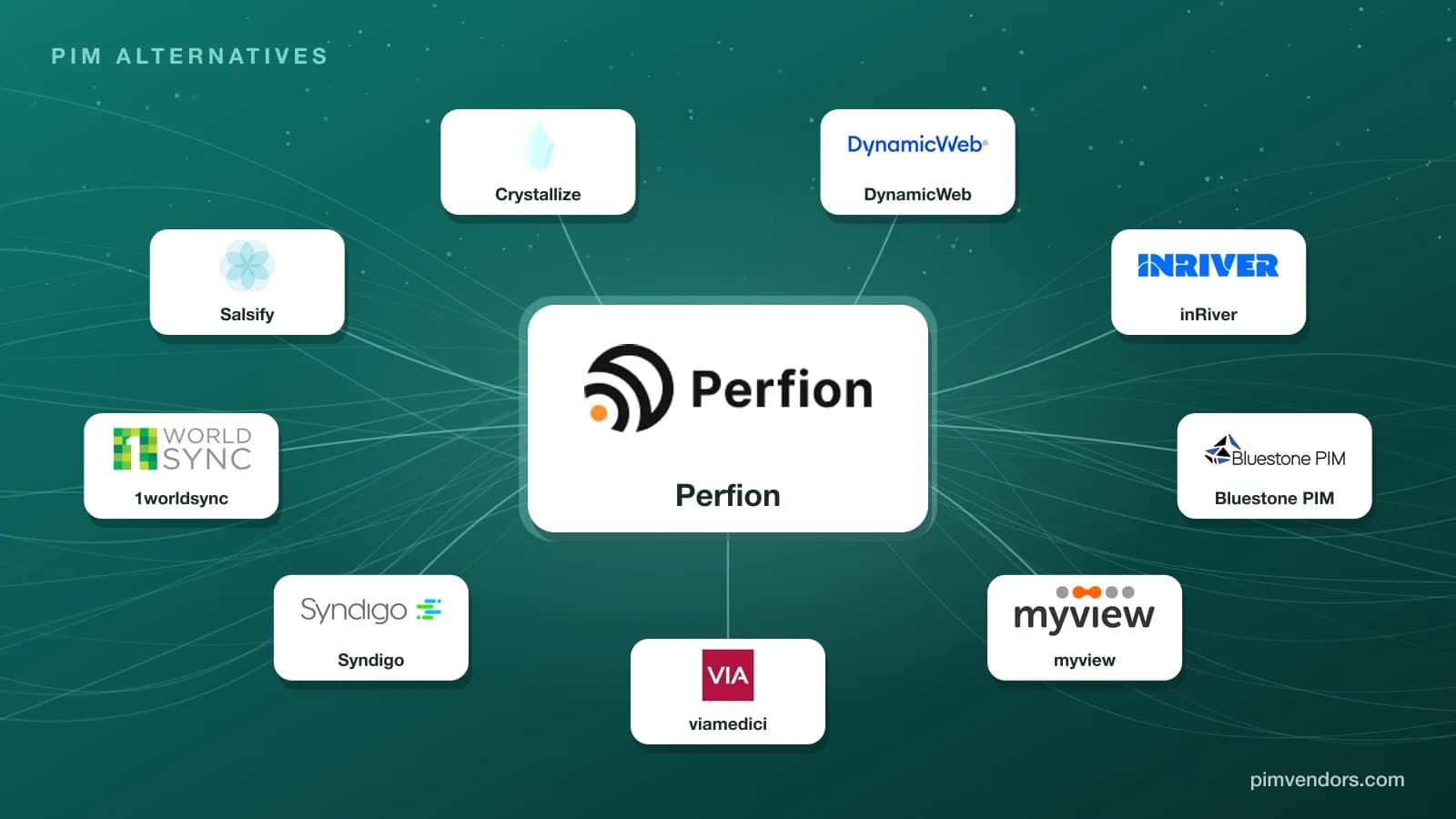
Perfion is on many shortlists of manufacturers and distributors that run Microsoft Dynamics or SAP Business One. Teams reopen the decision when the job changes: more marketplaces, retailer requirements, a new ERP or a composable commerce stack. This page covers what Perfion does well, why buyers compare alternatives, and seven alternatives ordered by fit for typical Perfion buyers. Fit and watch-out notes come from the analyst assessments on our vendor profiles.
What Perfion is and who it fits
Perfion is a Danish PIM vendor, sold as SaaS, on-premise or cloud-hosted. Its core is a relational product model that stays close to the ERP, with native integration with Microsoft Dynamics (NAV, AX and 365) and with SAP ERP, including SAP Business One. Around that sit a built-in DAM, workflows with version control, multilingual content, and print publishing through templates and an Adobe InDesign connection. Perfion is part of Boyum IT Solutions (our news item).
Our analyst assessment puts its best fit with mid-market to enterprise manufacturers, distributors and wholesalers that have complex relational catalogs, a heavy Dynamics or SAP Business One footprint, and a need to align print, e-commerce and ERP. It suits teams that are happy to configure through partners, using Perfion's low-code Actions and ecatDesigner. The strengths listed are flexible relational modeling, the built-in DAM, strong print and publications, an optional supplier portal and content store, and AI drafting features from the 2025-R3 release onward.
If that describes you, Perfion may still be the right choice. The reasons to look further sit in the gaps below.
Why teams look for a Perfion alternative
- Marketplaces and the digital shelf become the main job. Our analyst notes that Perfion is not a digital shelf or high-volume marketplace suite: syndication depends on connectors and custom exports.
- Retailers ask for GDSN. Perfion has no native GDSN certification, so you need a data pool or middleware.
- The ERP changes. Much of Perfion's value comes from its Dynamics and SAP Business One integration. A move to another ERP reopens the PIM decision too.
- The architecture shifts to composable. Teams that want an API-first PIM next to a headless shop compare Perfion with PIMs built that way. Perfion has REST APIs, but its strength is ERP-coordinated catalog work.
- You want less partner-led configuration. Perfion fits teams that configure through partners. If you want a product your own team sets up, weigh that early.
Perfion alternatives at a glance
- DynamicWeb: best for Microsoft Dynamics companies that want PIM, commerce and CMS in one suite.
- inRiver: best for manufacturers and brands with many channels that need print and digital from one model.
- Bluestone PIM: best for a composable, API-first commerce stack with large catalogs.
- myview: best for DACH manufacturers with technical, variant-rich catalogs, ETIM and print.
- Viamedici: best for SAP-centric enterprises that want PIM, MDM, DAM and CPQ from one vendor.
- Syndigo: best for brands that sell through retailers and need GDSN and validated syndication.
- Crystallize: best for digital-native teams that build their own storefront and want product, content and commerce in one backend.
The alternatives
DynamicWeb
DynamicWeb is a Danish .NET suite that combines PIM, e-commerce, CMS and marketing, sold as SaaS, cloud-hosted or on-premise. It was acquired by SignUp Software, a Microsoft Dynamics 365 software vendor (our news item).
It shares Perfion's Dynamics focus but adds the webshop, content and dealer portals to the same stack. Our analyst sees the best fit with mid-market B2B and B2C organizations standardized on Microsoft Dynamics, and lists practical enrichment tools (grid editing, completeness rules, workflows) and a print path for datasheets, price lists and catalogs.
Check: it is a suite first. Shortlist it as a PIM only if your scope is enrichment and syndication, not MDM, and assume partner work for GS1, GDSN and ETIM unless the vendor proves otherwise.
inRiver
inRiver is a Swedish SaaS PIM on Microsoft Azure, founded in 2007. Like Perfion it serves manufacturers, brands and wholesalers with complex catalogs, and it produces print and PDF from the same governed model.
The difference is on the channel side. Syndication to marketplaces and digital shelf analytics are core features, where Perfion relies on connectors and custom exports. Our analyst sees the best fit with mid-market and enterprise teams that have many channels and marketplaces and budget for an implementation partner.
Check: pricing is quote-only with indexed renewals, so model three to five years of cost. GS1, GDSN and ETIM often come through partner extensions rather than the core.
Bluestone PIM
Bluestone PIM is a Norwegian SaaS PIM built on microservices with an API-only architecture, for mid-market and enterprise manufacturers, distributors and omnichannel retailers. It handles variants, bundles and product families, with validation rules, completeness scoring, a native DAM and AI tools for enrichment and translation.
Where Perfion is built around the ERP, Bluestone is built to sit in a composable commerce stack with many systems around it. That suits teams that are replacing a monolithic shop or want to swap components later.
Check: our analyst assessment says to evaluate it on deployment effort, proof of standards support and commercial transparency. The profile lists a PDF generator; if print is a large part of your output, test your catalogs and datasheets in the demo.
myview
myview is a German PIM for manufacturers and distributors with technically complex, variant-rich catalogs, sold as SaaS, on-premise or cloud-hosted. Our analyst points to lighting, building services and industrial components, with PIM and DAM, BMEcat, ETIM and ECLASS exports, print and catalog automation, and master data led by the ERP.
Compared with Perfion it goes deeper into industry export formats and database publishing, with a Camunda-based workflow manager, a translation manager and the optional xom layer for portals and configurators.
Check: it is not built for GDSN or FMCG retail syndication without an external data pool, and supplier onboarding runs through imports and integrations rather than a supplier portal.
Viamedici
Viamedici is a German enterprise suite that combines PIM, multidomain MDM, DAM and a configurator with CPQ, sold as SaaS, cloud-hosted or on-premise. It fits the top end of Perfion's market: SAP-centric manufacturers and industrial distributors with configurable products, multilingual print and digital catalogs, ETIM and ECLASS, and a need for governed master data outside SAP.
Our analyst lists a credible SAP RFC integration, a golden record with a supplier portal, and print heritage through viaPUBLISH as strengths.
Check: it is not a lean composable PIM, so plan for suite complexity and system integrator cost. Evidence for GDSN and GS1 retail syndication is thin.
Syndigo
Syndigo is a US platform that combines PIM, MDM, DAM and content syndication with a network of retailers, and it is a certified GDSN data pool. It covers the gap our analyst names for Perfion: validated syndication to retailers and data pools at volume. Since September 2025 it also includes 1WorldSync; see our analysis of the deal.
Its best fit is enterprise teams in consumer goods, foodservice, health and beauty, hardlines and retail, where retailer compliance drives revenue. For brand-side syndication, also compare Salsify.
Check: Syndigo is not a classic PIM. Authoring and composable APIs come second to network compliance, and the content hub and the Riversand MDM are two integration surfaces. It pays off only if retailers or data pools set requirements for your content.
Crystallize
Crystallize is a Norwegian SaaS backend that combines headless PIM, content and commerce, with a GraphQL API, subscriptions and multi-market pricing. It is a different kind of alternative: it suits digital-native B2B or direct-to-consumer teams that build their own storefront and want product data, content and commerce in one backend.
Our analyst lists flexible product modeling, including configurator and bill-of-materials patterns, and transparent base pricing tiers as strengths.
Check: it is not a pure PIM for ERP-centric catalog operations, which is Perfion's core. It has no native GDSN, ETIM or marketplace syndication, and it needs engineering capacity.
How to choose, and how to switch
Write down what Perfion does for you
List the ERP integrations, the print templates and publications, the Actions and other configured logic, the DAM, the channels and exports, and who uses each part. This shows which parts carry the value and which ones you would rebuild.
Turn it into requirements
Rank the must-haves: ERP connector, print, ETIM or ECLASS, GDSN, marketplaces and API needs. The PIM RFP guide helps turn them into questions vendors must answer.
Shortlist three and demo with your own data
Give each vendor one real product family with variants, one print output and one channel export. Let the people who maintain product data score the work, not only the presenters.
Plan the migration in slices
Map and clean the data model, then move one product family or channel at a time, with a parallel run until the outputs match. Start with the print templates and the ERP sync, because they take the longest.
Time the contract
Check renewal dates and notice periods before you start, so the proof of concept and the parallel run fit before the renewal date.
Compare more PIM systems
Compare these and other systems in the PIM profile overview, or get a free shortlist based on your scale, sector and must-haves with the PIM Scan. For the wider market, see best PIM software and our PIM cost comparison.
Where to go from here
Frequently asked questions
What are the best Perfion alternatives?
It depends on why you are leaving. DynamicWeb for Microsoft Dynamics companies that want PIM and commerce in one suite, inRiver for an enterprise PIM with print and syndication, Bluestone PIM for a composable stack, myview for DACH technical catalogs, Viamedici for SAP-centric enterprises, Syndigo for retailer syndication and GDSN, and Crystallize for a headless commerce backend.
What is Perfion?
Perfion is a Danish PIM, sold as SaaS, on-premise or cloud-hosted. It manages complex relational product data close to the ERP, with native Microsoft Dynamics and SAP Business One integration, a built-in DAM, workflows, multilingual content and print publishing. It fits manufacturers, distributors and wholesalers.
Can Perfion manage complex variants and publish to B2B and B2C channels?
Yes, that is its core use. Perfion handles complex product relationships, variants and custom attribute sets, and publishes to webshops, marketplaces, apps and print. Our analyst notes that marketplace syndication runs through connectors and custom exports, so test the channels you need with your own data.
Why do companies look for a Perfion alternative?
The common reasons are marketplace and retailer syndication becoming the main job, a GDSN requirement, a new ERP, or a move to an API-first, composable stack. Perfion's strengths are ERP-coordinated catalogs and print, so the case for leaving usually comes from a change in that job.
Perfion or Salsify for a manufacturer that needs deep ERP integration?
They are built for different jobs. Perfion's strength is ERP-coordinated product data, especially with Microsoft Dynamics and SAP Business One. Salsify is a product experience platform for brands that syndicate content to retailers and digital channels. For deep ERP integration Perfion fits better; for a retailer network, compare Salsify and Syndigo.
Which Perfion alternative works with Microsoft Dynamics?
DynamicWeb is the closest: a .NET suite built around Microsoft Dynamics that combines PIM, commerce and CMS. For any other system, confirm the Dynamics connector, who maintains it and what it costs during shortlisting.
Does Perfion have an API?
Yes. Perfion offers REST APIs and connectors for commerce platforms such as Magento and Shopware. If an API-first, composable architecture is the main requirement, also compare Bluestone PIM and Crystallize, which are built API-first.
How do you migrate away from Perfion?
Inventory what Perfion does today, including print templates, Actions and ERP mappings. Turn that into requirements, demo three systems with your own data, migrate one product family or channel at a time with a parallel run, and switch Perfion off only when every integration and publication runs from the new system.
Diagnostic
Do you actually need a PIM?
Run the complexity index before you budget software or hire an SI.
Budget
Model a first-pass TCO
Translate catalog shape into a three-year cost range in under ten minutes.